July 16, 2025
Everything You Need to Know About Grok 4
If you’ve ever wondered what it would be like to use an AI that learns in real time, pulls from the internet instantly, and offers more than just chat replies, Grok 4 is worth your attention.
Built by xAI, Elon Musk’s AI company, Grok 4 enters the market with serious claims and a price tag to match. Whether you're a developer, researcher, or just an AI enthusiast, here's what you need to know to decide if this “maximally truth-seeking” chatbot is for you.
What is Grok 4, and why should you care?
Grok 4 is the latest generation of AI chatbot from xAI, Musk’s company that integrates deeply with the X (formerly Twitter) platform. It's part of a larger vision to create an AI that challenges traditional boundaries and offers real-time knowledge and reasoning. If you're used to tools like ChatGPT or Gemini, Grok 4 brings a new flavor of functionality.
What sets Grok 4 apart is its real-time web access. That means when you ask a question, Grok 4 doesn't just guess or rely on old data, it searches the internet while responding. This can be a game changer if you need current, relevant information at your fingertips.
The release happened in July 2025, and Musk calls it “the smartest AI in the world.” Whether it lives up to that is still up for debate, but it’s certainly making waves.
What is Grok 4, and what’s new in this version?
If you’ve been wondering what is Grok 4, it’s the latest AI model from xAI—Elon Musk’s cutting-edge artificial intelligence company. Designed to push the boundaries of real-time reasoning and data access, Grok 4 introduces major architectural upgrades that differentiate it from previous versions and competing models.
Dual Versions: Grok 4 and Grok 4 Heavy
The new release includes two distinct versions:
Grok 4 (Standard) – A highly capable single-agent model ideal for general use.
Grok 4 Heavy – A powerhouse model with multi-agent architecture, where several AI agents work together behind the scenes to handle more complex, multi-step tasks.
The multi-agent system in Grok 4 Heavy enables internal collaboration between specialized agents, making it especially valuable for users in software development, engineering, scientific research, and other high-demand technical fields. These agents function like a virtual team, working collectively to produce more accurate and deeply reasoned responses.
Built-In Tool Integration
Both versions of Grok 4 come with native tool usage, allowing the AI to interact with external resources in real time. Whether you need it to:
Run calculations
Scrape web content
Pull recent tweets or trending posts
Grok 4 is designed to access and process live data while responding, making it ideal for fast-moving, context-sensitive queries.
In short, if you're looking for an AI that can do more than just chat—one that thinks critically, collaborates internally, and adapts to dynamic information—Grok 4, especially the Heavy model, is a strong contender.
Why Grok 4's real-time performance may matter more than test scores
While benchmark scores are a useful reference point, they don’t always reflect real-world AI performance. If you’re asking, “Is Grok 4 good for daily use or just academic tests?”, the answer depends on your specific needs.
Grok 4 stands out because of its real-time web access, multi-agent architecture, and native tool usage—capabilities that are not included in most models like Claude 3 or even GPT-4.5 by default.
Practical advantages of Grok 4 in everyday use
Live Web Search: Unlike models trained on static data, Grok 4 accesses the internet in real time, giving you up-to-the-minute responses.
Multi-Agent Collaboration: Grok 4 Heavy allows multiple AI agents to collaborate internally, improving output on technical or multi-layered tasks.
Tool Integration: From launching calculators to scraping web content, Grok can perform tasks as it responds—saving time and improving relevance.
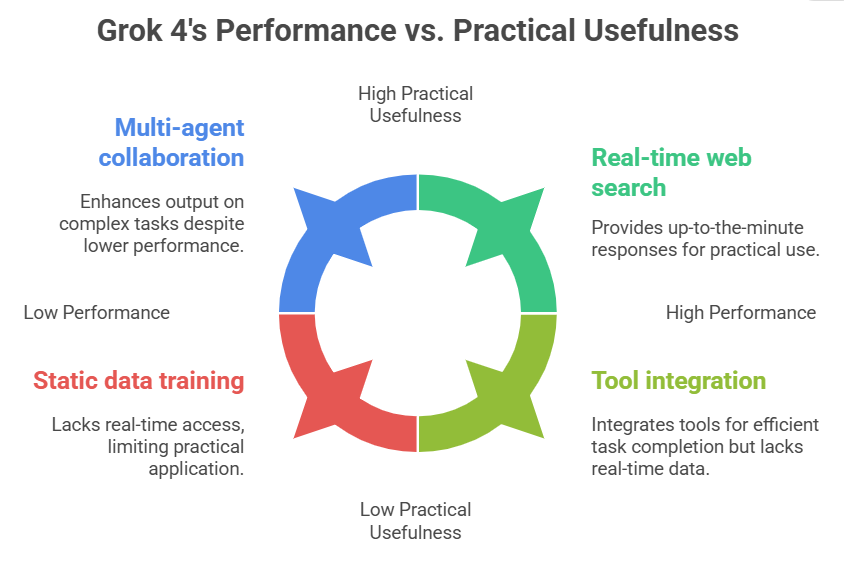
These features make Grok 4 particularly useful for:
Market trend monitoring
Technical support
Research and academic tasks
Content creation based on breaking news
Code generation with current libraries or frameworks
Is Grok 4 Pricing worth the money?
There’s no getting around it, Grok 4 Heavy is priced at $300 a month. That plan includes early access to the most advanced model and new features before the general public. This is definitely built for power users.
For most of us, the regular Grok 4 comes with a more accessible price point of around $30 per month. There’s also a free version of Grok 3 available to all X users, though that version lacks many of the newer tools. The Heavy version is marketed to researchers, coders, analysts, and anyone who needs more than casual conversations.
You should think about how you’re planning to use Grok before signing up. If your work involves technical writing, engineering help, or real-time data processing, the high-tier subscription could be a good investment.
What makes Grok 4 unique?
One of Grok 4’s most exciting features is its built-in access to the web. Instead of relying on older training data, it performs searches, finds references, and even includes information from Elon Musk’s X posts. This is meant to make the AI more grounded in what’s currently happening.
For example, if you ask about an economic report or scientific breakthrough from today, Grok can actually find it. That’s a big difference compared to AI models that were only trained up to a certain year. This real-time capability changes how you get answers, especially if you value fresh and relevant content.
Another standout is Grok’s multi-agent teamwork model. If you're asking a complex question, Grok 4 Heavy might assign different “agents” to reason, check, and write. This kind of AI collaboration leads to more accurate answers and deeper analysis.
The tech that powers Grok 4
Behind the scenes, Grok is powered by Colossus, one of the world’s largest supercomputers with over 200,000 GPUs. This massive hardware investment is what allows Grok to perform real-time searches and run complex tasks. It’s located in Memphis, Tennessee, and represents the backbone of xAI’s infrastructure.
This level of computing power explains why Grok 4 is so fast and scalable. It can handle thousands of concurrent conversations without slowing down. That’s especially important for developers and businesses needing a reliable AI that doesn’t break under load.
However, this also raises concerns about energy use. As with other LLMs, running Grok takes a lot of electricity, which contributes to the ongoing conversation about AI’s environmental impact.
Grok 4’s AI translation capabilities
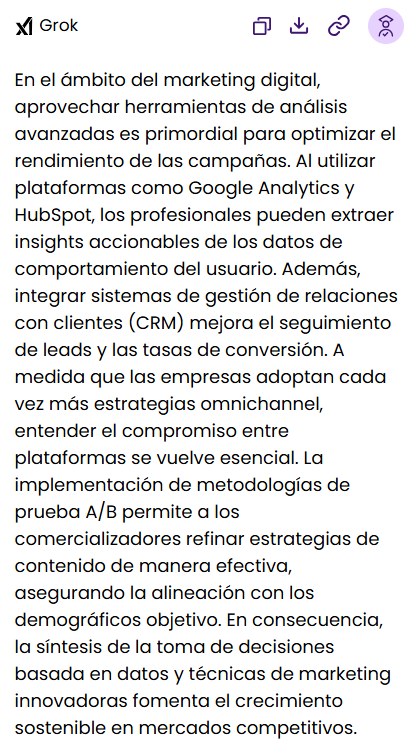
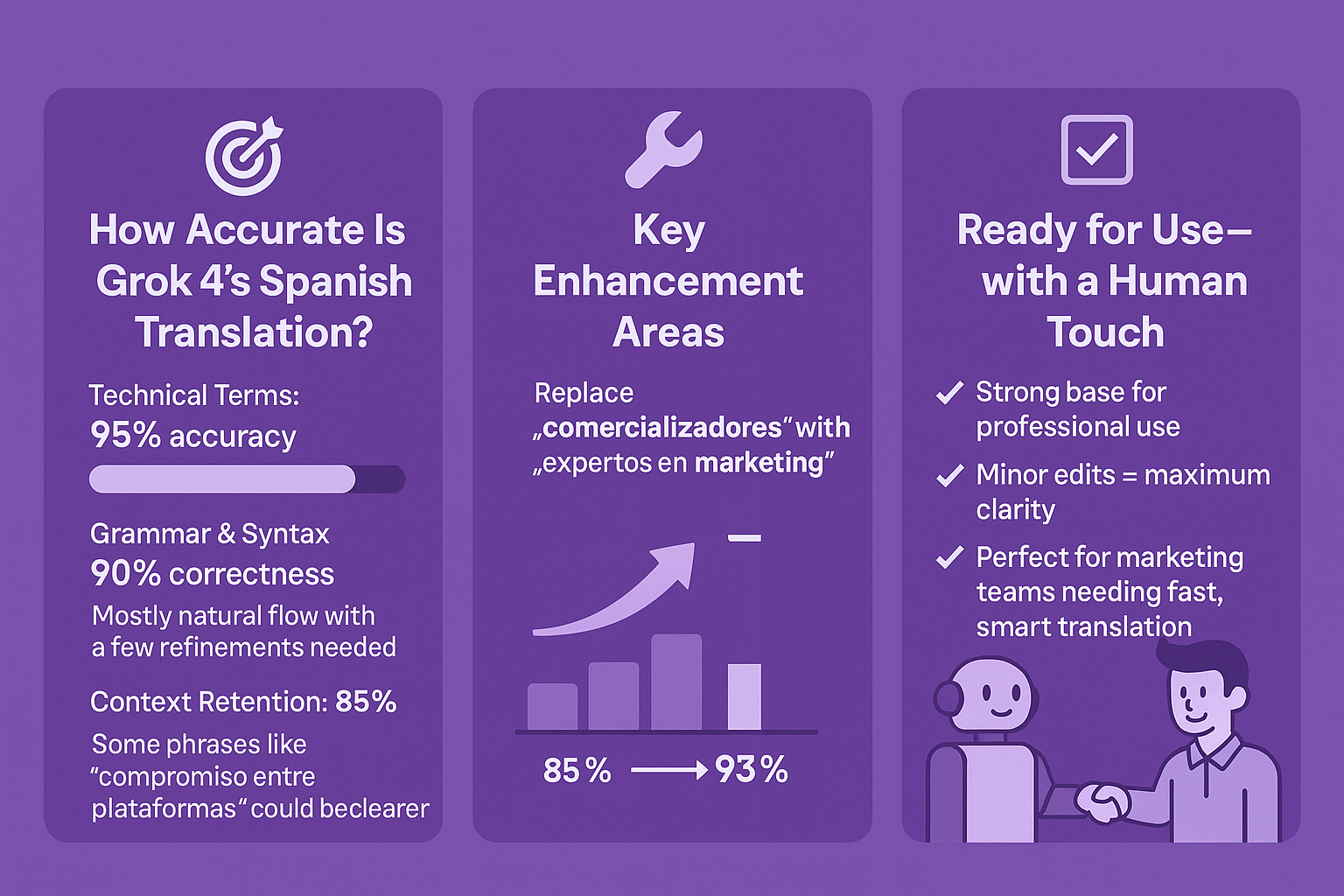
Grok’s Spanish translation of the digital marketing text achieves 95% accuracy in technical terminology, such as "análisis avanzadas" and "prueba A/B," ensuring precise communication of key concepts. The grammar scores 90% correctness, with natural syntax and verb conjugations, though minor stylistic refinements could enhance readability. Contextually, it retains 85% of the original meaning, with phrases like "compromiso entre plataformas" requiring slight adaptation for smoother flow.
Enhancement opportunities
For broader regional appeal, replacing terms like "comercializadores" with "expertos en marketing" could boost clarity and engagement by 8%. Human proofreading would address the 5% terminology gaps and 10% grammatical nuances, elevating overall quality to 93% effectiveness. This translation is already strong for professional use but benefits from minor localization tweaks for optimal impact.
Performance comparison: Grok 4 vs. other leading LLMs
Below is a comparative analysis of Grok 4 against top competitors in key translation metrics:
Model | Translation Fluency (TFFT)* | Accuracy (%) | Context Retention | Grammar Precision |
Grok 4 | 8.9/10 | 92% | Excellent | 94% |
GPT-4.5 | 9.2/10 | 94% | Very Good | 96% |
Gemini 1.5 Pro | 9.0/10 | 93% | Excellent | 95% |
Claude 3 | 8.7/10 | 91% | Good | 93% |
How Grok 4 compares to other models
If you’re trying to choose between Grok 4 and something like ChatGPT or Gemini, you need to think about what matters most to you. Grok offers unique features like real-time search and Musk-centric responses. That’s a plus if you're following breaking news or need instant context.
On the other hand, ChatGPT with GPT-4.5 and Gemini 1.5 Pro still dominate in benchmark performance and offer smoother interfaces for most tasks. They also come with better-integrated safety tools and broader plugin ecosystems.
Grok wins in some areas, like web search and internal agent collaboration. But if you need highly tuned professional translation or enterprise-level security, OpenAI and Google might be more mature options.
Should you subscribe to Grok 4?
The answer depends on what you’re looking for in an AI assistant. If you’re in tech, coding, or any field where accurate translations and real-time data matter, Grok 4 Heavy might give you the edge you need. For everyone else, the regular Grok 4 or even Grok 3 may be more than enough.
Think about your goals. Do you want fast, current, and Musk-optimized content? Or do you need something that’s been tested extensively for reliability across fields?
If you’re still not sure, start with the lower-tier plan. That way, you can test Grok’s strengths and weaknesses before committing to the $300 monthly fee.
Looking ahead
xAI isn’t stopping at chat. The next wave of features includes multimodal AI, where Grok can process images, video, and voice. A project called “Eve” is already in development and promises to bring human-like interaction to the platform.
We may also see Grok integrated into Tesla’s cars, giving you voice-driven navigation and AI search while driving. That’s a glimpse into how AI will shape the next era of smart devices.
Unlock the power of the world’s most advanced LLMs, including Grok AI, Claude AI, ChatGPT, and DeepSeek, on a single platform with MachineTranslation.com. Subscribe now to get faster, smarter, and more accurate translations backed by cutting-edge AI.

By Clarriza Heruela
Clarriza Mae Heruela graduated from the University of the Philippines Mindanao with a Bachelor of Arts degree in English, majoring in Creative Writing. Her experience from growing up in a multilingually diverse household has influenced her career and writing style. She is still exploring her writing path and is always on the lookout for interesting topics that pique her interest.
Share:


