June 26, 2026
The 6 most accurate AI translators in 2026
Not all AI translation is created equal, and "accuracy" means different things depending on what you are translating.
A business email and a legal contract both require accurate translation, but they fail in different ways and with different consequences. A product description and a marketing tagline both need to land in the target language, but one fails quietly and the other fails publicly. The AI translator that handles one well will not necessarily handle all of them well.
This guide evaluates six of the most widely used AI translation platforms on three content types (business communication, legal and technical text, and creative copy) using a consistent scoring framework. The goal is not to declare a single winner for all use cases, but to give you an accurate picture of where each platform performs reliably and where it does not.
The six platforms covered: MachineTranslation.com, DeepL, Claude, ChatGPT, DeepSeek, and Google Translate.
How we evaluated accuracy
Each platform was assessed across five dimensions, each scored out of 5:
1. Business content accuracy — Does the platform produce natural, register-appropriate output for professional correspondence? Test content: formal business communication across major language pairs.
2. Legal and technical accuracy — Does the platform preserve precise meaning, use correct terminology, and apply the appropriate formal register for legal instruments and technical documentation?
3. Creative and nuanced accuracy — Does the platform handle idioms, marketing copy, and culturally specific language — content where a literal translation fails even when grammatically correct?
4. Language coverage — How many languages does the platform support, and does quality hold across less common language pairs?
5. Accuracy verification — Does the platform provide any mechanism for validating or improving the accuracy of its output beyond the initial AI generation?
Maximum score: 25 points.
Platform rankings and scores in this guide are reviewed and updated annually. Current evaluation reflects testing conducted in 2026.
Quick comparison: Accuracy scores at a glance
| Platform | Business | Legal/Technical | Creative | Coverage | Verification | Total |
|---|---|---|---|---|---|---|
| MachineTranslation.com | 5 | 5 | 4 | 4 | 5 | 23/25 |
| DeepL | 5 | 4 | 3 | 3 | 2 | 17/25 |
| Claude | 4 | 5 | 4 | 3 | 1 | 17/25 |
| ChatGPT | 4 | 4 | 4 | 4 | 1 | 17/25 |
| DeepSeek | 4 | 3 | 4 | 4 | 1 | 16/25 |
| Google Translate | 3 | 2 | 2 | 5 | 1 | 13/25 |
1. MachineTranslation.com — best overall for accurate AI translation
Overall score: 23/25
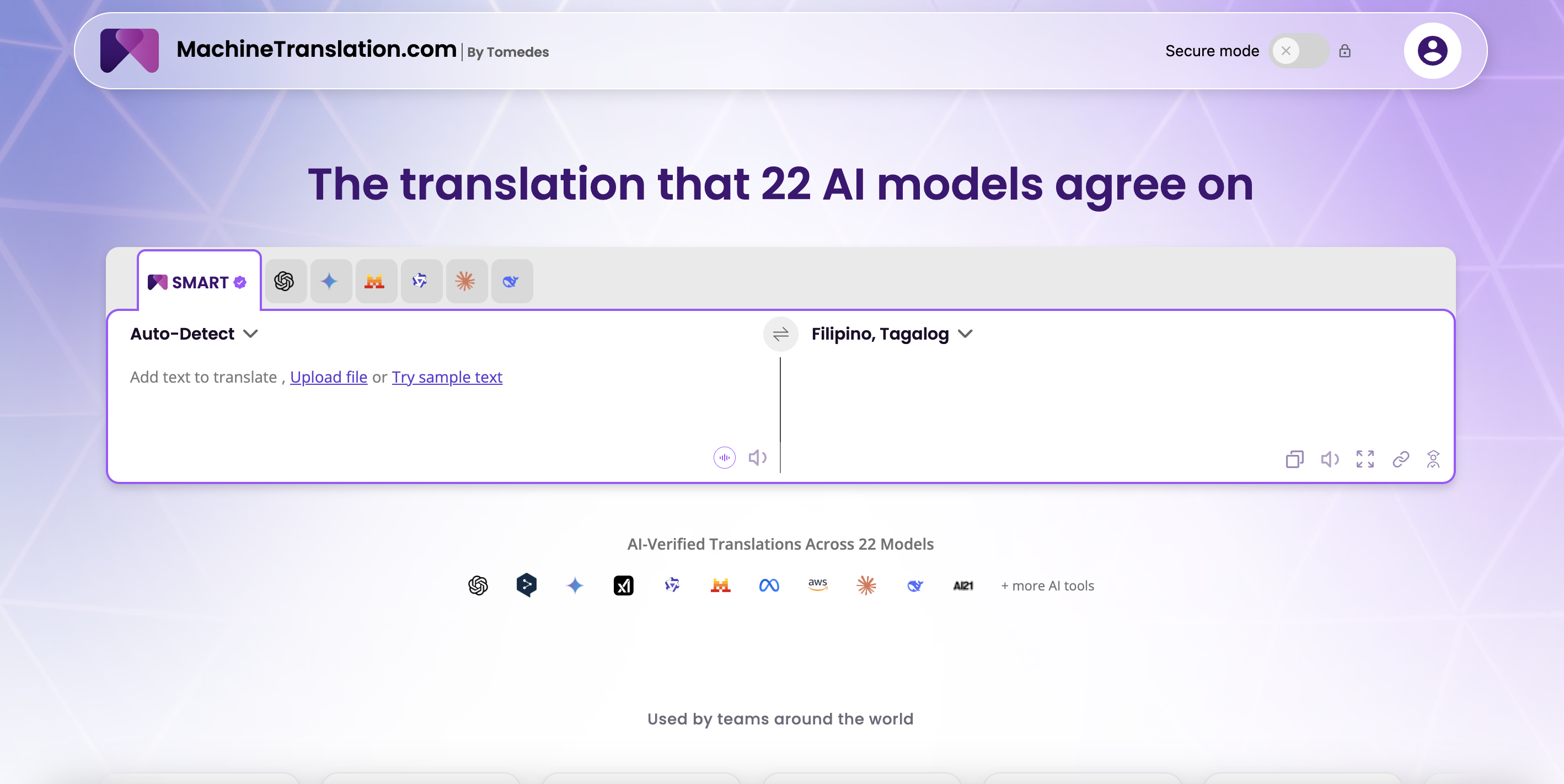
MachineTranslation.com takes a structurally different approach to accuracy from every other platform on this list. Where others generate a single translation from a single model, MachineTranslation.com runs up to 22 AI models simultaneously (including GPT, Claude, DeepSeek, Mistral, Gemini, and others) and identifies the consensus output through its SMART mechanism (the translation that most of the AI models agree on).
The practical effect is significant. As independent analysis has documented, different AI models produce meaningfully different translations of the same phrase — not just stylistically, but in meaning, register, and terminology. When you run a single model, you receive one of those outputs with no way of knowing whether the other models would agree. When you run 22 models and surface what the majority returns, the error rate drops substantially. MachineTranslation.com's internal benchmarking puts that reduction at 90% compared to single-model output.
The platform scores every translation with a quality rating. In testing across standard business content, quality scores of 9.4 to 9.5 are typical. On idiomatic or figurative content, scores of 9.0 to 9.2 are common. On content types where AI models structurally disagree (minority languages, highly culturally specific text), scores of 7.3 to 8.0 signal that the output should be treated with more care. That transparency is a meaningful accuracy signal that no other platform provides.
The fifth dimension is where MachineTranslation.com stands alone. It is the only platform in this evaluation that offers integrated human verification, a professional translator reviews and certifies the AI output. For businesses translating legal documents, financial communications, published marketing content, or anything with regulatory implications, this verification layer is the difference between AI-assisted translation and translation you can actually stand behind.
Strengths: Multi-model consensus catches errors single models miss; transparent quality scoring; human verification available within the same interface; strong performance across business and legal content.
Limitations: Creative scores (4/5) reflect the structural challenge that even a 22-model consensus occasionally defaults to a competent rather than inspired marketing translation. For brand-voice-critical creative content, human editing remains advisable regardless of platform.
Best for: Businesses translating professional content at volume; any organisation where translation errors carry real consequences; teams that need AI speed with the option of human-certified accuracy.
2. DeepL — best single-engine accuracy for European languages
Overall score: 17/25
DeepL consistently outperforms other single-model AI translators on European language pairs. Its neural translation engine, trained on high-quality parallel corpora and fine-tuned for natural fluency, produces translations that read like they were written in the target language rather than converted from the source. For English-to-German, English-to-French, English-to-Spanish, and similar European pairs, DeepL is the highest-ceiling single-model option available.
The limitations are structural. DeepL supports around 30 languages, far fewer than the other platforms in this evaluation. For businesses working in Southeast Asian, African, or less common language pairs, DeepL simply does not offer coverage. Its creative score (3/5) reflects a consistent tendency toward technically correct but occasionally flat translations of idiomatic or rhetorical content. Marketing copy written for emotional impact often loses that impact when processed through DeepL without human editing.
DeepL Pro includes a limited proofreading feature, which earns it a 2/5 on verification — above the baseline, but a long way from integrated human review.
Strengths: Excellent fluency on European language pairs; clean, minimal interface; strong business prose output.
Limitations: Narrow language coverage; no integrated human verification; creative content accuracy inconsistent.
Best for: Teams translating primarily within European language pairs who prioritise fluency and do not require verification infrastructure.
3. Claude — best for register and tone precision
Overall score: 17/25
Claude (Anthropic) is not a dedicated translation platform (it requires a conversational prompt to produce translations), but its output quality for certain content types is genuinely strong. In side-by-side testing on legal content, Claude demonstrates a measurable awareness of formal register that other models miss: in Japanese legal translation, for example, Claude consistently uses plain form verb endings (the correct register for formal contracts) while other models default to polite form. On Arabic emotional content, Claude tends to make vocabulary choices that more precisely reflect the speaker's internal state rather than the structurally equivalent but slightly less precise default.
The limitations are practical. Without a translation-specific interface, Claude requires prompting, which introduces inconsistency. It does not provide quality scores, has no verification mechanism, and its language coverage (while broad) is not benchmarked for accuracy across all supported pairs in the way dedicated translation platforms are. The legal score of 5/5 reflects genuine linguistic precision on content we tested; the practical usability score is lower.
Strengths: Strong register awareness on legal and formal content; nuanced vocabulary choices on emotionally sensitive material.
Limitations: Not a dedicated translation interface; no quality scoring; no verification; requires user prompting for consistent output.
Best for: Translating specific high-register content (legal clauses, formal correspondence) where a specialist user can prompt and evaluate directly.
4. ChatGPT — best for contextual and creative content
Overall score: 17/25
ChatGPT (OpenAI, GPT-4.1 and later) performs well across a wide range of content types, with particular strength on content that requires contextual interpretation. Its training on diverse text at scale gives it broad cultural and idiomatic awareness — it handles figurative language reliably in most major European languages, and its Japanese output is among the strongest of any model tested.
Like Claude, ChatGPT is not a dedicated translation interface. Translation quality varies depending on how the request is framed, and there is no mechanism for scoring confidence or identifying when the model is less certain about an output. As research on the variation between AI translation models shows, what looks like a confident, fluent translation from a single model can diverge significantly from what other models would return — a risk that is invisible when you only run one model.
GPT-4.1-NANO, the smallest model in the GPT-4.1 family, produces quality scores of 9.4 to 9.5 on standard business content when run inside MachineTranslation.com — a strong result from a model that costs $0.40 per million output tokens. The full GPT-5 family raises that ceiling further, particularly for nuanced and creative content.
Strengths: Strong contextual and creative translation; wide language coverage; good performance on Asian languages.
Limitations: No translation-specific interface; no quality scoring; single-model output with no consistency check; no verification.
Best for: Ad hoc translation of diverse content types; creative and contextual content where cultural interpretation matters.
5. DeepSeek — best for Chinese and East Asian language pairs
Overall score: 16/25
DeepSeek has made a strong impression on the AI translation landscape, particularly for Chinese, Japanese, and Korean language pairs. Its training data is heavily weighted toward East Asian content, and this shows in output quality: for Chinese-English and Japanese-English translation, DeepSeek performs at or near the level of the most capable Western models.
In testing on MachineTranslation.com (where DeepSeek runs as one of the available models), it has shown a notable willingness to engage with script-level decisions. On Inuktitut translation, for example, DeepSeek returned a properly formed Canadian syllabics output where other models defaulted to Latin romanisation or produced garbled characters. That said, its performance on European language pairs is less consistently strong, and it lacks the verification infrastructure that high-stakes professional translation requires.
Strengths: Strong on Chinese, Japanese, Korean; capable of handling non-Latin scripts; improving rapidly.
Limitations: Less consistent on European languages; no dedicated translation interface; no verification; newer entrant with less established reliability benchmark.
Best for: Businesses primarily translating into or out of Chinese or East Asian language pairs.
6. Google Translate — best for coverage, not accuracy ceiling
Overall score: 13/25
Google Translate supports more languages than any other platform in this evaluation (more than 130 at the time of writing) and for that reason alone it remains widely used. For quick, informal translation tasks where accuracy is directional rather than critical, Google Translate is accessible, free, and adequate.
The accuracy ceiling, however, is meaningfully lower than every other platform in this list. On legal and technical content, Google Translate produces translations that preserve surface meaning but frequently miss the register precision that professional documents require. On creative content, it defaults to literal renderings that preserve words at the cost of meaning. On minority and low-resource languages, accuracy drops sharply. There is no quality scoring, no confidence signal, and no verification mechanism.
For businesses translating content that will be published, acted upon, or used in a professional context, Google Translate's accessibility does not compensate for its accuracy limitations.
Strengths: Widest language coverage of any platform; free; fast; accessible on all devices.
Limitations: Lowest accuracy ceiling of platforms tested; no professional register awareness; no quality scoring; no verification; not suitable for legal, medical, or published professional content.
Best for: Quick informal reference translation; understanding the general meaning of a foreign-language document before investing in accurate translation.
How to choose the right accurate AI translator for your needs
The right platform depends on three questions:
1. What are the consequences of an inaccuracy? For internal communications, informal content, or directional understanding — the cost of an error is low. Google Translate or a quick ChatGPT prompt may be sufficient. For anything published, contractual, regulatory, or customer-facing — the cost of an error is real. A platform with quality scoring and an available human verification layer is not optional; it is risk management.
2. What language pairs do you work in? DeepL is the strongest single-engine option for European languages. DeepSeek is the strongest for Chinese and East Asian pairs. MachineTranslation.com covers the widest range at professional quality because it runs multiple engines simultaneously, meaning the best-performing model for your specific language pair is already in the pool.
3. Do you need to verify the output? If your translation will be used in a context where an error has consequences, you need more than an AI output. MachineTranslation.com is the only platform in this evaluation that offers integrated human verification within the same workflow, without requiring a separate professional translation service.
For the majority of professional use cases (business correspondence, marketing content, product documentation, HR communications, legal contracts), MachineTranslation.com's SMART consensus approach delivers the highest accuracy across content types, with the option to verify any output that carries material risk.
Frequently asked questions
1. What is the most accurate AI translator in 2026?
MachineTranslation.com scores highest in our evaluation (23/25), primarily because its multi-model consensus approach (running up to 22 AI models simultaneously and selecting the agreed output) catches errors that any individual model would miss. DeepL scores highest among single-engine translators for European language pairs. Claude and ChatGPT are stronger for register-sensitive and creative content respectively. No single platform is the most accurate across all content types and language pairs.
2. Is AI translation accurate enough for professional use?
It depends on the content type. AI translation scores 9.4 to 9.5 (on MachineTranslation.com's quality scale) on standard business correspondence, accurate enough for most professional use without review. Legal documents, published marketing content, and regulatory or medical text require a higher threshold, which means either multi-model consensus to reduce error risk or human verification of the AI output. MachineTranslation.com offers both within the same interface.
3. How is MachineTranslation.com different from other AI translators?
Most AI translators run a single model and return a single output. MachineTranslation.com runs up to 22 models simultaneously (including the models powering ChatGPT, Claude, DeepSeek, Gemini, and others) and identifies the consensus output through its SMART mechanism. Each translation receives a quality score reflecting how much the model pool agreed. A human verification option is available for content where AI accuracy alone is not sufficient.
4. Is DeepL more accurate than Google Translate?
Yes, consistently — particularly for European language pairs. DeepL produces more natural, register-appropriate translations for business and professional content. Google Translate's advantage is language coverage (130+ languages) rather than accuracy ceiling. For professional use in major European language pairs, DeepL is the stronger single-engine choice. For the broadest accuracy across language pairs and content types, a multi-model consensus platform like MachineTranslation.com outperforms both.
5. Can I use AI translation for legal documents?
AI translation can produce a reliable first draft of legal documents, particularly for standard contractual clauses in major language pairs. However, legal translation carries accuracy requirements that go beyond meaning — register, terminology, and jurisdiction-specific usage all matter. The safest approach is to use a high-quality AI translation platform (preferably one with multi-model consensus) and verify the output with a professional legal translator before use. MachineTranslation.com's human verification service provides this review.

By Rachelle Garcia
Connect on LinkedInRachelle leads product and AI at Tomedes, where she runs the experiments that turn internal data into better translation experiences. She writes about what actually happens when you build AI products such as MachineTranslation.com — the numbers, the surprises, and the parts that don't go to plan.
Share:


