June 19, 2026
We asked AI to translate 4 words that didn't exist two years ago. Here's what happened.
AI translation systems are trained on billions of words. Academic papers, news archives, literary texts, technical manuals, forum posts — language accumulated over decades, scraped and processed at a scale no human could read in several lifetimes.
None of that data includes tokenmaxxing. Or vibe coding. Or AI slop. These words didn't exist until recently. They were born in English, on the internet, in the specific culture that emerged around large language models — and no Spanish dictionary has caught up with them yet.
So what does AI do when you ask it to translate a word it has never seen? We ran four of the newest AI-era neologisms through MachineTranslation.com's SMART system (the only AI translation platform that runs up to 22 models simultaneously on the same input) and translated each one into Spanish. The results were not uniform. They were not even close to uniform. And what they reveal about how AI handles genuinely new language is more interesting than any benchmark comparison.
The experiment: Four neologisms, one platform, up to 22 models
The four terms we tested represent different types of translation challenge:
- Tokenmaxxing — optimising AI prompts to get the maximum output within a token limit. A portmanteau of "token" and "maxxing" (the internet suffix meaning to maximise something relentlessly, as in looksmaxxing or sleepmaxxing).
- Vibe coding — writing or generating code through natural language and intuition rather than syntax knowledge. Coined to describe how non-programmers use AI to produce working code.
- AI wrapper — a product or service that provides a simplified interface to an existing AI model's API, often without substantial original technology underneath.
- AI slop — low-quality, mass-produced AI-generated content, distinguished not just by being AI-made but by being careless, generic, and inauthentic.
Each term has no established Spanish equivalent. No Real Academia Española entry. No standard translation in any style guide. What they do have is meaning — specific, culturally embedded, understood immediately by anyone who spends time in AI spaces.
We ran each through MachineTranslation.com with the full model panel visible. Here is what happened.
Tokenmaxxing: When AI's best answer is to say nothing
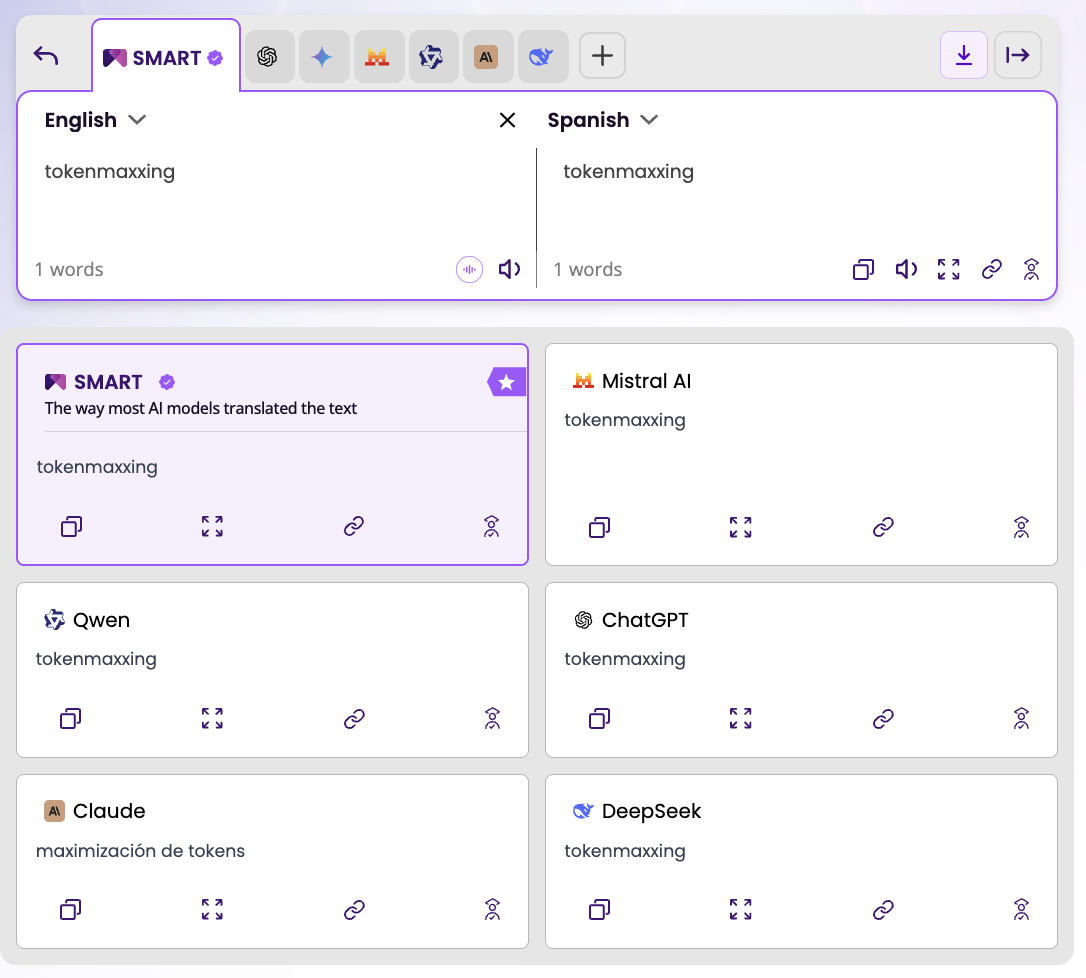
What the models did: Five out of six models returned the English word unchanged. Claude alone attempted a translation: "maximización de tokens."
SMART consensus: "tokenmaxxing."
At first glance, five models refusing to translate looks like a failure. It isn't. It is the most linguistically honest response available.
Tokenmaxxing is a cultural artefact as much as a functional term. The "-maxxing" suffix carries an entire register with it — internet-native, slightly self-deprecating, ironic in the way productivity optimisation culture is always slightly ironic about itself. "Maximización de tokens" is accurate as a description. It is not accurate as a translation. A Spanish speaker who reads "maximización de tokens" in a developer forum has received the definition of the word, not the word itself.
Claude's translation is genuinely thoughtful. It broke the portmanteau apart and rendered the meaning compositionally, "token maximization." But it stripped out everything that makes the word feel like a word rather than a phrase, including the community in-joke quality of the "-maxxing" construction that Spanish has no direct equivalent for.
When a word is so culturally embedded that translating it means losing it, the correct answer is to leave it in the source language. Five models understood this instinctively. SMART followed the consensus, and the consensus was right.
Vibe coding: Five models, five different translations, zero consensus
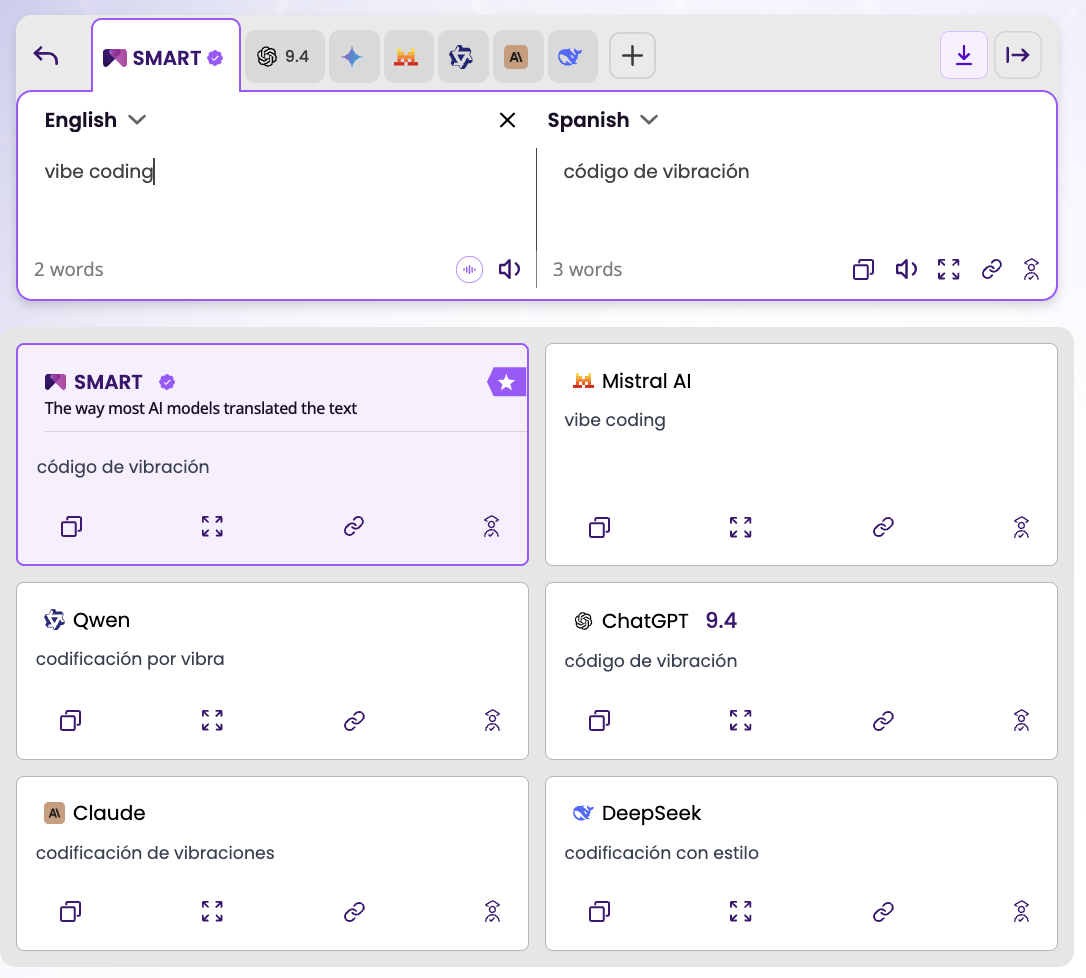
What the models did: Every model did something different.
| Model | Translation | Approach |
|---|---|---|
| ChatGPT | código de vibración | Literal — both words translated |
| SMART | código de vibración | Consensus with majority |
| Claude | codificación de vibraciones | Literal — plural "vibraciones" |
| Qwen | codificación por vibra | Hybrid — "codificación" + anglicised "vibra" |
| Mistral AI | vibe coding | Refused to translate — kept English |
| DeepSeek | codificación con estilo | Interpretive — "coding with style" |
SMART consensus: "código de vibración."
This is the most revealing result of the four. Five approaches, none of them definitively correct, each one exposing a different assumption about what translation is supposed to do.
The literal translations ("código de vibración," "codificación de vibraciones") are phonetically reasonable but semantically empty. "Código de vibración" sounds like a term from physics or music production — the kind of phrase that would appear in a manual for a synthesizer, not a description of how a non-programmer uses an AI model to build a web app in an afternoon. The word that creates the problem is vibe itself. Even in English, vibe resists definition. It means atmosphere, intuition, feeling, attitude — none of which have crisp single-word equivalents in Spanish.
Mistral's refusal to translate (returning "vibe coding" unchanged) is intellectually defensible for the same reason five models refused to translate tokenmaxxing. The Spanish tech community already uses vibe coding in English. Coining a new term risks confusing rather than clarifying.
DeepSeek's "codificación con estilo" (coding with style) is the most creative and arguably the closest in spirit. Vibe coding is not about vibrations. It is about a certain casual confidence, a way of approaching code as if you understand the vibe of what you want to build rather than the mechanics of how to build it. "Style" captures something of that register. It is still not right. But it is wrong in the most interesting direction.
The five-way split is itself useful information. When MachineTranslation.com shows you five different translations of the same two words, that disagreement is a signal: this term does not yet have a settled Spanish equivalent, and any single model's output should be treated as provisional.
AI wrapper: The most dangerous result — everyone agreed, everyone got it wrong
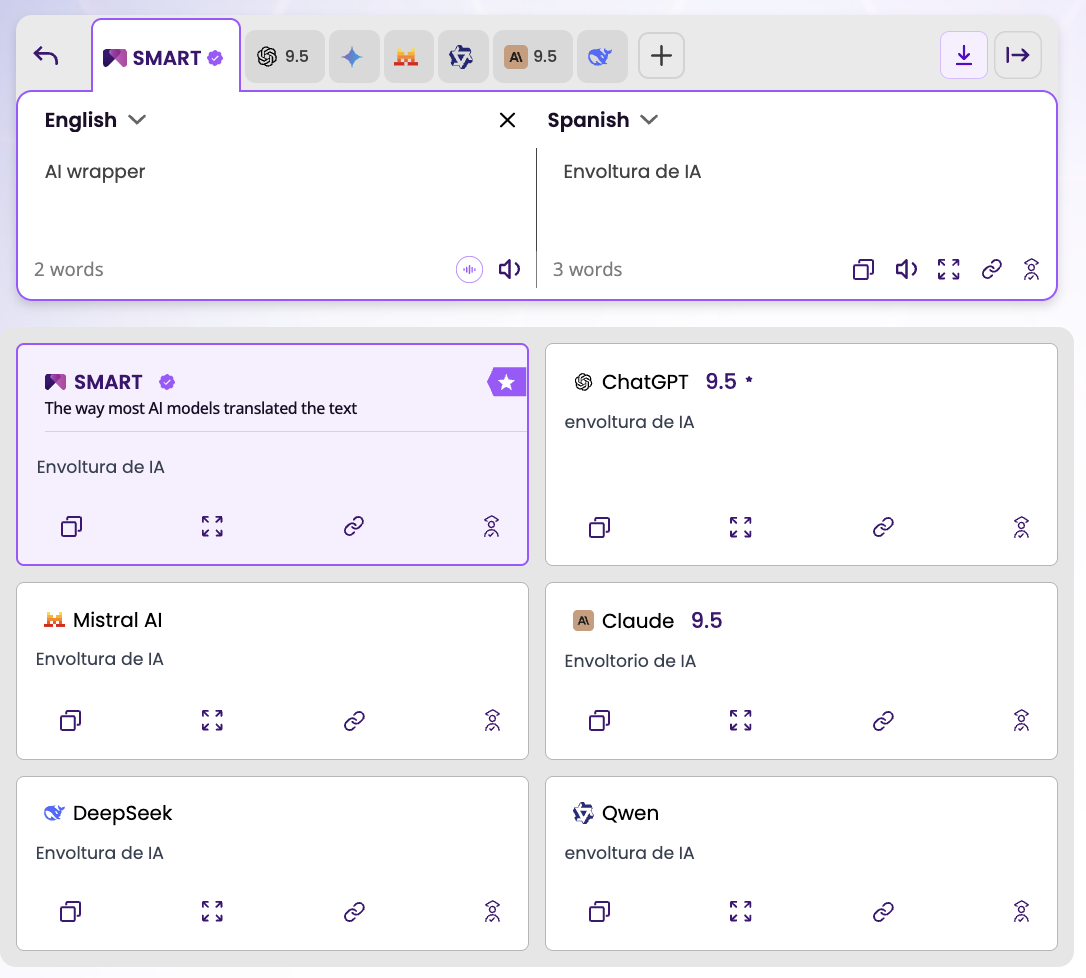
What the models did: Five models agreed on "envoltura de IA." Claude used "envoltorio de IA", a synonym with the same meaning.
SMART consensus: "Envoltura de IA."
Scores: ChatGPT 9.5, Claude 9.5.
High scores. Strong consensus. Completely wrong.
Envoltura means wrapping, the physical kind. Gift wrapping. Food packaging. The material around a wire. It is an accurate translation of the English word wrapper as it exists in everyday language. It is not an accurate translation of AI wrapper as the term is used in the technology industry, where it refers to a software product that exposes a simplified interface to an underlying AI model, typically without adding meaningful technical innovation.
A startup that describes its product as an "envoltura de IA" to a Spanish-speaking investor has told them it is a packaging company. The actual term used in the Spanish-language tech community is, without exception, wrapper de IA — the English technical term retained with Spanish grammar applied.
This is the most important finding of the four tests. High model confidence and strong consensus are not the same as accuracy. When the models share a common understanding of a word's everyday meaning, they converge on that meaning regardless of whether the everyday meaning is the relevant one. Wrapper in tech is a homonym — same spelling, completely different meaning from its general-language use. Every model translated the word. None of them translated the concept.
As TechBullion noted in their analysis of why the same phrase produces different translations across AI models, the failure modes that matter most in professional translation are not the ones where models disagree — those are visible. The failures that cause real problems are the ones where models confidently agree on an output that misses the intended meaning.
This is precisely the scenario where MachineTranslation.com's human verification option earns its place. When all models return high scores and strong consensus for a term with a technical or industry-specific meaning, a professional translator's review is the only reliable check. The platform's built-in human verification is designed exactly for this: content where the AI output looks fine but the stakes of being wrong are real.
AI slop: The one where getting the tone right mattered more than the words
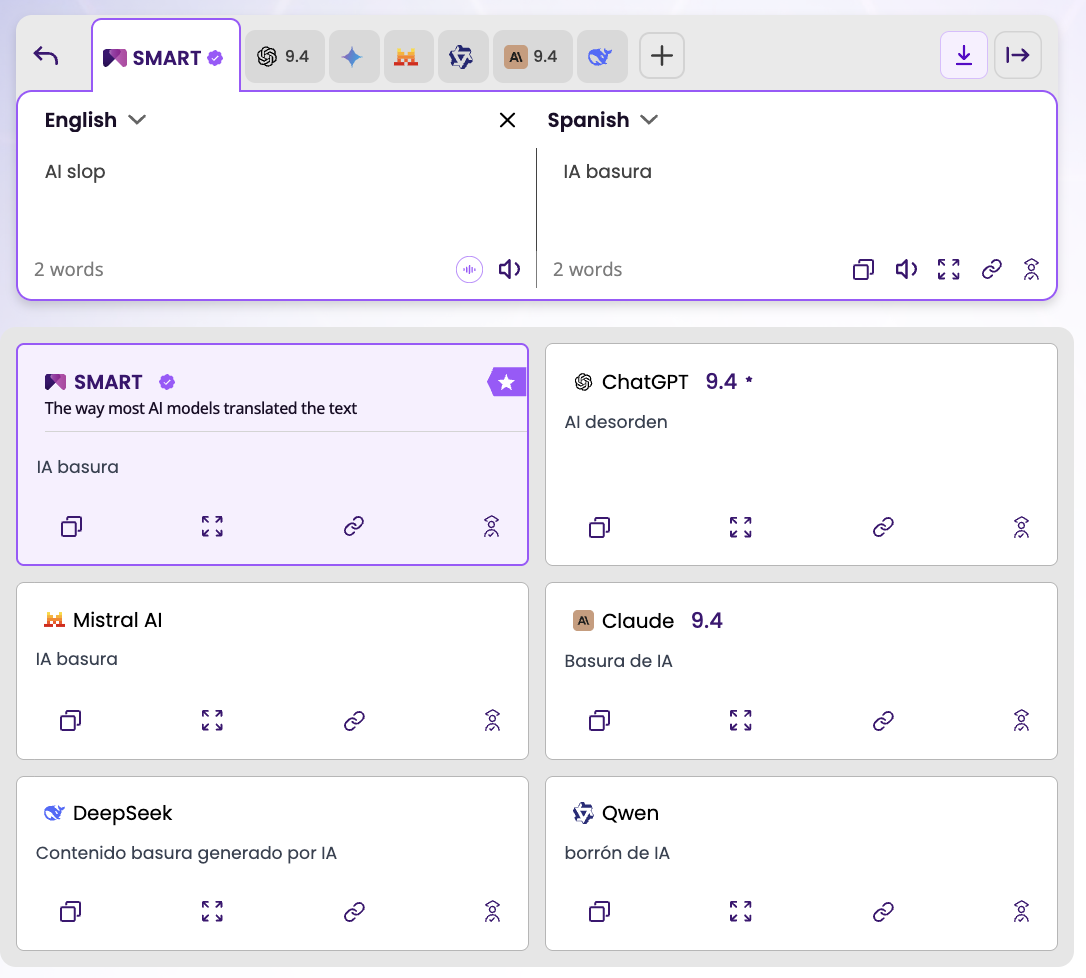
What the models did: Four different translations, but three of them share the same core word: basura (trash/garbage).
| Model | Translation | Register |
|---|---|---|
| SMART | IA basura | Punchy, informal — matches "slop" |
| Mistral AI | IA basura | Same |
| Claude | Basura de IA | Same meaning, inverted word order |
| DeepSeek | Contenido basura generado por IA | Explicit definition, "garbage content generated by AI" |
| ChatGPT | AI desorden | Weaker, "disorder" lacks the contempt of "slop" |
| Qwen | borrón de IA | Poetic ("blot/smudge of AI"), loses the register entirely |
SMART consensus: "IA basura." Score: ChatGPT 9.4, Claude 9.4.
Slop is not a polite word. It is dismissive, visceral, and slightly contemptuous — the kind of word you use when you want to signal that something is not just low quality but carelessly, insultingly low quality. The term has a specific meaning in AI discourse: content produced at volume, without craft, purely because AI makes it cheap to produce. Think auto-generated product descriptions, formulaic articles churned at scale, images that hit a brief without having any particular reason to exist.
"IA basura" captures that register. Basura (garbage, trash) carries exactly the right level of dismissal. It is the same kind of verbal shrug as slop: technically edible, nobody wanted it, you wouldn't serve it to someone you respected.
"AI desorden" (ChatGPT's choice) means disorder or mess. It is a softer word. A messy room is desorden. A pile of unread emails is desorden. The word does not carry the contempt that slop does, and it fails to communicate that the problem is not just messiness but the particular kind of cynical mediocrity that AI-generated-at-scale tends to produce.
DeepSeek's "contenido basura generado por IA" is the most complete definition ("garbage content generated by AI") but it is a phrase, not a term. It would work in an explanatory sentence. It cannot replace a word.
Qwen's "borrón de IA" (a blot or smudge) is interesting as a metaphor: something that stains rather than illuminates. But it loses the contempt entirely and introduces a visual metaphor that the English word does not carry.
SMART correctly identified "IA basura" as the consensus — and on a term where the register is the entire point, that is the right call.
What these four tests reveal: A taxonomy of how AI handles words it's never seen
Four terms. Four completely different outcomes. The pattern is worth naming.
1. The surrender (tokenmaxxing): When a word is too culturally embedded to translate without losing its identity, most models correctly leave it in the source language. This is not failure. It is the appropriate response to a word that belongs to its original language community.
2. The fragmentation (vibe coding): When a word has no established equivalent and its meaning is culturally complex, models diverge completely. Five different translations signal genuine uncertainty — not a reason to distrust AI translation, but a reason to treat any single output as a starting point rather than a conclusion.
3. The false consensus (AI wrapper): When all models agree and all models are wrong, there is no internal signal that something has gone wrong. High scores, strong consensus, completely incorrect meaning. This is the hardest failure to catch — it requires a reviewer who knows the term's technical meaning, not just a grammar check.
4. The register match (AI slop): When a word's core meaning is accessible even if its cultural context is new, models that converge on the right register outperform models that converge on a technically accurate but tonally wrong equivalent. IA basura works where AI desorden doesn't because it preserves the attitude of the original.
What ties all four together is a single observation: AI translation excels at language that has accumulated history. It struggles with language that hasn't yet. The models running on MachineTranslation.com were trained on data that predates these terms — and their responses reflect, faithfully, exactly how much they know and don't know about the world that created them.
The SMART mechanism's value in this context is not that it resolves ambiguity perfectly. It is that it makes the ambiguity visible. Five models disagreeing on vibe coding is more useful information than one model confidently returning código de vibración. As technology.org reported in their coverage of how five AI models produced five different translations of the same phrase, the divergence between models on culturally complex language is itself a quality signal — one that single-model platforms suppress entirely.
MachineTranslation.com runs up to 22 AI models simultaneously on every translation, and more than 1,500,000 users rely on that cross-verification to surface exactly the kind of disagreement these tests produce. For standard professional language, that consensus builds confidence. For neologisms, it builds transparency — which is the next best thing.
And for cases like AI wrapper, where the consensus is confidently wrong, the platform's human verification option is the final line: a professional translator reviewing the output with a one-year guarantee. Not because AI failed, but because some words need a human who already knows what they mean.
As globalgurus.org explored in their piece on the biggest myth in AI right now — that one model is enough, the argument for multi-model approaches is not just about accuracy averages. It is about catching the specific failure modes that single models cannot see in themselves. The neologism test is one of the clearest illustrations of why that matters.
Frequently asked questions
1. What is tokenmaxxing and how do you translate it?
Tokenmaxxing refers to optimising AI prompts to extract maximum useful output within a model's token limit. The "-maxxing" suffix comes from internet culture, where it signals the obsessive maximisation of something. When tested on MachineTranslation.com, five out of six models returned "tokenmaxxing" unchanged (keeping the English word) while Claude translated it as "maximización de tokens." The Spanish-language AI and tech community generally uses tokenmaxxing in English, as no established equivalent exists yet.
2. What is "vibe coding" in Spanish?
There is no settled Spanish translation for vibe coding. When tested on MachineTranslation.com's SMART system, models returned five different translations: vibe coding (Mistral, kept in English), código de vibración (ChatGPT/SMART), codificación de vibraciones (Claude), codificación por vibra (Qwen), and codificación con estilo (DeepSeek). The wide disagreement reflects genuine uncertainty about how to convey "vibe" (a culturally loaded English word) in Spanish. The term is most commonly used as vibe coding in Spanish-language tech contexts.
3. Can AI translate new words and slang accurately?
It depends on the type of newness. AI translation handles recently coined words with straightforward meanings reasonably well. It struggles with words whose meaning is culturally embedded, industry-specific, or where the everyday translation of a word differs from its technical usage. The four-term test on MachineTranslation.com produced four different patterns: correct transliteration, fragmented disagreement, false consensus, and register-accurate translation. The most reliable approach for genuinely new terminology is to use a multi-model platform that surfaces disagreement, and a human verification step for high-stakes content.
4. What does "AI slop" mean in Spanish?
The closest Spanish equivalent is IA basura, "AI garbage" or "AI trash." When tested on MachineTranslation.com, the SMART consensus and two other models agreed on IA basura as the most accurate register match. ChatGPT used AI desorden (AI disorder/mess), which is technically accurate but weaker in tone. DeepSeek provided the most explicit translation: contenido basura generado por IA (garbage content generated by AI). The word basura captures the contempt and dismissiveness of "slop" more accurately than softer alternatives.
5. Why did all the models get "AI wrapper" wrong?
Every model translated AI wrapper as envoltura de IA or envoltorio de IA, meaning physical wrapping or packaging. This is the correct translation of the English word "wrapper" in its everyday use. In technology, however, "AI wrapper" refers specifically to a product built on top of an existing AI model's API, often without adding significant original technology. That technical meaning does not appear in general-language training data, so every model defaulted to the everyday meaning. The Spanish-language tech community uses wrapper de IA, keeping the English technical term. This is the clearest example of why high model confidence and strong consensus do not guarantee a correct translation for industry-specific jargon.

By Rachelle Garcia
Connect on LinkedInRachelle leads product and AI at Tomedes, where she runs the experiments that turn internal data into better translation experiences. She writes about what actually happens when you build AI products such as MachineTranslation.com — the numbers, the surprises, and the parts that don't go to plan.
Share:


