June 26, 2026
Can AI translate brainrot?
Internet slang does not respect language borders. The 67 trend originated in English, on English-speaking corners of the internet, built on a specific generational register that only makes sense if you already know what it is. Within weeks of going viral, it was being discussed, referenced, and recreated by users in Spanish, French, Portuguese, German, and dozens of other languages — people who encountered it not through translation but through the sheer velocity of how content moves online.
That global spread creates a real problem for anyone who needs to communicate about internet culture across languages. Brands writing social media copy, content creators localising videos, journalists covering digital culture for non-English-speaking audiences — they all eventually face the same question: how do you translate something that was designed not to mean anything?
We ran the 67 trend through every AI model we support to find out.
Table of contents
- What the 67 trend is
- What happened when we translated it
- The "brainrot" problem: One word, three decisions
- Three other divergences hiding in the same sentence
- Why internet slang is a different kind of translation problem
- Frequently asked questions
What the 67 trend is
The 67 trend is a piece of Gen Z and Gen Alpha brainrot — a category of deliberately absurdist, nonsensical internet content designed to be incomprehensible to anyone outside the in-group. The number 67 carries no inherent meaning. That is precisely the point. It functions as a kind of generational shibboleth: if you know what it means when someone says "67," you are in. If you don't, you are not. The confusion itself is the joke.
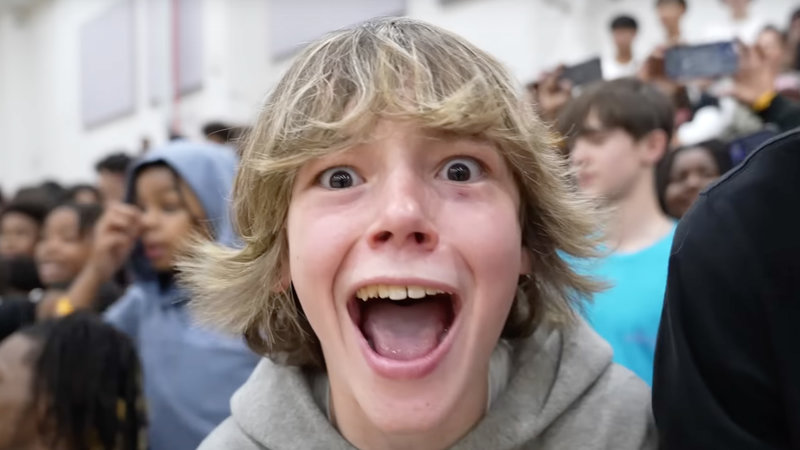
Brainrot, for anyone who has managed to avoid it, refers to a style of internet content so chaotic and reference-dense that prolonged exposure feels like it is degrading your brain — hence the name. It is the defining aesthetic of Gen Alpha's online culture, and it has become one of the most discussed phenomena in digital media in 2025 and 2026.
What makes the 67 trend interesting from a translation standpoint is not what it means. It is what happens when you ask AI to translate the description of something that does not mean anything.
What happened when we translated it
We entered the following sentence into MachineTranslation.com and ran it through our full AI model panel, English to Spanish:
"The 67 trend is a viral brainrot meme and catchphrase popular among Gen Z and Gen Alpha. It is primarily a nonsensical inside joke used to confuse older generations."
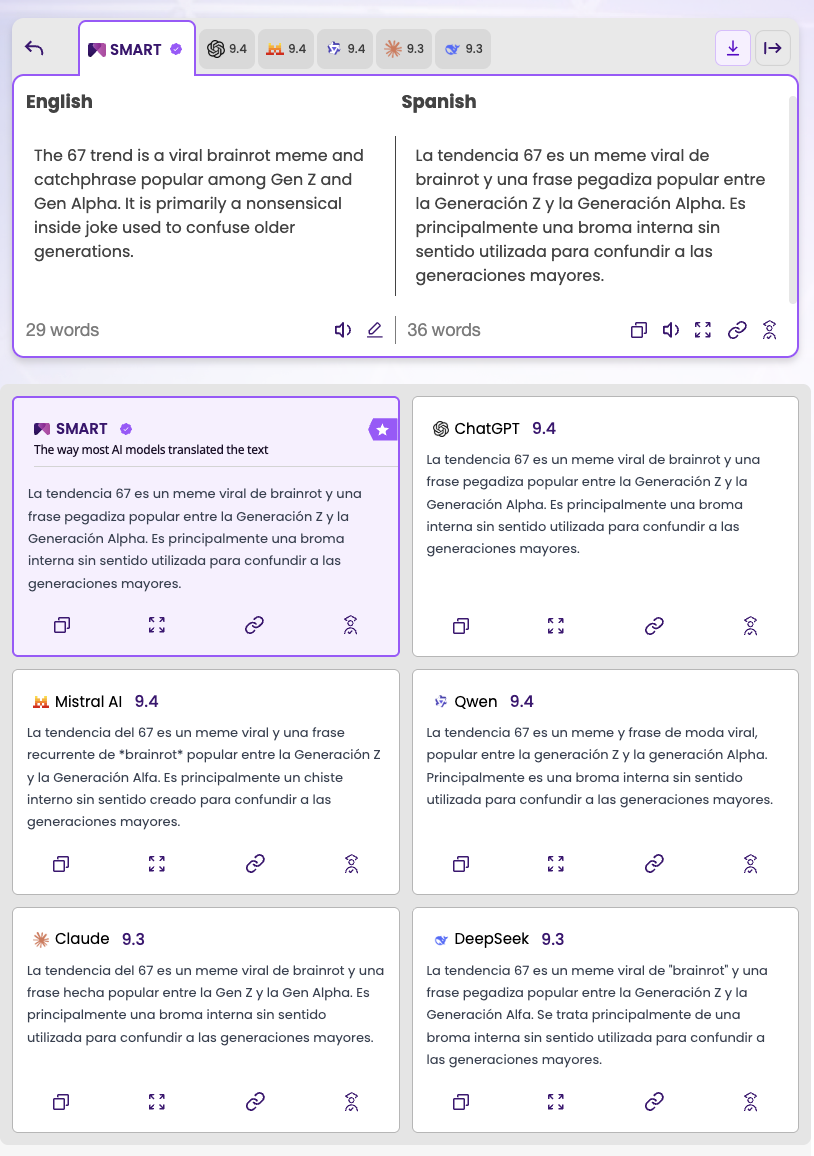
The SMART consensus output: "La tendencia 67 es un meme viral de brainrot y una frase pegadiza popular entre la Generación Z y la Generación Alpha. Es principalmente una broma interna sin sentido utilizada para confundir a las generaciones mayores."
The models largely agreed on the structure and meaning of the sentence. But inside that agreement, three separate micro-decisions produced four different outcomes — and each one reveals something about how AI handles content that sits at the edge of what it can confidently translate.
The "brainrot" problem: One word, three decisions
"Brainrot" has no Spanish equivalent. It is an English compound noun that emerged from internet culture, spread entirely through social media, and has not been formally absorbed into Spanish as a loanword. When a model encounters it, it has to make a choice: translate it (impossible), transcribe it (safe), or signal its foreignness through formatting.
Our models made three different choices:
Leave it as-is. ChatGPT, Qwen, and Claude all inserted "brainrot" into the Spanish text without any formatting — treating it as a loanword that Spanish-speaking readers would recognise from the same online context where it originated. This is probably the most defensible choice for a Gen Z audience, who encountered the word in English regardless of their native language.
Italicise it. Mistral rendered it as brainrot, using italics to signal that this is a foreign term being borrowed rather than a Spanish word. This is the typographic convention for foreign-language insertions in formal writing. It is technically correct and contextually slightly awkward: nobody italicises "brainrot" in a TikTok comment.
Quote it. DeepSeek wrapped the word in quotation marks ("brainrot"), a choice that signals unfamiliarity or distance from the term, as if the text is acknowledging that this is not a word it can fully vouch for. In journalism, quotes around a term often indicate slang, neologism, or contested usage. For a piece of internet culture content, it reads as slightly detached.
Three formatting decisions, one word, no wrong answers — just different editorial stances on how to handle a term that exists in the gap between languages.
Three other divergences hiding in the same sentence
"Gen Alpha" or "Generación Alfa"? Most models kept "Alpha" in English (Generación Alpha) treating it as a proper noun that doesn't need adaptation. Mistral and DeepSeek translated it phonetically to "Generación Alfa," which is how the term is increasingly used in Spanish-language media. Both are in active use. The difference is whether you treat "Gen Alpha" as a brand name (don't touch it) or a descriptor (localise it).
"Catchphrase" — three different translations: ChatGPT chose frase pegadiza — literally a "sticky phrase," one that sticks in the mind. Claude chose frase hecha — a "set phrase" or established expression, which implies something more formalised. Qwen chose frase de moda — a "trendy phrase," emphasising its viral, contemporary quality. Each captures a different dimension of what a catchphrase actually is. "Sticky," "set," and "trendy" are not the same thing, and the choice affects how the concept reads in Spanish.
"Inside joke" — broma or chiste? The majority of models translated "inside joke" as broma interna. Mistral chose chiste interno. Both work: broma leans toward a prank or playful act, chiste toward a verbal joke. In the context of brainrot humour (which is more about confusion than a punchline), broma interna is arguably the better fit. Mistral's choice is not wrong; it is simply from a slightly different register.
Why internet slang is a different kind of translation problem
Traditional translation problems are about meaning: how do you render a concept from one language in another without losing what it expresses? Internet slang creates a different kind of problem — not about meaning, but about belonging.
Words like "brainrot," "slay," "rizz," or "no cap" are not primarily semantic. They are social signals. They mark membership in a generational cohort, a platform community, a shared cultural moment. Their meaning, to the extent they have one, is secondary to what they perform: I am part of this, I understand this, I was there when this happened.
When you translate that kind of content, you are not translating meaning. You are translating belonging, and that is something AI models were not built to handle. They can tell you what the words say. They cannot tell you whether the translation will land the same way with a Spanish-speaking 15-year-old on TikTok as it did with an English-speaking one.
That gap is not a failure of AI translation. It is a reflection of something genuine about what certain kinds of language do. The SMART result on our test is accurate, the models translated the sentence correctly. What the score cannot measure is whether broma interna sin sentido hits the way "nonsensical inside joke" does. That judgment belongs to a human who lives inside the culture, not outside it.
For brands and content creators working in this space (anyone localising social media content, youth marketing campaigns, or digital culture coverage), the takeaway is practical: AI handles the structure, the grammar, the semantic content. The cultural resonance still needs a human read.
Frequently asked questions
1. What is the 67 trend?
The 67 trend is a Gen Z and Gen Alpha "brainrot" meme, a piece of deliberately nonsensical internet content that functions as an in-group reference. It carries no literal meaning; the point is that people who are in on it know what it refers to, and people who are not are confused. It is part of a broader category of absurdist internet humour associated with Gen Alpha's online culture.
2. Can AI translate internet slang accurately?
AI translation handles the structural and semantic content of internet slang well, as shown by the SMART result on our 67 trend test. Where models diverge is in micro-decisions about words that have no target-language equivalent, like "brainrot": some leave them as-is, some italicise them, some quote them. These are editorial choices, not translation errors. For culturally loaded slang where register and resonance matter, a human review layer is advisable.
3. Why did different AI models format "brainrot" differently in Spanish?
"Brainrot" has no established Spanish equivalent, which means models had to decide how to signal its foreign status. ChatGPT and Claude inserted it directly as a loanword. Mistral italicised it following the typographic convention for foreign insertions. DeepSeek quoted it to mark it as non-standard terminology. All three approaches are defensible; the right choice depends on the audience and the context the content will appear in.

By Ofer Tirosh
Connect on LinkedInOfer Tirosh is the founder and CEO of Tomedes, a language technology and translation company that supports business growth through a range of innovative localization strategies. He has been helping companies reach their global goals since 2007.
Share:


