March 31, 2025
How AI Translation Boosted Multilingual Cognitive Psych Document Accuracy by 80%
If you're working with international research or academic texts, you know how crucial accurate, context-aware translations are—especially when dealing with fields like cognitive psychology. Whether you're translating clinical studies, research papers, or training materials, you can’t afford to lose meaning or precision. This is the challenge one psychiatric institution faced when it needed to translate large volumes of cognitive psychology documents from Russian to German—and how they found a game-changing solution with MachineTranslation.com.
Let’s explore how they did it, and how you can do the same.
Why translation matters in cognitive psychology
Cognitive psychology is complex. It’s filled with technical language, specialized terminology, and nuanced ideas. Words like оперантное обучение (operant conditioning) or когнитивные искажения (cognitive distortions) must be translated correctly to maintain the integrity of the text.
If you're in the healthcare or academic space, you already understand that even small translation errors can lead to misunderstandings—or worse, misapplication of key concepts.
This psychiatric institution was collaborating with German-speaking researchers and publishing findings across European journals. Most of their original documents were in Russian, and translating them manually was time-consuming, expensive, and error-prone.
They needed a solution that could deliver fast, accurate translations, but also adapt to their specific terminology and tone.
That’s when they discovered MachineTranslation.com—the AI-powered translation platform that made all the difference.
The problem: Speed vs. accuracy vs. budget
The institution’s translation needs were growing fast. From research papers and clinical trial documents to educational materials, they needed to translate hundreds of pages—sometimes within tight deadlines. Traditional translation methods weren’t cutting it.
Manual translations took too long and cost too much. And generic machine translation tools often failed to grasp the technical terminology. Words were translated literally, tone was lost, and key psychological terms were distorted.
Sound familiar?
You’ve likely dealt with one-size-fits-all tools like Google Translate or DeepL. While helpful for general use, they don’t offer the level of precision needed for academic or medical fields.
What this institution needed—and what you might need too—was a platform that balances speed, accuracy, and affordability, all while adapting to the language of your field.
How MachineTranslation.com became the perfect translation solution
Here’s how MachineTranslation.com stepped in and delivered where others couldn’t.
1. Multiple AI LLMs in one place
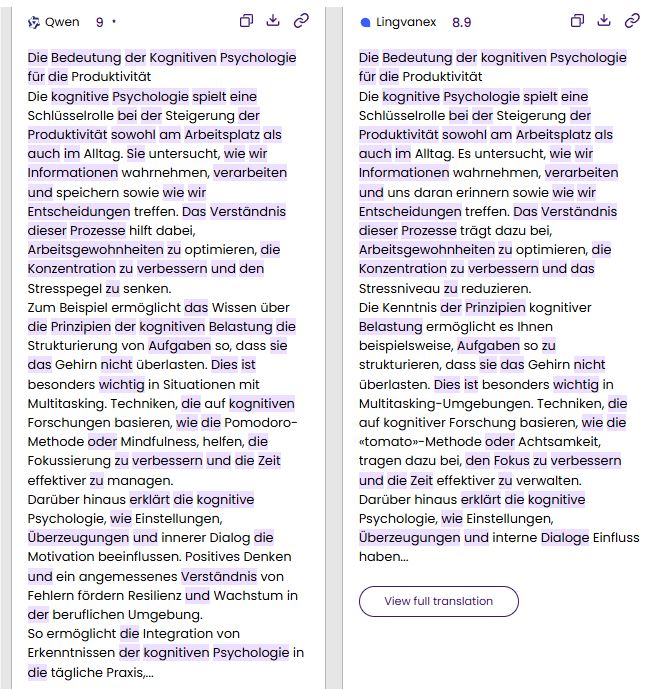
Instead of relying on a single translation engine, MachineTranslation.com aggregates results from multiple top AI and LLM translation sources. This gives you several translation options at once, which you can compare side-by-side. For Russian-German translation, this feature was essential.
The institution found that one engine might handle academic tone better, while another offered more literal interpretations. With a few clicks, they could select the best version for each use case.
2. Key Term Translations
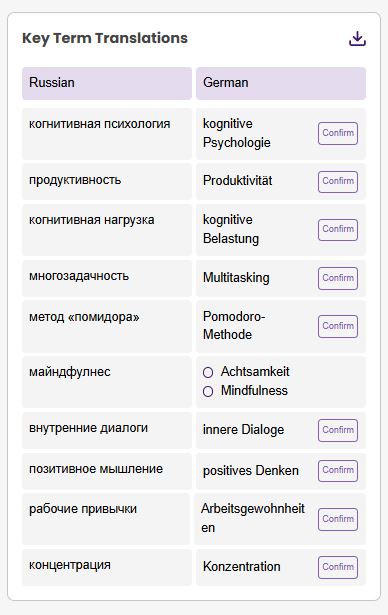
Cognitive psychology is full of field-specific terms. MachineTranslation.com automatically identified up to 10 specialized terms per document, then presented up to three top translations for each—in a simple comparison table.
This allowed researchers to choose the most accurate translation based on their preferred theoretical framework. No more cross-checking dictionaries or mistranslating critical terms.
3. AI Translation Agent with Memory
The real game-changer?
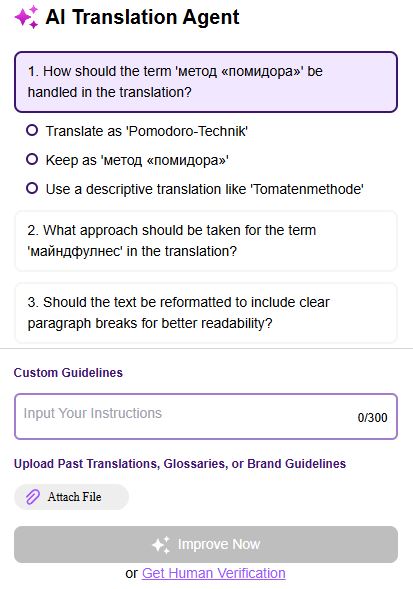
MachineTranslation.com’s AI Translation Agent didn’t just translate—it asked questions to refine the output. For instance, “Do you want a formal or academic tone?” or “Should technical terms remain in Russian for context?”
Even better: if you’re a registered user, the Agent remembers your answers and learns from your past revisions. That means the more you use it, the smarter it gets.
For the psychiatric institution, this meant they didn’t have to re-edit the same terminology or fix stylistic issues in every document. The AI remembered their preferences—academic tone, technical vocabulary, formatting—saving them hours of post-editing time.
4. Segmented Bilingual View
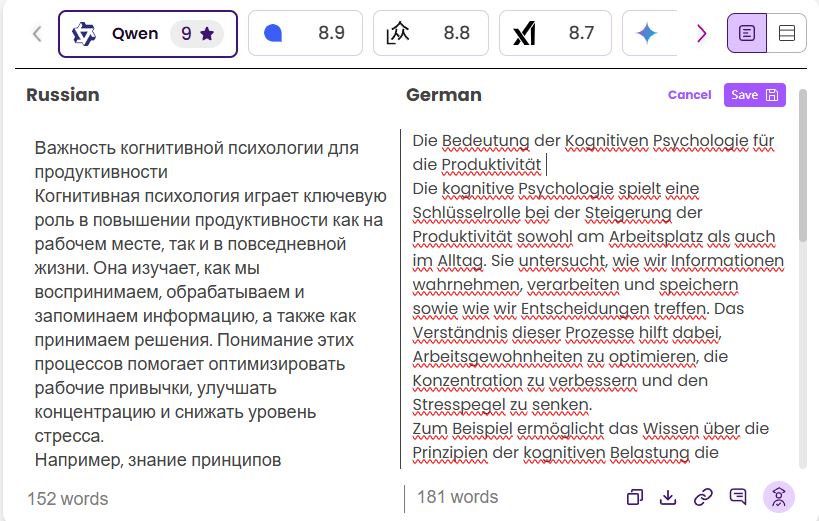
You can view your translations in segmented bilingual format, which means you see the source text and translation side-by-side, broken down into smaller sections.
This helped their team quickly catch inconsistencies or errors. For example, if a segment on memory recall had a mistranslation, they could spot and fix it immediately—without rereading the entire document.
If you're reviewing translations manually or collaboratively, this view is a huge time-saver.
5. Translation quality scores and insights
How do you know if a translation is good enough? MachineTranslation.com gives each engine output a quality score (0–10) as presented above, and provides AI-powered insights into differences in tone, terminology, and phrasing. This gave the institution confidence when choosing between multiple translations.
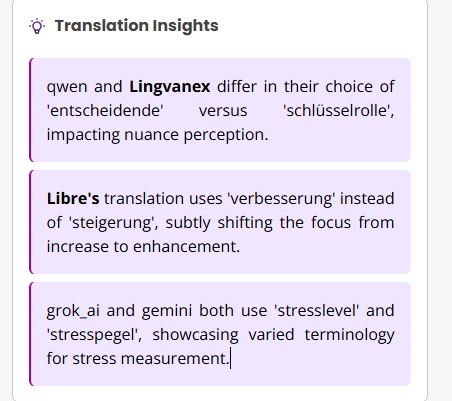
They could even see editing suggestions for each version—making it easy to decide whether they needed human review or if the machine version was good to go.
The results: Speed, savings, and accuracy
Let’s break it down:
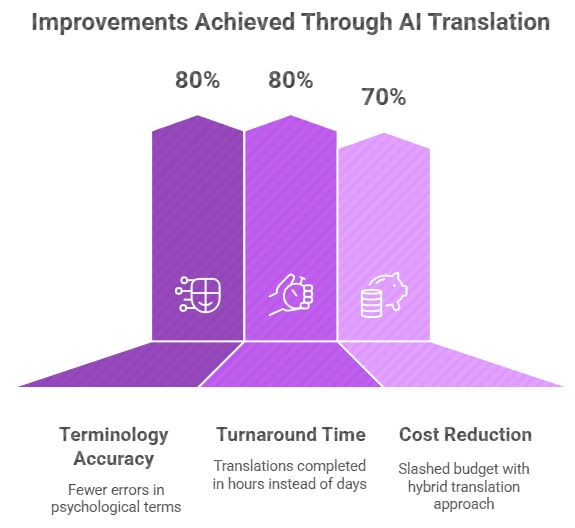
80% Increase in Terminology Accuracy: Thanks to Key Term Translations and AI memory, the institution saw fewer errors in critical psychological terms.
Turnaround Time Cut by 80%: Translations that used to take days were now ready in a few hours.
70% Cost Reduction: By using a hybrid approach—AI translation with optional human review—they slashed their translation budget.
Most importantly, their translated content met the rigorous standards of German academic journals, enabling smoother publication, peer collaboration, and broader knowledge sharing.
What this means for you
If you’re dealing with sensitive, technical, or academic texts, MachineTranslation.com gives you the control and customization you need.
Whether you’re a researcher, clinician, or academic, this platform lets you:
Translate Russian cognitive psychology documents (or any of 270+ languages).
Maintain accuracy with industry-specific terminology.
Customize tone and style using the AI Translation Agent.
Save time with bilingual segmented editing.
Cut costs without sacrificing quality.
And if you're in another field—legal, medical, engineering—it works just as well. The platform is built for specialized content across industries.
Bonus: Try it free
If you're unsure, start with the free trial. MachineTranslation.com gives you 100,000 words free translations upfront—no payment required.
Translate a paper, upload a PDF, or even just paste your notes—and see the difference for yourself.
Want even more personalized results? Register your account and unlock the AI Translation Agent's memory feature, so your future translations are even more tailored to your needs.
Final thoughts
In today’s fast-moving research world, you can’t afford slow, inaccurate, or inconsistent translations. Whether you're working with cognitive psychology texts, neuroscience reports, or academic collaborations across borders, your words matter.
MachineTranslation.com empowers you with AI-powered translation tools that are fast, accurate, and tailored to your field.
Just like this psychiatric institution, you can streamline your workflow, improve translation quality, and connect with a wider audience—without blowing your budget.
So the next time you need a Russian to German translation for your research, skip the guesswork. Use the platform trusted by professionals who value precision and efficiency.
Sign up today and experience the world’s most accurate AI translator—built for real-world results.

By Clarriza Heruela
Clarriza Mae Heruela graduated from the University of the Philippines Mindanao with a Bachelor of Arts degree in English, majoring in Creative Writing. Her experience from growing up in a multilingually diverse household has influenced her career and writing style. She is still exploring her writing path and is always on the lookout for interesting topics that pique her interest.
Share:


