July 1, 2026
How companies actually use AI translation
There is a tension at the centre of most AI translation platforms that nobody talks about openly: the product is built like a subscription, but the demand is not subscription-shaped.
A law firm does not translate every day. A mid-size exporter does not have a standing translation need running in the background. A content team localising materials for a new market has an intense, concentrated need for several weeks — and then the need goes quiet. This is how translation for companies works in practice. It arrives in waves, tied to projects, timelines, and decisions rather than recurring at a predictable weekly cadence.
This has always been true of the language services industry. Traditional agencies built their entire pricing model around it — corporate translation sold as projects in, projects out, no retainer unless you were a very large enterprise client. The shift to AI translation platforms brought subscription pricing into the category, which created a mismatch: a platform priced for daily use, serving companies that need it once a month.
We have been thinking about this tension for a while. In June, we ran a campaign that confirmed what we suspected.
The hypothesis we were testing
The offer was simple: 24 hours of completely free, unlimited translations on MachineTranslation.com. Reply to the email and we would activate it personally on your account.
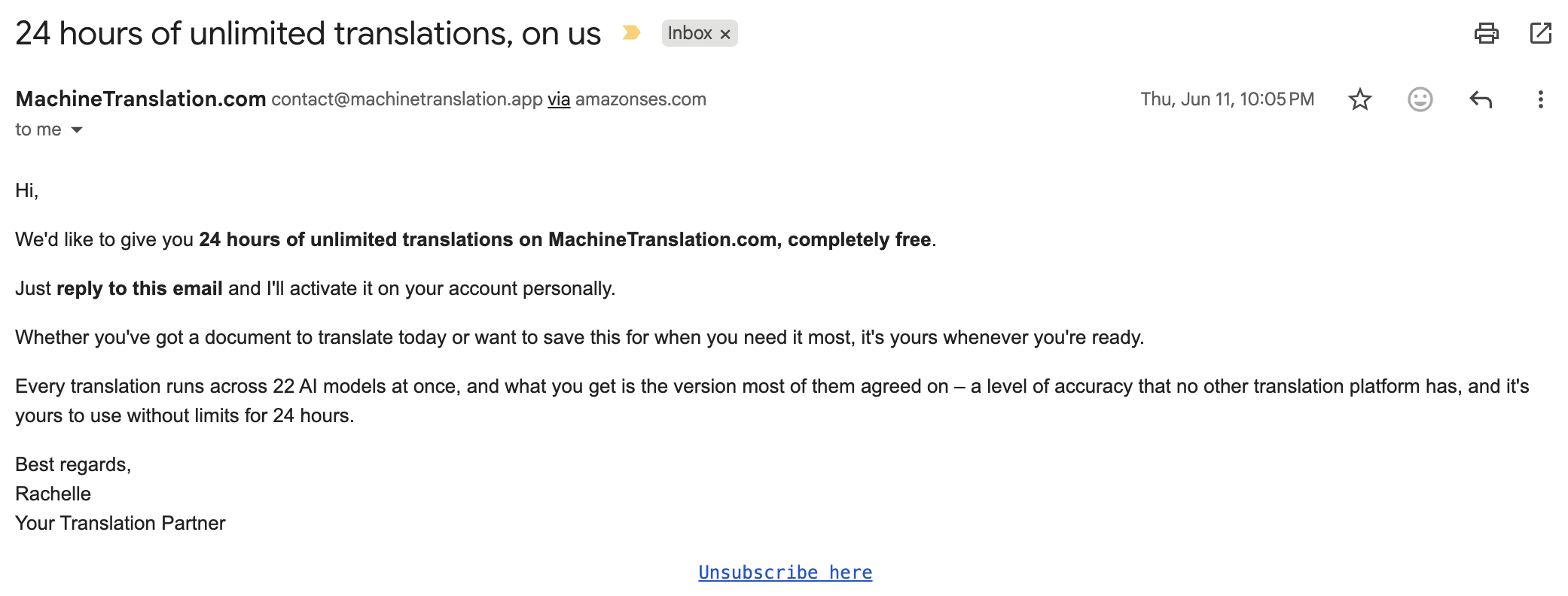
The logic behind it was not primarily about generosity, it was about fit. A 24-hour on-demand translation window maps almost exactly onto how a project-driven business user actually experiences a need. You have a document. You need it translated well, today. You do not need a subscription; you need the best possible translation of this one thing, right now. If we could put the full platform experience (22 AI models running simultaneously, surfacing the consensus translation) in front of someone at the exact moment they had a real translation to do, the quality would do the work.
The question was whether the timing would land. We did not know in advance that it would.
What the send revealed about subject line strategy
Before sending to our full list, we A/B tested two subject lines on equal-sized groups:
- Subject A: "24 hours of unlimited translations, on us"
- Subject B: "Translate anything for free — 24 hours, no limits"
Subject A opened at 28.61%. Subject B opened at 2.75%.
A ten-to-one gap between two subject lines sent to the same list within fifteen minutes of each other is not a performance difference, it is a deliverability event. Our assessment is that Subject B triggered spam filters before it reached most inboxes. Combining "free" with "no limits" in a subject line is a documented risk; Mailchimp's guidance on spam triggers flags exactly this kind of phrasing. Subject A used plain, conversational language ("on us" is how a person speaks, not how a banner reads) and landed cleanly.
The tactical lesson is immediate: promotional language written to sound exciting often sounds like spam, because spam is written to sound exciting. The more strategic point is about sender trust. We have spent time building a clean list with low bounce and unsubscribe rates. A poorly worded subject line can undermine that infrastructure in a single send. We will not use that combination again.
Subject A went to the full remaining list at a 16.71% open rate — a natural step down from the test group, which contains the most engaged subscribers, and a result that sits within solid range against industry benchmarks.
What actually happened afterwards
This is the part that matters most, and the part I can only describe in general terms — not because I am being coy about numbers, but because the conversion mechanism for this campaign was a reply, not a click, and reply data requires a different kind of pull than a dashboard metric.
What I can say is this: companies used the 24 hours. Many of them used all of it. And a meaningful proportion of those users have continued using the platform afterward — not because we followed up with them, not because we pushed a trial-to-paid conversion sequence, but because the product experience was sufficient on its own.
That is the validation we were looking for. Not open rates. Not reply volume. The fact that giving a company a genuine 24-hour window of free AI translation access (with no friction, no upsell, no expiry warning) was enough to bring them back on their own terms.
What it confirms about corporate translation demand
The pattern of who came back reinforces the hypothesis we started with. It was not casual experimenters who returned. It was businesses with recurring but irregular translation needs — the kind of companies that are not looking for a translation subscription, but who need an on-demand translation capability they trust to be there when the next project arrives.
This is meaningfully different from how most SaaS acquisition thinking works, where the goal is daily active use and habit formation. Corporate translation, for most of the businesses who need it, is not a habit. It is a capability. The acquisition question is not "how do I get them to open the platform every morning" — it is "how do I be the platform they remember and return to when the next contract, the next product launch, the next piece of content needs to exist in another language."
A 24-hour free AI translation offer is well designed for that relationship. It does not ask for a commitment that does not match how the need actually presents. It asks for one thing: use this, right now, for whatever you have. If the quality is there, the relationship will follow.
What we are changing before the next send
There are three things I would do differently. We sent without first-name personalisation, a basic omission that research consistently shows lifts open rates and makes an email feel like a message rather than a broadcast. We sent at 7 AM, earlier than the window I would now target. And we had no secondary trackable link — the reply mechanic was right for this campaign, but a soft footer link would have given us click data without undermining the personal feel of the CTA.
These are correctable. The more important finding is that the strategic bet held: the product experience was the conversion mechanism, not the email. The email just needed to get out of the way.
We are sharing this in the spirit of building transparently — not because everything went perfectly, but because the companies building in this space tend to share their pitch decks and their launch announcements and very little of what actually happens in between. This is what happens in between.

By William Mamane
Connect on LinkedInWilliam leads marketing and growth at Tomedes, where he turns SEO experiments and real campaign data into the strategy behind MachineTranslation.com's reach. He writes about how AI products actually get found and trusted plus the tactics that work, the ones that don't, and what search is rewarding right now.
Share:


