June 19, 2026
AI translation for immigration documents: What it can do, what it can't, and when it's not enough
You have a foreign document in front of you. Maybe it's a birth certificate from Mexico, a marriage record from Poland, or a court notice from South Korea that arrived two weeks before your visa appointment. You open an AI translator, paste the text, and get a fluent-sounding result in under a second.
The question is whether that's enough, and the honest answer depends entirely on what you plan to do with it.
AI translation has made genuine progress. But immigration is one of the few contexts where the gap between good enough for me to understand and acceptable for official submission is not a technicality. It is the difference between a smooth process and a rejected application, a rescheduled appointment, or a permanent mark on a filing record.
This guide gives you a clear picture: what AI translation handles well in an immigration context, where it cannot substitute for certified translation, what USCIS and comparable immigration authorities actually require, and why MachineTranslation.com is built differently from every other AI translation platform — including a human verification option that no competitor offers.
What "acceptable" means depends entirely on what you're doing with the document
Immigration involves two completely different uses of translated documents. They look similar on the surface but operate under entirely different standards.
The first is personal understanding. You need to read a document written in a language you don't speak — to know what's in it, prepare for an appointment, confirm your name is spelled consistently across documents, or understand what rights or conditions apply to you. For this purpose, AI translation is fast, accurate for standard terminology, and entirely appropriate.
The second is official submission. You're attaching a translation to a visa application, a green card petition, a naturalization filing, or a court immigration case. Here, the translation is a legal document in its own right. The standard is not understandable, it is certified.
Those two use cases require two completely different approaches. Most of the confusion around AI translation and immigration stems from treating them as the same thing. This guide keeps them separate throughout.
Where AI translation genuinely helps with immigration paperwork
Before getting into where AI translation falls short, it's worth being specific about where it earns its place in an immigration workflow.
Reading and understanding foreign documents. When a foreign relative sends you a power of attorney, a property deed, or a court summons, AI translation gives you a working read of the content. You are not submitting this anywhere, you just need to understand what you are looking at before you decide what to do next.
Preparing for appointments. Immigration appointments often require you to present original documents alongside certified translations. Understanding those documents beforehand (knowing the names, dates, and key clauses) means you are not reading them for the first time in a waiting room.
Running a basic check on translated documents you've received. If you already have a certified translation in hand, running the original through an AI translator is a reasonable sanity check. Major discrepancies in names, dates, or document type are visible at this level.
Translating non-submission materials. Cover letters, personal statements written for legal teams, notes you are preparing ahead of a consultation with an immigration attorney — none of these require certified translation, and a high-quality AI translator handles them well.
As relocation resource Frayed Passport noted in a guide on documents you should never trust to a free translation app when moving abroad: unverified AI output is fine for general orientation, but specific document categories carry consequences that free, unverified tools are not equipped to handle.
Is AI translation accepted by USCIS?
No. For official immigration filings in the United States, USCIS requires certified translations under 8 CFR 103.2(b)(3). Any document submitted in a language other than English must be accompanied by a complete English translation certified by a competent translator who attests that it is complete, accurate, and that they are competent to translate from the source language into English.
An AI-generated translation does not meet this standard. Google Translate, DeepL, ChatGPT, and any AI model cannot provide a legally certified translation for USCIS submission.
Documents subject to this requirement include:
- Birth certificates
- Marriage and divorce certificates
- Death certificates
- Court records and criminal history documents
- Academic transcripts and diplomas
- Foreign passports (when field translation is required)
- National identity documents
The same framework applies across most major immigration jurisdictions. UK Visas and Immigration (UKVI), Immigration Refugees and Citizenship Canada (IRCC), and most EU member state immigration authorities require certified or sworn translations for official filings. In some countries (France, Spain, and Germany among them), translations must be produced or certified by a traducteur assermenté or traductor jurado, a sworn translator with state-recognised credentials.
Submitting an uncertified AI translation is not a grey area. It is a documented basis for rejection, and in cases where the discrepancy between the source document and the submitted translation appears significant, it can create more serious complications for the applicant's record.
What happens when an AI translation gets an immigration term wrong
The consequences of translation errors in immigration filings range from administrative delay to application rejection. A name transliterated inconsistently across documents, a date formatted in a way that creates ambiguity, or a legal term rendered incorrectly — each of these creates downstream problems that take time, money, and sometimes months to resolve.
Research covering what international students lose when AI translation gets it wrong makes a useful point: the costs are rarely about the translation failure itself, but about the consequences — missed filing deadlines, resubmission fees, rescheduled hearings, and the cumulative damage to how a case is perceived.
The specific problem with single-model AI translation is not that it produces obviously wrong results. It is that it produces confidently wrong results that look fine on the surface. A single model has no mechanism to flag its own uncertainty. If it renders a legal term in a way that sounds natural but is technically imprecise, there is nothing in the output to tell you that.
Legal translation errors in immigration are rarely vocabulary failures. They are precision failures. The Spanish term "acta de nacimiento" refers specifically to the civil registry birth record in Mexico. "Partida de nacimiento" is the equivalent form in much of South America. Both translate to "birth certificate" in general use — but in a forensic or legal immigration context, the specific document type and its issuing authority matter. A single AI model translating under general instruction may not preserve that distinction. In immigration, that level of imprecision is not inconsequential.
This is exactly the problem that consensus-based translation was designed to address.
How MachineTranslation.com approaches high-stakes documents differently
Most AI translation platforms give you one output from one model and present it as the answer. MachineTranslation.com's SMART mechanism works differently from the ground up.
Five models, and you can see the evidence
When the SMART mechanism translates a phrase, it does not run one model. It runs up to 22 AI models simultaneously (including ChatGPT, Claude, DeepSeek, Mistral AI, and Qwen) and identifies the translation that the majority of models agree on. The result you see is not a single model's best guess. It is a cross-verified output. And the platform shows you exactly which models agreed and which didn't.
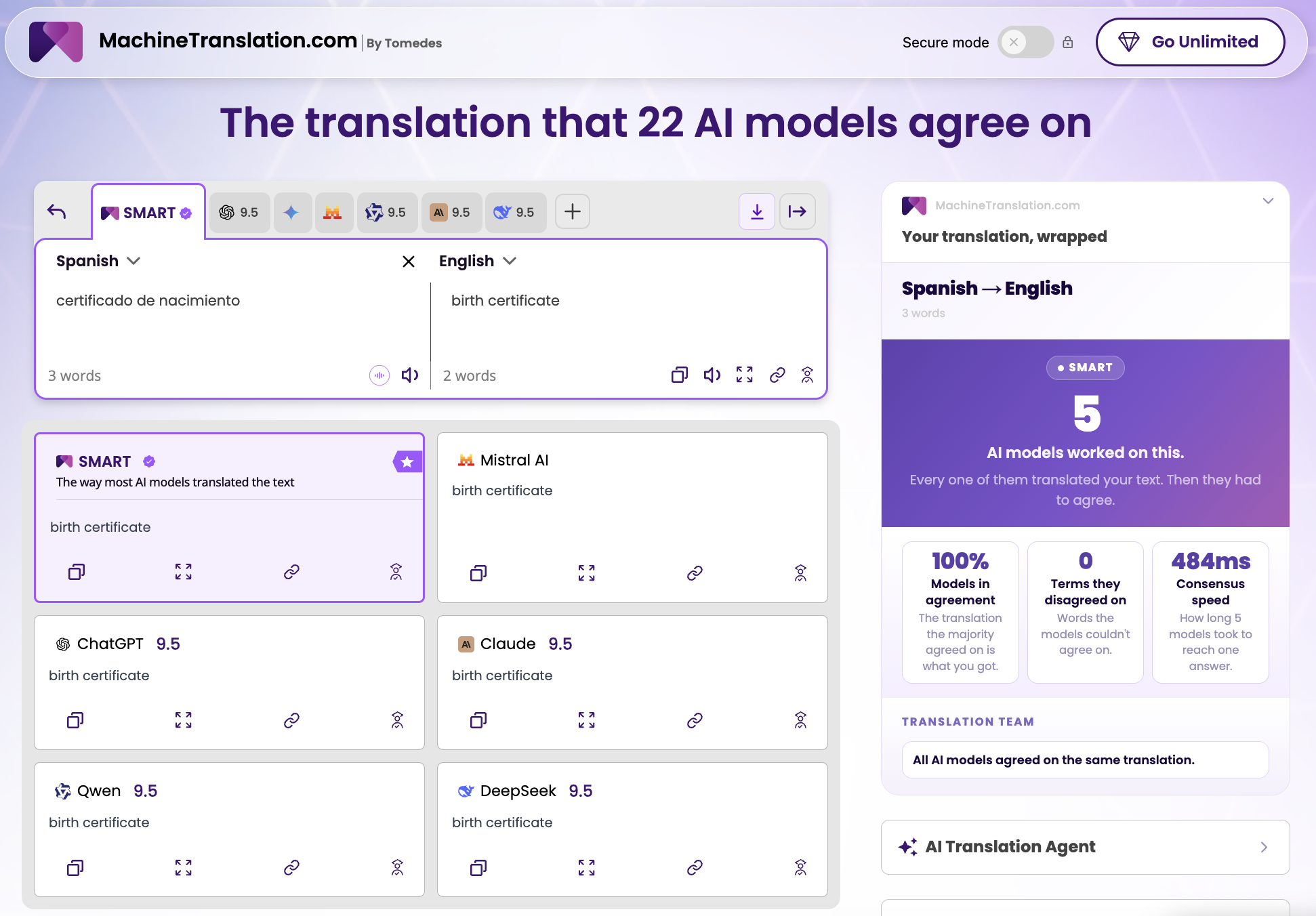
When MachineTranslation.com translated "certificado de nacimiento" (the Mexican Spanish term for birth certificate, one of the most frequently requested document translations in immigration filings), five models ran simultaneously. Every one returned the same output: birth certificate. Zero terms in disagreement. Full consensus reached in 484 milliseconds.
That kind of transparency does not exist on any other AI translation platform. You are not trusting a black box. You can see exactly where the world's best models align — and when they diverge, that disagreement itself is a meaningful signal that the text deserves closer review before you act on it.
The SMART methodology is built on a straightforward principle: consensus as a reliability signal in applied AI mathematically eliminates translation outliers, the edge cases where a single model produces a plausible but incorrect result. With the outputs of 22 models compared against one another, the probability of a systematic error surviving to the final output drops significantly. According to MachineTranslation.com's internal benchmarking, SMART cuts translation error risk by 90% compared to single-model outputs, and the platform now serves over 1,500,000 users who rely on that standard.
The human verification option: Built for when errors are not acceptable
For content where even a small error carries real consequences, MachineTranslation.com offers something no other AI translation platform has built: human verification, directly within the platform.
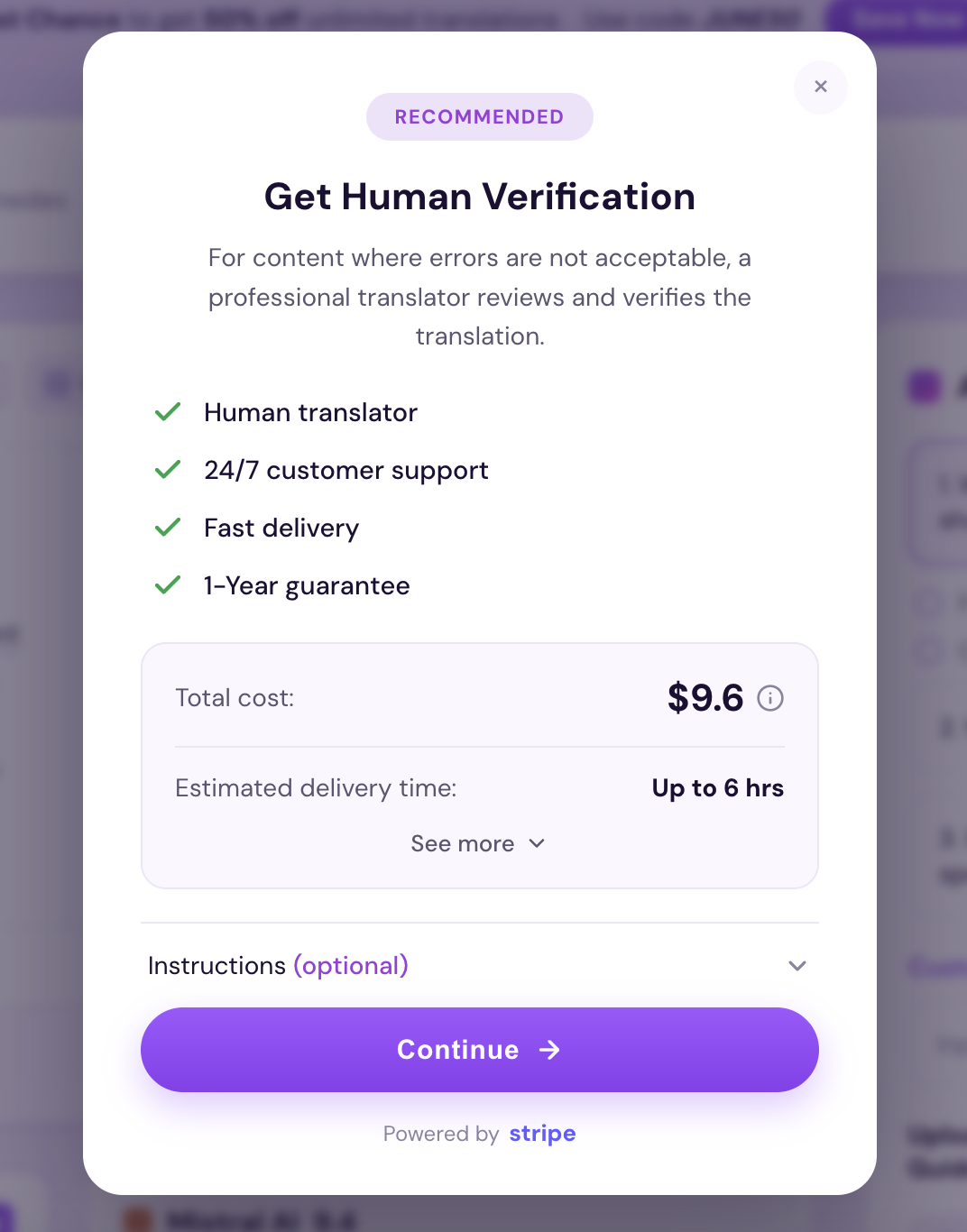
After receiving your AI translation, you can request a professional human translator to review and verify the output — without leaving the platform, without searching for a separate service, and without starting the document process over. The modal labels this exactly as it is: "For content where errors are not acceptable."
The service includes a professional human translator review, 24/7 customer support, fast delivery in up to six hours, and a one-year guarantee on the verified translation. The cost varies on complexity and language pair selection.
"The human verification option was built to close a real gap," says a senior translation specialist at Tomedes (professional translation company that developed MachineTranslation.com). "Between an AI output that's probably accurate and a fully certified translation for official submission, there's a large middle category — documents you need to be certain about, but that don't require the full certification workflow. A foreign insurance document. A landlord notice. A letter from an immigration authority you need to respond to before your appointment. For those, a couple of dollars and six hours gives you a professional eye on the translation, a guarantee behind it, and the confidence to act."
No other AI translation platform offers this. On Google Translate, DeepL, or any other competitor, your only options are to use the AI output as-is or to find a separate human translator on your own. MachineTranslation.com is the only AI translation platform that keeps both options (and the pathway to full certified translation) in one place.
HRTech Edge's coverage of what human verification actually solves for high-accuracy use cases captures the core point: the value of human verification is not that AI is unreliable. It is that certain contexts carry consequences significant enough to warrant a second layer of review, and building that layer into the platform removes the friction that causes people to skip it.
Matching the right translation approach to your document type
The right approach depends on what the document is and what you need to do with it. Use this as a practical reference:
| Document type | AI translation useful? | Human verification recommended? | Certified translation required? |
|---|---|---|---|
| Birth certificate — personal understanding | ✅ Yes | ✅ Recommended | ❌ Not for personal use |
| Birth certificate — USCIS / official filing | ⚠️ Prep only | ✅ At minimum | ✅ Mandatory |
| Marriage / divorce certificate — official filing | ⚠️ Prep only | ✅ At minimum | ✅ Mandatory |
| Foreign lease or rental agreement | ✅ Yes | ✅ Recommended before signing | ❌ Not always required |
| Court document — immigration case | ⚠️ Prep only | ✅ At minimum | ✅ Mandatory |
| Cover letter / personal statement | ✅ Yes | ⚠️ Optional | ❌ Not required |
| Foreign government notice / letter | ✅ Yes | ✅ Recommended before responding | ❌ Depends on context |
| Academic transcript — visa application | ⚠️ Prep only | ✅ At minimum | ✅ Mandatory |
| Foreign insurance or financial document | ✅ Yes | ✅ Recommended | ❌ Usually not required |
The core principle: when a document is going to an immigration authority as part of a filing, AI translation (however accurate) is not sufficient. When you need to understand, prepare, or respond to a document for your own purposes, AI translation combined with human verification where stakes are high is the most practical and reliable approach available.
When AI translation isn't enough: Getting a certified translation
MachineTranslation.com is built by Tomedes, one of the world's leading translation companies. For documents that require certified translation (USCIS filings, visa applications, immigration court proceedings, sworn declarations), Tomedes provides professionally certified translations that meet the legal standards of immigration authorities worldwide.
The workflow is designed to be continuous. You can use MachineTranslation.com to understand your documents and prepare for the process, then move to Tomedes certified translation for the official submission — without switching providers, repeating context, or starting from scratch.
As British Business Magazine reported in their 2026 coverage of why businesses are getting legal translation wrong and what AI consensus is changing, the most common and costly mistake is not knowing when to make the transition — treating a capable AI output as sufficient for a purpose it was not designed to meet.
The question to ask is not "is this translation accurate enough?" It is "what am I doing with it?" AI translation and certified translation are not competitors in an immigration workflow. They serve different needs in the same process, and MachineTranslation.com is the only platform where both are accessible from the same interface.
Frequently asked questions about AI translation and immigration documents
1. Is AI translation legal for immigration documents?
Using AI translation to understand your documents is legal and practical. Submitting an AI-only translation to immigration authorities such as USCIS, UKVI, or IRCC as an official certified translation does not comply with their requirements. Official immigration filings require certified translations produced or verified by a qualified human translator.
2. Can I use MachineTranslation.com for my immigration documents?
Yes — for personal understanding, appointment preparation, and document review. MachineTranslation.com also offers a built-in human verification option, where a professional translator reviews and verifies your AI translation with delivery in up to six hours, for situations where accuracy is critical but certified translation is not required. For official immigration submissions, Tomedes provides certified translation directly.
3. What is the difference between AI translation and certified translation?
AI translation produces a fast, accurate rendering of text in another language. Certified translation is produced or verified by a qualified human translator who signs a declaration attesting to its accuracy and completeness. Immigration authorities require certified translation for official filings; AI translation alone does not meet that legal standard.
4. Why does MachineTranslation.com's SMART consensus mechanism reduce errors compared to other AI translators?
SMART runs up to 22 AI models at once and selects the output that the majority agree on. This consensus approach eliminates outliers, cases where one model produces a plausible but technically incorrect result. When MachineTranslation.com translated "certificado de nacimiento," five models ran simultaneously, all returned "birth certificate," and reached full consensus in 484 milliseconds with zero terms in disagreement. That level of cross-verification is not available on any other AI translation platform.
5. What does the human verification option on MachineTranslation.com actually include?
After receiving an AI translation, users can request a professional human translator to review and verify the output. The service includes 24/7 customer support, and comes with a one-year guarantee. It is marked as recommended for content where errors are not acceptable — including immigration-related documents, legal agreements, and financial filings where precision matters.

By Rachelle Garcia
Connect on LinkedInRachelle leads product and AI at Tomedes, where she runs the experiments that turn internal data into better translation experiences. She writes about what actually happens when you build AI products such as MachineTranslation.com — the numbers, the surprises, and the parts that don't go to plan.
Share:


