April 30, 2026
We halved our AI translation price. Here's exactly what happened.
On April 1, 2026, we changed the Pro Plan price on MachineTranslation.com from $39 to $19 per month and cut 24-Hour Unlimited Translations from $9.50 to $6. It was a deliberate experiment — not a reaction to pressure, but a data-driven decision to test whether our pricing architecture matched how our users actually behaved.
Four weeks later: conversion rate up 72%, paid sessions up 59.9%, active subscribers up 36%, and a new all-time monthly record for paying users. Here's exactly how we got there.
Pricing on MachineTranslation.com is current as of April 2026 and is subject to change.
Why we did it: Pricing architecture vs. User behavior
Our internal data told us something important: 62% of MachineTranslation.com users were translating short, personal or professional text — messages, captions, quick document excerpts. Everyday use cases, not enterprise workflows.
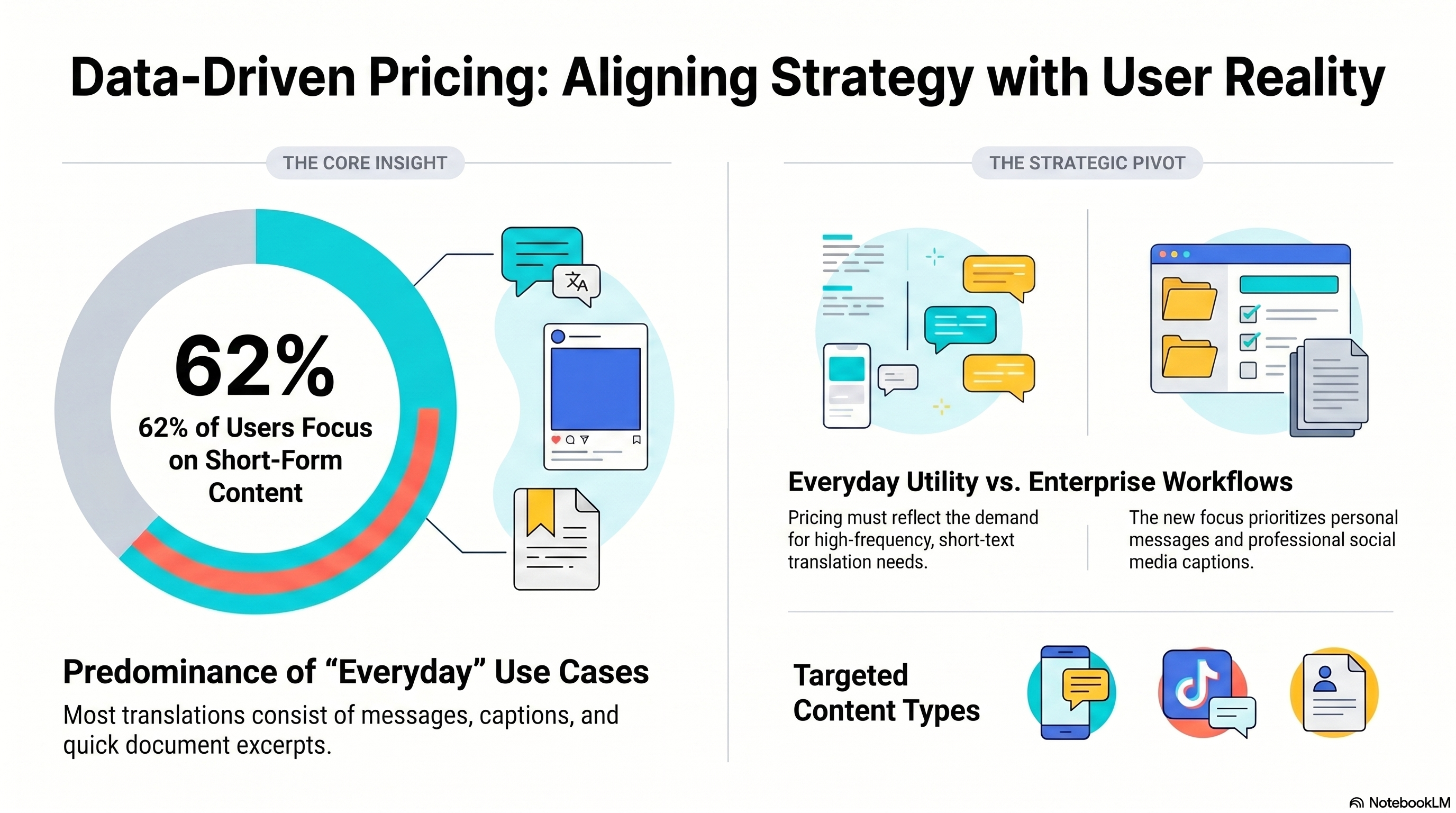
Our $39 Pro Plan had been built for power users. It was the right product for a segment of our audience, but it created a gap — users who found genuine value in the platform but couldn't justify a monthly commitment for occasional use. The 24-Hour Unlimited Translations option existed, but it wasn't prominent enough in the flow to serve that audience well.
When we reviewed cancellation patterns in late March, the signal was consistent: price sensitivity was concentrated among users with high engagement but low frequency. These weren't users who didn't value the product. They were users whose usage pattern didn't match our pricing model.
The insight: A pricing architecture that doesn't match user behavior will always produce avoidable churn, regardless of product quality.
We restructured the pricing to serve two distinct user profiles properly: the Pro Plan at $19/month for regular users, and 24-Hour Unlimited Translations at $6 for those who need translation on demand. We ran it as a controlled experiment with a defined review window.
What the first two weeks taught us
The early weeks of a pricing experiment carry a specific dynamic that's worth understanding before you run one. Existing traffic is priced against the old number in the user's memory. Paywall UX that was optimised for the old price point may not perform the same way for the new one. And organic discovery hasn't yet caught up to the change.
We used this window deliberately. Rather than measuring raw conversion against a baseline, we focused on identifying friction points in the paywall and sign-up flow that we could address in parallel. Two changes came directly from this period.
First, we updated the mobile paywall default from the Pro Plan to the 24-Hour Unlimited Translations option. Mobile users (who represent a growing share of our traffic) behave differently from desktop users. They are more likely to be in a task-oriented moment and less likely to be ready to evaluate a subscription. Giving them the lowest-friction path first, without removing the Pro Plan option, aligned the default with actual mobile intent.
Second, we removed the mandatory account creation step before Stripe payment for 24-Hour Unlimited Translations. The new flow goes directly from paywall to Stripe checkout, with automatic account creation post-payment. This eliminated a drop-off point that had been invisible in our previous funnel analysis, and it's the kind of friction that only becomes visible when you're actively looking for it.
Both changes were live before the pricing experiment reached its peak impact window. They compounded the conversion gains significantly.
The quality signal we're glad we caught
One of the more valuable outcomes of this experiment wasn't in the conversion data, it was in the cancellation data.
As volume increased with the new pricing, we observed a rise in cancellations citing accuracy issues for specific language pairs. This gave us something we hadn't had before: a quality signal with enough statistical weight to act on. Higher volume, by definition, produces more data. More data produces clearer patterns.
We built a command centre analysis specifically to map which language pairs and content types were generating accuracy feedback. That analysis is now directly informing our model improvement prioritisation — which language pairs get attention first, and where our consensus engine needs refinement.
The lesson: Volume is a diagnostic tool. Higher traffic at a lower price point surfaces product intelligence that lower-traffic, higher-price models never generate.
As always, we recommend that translations used in professional, legal, medical, or official contexts be verified by a qualified human — our human review add-on is designed exactly for that.
The numbers: Four weeks of data
| Metric | Result |
|---|---|
| Pro Plan price | $39/month → $19/month |
| 24-Hour price | $9.50 → $6 |
| Active subscriber growth | +36% in 4 weeks |
| Conversion rate (CVR) | 1.11% → 1.91% (+72%) |
| Paid sessions per day | +59.9% |
| Paying users | New monthly record — April 2026 |
| 24-Hour subscribers | All-time monthly high — April 2026 |
The conversion rate lift was the cleanest signal, consistent across multiple weeks and not attributable to a single traffic spike. The 24-Hour Unlimited Translations figure was the most surprising: a single month producing an all-time high for that access type, confirming this is a distinct and underserved user profile — not just a lower-commitment version of the Pro Plan audience.
Three changes that actually drove the results
Looking back, the conversion gains came from three compounding decisions — not from the price change alone.
1. Matching the default to mobile intent
Changing the mobile paywall default to 24-Hour Unlimited Translations aligned our highest-friction entry point with the behaviour of our fastest-growing user segment. Mobile users convert on low-commitment options. Showing them a monthly subscription first was the wrong sequence.
2. Removing sign-up friction from the 24-hour flow
Going directly from paywall to Stripe checkout (with automatic account creation post-payment) eliminated a step that had been causing silent drop-off. The lesson isn't that sign-up is bad; it's that sign-up before payment is a trust ask you haven't earned yet at that moment in the flow.
3. Building quality intelligence into the growth loop
Using the quality feedback from increased volume to drive model improvement means the experiment has a compounding benefit beyond the conversion metrics. The platform improves faster at scale than it does at lower volume. That's a structural advantage of the lower price point that wasn't visible in advance.
What this means for AI translation pricing more broadly
The conventional wisdom in SaaS pricing is to charge what the market will bear and protect your margins. That's sound advice for stable markets. AI translation is not a stable market.
The cost to deliver AI translation has dropped dramatically in the past two years. The quality ceiling has risen. User expectations have shifted from "impressive for AI" to "comparable to human for common content." In that environment, a pricing model built on 2023 assumptions will produce 2023 conversion rates.
What we found (and what I think applies beyond our specific context) is that the right price point for an AI tool isn't the highest price users will pay at a given quality level. It's the price that generates enough volume to continuously improve quality while sustaining the business. Those are different numbers, and the gap between them is where most AI tool pricing decisions go wrong.
Was it worth it?
The growth trajectory is real and continuing. Active subscribers are growing week over week. The 24-Hour Unlimited Translations model has validated a user profile we'll now build for explicitly. The quality intelligence we've gained is accelerating product improvement.
The experiment confirmed something we suspected: our product was being undersold to an audience that wanted it. The work now is making sure the quality, the paywall clarity, and the onboarding experience are worthy of the volume we're attracting. That's a better problem to have than the one we started with.

By Rachelle Garcia
Connect on LinkedInRachelle leads product and AI at Tomedes, where she runs the experiments that turn internal data into better translation experiences. She writes about what actually happens when you build AI products such as MachineTranslation.com — the numbers, the surprises, and the parts that don't go to plan.
Share:


