May 27, 2026
Why we didn't raise our AI translation prices, and what we did instead
Every few months, our team sits down to ask an uncomfortable question: are we charging the right amount for what we've built?
In May 2026, we did that exercise properly. Our data analyst Bryan ran a structured competitive analysis (pulling current pricing from ChatGPT, DeepL, and other AI tools) and brought the findings into one of our weekly product meetings. The conclusion wasn't what I expected.
We weren't obviously underpriced. We weren't obviously overpriced. We were priced in a way that depended entirely on how you framed what we were selling.
This post is about that framing, the research behind it, and the decision we made: hold the price flat, add more currencies, and double down on making the product more accessible globally rather than more expensive locally.
The research Bryan brought to the table
Bryan didn't just pull pricing pages. He structured the comparison around a question that matters operationally: when a user pays for MachineTranslation.com, what category of product are they paying for?
That question matters because it determines who your real competitors are, and whether your price looks high or low relative to them.
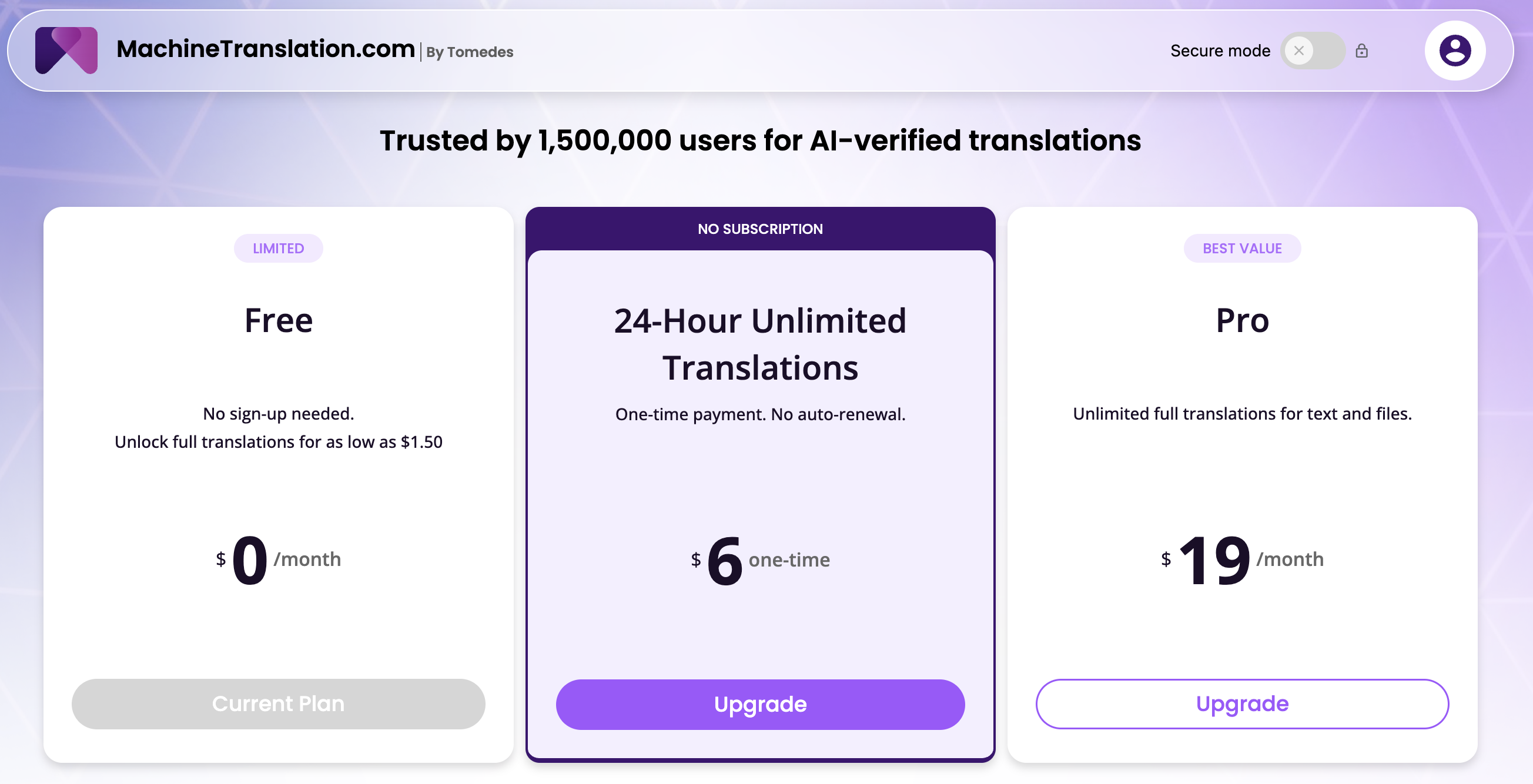
The research came back with a clear split. When MachineTranslation.com is framed as a translation service (something you use to get text from one language to another, the way you'd use Google Translate or a freelancer), the $19/month Pro Plan looks expensive relative to free tools and cheap relative to professional services, but without a clear anchor it can feel unclear.
When MachineTranslation.com is framed as an AI utility (a platform that runs 22 AI models simultaneously, compares their outputs, and surfaces a verified consensus result), $19/month is directly comparable to ChatGPT Plus at $20/month, and notably cheaper than DeepL Pro at around $34.49/month, while doing something neither of them does: running a consensus layer across multiple models so you're not trusting a single AI's judgment.
Same price. Completely different perception. Which frame you use determines whether $19 feels cheap, fair, or expensive.
The framing question: Translation service or AI utility?
This is the tension we've been navigating since we cut the Pro Plan price from $39 to $19 earlier this year. The price reduction worked — conversion improved, more users found the value proposition accessible. But it also raised a question we hadn't fully answered: what exactly are people paying $19 for?
The answer we keep coming back to is this: they're paying for certainty.
A single AI model translates fast and usually gets it right. But "usually" is doing a lot of work in that sentence. When the text matters (a contract clause, a product description going to 30 markets, a medical form), "usually accurate" isn't sufficient. What MachineTranslation.com does differently is run the translation through multiple models, compare the outputs, and show you where they agree. High agreement means high confidence. Disagreement flags where you should look more carefully.
That's not a translation service. That's an AI verification layer for translation. And when you frame it that way, the pricing conversation looks entirely different.
What the competitor pricing actually showed
Here's the summary of what Bryan's research found, and what I took from it:
| Tool | Monthly price | What you're paying for |
|---|---|---|
| MachineTranslation.com Pro | $19 | 22-model consensus translation, document processing, SMART verification |
| ChatGPT Plus | $20 | General AI assistant with translation capability |
| DeepL Pro (Starter) | ~$34.49 | High-quality single-engine translation, especially European pairs |
| Google Translate | Free (API usage billed separately) | Fast, broad-coverage single-engine translation |
The table tells you something important: MachineTranslation.com at $19 is essentially priced at parity with ChatGPT Plus. The difference is that ChatGPT is a general-purpose AI tool that can translate among many other things, while MachineTranslation.com is built entirely around the problem of getting a translation you can trust.
For someone whose primary use case is translation (not general AI assistance), that's a more compelling proposition at the same price point. DeepL is a stronger direct comparison for users who need high-quality European-language translation from a dedicated tool, but DeepL gives you one engine's output. MachineTranslation.com gives you a consensus across many.
The research didn't tell us our price was wrong. It told us our framing needed to catch up with our product.
Why we chose currency expansion over price increases
The natural conclusion from Bryan's research might have been: raise the price. If we're competitive with tools that charge more, and our product does more than single-engine translation, why not reflect that?
We chose not to. Here's why.
We don't yet have enough data on how price sensitivity varies by user type and region. Our paying users span dozens of countries. A $19 Pro Plan is genuinely affordable in the US and Western Europe. In Brazil, Indonesia, Mexico, or Egypt, the purchasing power dynamic is completely different — a flat $19 USD can represent a meaningful cost that has nothing to do with whether the product is valuable.
Rather than raise the price for users where it's already accessible, we made the opposite call: expand currency support so that users in high-traffic markets can pay in their local currency. We're adding Japanese Yen, Mexican Peso, Brazilian Real, and around 20 other currencies based on where our sessions are actually coming from.
This doesn't change the economics dramatically in the short term. But it removes friction for a class of users who want to pay and are being blocked not by price skepticism but by payment infrastructure. A user in São Paulo who sees R$95 instead of $19 USD has an easier decision to make, the mental conversion is gone.
The pricing research gave us confidence that we're in the right range. The currency expansion is how we act on that confidence without waiting for a price increase to validate it.
What this means for how we think about MachineTranslation.com's value
The exercise was useful beyond the pricing question itself. It forced a precise answer to something we'd been leaving slightly fuzzy: what is someone actually buying when they subscribe to MachineTranslation.com?
They're not buying translations. They can get those for free.
They're buying a process that reduces the risk of trusting a single AI. They're buying the peace of mind that comes from seeing seven models agree on a phrasing before it goes into their legal document or their product listing or their patient communication. They're buying the ability to catch the one translation where three models disagreed and two of the disagreeing ones were right.
That's a different product category than a translation widget. And once we're clear on that internally, it becomes easier to explain externally — in how we write about the product, how we position it against competitors, and how we talk to users who are evaluating whether $19/month is worth it for them.
The answer, when framed correctly, is almost always yes. Our job is to make the framing visible.

By Ofer Tirosh
Connect on LinkedInOfer Tirosh is the founder and CEO of Tomedes, a language technology and translation company that supports business growth through a range of innovative localization strategies. He has been helping companies reach their global goals since 2007.
Share:


