June 26, 2026
How AI translates World Cup press conferences
Translation is already one of the stories of the 2026 World Cup, and not in a comfortable ways.
Earlier in the tournament, a journalist from Mexico's TV Azteca asked Morocco's Achraf Hakimi a question in Spanish. Hakimi, a native Spanish speaker, answered in Spanish. The problem: FIFA's press conference translation setup only covered Arabic and Portuguese for that match. A video of the exchange went viral. FIFA announced it would add Spanish translation to all press conferences for the rest of the tournament.
That incident (one language, one question, one viral moment) is a small window into something much larger. The 2026 World Cup is the biggest and most linguistically diverse tournament in the history of the competition. 48 teams, three host countries, three official languages just in the host nation, and fans and press corps representing dozens more. Every press conference is a translation event. Every coaching staff has an interpreter. Every quote that travels from a Spanish locker room to an English-language back page has been filtered through someone's judgment about meaning, register, and word choice.
We wanted to see what happens when you remove the human from that judgment, and run it through 22 AI models at once.
We took five real press conference quotes from the 2026 World Cup: one in Spanish, two in French, one in Portuguese, and one in German. We ran each one through MachineTranslation.com, which processes every input through up to 22 AI models simultaneously and assigns a quality score reflecting how closely the models agreed. Here is what we found.
How we ran the test
Each quote was entered into MachineTranslation.com exactly as spoken — no paraphrasing, no context added. The platform ran each through its full model panel, which includes GPT, Claude, DeepSeek, Gemini, Mistral, Qwen, and others. SMART identifies the translation that most of the AI models agree on. Individual model scores are also visible, so you can see not just what the consensus said but where and how individual models diverged.
All five quotes are real, reported statements from the 2026 World Cup, cited from the sources linked below each entry.
Quote 1 — Scaloni (Spanish): "Sufrimos, sabemos sufrir, eso es importante."
Argentina manager Lionel Scaloni said this after Argentina beat Austria 2–0, securing their place in the knockout rounds. The full quote in Spanish: "Sufrimos, sabemos sufrir, eso es importante."
SMART output: "We suffer, we know how to suffer—that's important."
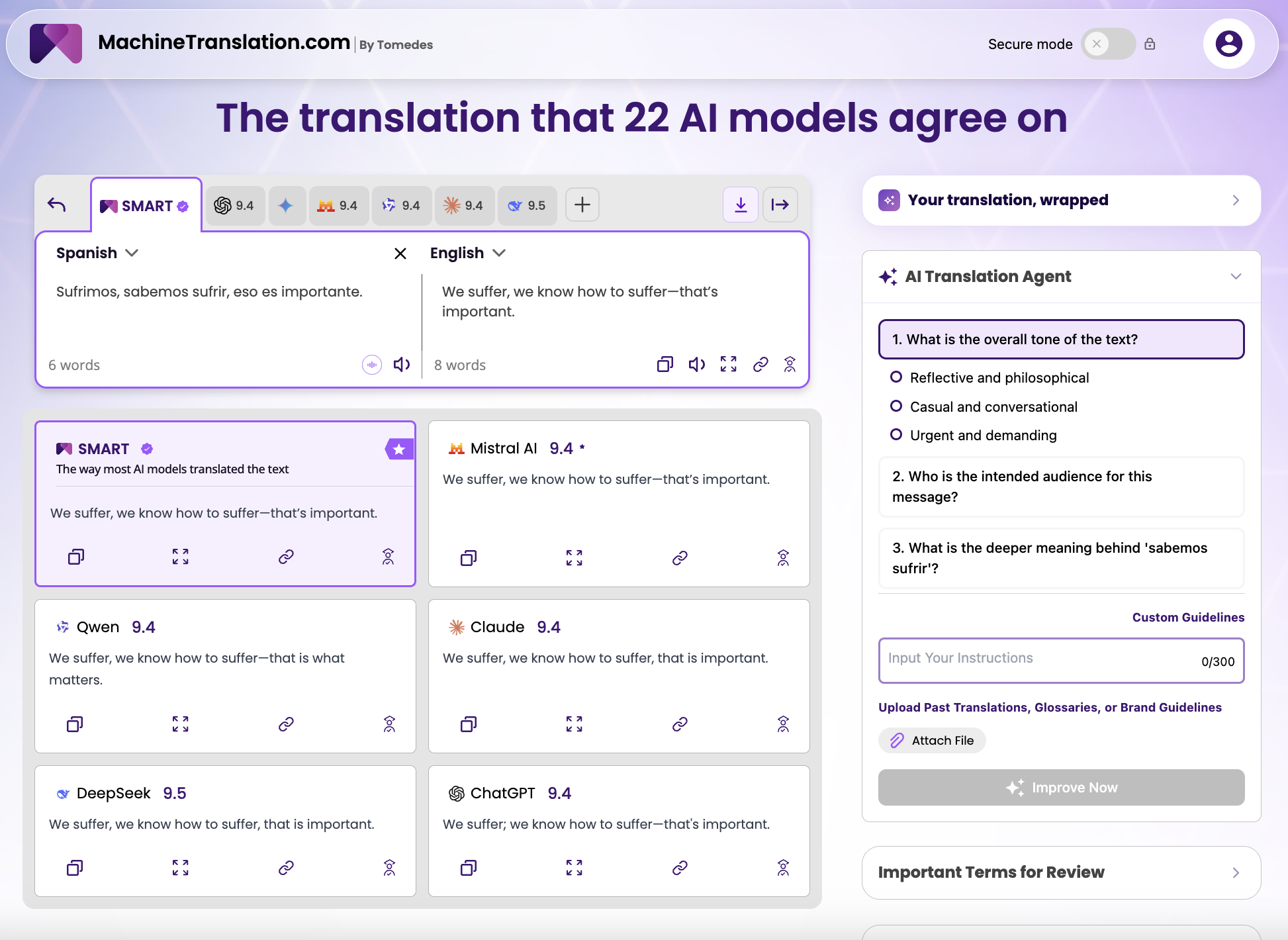
At first glance this is a perfectly accurate translation. Every word is accounted for. The em-dash rhythm even preserves some of the punchy cadence of the original. But read it again in English and something feels flat, "we suffer, we know how to suffer" is the translation of a football coach describing mental resilience after a hard-fought win. In Spanish football culture, "saber sufrir" (knowing how to suffer) is a term of honour. It describes a team that can absorb pressure, stay organised when under the cosh, and see the game out. In English, the closest register would be something like "we know how to grind" or "we know how to dig in."
Most models landed on near-identical outputs: Mistral, Claude, DeepSeek, and ChatGPT all returned variations of "we suffer, we know how to suffer—that's important." The one that broke from the pack was Qwen, which scored 9.4 and translated the phrase as: "We suffer, we know how to suffer—that is what matters."
"That is what matters" is a small shift from "that's important", but it's a more emotionally precise one. In the context of Scaloni's post-match press conference, the emphasis isn't just that this quality exists, but that it is the defining quality of a champion. Qwen's version lands closer to what Scaloni was communicating, even if neither translation fully captures what "saber sufrir" means to anyone who grew up watching South American football.
SMART: The consensus was clean. The nuance was not.
Quote 2 — Mbappé (French): "On essaie de ne pas trop regarder trop loin. Une Coupe du monde, c'est très imprévisible. Il faut juste jouer les matchs les uns après les autres et écrire notre histoire à chaque match."
Kylian Mbappé said this before France's group-stage match against Iraq, in a press conference conducted in his native French in Philadelphia. The original French transcript was published by Franceinfo.
SMART output: "We try not to look too far ahead... to write our story with every match."
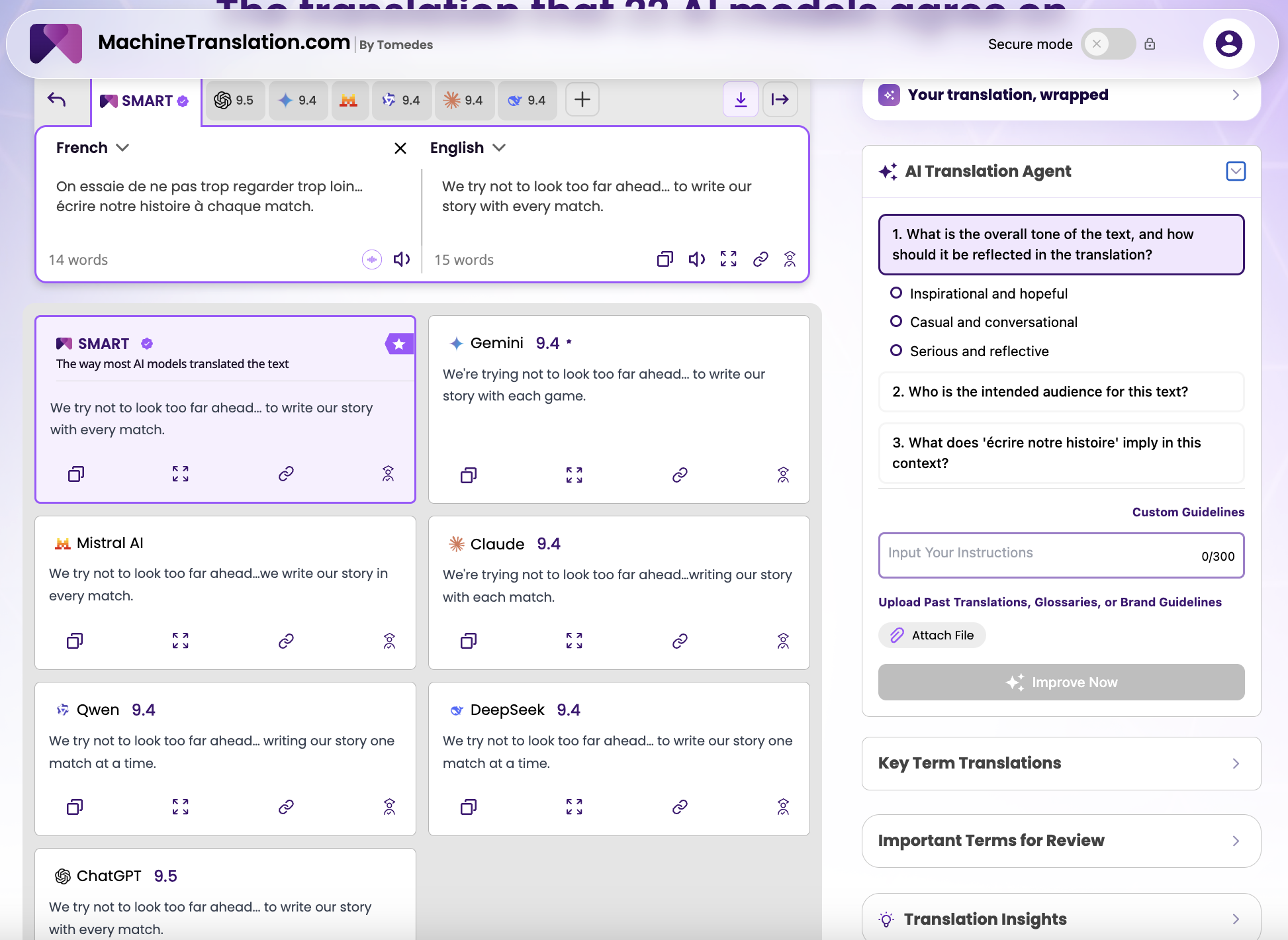
ChatGPT also scored 9.5 with an identical output. Mistral, Claude, Qwen, and DeepSeek all returned close variants in the 9.4 range, mostly differing in how they handled the final clause: Qwen gave "writing our story one match at a time," DeepSeek matched it, and Mistral produced "we write our story in every match."
The divergence that caught our attention was Gemini (9.4), which translated "à chaque match" as "with each game."
Match and game mean the same thing to most English speakers. In football (and specifically in the context of a World Cup press conference), they do not. "Match" is the standard register in football journalism globally. "Game" reads as American English, or more casual. Mbappé did not say this in a casual register; he said it at a formal FIFA press conference in front of an international press corps. Gemini's translation is not wrong. It is slightly off in a way that a human translator would have caught in thirty seconds.
SMART: High consensus, one register slip that only surfaces under scrutiny.
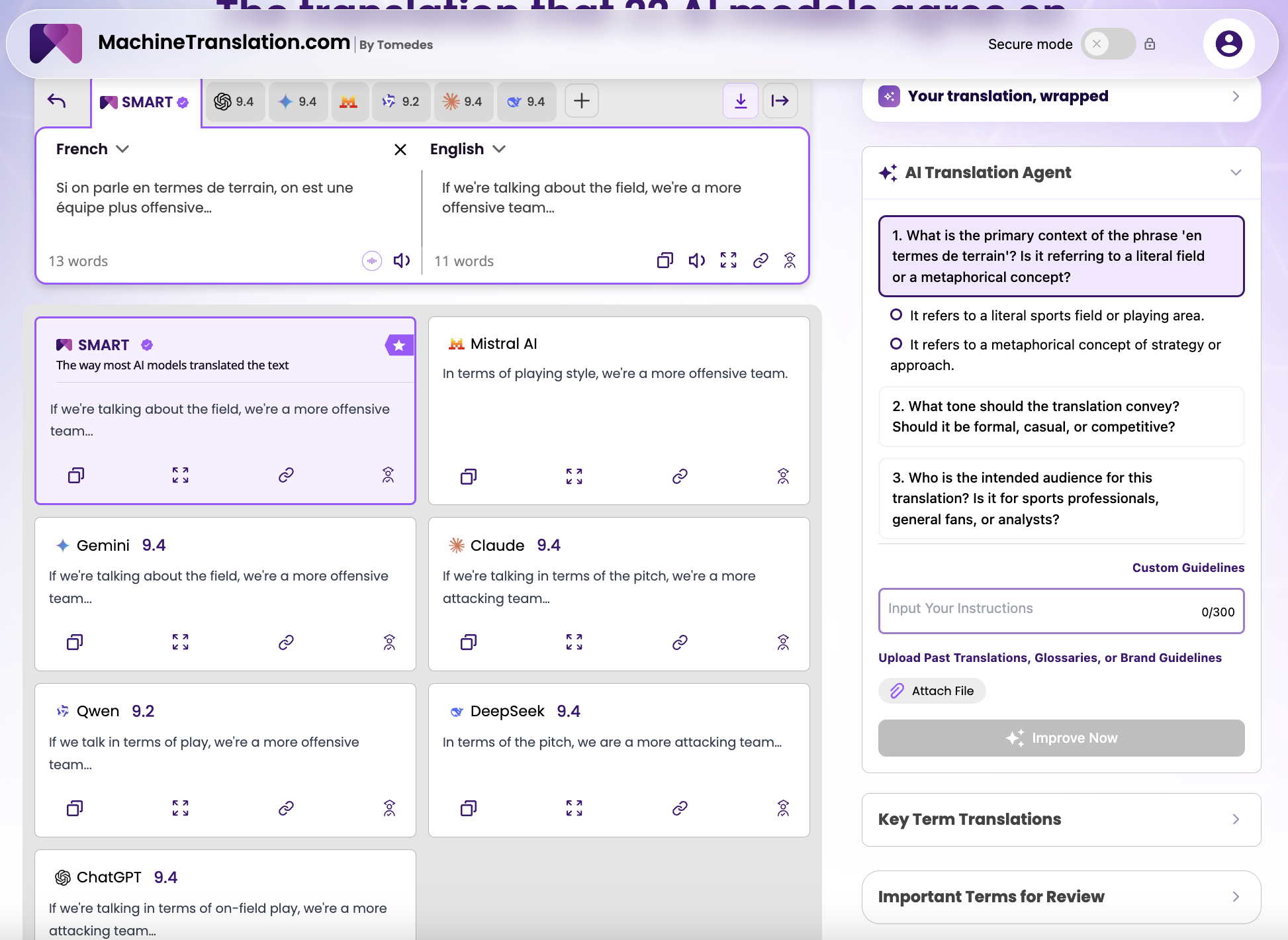
Quote 3 — Mbappé (French): "Si on parle en termes de terrain, on est une équipe plus offensive qu'en 2018 et en 2022. On est plus portés vers l'avant."
Also from Mbappé's pre-Iraq press conference, also sourced from Franceinfo. Mbappé is describing France's style of play in tactical terms.
SMART output: "If we're talking about the field, we're a more offensive team..."
This is where the model panel split along a fault line that reveals something genuinely interesting about AI translation, and about the 2026 World Cup specifically.
Claude produced: "If we're talking in terms of the pitch, we're a more attacking team."
DeepSeek produced: "In terms of the pitch, we are a more attacking team."
ChatGPT produced: "If we're talking in terms of on-field play, we're a more attacking team."
Meanwhile, SMART, Gemini, Mistral, and Qwen all converged on "field" and "offensive."
The disagreement is "pitch" vs "field" and "attacking" vs "offensive", and both divergences map to the same underlying split: British English football vocabulary vs American English. "Pitch" is the standard term in global football journalism (and is what Mbappé, as a French player embedded in European football, would understand as the translation of "terrain" in this context). "Attacking" is the standard adjective for forward-oriented play in British football media. The SMART consensus landed on the American English version — possibly because the World Cup is hosted in the United States, possibly because the majority of models were weighted toward American training data.
Qwen scored a notably lower 9.2 here, returning "If we talk in terms of play, we're a more offensive team" — a phrasing that loses both the conditional framing and the spatial specificity of "en termes de terrain."
The correct answer arguably belongs to Claude and DeepSeek. SMART chose the American version. Neither is wrong. Only one would run in The Guardian.
SMART: Most interesting divergence in the set.
Quote 4 — Vinicius Jr. (Portuguese): "Estou com o Brasil, vou falar português."
Vinicius Jr. said this after a journalist at a press conference asked him to answer in Spanish — a request he declined, as reported by FIFA.com's Portuguese edition. The statement is seven words. It produced the lowest scores of any quote we tested.
SMART output: "I'm with Brazil, I'll speak Portuguese."
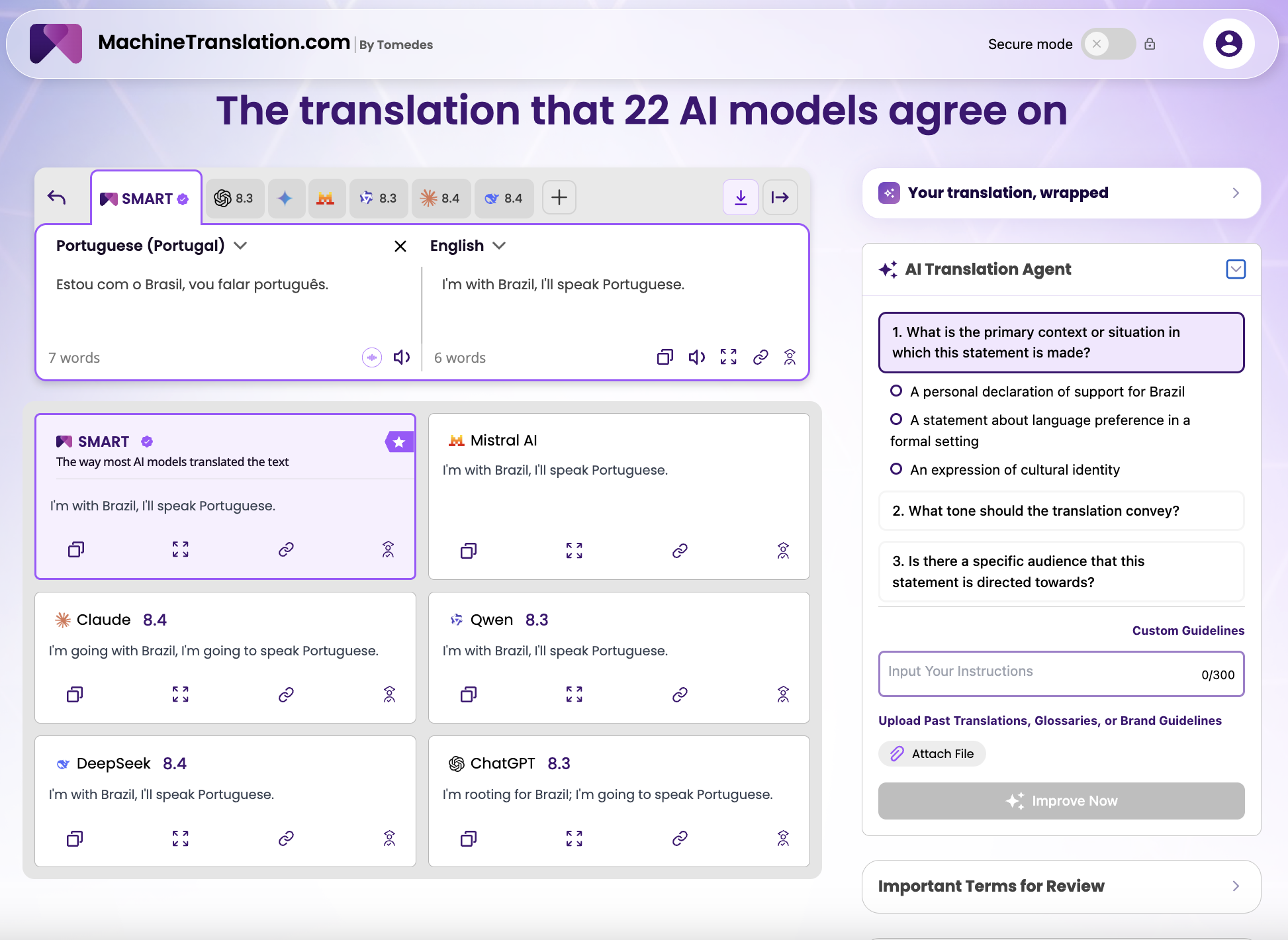
Mistral: "I'm with Brazil, I'll speak Portuguese." (8.3)
Qwen: "I'm with Brazil, I'll speak Portuguese." (8.3)
DeepSeek: "I'm with Brazil, I'll speak Portuguese." (8.4)
Claude: "I'm going with Brazil, I'm going to speak Portuguese." (8.4)
ChatGPT: "I'm rooting for Brazil; I'm going to speak Portuguese." (8.3)
Four of the six visible models agreed on the literal translation. Two departed in ways that reveal the structural limit of what AI translation does by default. Claude's "going with Brazil" is grammatically possible but registers as a betting tip. ChatGPT's "rooting for Brazil" reframes the entire statement, turning a declaration of identity into an expression of fan support.
Vinicius was not saying he supports Brazil the way a supporter in the stands supports a team. He was saying he is Brazil. "Estou com o Brasil" in this context is closer to "I stand with Brazil" or "I represent Brazil" — it is an assertion of belonging and pride, made in the moment of being asked to de-prioritise his native language. ChatGPT and Claude both missed this. The platform's AI Translation Agent flagged the ambiguity directly, asking: "What is the primary context or situation in which this statement is made?" and offering "An expression of cultural identity" as one of the options.
That question is exactly what a good human translator would ask before rendering this sentence. The AI systems that went straight to output without contextual anchoring produced translations that are technically defensible and culturally off.
SMART: The simplest quote. The most revealing result.
Quote 5 — Wirtz (German): "Ich bin jemand, der gerne sehr groß denkt. Der WM-Titel ist und bleibt das Ziel."
Germany midfielder Florian Wirtz made this statement in a profile piece on FIFA.com's German edition, published during the tournament.
SMART output: "I am someone who likes to think big. The World Cup title is and will remain the goal."
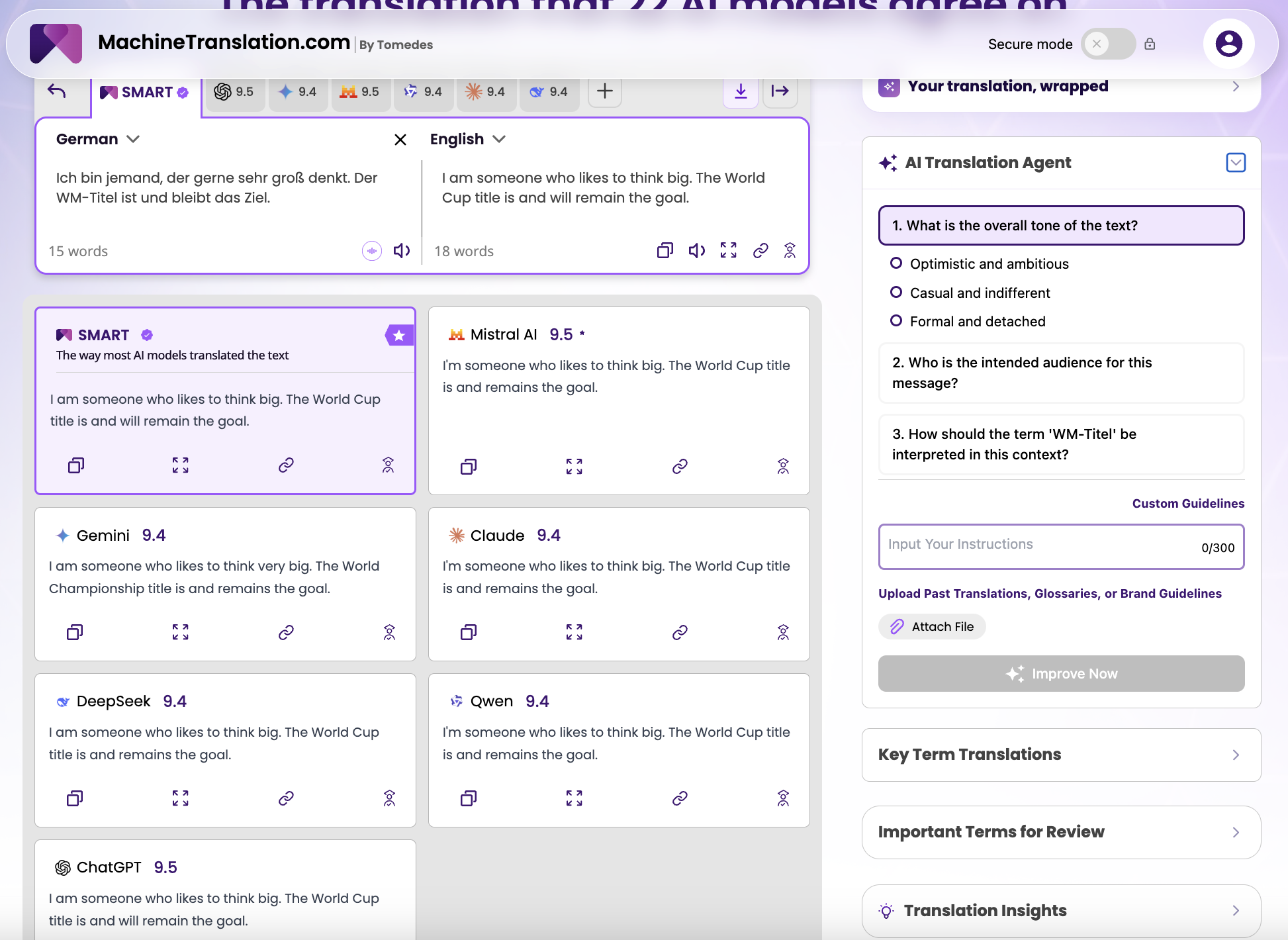
Near-total consensus — ChatGPT (9.5), Mistral (9.5), DeepSeek (9.4), Qwen (9.4), Claude (9.4) all landed on extremely close variants. The one notable exception was Gemini (9.4), which produced: "I am someone who likes to think very big. The World Championship title is and remains the goal."
Two changes. "Very big" instead of "big" — because Wirtz said "sehr groß," and "sehr" technically means "very." Every other model absorbed "sehr groß denkt" as an idiomatic compound meaning to think ambitiously, not to think in an especially large way. Gemini translated it more literally.
The second change is more consequential: Gemini rendered "WM-Titel" as "World Championship title" rather than "World Cup title." Technically, Weltmeisterschaft does mean World Championship. But in English, the tournament is called the World Cup (not the World Championship) and no anglophone sports journalist would write "World Championship" in this context. Gemini's translation is etymologically correct and register-wrong.
It is also, in a small way, the clearest demonstration of what high scores actually measure: not linguistic correctness in the abstract, but convergence on the translation that a native English reader would recognise as natural in context.
SMART: The most agreed-upon quote. Two quiet errors from one model that only a football reader would notice.
What five quotes across four languages revealed
Across four languages and five press conference quotes, quality scores ranged from 8.3 to 9.5. Four of the five quotes scored 9.4 or above, a strong baseline for AI translation of professional-register speech. The one outlier was the shortest quote in the set.
That inversion matters. In AI translation, complexity and length tend to predict difficulty. Longer sentences with more subordinate clauses give models more structural information to work with. Idioms and technical vocabulary create divergence because models are drawing on different training data and different probability distributions for domain-specific terminology.
The Vinicius quote (seven words, no idiom, no technical vocabulary, standard present tense) scored the lowest of all five because it was culturally loaded in a way that the models could not resolve without context. The AI Translation Agent on MachineTranslation.com identified this instinctively, surfacing the question "Is this an expression of cultural identity?" before the translation was completed. That question is the right question. Most of the models answered it incorrectly.
The Mbappé tactical quote, meanwhile, revealed a different kind of uncertainty: not a failure of cultural reading, but a genuine ambiguity between two correct translation traditions. "Pitch" vs "field," "attacking" vs "offensive" — both are right. Which is right depends on who your reader is, what publication you are writing for, and where in the world the tournament is being played. AI systems cannot make that editorial judgment. SMART surfaced the split and let the human decide.
That is, in the end, what a 22-model consensus does better than any single model: it does not eliminate uncertainty, but it makes uncertainty visible. A single model gives you one output and a confidence you have no basis to evaluate. A consensus engine shows you where the models aligned and where they pulled apart, and where they pulled apart the hardest is almost always where the translation is most worth examining.
Press conferences at a 48-team World Cup will keep generating this kind of material for another three weeks. The questions AI asks before translating may matter more than the translations it produces.
Frequently asked questions
1. Can AI translate football press conferences accurately?
For most standard professional speech (tactical analysis, post-match reactions, pre-tournament ambitions), AI translation performs well, producing quality scores of 9.4 to 9.5 on the quotes we tested. The gap between models tends to appear on culturally loaded language, football-specific vocabulary, and statements that require contextual inference to interpret correctly.
2. Why did the Vinicius Jr. quote score lower than the others?
"Estou com o Brasil, vou falar português" scored 8.3 (the lowest of the five quotes tested) because the phrase "Estou com o Brasil" is culturally ambiguous. It can mean "I am with Brazil" (identity), "I support Brazil" (fandom), or "I stand with Brazil" (solidarity). Without context, the models disagree on which reading is correct. ChatGPT rendered it as "rooting for Brazil," which reframes the identity statement as fan support — a meaningful difference from what Vinicius was communicating.
3. Does the World Cup host country affect AI translation choices?
Possibly. In the Mbappé tactical quote, the SMART consensus chose "field" (American English) over "pitch" (British English), and "offensive" over "attacking" — the American football vocabulary equivalents. This may reflect the distribution of training data across models, or it may reflect that the majority of models weighted their output toward the host country's English dialect. The 2026 World Cup is hosted in the United States, Canada, and Mexico.
4. How is MachineTranslation.com different from using a single AI translator?
A single AI model gives you one output with no indication of whether another model would translate it differently. MachineTranslation.com runs up to 22 models simultaneously and surfaces the translation that most of the AI models agree on, but also shows every model's individual output and score. For the five quotes we tested, this meant the divergences between models were visible: where they agreed, confidence was high. Where they disagreed, as with Vinicius Jr.'s seven-word statement, the disagreement itself was the signal worth reading.

By Ofer Tirosh
Connect on LinkedInOfer Tirosh is the founder and CEO of Tomedes, a language technology and translation company that supports business growth through a range of innovative localization strategies. He has been helping companies reach their global goals since 2007.
Share:


