March 26, 2026
Best AI translator for English to German in 2026
German is the most widely spoken native language in the European Union, and it is the language where AI translation engines disagree with each other more than almost any other major European language. The compound nouns are longer. The legal terminology is stricter. The formality rules carry commercial consequences.
We ran three real-world text types through MachineTranslation.com's English-to-German translator, which compares up to 22 AI models simultaneously and uses SMART – a consensus-based system that identifies what the majority of models agree on and flags where they diverge.
Here is what we found, what it means for your German translation workflow, and why picking "the best engine" is the wrong question to ask in 2026.
Why English-to-German translation is harder than most language pairs
English-to-German is not a simple swap. Three structural features make it one of the most demanding pairs for AI translators.
Compound nouns that break single-engine translators
German builds meaning by stacking nouns together. A phrase like "federal data protection officer" becomes a Bundesbeauftragte für den Datenschutz – or Bundesdatenschutzbeauftragter, depending on context. "Telecommunications surveillance regulation" becomes Telekommunikationsüberwachungsverordnung, a single 46-character word.
When we tested this on MachineTranslation.com, only 63% of engines agreed on the correct rendering of "data protection officer." Claude chose Arbeitnehmerdatenverarbeitung for "employee data processing" while the majority of engines used Mitarbeiterdaten – a shorter, more standard term in German corporate usage. SMART flagged the disagreement and selected the majority-backed phrasing.
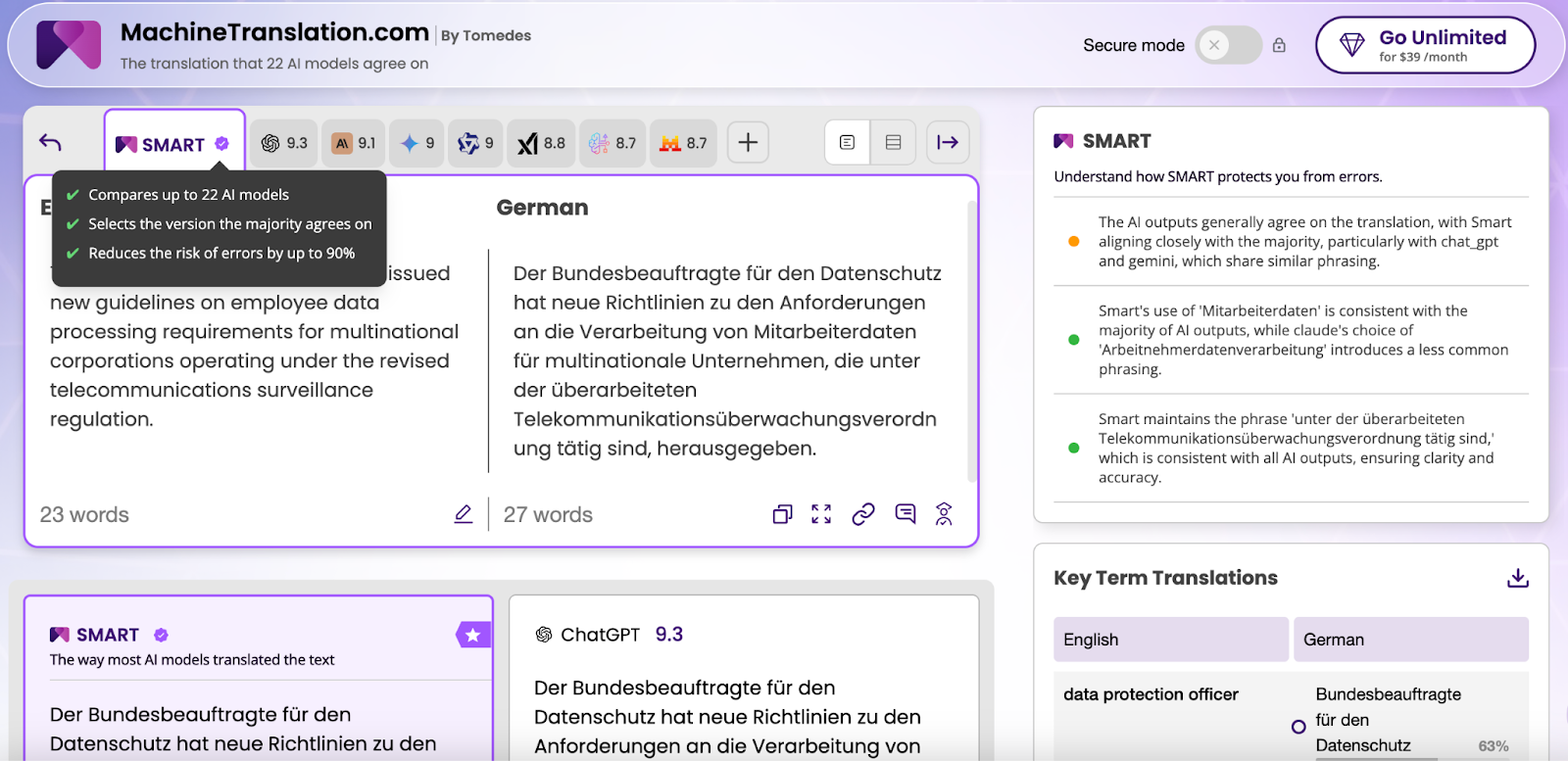
This kind of divergence is invisible if you use a single model. You get one answer and assume it is correct. The compound noun might be technically valid but stylistically unusual, the kind of phrasing that makes a German reader pause and question whether they are reading a translation.
The formality question: Sie vs. du across AI models
German distinguishes between formal (Sie) and informal (du) addresses. In B2B contexts, using du where Sie is expected signals unprofessionalism. In consumer marketing aimed at younger audiences, Sie can feel distant and corporate. No single model consistently gets this right because the correct choice depends on audience context, not grammar rules.
Internal testing on MachineTranslation.com shows that when source text uses "you" in a formal business context, approximately 14% of engines default to phrasing patterns that lean informal – substituting Redlichkeit for Fairness or restructuring sentences in ways that lower the register. SMART catches these register mismatches by comparing across all engines and selecting the formality level that the majority agrees on.
How we tested: 22 AI models on three German text types
We ran three different text types through MachineTranslation.com's English-to-German translator to stress-test accuracy across legal, technical, and marketing content. Each text was processed by up to 22 AI models simultaneously.
Legal text: GDPR compliance clause
We translated a 50-word GDPR clause covering data controller obligations, lawfulness principles, and cross-border data transfer safeguards.
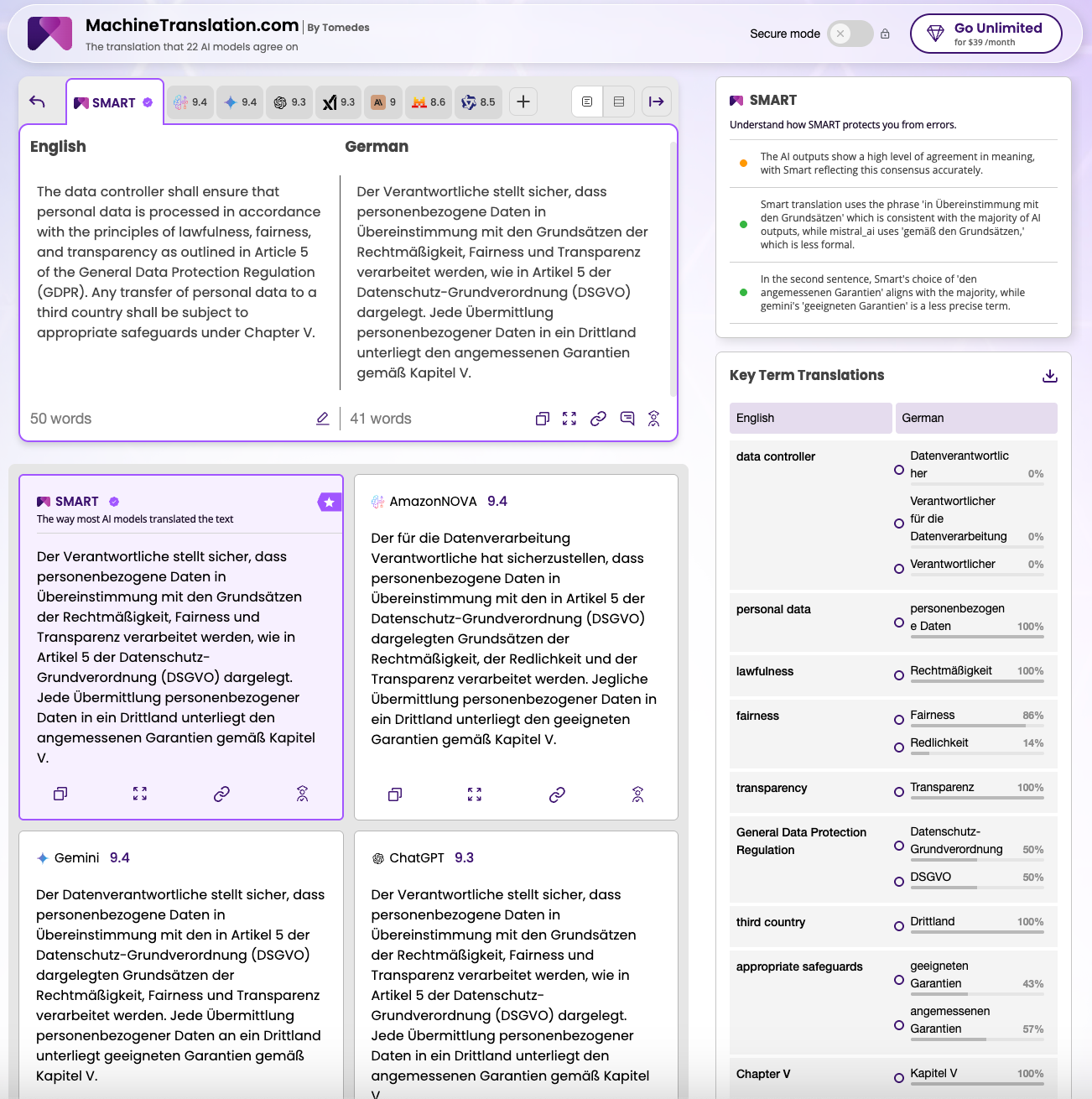
The results revealed a critical split. For "appropriate safeguards," 57% of the models chose angemessenen Garantien while 43% used geeigneten Garantien. Both are defensible translations, but in German legal drafting, angemessen (appropriate, proportionate) carries a different regulatory weight than geeignet (suitable, fit for purpose). SMART selected angemessenen Garantien, the majority-backed term that aligns with standard GDPR terminology in German legal practice.
Mistral AI scored lowest at 8.6, partly because it used the phrase gemäß den Grundsätzen in a less formal construction that the SMART analysis flagged as inconsistent with the majority.
Technical text: compound noun stress test
We translated a 23-word sentence about a federal data protection officer issuing employee data processing guidelines under telecommunications surveillance regulation.
The results showed that ChatGPT (9.3) and AmazonNOVA (9.1) led the pack, while Mistral (8.7) and Qwen (8.7) scored lower. The critical divergence was on compound noun construction. SMART's choice of Mitarbeiterdaten aligned with the majority consensus, while Claude's Arbeitnehmerdatenverarbeitung introduced a less common compound that, while grammatically correct, would read as unusual in standard German corporate documentation.
Marketing copy: brand tone preservation
We translated a 38-word marketing paragraph about enterprise collaboration and business growth in the German-speaking market.
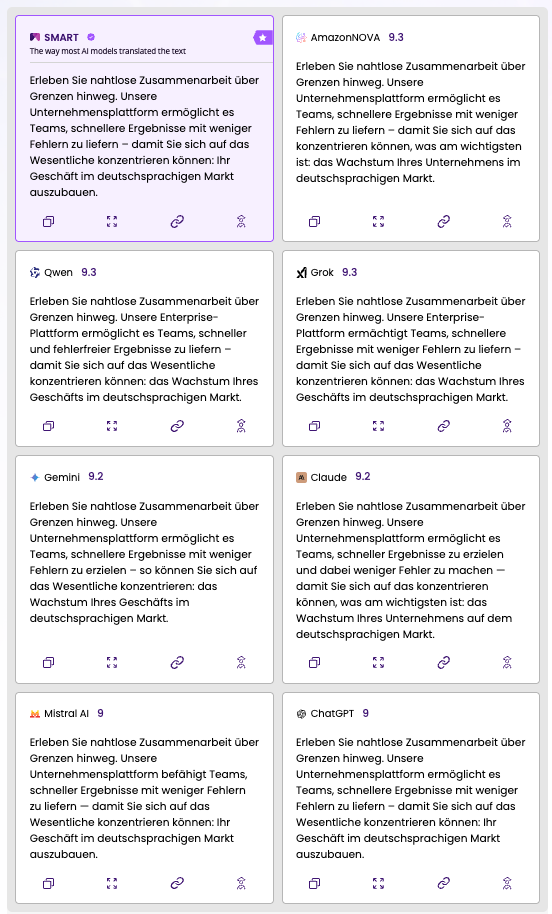
This test produced the highest agreement among engines. Scores ranged from 9.0 (Mistral AI, ChatGPT) to 9.3 (Qwen, Grok, AmazonNOVA), with SMART producing a clean consensus translation. The minor variations were in verb choice – befähigt (empowers) vs. ermöglicht (enables) vs. ermächtigt (authorises) – each carrying a slightly different brand tone. SMART selected ermöglicht es, the most neutral and widely agreed-upon option.
The results: which AI model scored highest for German
Top engines by SMART score
AI model | Legal (GDPR) | Technical (compounds) | Marketing (tone) | Average |
AmazonNOVA | 9.4 | 9.1 | 9.3 | 9.27 |
Gemini | 9.4 | 9.0 | 9.2 | 9.20 |
ChatGPT | 9.3 | 9.3 | 9.0 | 9.20 |
Grok | 9.3 | 8.8 | 9.3 | 9.13 |
Claude | 9.0 | 9.0 | 9.2 | 9.07 |
Qwen | 8.5 | 9.0 | 9.3 | 8.93 |
Mistral AI | 8.6 | 8.7 | 9.0 | 8.77 |
No single model won every category. AmazonNOVA topped legal and marketing but fell behind ChatGPT on technical text. ChatGPT led on compound nouns but scored lowest on marketing tone. This is exactly why a single-model approach fails for German.
Where engines disagree most, and why it matters
The Key Term Translations panel on MachineTranslation.com showed disagreement on 4 out of 9 key terms in the legal test alone. The highest-stakes disagreements were:
"appropriate safeguar": 57% angemessenen Garantien vs. 43% geeigneten Garantien
"fairne": 86% Fairness vs. 14% Redlichkeit
"General Data Protection Regulati": 50% full German name vs. 50% DSGVO abbreviation
Each of these would produce a different legal interpretation in a German contract. If you rely on a single engine and it falls on the minority side, you are publishing a legally imprecise translation without knowing it.
Why no single AI model is "the best" for German
The data makes this clear: the best model for German legal text is not the best model for German marketing copy. AmazonNOVA and Gemini excel at formal regulatory language. ChatGPT handles compound noun construction more consistently. Qwen and Grok perform strongest on natural-sounding marketing prose.
What matters is not which engine you pick but whether the translation you publish reflects what the majority of engines agree on – because where they agree, the translation is almost certainly correct. Where they disagree, you have a decision point that needs human attention.
This is the core principle behind MachineTranslation.com's English-to-German translator: do not trust one AI model. Compare them all and use the consensus.
How MachineTranslation.com's consensus approach works
SMART’s mechanism explained
SMART compares the output of up to 22 AI models for any given text, identifies where they agree, and produces a consensus-based translation that reflects the majority output.
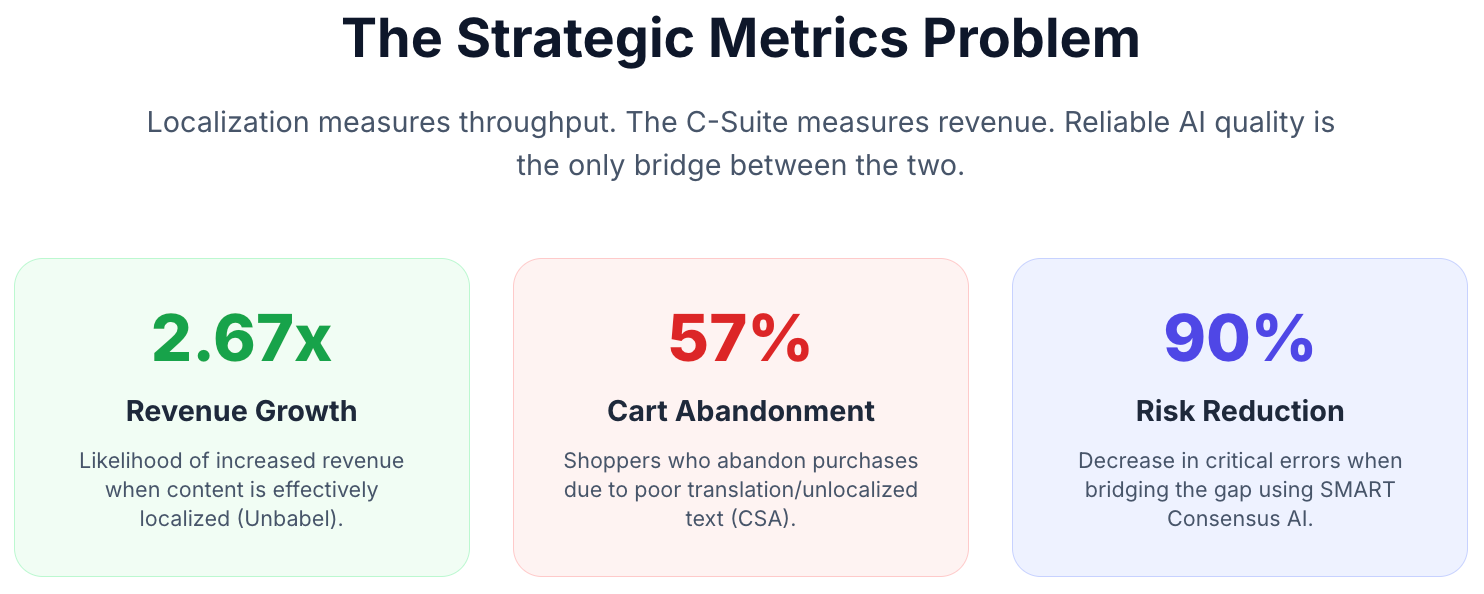
MachineTranslation.com's internal benchmarks show that the SMART consensus approach reduces translation errors by up to 90% compared to relying on any single model, because the errors that one model makes are typically caught by the other 21. (Source: Unbabel Global Multilingual CX Report; CSA Research (2020); MachineTranslation.com internal quality benchmarks.)
What the key term translations panel reveals
Below every translation, MachineTranslation.com displays a Key Term Translations table showing how each critical term was rendered by each engine, with consensus percentages. For the GDPR test, this panel showed that Rechtmäßigkeit (lawfulness) and Transparenz (transparency) had 100% agreement, while angemessenen Garantien (appropriate safeguards) had only 57% – a clear signal that this term needs human review.
This is not something any single-model translator provides. It is the difference between receiving one answer and seeing the full landscape of how 22 models interpret the same phrase.
When to use AI translation vs. human review for German
Not every English-to-German translation needs the same level of scrutiny. Here is a practical framework:
High SMART agreement: Safe to use the consensus output directly. This typically applies to straightforward informational content and marketing copy with standard vocabulary.
Mixed agreement: Review the Key Term Translations panel. Where engines disagree, apply human judgement to select the correct variant for your specific context – legal, technical, or regional.
Low agreement on critical terms: Flag for professional human review. This typically happens with highly specialised legal clauses, medical terminology, or patent-specific language where a single word choice changes the legal meaning.
MachineTranslation.com's English-to-German translator gives you the data to make this decision for every sentence, instead of guessing whether your single model got it right.
FAQs
1. What is the most accurate AI translator for English to German?
No single model is most accurate across all content types. In our testing, AmazonNOVA scored highest on legal text (9.4), ChatGPT led on technical compound nouns (9.3), and Qwen and Grok topped marketing copy (9.3). MachineTranslation.com's SMART consensus approach combines all models and selects the translation the majority agrees on, reducing errors by up to 90%.
2. Is DeepL better than Google Translate for German?
Both are strong for German, but they disagree on key terms more often than users realise. The better question is whether either model matches what the majority of 22 models agree on. MachineTranslation.com lets you compare both alongside 20 other models and see exactly where they converge.
3. Can AI handle German compound nouns accurately?
Most models handle common compounds well, but they diverge on specialised terms. In our test, only 63% of models agreed on the correct rendering of "data protection officer" in German. Consensus-based translation catches these disagreements before they reach your published content.
4. How does SMART scoring work on MachineTranslation.com?
SMART compares up to 22 AI model outputs for the same text, scores each engine on how closely it aligns with the majority consensus, and produces a translation that reflects what most models agree on. The Key Term Translations panel shows consensus percentages for every critical term, so you can see exactly where models agree and where they diverge.
5. Is AI translation good enough for German legal documents?
AI translation can produce a strong first draft of German legal text, but our testing found that 4 out of 9 key legal terms had split consensus among models. For high-stakes legal documents, use the SMART consensus as your starting point and have a qualified human reviewer verify terms where model agreement falls below 80%.