March 19, 2026
How good is Claude for translation? Features, limits, and benchmarks
In Lokalise's 2025 blind evaluation by professional translators, Claude 3.5 received the highest ratings of any LLM tested — 78% of translations rated "good," ahead of GPT-4, DeepL, and Google Translate. At WMT24, the industry's primary machine translation benchmark competition, Claude 3.5 ranked first in 9 out of 11 language pairs. Those results put Claude in a different category from most AI translation tools: not just capable, but the model professional translators preferred when they didn't know which tool produced each output.
Since those evaluations, Anthropic has released two full generations of new models — Claude 4 in May 2025, followed by Claude 4.5 and 4.6 through late 2025 and early 2026. This article covers what Claude brings to translation work, how to choose the right model for your use case, where the current models fall short, and what it means to use Claude as one engine inside a broader translation workflow.
In this article
- What is Claude?
- Which Claude model should you use for translation?
- What are Claude's translation strengths?
- What are Claude's translation limitations?
- How does Claude compare on translation benchmarks?
- How to use Claude for translation
- How does Claude pricing work?
- FAQs
What is Claude?
Claude is a family of large language models developed by Anthropic, an AI safety company founded in 2021. It is a separate product from OpenAI's models — developed, hosted, and maintained independently by Anthropic. Claude is available via claude.ai for consumer and professional users, via the Claude API for developers, and via cloud platforms including Amazon Bedrock and Google Vertex AI.
The current Claude model family is the Claude 4 generation, with the most recent releases being Claude Opus 4.6 (February 2026) and Claude Sonnet 4.6 (February 2026). Claude models are organized into three tiers based on capability and cost:
- Haiku — fastest and most cost-efficient, suitable for high-volume, lower-complexity tasks
- Sonnet — balanced capability and speed, recommended for most professional applications
- Opus — highest capability, designed for complex, long-horizon, and precision-critical tasks
All current Claude models support multilingual text input and output, image processing, and document handling across most world languages. Claude processes input in most languages using standard Unicode characters, with particularly strong capabilities in high-resource languages including English, French, German, Spanish, Portuguese, Japanese, Chinese, and Korean.
Which Claude model should you use for translation?
For most translation use cases, Claude Sonnet 4.6 is the recommended starting point. It delivers near-Opus-level performance on document comprehension, instruction following, and language tasks at a lower cost per token than Opus. Anthropic describes Sonnet 4.6 as its most capable Sonnet yet, with improvements across coding, long-context reasoning, and knowledge work.
Claude Opus 4.6 is the appropriate choice when translation requires sustained precision across long documents — legal contracts, research papers, technical specifications where terminology must remain consistent across thousands of words and the stakes of a mistranslation are high. Opus 4.6 supports a 1 million token context window (in beta), which makes it one of the few models capable of maintaining coherence across very large documents.
Claude Haiku 4.5 is suited for high-throughput workflows where speed and cost matter more than nuanced accuracy — customer support translation, real-time chat, bulk content processing where quality is reviewed downstream.
| Model | Best for | Context window | API pricing (input/output per M tokens) |
|---|---|---|---|
| Claude Sonnet 4.6 | Most professional translation tasks | 200K (1M beta) | $3 / $15 |
| Claude Opus 4.6 | Long documents, high-stakes precision content | 200K (1M beta) | $5 / $25 |
| Claude Haiku 4.5 | High-volume, speed-sensitive workflows | 200K | Lower than Sonnet |
What are Claude's translation strengths?
Contextual understanding and idiomatic accuracy. Claude's multilingual embedding alignment means it processes source text semantically rather than word-by-word. For idiomatic expressions, Claude identifies the underlying meaning and finds an equivalent in the target language — rather than producing a literal translation that reads as foreign. This is what drove its strong performance in the Lokalise blind study and WMT24 rankings.
Long-document coherence. One of Claude's most practical translation advantages is its large context window. Opus 4.6's 1M token context window (Sonnet's 200K is also far larger than most dedicated translation APIs) means Claude can process legal contracts, research papers, or multi-chapter documents in a single pass, maintaining terminology consistency and tonal coherence across the full document — a capability that chunked translation workflows cannot match.
High-resource language quality. Claude scores consistently above 80% relative to English performance across major European, East Asian, and other high-resource languages on standardized multilingual benchmarks. For the languages most commonly needed in professional translation (English, Spanish, French, German, Portuguese, Japanese, Chinese, Korean), Claude produces output that professional translators rated favorably in blind testing.
Instruction-following for translation format. Claude responds accurately to explicit translation instructions — target register (formal vs. informal), domain terminology, output format, length constraints. For localization workflows that require consistent formatting or specific terminology, Claude handles these constraints reliably.
For a comparison of how Claude performs against other translation engines on specific language pairs, see best machine translation engines per language pair.
What are Claude's translation limitations?
Lower-resource languages. Claude's performance drops meaningfully for languages with limited digital training data. Southeast Asian languages, African languages, and less-resourced dialects show reduced quality — translation accuracy can fall to 72–78% for languages like those in the Southeast Asian tier, compared to 88–92% for Romance languages. For these language pairs, human review is strongly recommended.
No persistent learning across sessions. Claude does not learn from your corrections over time in standard deployments. Each new session starts without memory of previous translations, terminology preferences, or style feedback unless you are using Claude's Projects feature (which maintains context within a defined project) or explicitly pass prior context in the prompt. Dedicated translation memory systems handle this better for high-volume workflows.
Cultural and domain nuance in sensitive content. For marketing copy, creative content, and materials with cultural specificity, Claude's output can be technically accurate but culturally flat — missing the register, tone, or cultural reference that makes content feel native. Human review from a local expert remains appropriate for consumer-facing campaigns.
No built-in terminology management. Claude does not have a native glossary or translation memory feature. For workflows requiring strict consistency in technical terminology (clinical documentation, regulatory filings, legal contracts), you need to provide terminology guidance explicitly in the prompt, or use a platform that handles glossary management upstream.
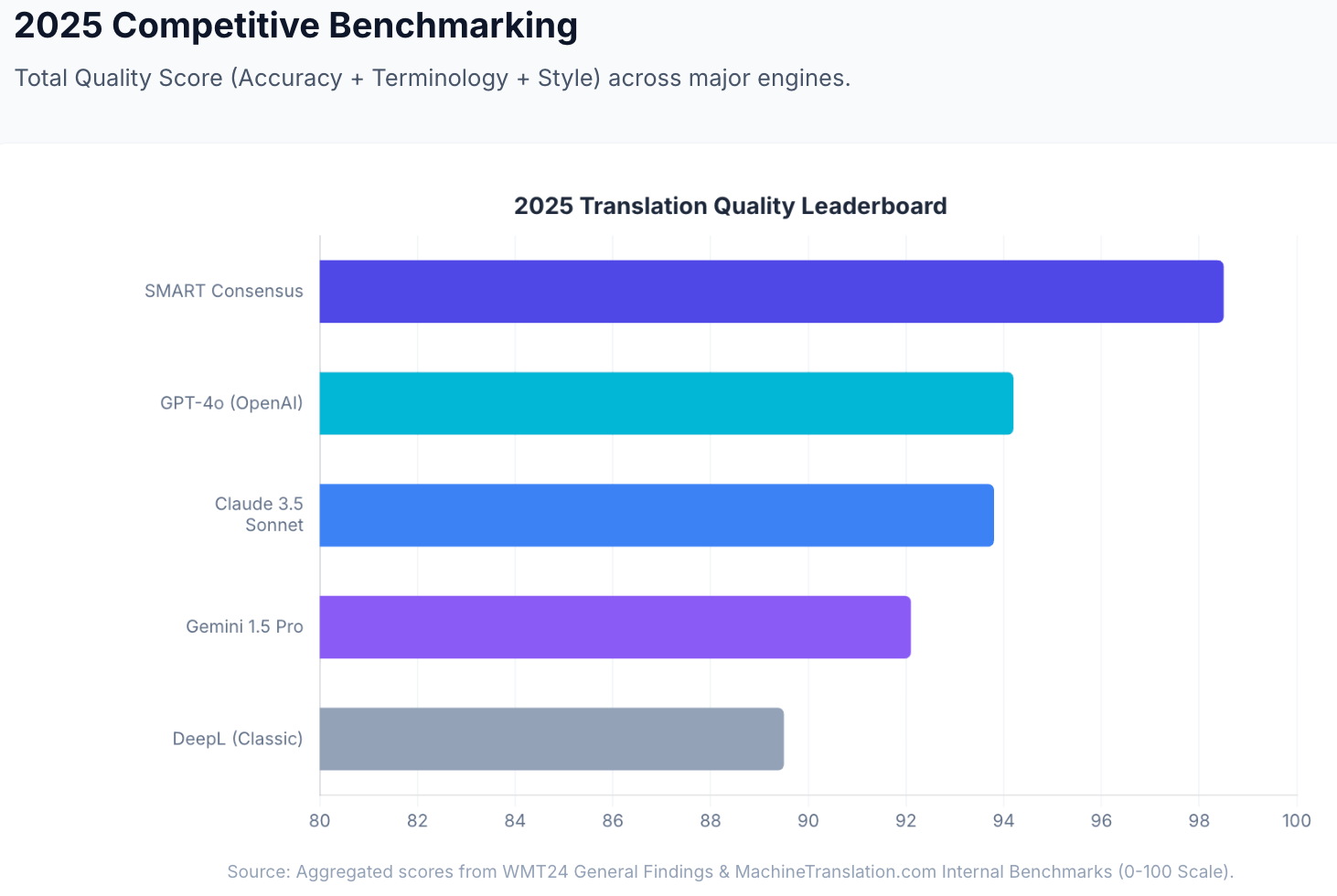
Single-model limitation. Like all individual AI models, Claude produces one output with no cross-check. A confident-sounding translation from Claude can still be wrong — particularly for specialized terminology, legal language, or culturally sensitive content. MachineTranslation.com's internal benchmarks show Claude (equivalent to the Claude 3.5 tier) scoring 93.8 out of 100 on translation quality — among the highest of any single model. MachineTranslation.com, which aggregates Claude alongside 21 other models including GPT-4o, DeepL, and Google and selects the consensus output, reaches 98.5. The difference is not speed or scale, it is confidence. Source: MachineTranslation.com internal benchmarks and WMT24 General Machine Translation Findings.
For workflows where translation errors carry professional liability, see translating legal documents with machine translation.
How does Claude compare on translation benchmarks?
Claude's translation benchmark performance is among the strongest of any general-purpose LLM, a distinction worth understanding precisely because Claude is not a dedicated translation engine.
At WMT24 (the industry's primary annual machine translation competition), Claude 3.5 ranked first in 9 of 11 language pairs evaluated, placing ahead of GPT-4 and outperforming dedicated neural MT systems in most pairs tested. This performance holds for high-resource pairs across European and East Asian languages. Source: WMT24 General Machine Translation Findings.
In Lokalise's 2025 blind study, professional translators rated 78% of Claude 3.5 translations as "good" — the highest rating among all LLMs evaluated, including GPT-4 and Gemini.
In MachineTranslation.com's internal benchmarks, Claude (equivalent to the 3.5 Sonnet tier) scores 93.8 out of 100 on translation quality. For context, GPT-4o scores 94.2. MachineTranslation.com (which aggregates 22 models including both Claude and GPT-4o) achieves 98.5, demonstrating that the ceiling on individual model performance is a real constraint even for the strongest single models. Users who switched to this tool spent on average 27% less time verifying and correcting outputs compared to those relying on a single engine. Source: MachineTranslation.com internal benchmarks and WMT24 General Machine Translation Findings.
Claude is one of the 22 AI models inside MachineTranslation.com's SMART consensus system. Every translation draws on Claude's contextual strength alongside 21 other models — meaning you get Claude's documented translation quality as a contributor to consensus, not as a single point of trust.
How to use Claude for translation
Using Claude for translation is straightforward, though getting consistent quality requires deliberate prompt design.
Access the platform. Claude is available at claude.ai for direct use, and via the API at platform.claude.com for developer integration. Claude is Anthropic's product, it is not hosted on any other AI platform.
Specify your requirements explicitly. Claude responds accurately to translation instructions when they are specific. State the target language, the register (formal, informal, technical), the domain (legal, medical, marketing), and any terminology constraints. The more context you provide, the more closely the output matches your requirements.
Use the context window for document coherence. For longer documents, upload the full text in a single session rather than translating in chunks. Claude's large context window allows it to maintain terminology consistency and tonal coherence across the full document, one of its key advantages over traditional MT engines.
Review outputs for specialized content. For legal, medical, or regulatory material, Claude's output should be reviewed by a professional with domain expertise before use. Claude handles specialized terminology well but cannot guarantee the precision that high-stakes content requires without verification. MachineTranslation.com's Human Verification (available in-platform, no external vendor), provides a 100% accuracy guarantee from a certified professional reviewer for exactly this use case.
For multilingual customer support or real-time use, Claude Haiku 4.5 or integration via the Claude API is the appropriate path, with MachineTranslation.com's platform offering direct access to Claude alongside 21 other models for every translation. See how this applies to multilingual customer support workflows.
How does Claude pricing work?
Claude is available in two ways: directly through Anthropic's consumer plans, or via the API.
Consumer plans (claude.ai):
- Free plan: Access to Claude Sonnet with rate limits
- Pro: $20/month — higher usage limits, access to Opus and extended thinking
- Max: Higher usage limits for power users
- Team and Enterprise: Per-seat plans with additional collaboration and admin features
API pricing (per million tokens):
- Claude Sonnet 4.6: $3 input / $15 output
- Claude Opus 4.6: $5 input / $25 output
- Claude Haiku 4.5: Lower rates
MachineTranslation.com provides access to Claude as one of 22 models — free, no sign-up required. Rather than building or paying for direct Claude API access, teams can translate through MachineTranslation.com's platform and receive Claude's output alongside 21 other models, with SMART consensus translation included. The 24-Hour Unlimited Translations is $9.50 for unlimited translations in a 24-hour window (or opt for a monthly plan).
FAQs
1. Is Claude good for translation?
Yes, Claude is among the strongest general-purpose LLMs for translation. At WMT24, Claude 3.5 ranked first in 9 of 11 language pairs evaluated. In Lokalise's 2025 blind study, professional translators rated 78% of Claude translations "good" — higher than GPT-4, DeepL, or Google Translate. Performance is strongest for high-resource language pairs; lower-resource languages show more variation.
2. Which Claude model is best for translation?
For most professional translation tasks, Claude Sonnet 4.6 is the recommended model. It offers near-Opus-level quality at lower cost. Claude Opus 4.6 is appropriate for long documents requiring sustained terminology precision — legal contracts, research papers, technical manuals. Claude Haiku 4.5 is suited for high-volume, speed-sensitive workflows.
3. Who makes Claude, is it related to OpenAI?
Claude is made by Anthropic, a separate AI safety company founded in 2021 by former OpenAI researchers. Claude is not a product of, hosted by, or affiliated with OpenAI. The two are distinct companies with separate models, platforms, and APIs.
4. Does Claude remember my translation preferences?
Not in standard use. Each Claude session starts without memory of previous interactions. If you need consistent terminology or style across multiple translation sessions, use Claude's Projects feature (available on paid plans) to maintain context, or explicitly include terminology and style guidelines in each prompt.
5. How does Claude perform on low-resource languages?
Performance drops meaningfully for languages with limited training data. Claude's accuracy on Southeast Asian languages runs approximately 72–78%, compared to 88–92% for Romance languages. For low-resource language pairs, human review is recommended. See machine translation for low-resource languages for more.
6. Is Claude available on MachineTranslation.com?
Yes. Claude is one of the 22 AI models aggregated by MachineTranslation.com. Every translation runs Claude alongside GPT-4o, DeepL, Google, and 18 other models, returning the consensus output (SMART). This means you get Claude's documented translation quality as part of a cross-model verification process — free, no sign-up required at MachineTranslation.com.
7. What are Claude's main limitations for translation?
The main limitations are: reduced quality for low-resource languages; no persistent terminology memory across sessions without explicit setup; cultural flatness in tone-sensitive creative content; and the fundamental single-model constraint — even a strong model like Claude produces errors it cannot detect in its own output. For high-stakes content, cross-model consensus or professional human verification is the appropriate safeguard.

By Clarriza Heruela
Clarriza Mae Heruela graduated from the University of the Philippines Mindanao with a Bachelor of Arts degree in English, majoring in Creative Writing. Her experience from growing up in a multilingually diverse household has influenced her career and writing style. She is still exploring her writing path and is always on the lookout for interesting topics that pique her interest.
Share:


