August 28, 2026
Claude vs. Qwen for translation: Where each model actually leads
In July 2025, Alibaba released Qwen3-MT — a machine translation model built specifically for translation, not a general-purpose LLM repurposed for it. Trained on trillions of multilingual and translation tokens with reinforcement learning, it supports 92 languages and achieves competitive BLEU scores against GPT-4.1 and Gemini 2.5 Pro on the WMT24 multilingual benchmark, while outperforming GPT-4.1-mini and Gemini 2.5 Flash on Chinese-English and English-German test sets. Source: Alibaba Qwen, qwenlm.github.io, July 2025.
Claude, developed by Anthropic, has no translation-specific variant. It is a general-purpose large language model that handles translation alongside reasoning, coding, analysis, and writing. Its translation quality is strong (demonstrated across European language pairs in independent evaluation) but it was not built from the ground up for translation as Qwen3-MT was.
This asymmetry defines the comparison in 2026. Qwen brings two distinct assets: the general Qwen LLM with deep Chinese-origin training, and a purpose-built translation model. Claude brings documented excellence on European language quality and tonal precision. Understanding where each leads means understanding the language families and content types where their structural advantages show.
What is Qwen, and what has changed since 2025?
Qwen is Alibaba Cloud's family of large language models, with a specific strength in Chinese and Asian language processing that reflects its training origin and commercial deployment context.
The Qwen family has expanded significantly since the original version of this article was published. As of May 2026:
Qwen 3.5 (March 2026) — the current general-purpose Qwen LLM, spanning parameter sizes from 0.5B to over 397B. Trained on 20+ trillion tokens with exceptional Chinese vocabulary and semantic depth, it leads on Chinese, Japanese, and Korean benchmarks and is deployed across 90,000+ enterprises. Developer analysis confirms: "No open-source model matches Qwen for Chinese, Japanese, and Korean text processing." Source: AI Magicx, March 2026.
Qwen3-MT (July 2025) — Alibaba's translation-specific model, built on the Qwen3 architecture with a lightweight Mixture-of-Experts backbone. Trained specifically for translation across 92 languages with reinforcement learning, it achieves competitive performance against GPT-4.1 and Gemini 2.5 Pro on WMT24 multilingual benchmarks — at significantly lower computational cost. This makes Qwen one of the few AI providers with a model built exclusively for translation. Source: Marktechpost, July 2025.
The Qwen used in MachineTranslation.com's SMART system is the general Qwen LLM, specifically the Qwen 2.5 72B Instruct Turbo and QwQ 32B variants per Intento's 2025 system documentation.
Claude is currently at Sonnet 4.6 and Opus 4.6 (February 2026). Claude has no translation-specific variant; all translation capability comes from its general-purpose training. Claude 4 continues the trajectory established by Claude 3.5 and 3.7 — strong on European language pairs, tonal precision, and contextual understanding for professional content.
Where does Qwen have a structural advantage for translation?
Qwen's advantage is structural and deeply rooted in its training origin: Chinese, Japanese, and Korean content is where Qwen's depth shows most clearly.
Chinese language processing. Qwen was trained from the ground up by Alibaba, with Chinese as a primary rather than secondary language. Most Western-origin LLMs (including Claude) are trained on predominantly English data with other languages added. Qwen's training corpus reflects the full depth of Chinese written language across registers, domains, and historical periods. For business-to-Chinese translation, Chinese-to-English translation, and Chinese-language content with culturally embedded phrasing, Qwen's training depth produces more natural, less translated-sounding output.
Intento's 2025 evaluation found that Simplified Chinese achieved exceptional performance with zero major or critical errors detected across the solutions evaluated, partly because top-performing models for Chinese include systems with deep Chinese training. Qwen3-MT specifically achieves leading BLEU scores on Chinese-English test sets, outperforming GPT-4.1-mini and Gemini 2.5 Flash for this pair. Source: Qwen official blog, July 2025.
Japanese and Korean. The broader CJK (Chinese, Japanese, Korean) group presents structurally different translation challenges from European languages — different writing systems, different word order, different honorific and register systems. Qwen's training includes deep coverage of Japanese and Korean alongside Chinese. For developer teams building multilingual products targeting Asian markets, Qwen's CJK performance means less post-editing on the most structurally challenging pairs.
Open-source accessibility and cost. Qwen's open-weight models can be deployed locally or on custom infrastructure. This gives data-sensitive organisations (those translating confidential documents, healthcare records, or proprietary business content) the option to run Qwen entirely within their own environment without data leaving their infrastructure. Claude is a closed-source API-only model; there is no self-hosted option.
Translation-specific training with Qwen3-MT. The existence of a purpose-built translation model gives Qwen an option that Claude does not offer: a model where every training decision was made specifically for translation quality rather than general-purpose capability. For teams building translation-first workflows, Qwen3-MT's reinforcement learning approach (optimising directly for translation fidelity rather than general language quality) can produce more consistent output on standard professional content.
Where does Claude have a structural advantage for translation?
Claude's advantage is in European language quality, tonal and register precision, and documented performance on professional and literary content.
European language pairs. Claude (Opus 4 and Sonnet 3.7) appears in the "best" category for English to German, English to Italian, English to Dutch, English to French, and English to Arabic in Intento's 2025 human LQA evaluation. These are independent, human-scored evaluations — not self-reported benchmarks. Qwen is not in the top-tier group for European language pairs in the same evaluation. For European professional content, Claude's track record is stronger across independent assessments.
Tonal precision and register. Claude's training places strong emphasis on natural language equivalence and tonal fidelity. The 200-sentence independent test conducted by AI Tool Clash (February 2026) found Claude scored 8.3/10 overall versus ChatGPT's 7.9, with significantly fewer literal idiom errors (8% vs 34%) and stronger preservation of literary tone and register. While this comparison is Claude vs. ChatGPT rather than Claude vs. Qwen directly, it reflects Claude's documented contextual understanding advantage for content where tone is not secondary.
Professional and formal content in Western contexts. For content where Western business register, legal formality, or European cultural context matters (contracts in German, marketing content for French audiences, corporate communications in Italian) Claude's Western-origin training gives it a depth of cultural context that Qwen does not prioritise.
Long-document coherence on tonal content. Claude Sonnet 4.6's 200K-token context window and Claude Opus 4.6's 1M-token beta window allow full-document processing without chunking. For narrative content, marketing campaigns, or long reports where a consistent voice must hold across the whole document, Claude's context handling maintains register and tonal consistency at a level suited to professional review.
How do they compare for specific content types?
| Content type | Stronger choice | Reason |
|---|---|---|
| Chinese-English / English-Chinese | Qwen | Native training depth; Qwen3-MT translation-specific model; Intento Chinese excellence finding |
| Japanese and Korean content | Qwen | CJK training depth; no Western-origin LLM matches Qwen for CJK processing |
| European languages (German, Italian, Dutch, French) | Claude | Intento 2025 top-tier for German, Italian, Dutch; independent evaluation standing |
| Literary and tone-sensitive translation | Claude | AI Tool Clash 8.3/10 overall; 9.2/10 on literary passage; strong register preservation |
| Ambiguous source text | Claude | Surfaces both interpretations rather than committing to one |
| Confidential / self-hosted workflows | Qwen | Open-weight deployment; no API dependency; data stays on-premise |
| Translation-first API workflows | Qwen3-MT | Purpose-built translation model; RL-optimised for fidelity; 92 languages |
| General professional European content | Either | Both cover high-resource European pairs at comparable quality levels |
The pattern across content types reflects the structural training difference: Qwen for Asian languages and translation-specific deployment, Claude for European language quality and tonal-precision-dependent content. For content that falls in neither extreme (general professional communication in high-resource languages), the difference between the two is less consequential than the difference between either model and a verified consensus output.
What to use when both are part of the same system
Both Qwen and Claude are among the 22 models in MachineTranslation.com's SMART system. SMART runs all 22 simultaneously (including both Qwen (Qwen 2.5 72B Instruct Turbo, QwQ 32B) and Claude (Sonnet 4.6 equivalent tier)) and returns the output the majority agree on, alongside a Translation Quality Score.
For Chinese-to-English or English-to-Chinese content specifically, the SMART system combines Qwen's CJK depth with Claude's tonal understanding, Google's broad Chinese corpus, and 19 other models. When Qwen's Chinese-trained output agrees with Claude's contextual interpretation of the same passage, that agreement is a strong quality signal. When they diverge (which is more likely on ambiguous passages or culturally embedded content than on clear standard text), MachineTranslation.com surfaces that uncertainty rather than delivering a confident wrong answer.
In MachineTranslation.com's internal benchmarks, individual top-tier models including Claude and Qwen reach 93–94 out of 100 on translation quality. The 22-model consensus reaches 98.5/100.
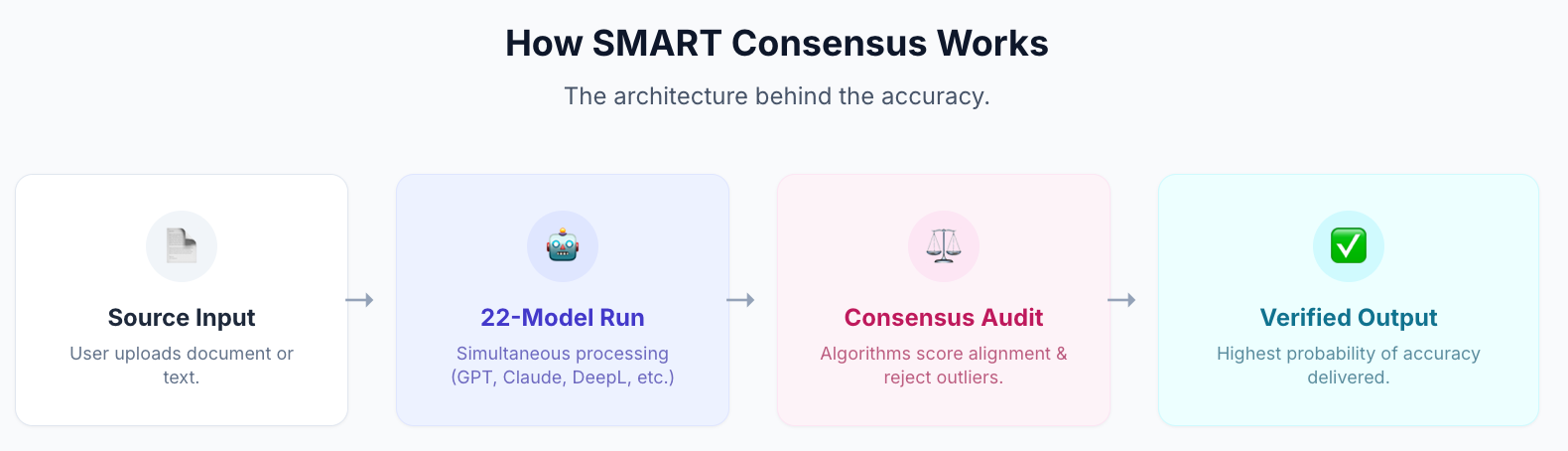
For high-stakes content (legal submissions, clinical documentation, regulated materials), Human Verification escalates the consensus to a certified professional reviewer within the same platform. 100% accuracy guaranteed.
Translate with Qwen, Claude, and 20 other models at MachineTranslation.com — free, no sign-up required.
Frequently asked questions
1. Is Qwen better than Claude for Chinese translation?
For Chinese-to-English and English-to-Chinese translation, Qwen has a structural advantage: it was trained from the ground up on Chinese language data by Alibaba, with Chinese as a primary training language rather than a secondary one. Alibaba also released Qwen3-MT in July 2025 — a translation-specific model that achieves leading BLEU scores on Chinese-English test sets, outperforming GPT-4.1-mini and Gemini 2.5 Flash. For Chinese translation specifically, Qwen is the stronger documented choice.
2. Is Claude better than Qwen for European languages?
Yes, based on independent evaluation. Claude Opus 4 and Sonnet 3.7 appear in Intento's 2025 top-tier for English to German, Italian, Dutch, and French in human LQA evaluation. Qwen does not appear in the top group for European language pairs in the same evaluation. For European professional content where register and tone matter, Claude's independent evaluation standing is stronger.
3. What is Qwen3-MT?
Qwen3-MT (qwen-mt-turbo) is a machine translation model released by Alibaba in July 2025, built on the Qwen3 architecture. Unlike general-purpose LLMs, it was designed and trained specifically for translation — using a lightweight Mixture-of-Experts backbone and reinforcement learning optimised for translation fidelity. It supports 92 languages, achieves competitive performance against GPT-4.1 and Gemini 2.5 Pro on WMT24 benchmarks, and includes advanced customisation options including terminology intervention and domain prompts.
4. Can Qwen be run locally for confidential translation?
Yes. Qwen's open-weight models can be deployed on local infrastructure without sending data to external APIs. This makes Qwen an option for organisations with strict data sovereignty requirements — healthcare providers, legal teams, and financial institutions translating confidential documents. Claude is a closed-source API-only model with no self-hosted option.
5. Which is better for Japanese and Korean translation?
Qwen. Developer analysis consistently identifies Qwen as the strongest open model for CJK (Chinese, Japanese, Korean) processing. Its training depth in Asian languages reflects Alibaba's commercial deployment context across 90,000+ enterprises in Asian markets. No Western-origin open-source model matches Qwen for CJK text processing in current benchmarks.
6. Are both Qwen and Claude available on MachineTranslation.com?
Yes. Both are among the 22 models in MachineTranslation.com's SMART system. Every SMART translation runs Qwen, Claude, and 20 other models simultaneously, returning the output the majority agree on. For Chinese-language content specifically, having both Qwen's CJK depth and Claude's contextual understanding in the same consensus is particularly valuable.
7. How have both models changed since the original comparison (Claude 3.7 vs Qwen 2.5)?
Claude has advanced to Sonnet 4.6 and Opus 4.6 (February 2026), with improvements in instruction following, reasoning, and multilingual capability. Qwen has advanced to Qwen 3.5 (March 2026) for the general model, and also released Qwen3-MT (July 2025) — a translation-specific model that didn't exist at the time of the original comparison. The structural advantage each model holds (Qwen for CJK, Claude for European) has remained consistent across generations.

By Clarriza Heruela
Clarriza Mae Heruela graduated from the University of the Philippines Mindanao with a Bachelor of Arts degree in English, majoring in Creative Writing. Her experience from growing up in a multilingually diverse household has influenced her career and writing style. She is still exploring her writing path and is always on the lookout for interesting topics that pique her interest.
Share:


