June 9, 2026
Common phrases are harder to translate than you think, 22 AIs prove it
There is a reasonable assumption most people make when they look up a phrase translation: that short, common phrases are easy. A single word like "sorry" or a three-word sentence like "I love you", surely these are solved. Surely any AI can handle them.
MachineTranslation.com ran ten of the world's most searched phrases through 22 AI models at the same time. The results are more interesting than that assumption allows.
Some phrases produced unanimous agreement across every model — same word, same spelling, no divergence. Others split the models down a register fault line, with half choosing a formal expression and half choosing a casual one. One phrase triggered a question that no translation tool usually asks: is there a specific cultural nuance in this language that should replace a direct translation entirely?
What follows is not a list of translations. It is an account of what happens when you treat a common phrase not as a lookup task but as a linguistic problem, and what 22 simultaneous AI models reveal about the difference between the two.
How MachineTranslation.com's 22-model verification works
Every phrase in MachineTranslation.com's verified translation series is processed by 22 AI models simultaneously. Each model produces its own output independently. The platform then identifies the consensus (the translation the majority of models agreed on) and surfaces that as the verified result. Where models diverge, the divergence is shown, not hidden.
Alongside the consensus output, MachineTranslation.com's AI Translation Agent analyses the phrase for contextual ambiguity. When a phrase could mean different things depending on who is speaking, who is listening, or what situation is implied, the Agent surfaces those questions directly — before the translation is finalised.
"Running 22 models on the same input isn't about redundancy," says Shashank, Tech Lead at Tomedes (the translation company that developed MachineTranslation.com). "It's about signal quality. When 20 models agree and 2 diverge, that's a reliable output. When the split is closer to half and half, that divergence is linguistically meaningful — it tells you the phrase carries genuine ambiguity that a single model would resolve invisibly."
This methodology underlies the verified translation series: ten common phrases, ten target languages, each run through 22 models, with the consensus result and any notable divergence documented for the reader.
When all the models agree, and why that's still not the whole story
Consensus across 22 models sounds like certainty. In some cases it is. In others, it is certainty about the words — and silence about everything else.
"I love you" in French — one unanimous output, three very different meanings
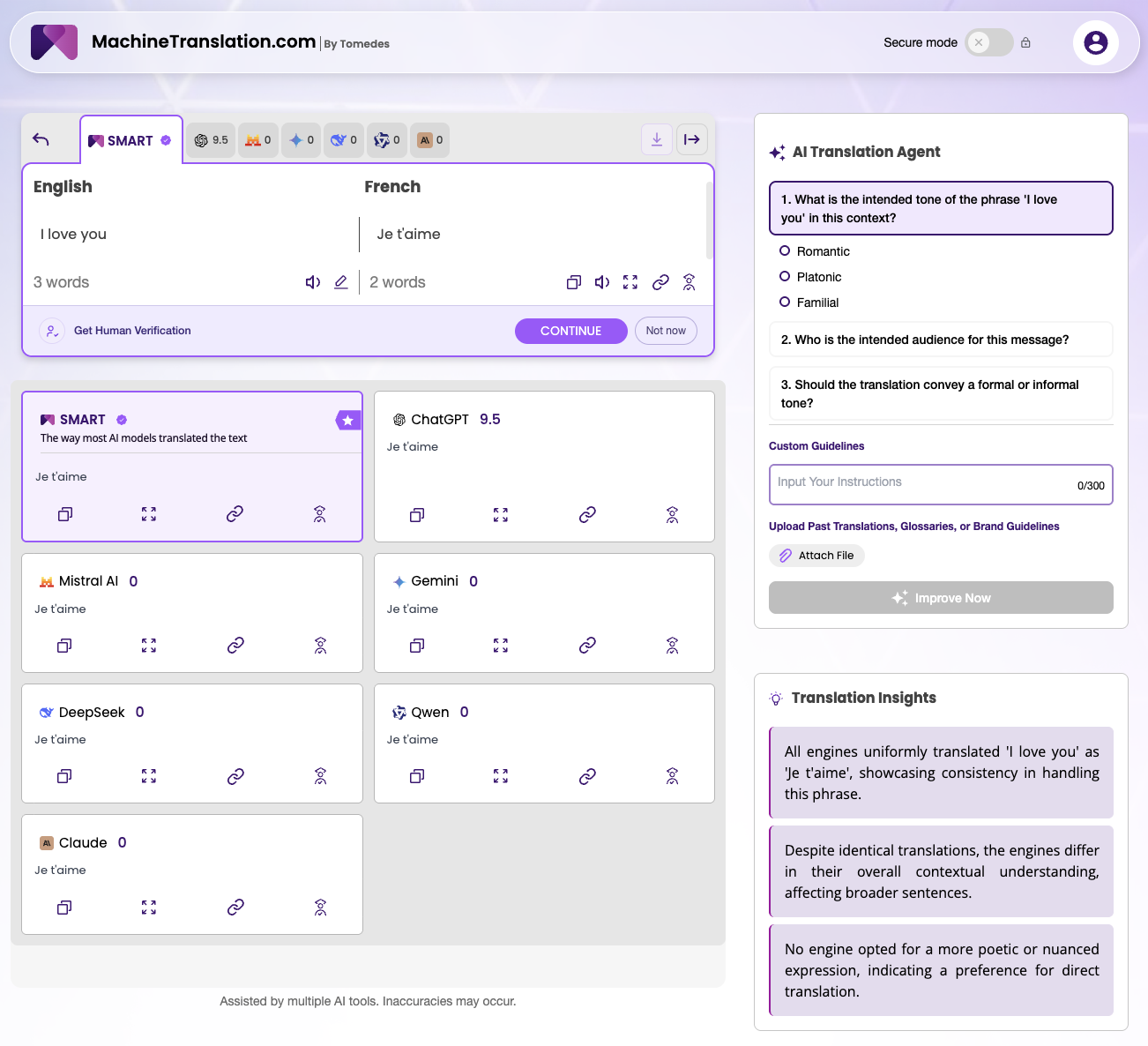
Every model agreed: Je t'aime.
ChatGPT, Claude, Gemini, DeepSeek, Qwen, Mistral — all produced the same two words. In one sense, this is the correct answer. Je t'aime is the standard French expression for "I love you" and the one a French speaker would recognise immediately.
But MachineTranslation.com's AI Translation Agent asked something the translation itself doesn't answer: what is the intended tone of this phrase in this context? Romantic. Platonic. Familial.
The question matters because Je t'aime carries all three meanings in French, and the weight of each is distinct. Saying Je t'aime to a romantic partner and saying Je t'aime to a parent are grammatically identical but culturally and emotionally different expressions. The platform's Translation Insights noted that no model opted for a more poetic or contextually specific rendering, reflecting a consistent preference for direct translation over nuanced equivalence.
For most uses, Je t'aime is exactly right. But the AI Translation Agent's question is a reminder that "correct" and "complete" are not the same thing, and that the context the phrase will live in determines whether the direct translation is also the best one. See the full verified translation of "I love you" in French for the complete breakdown.
"Good morning" in Japanese, a formality decision every model made silently
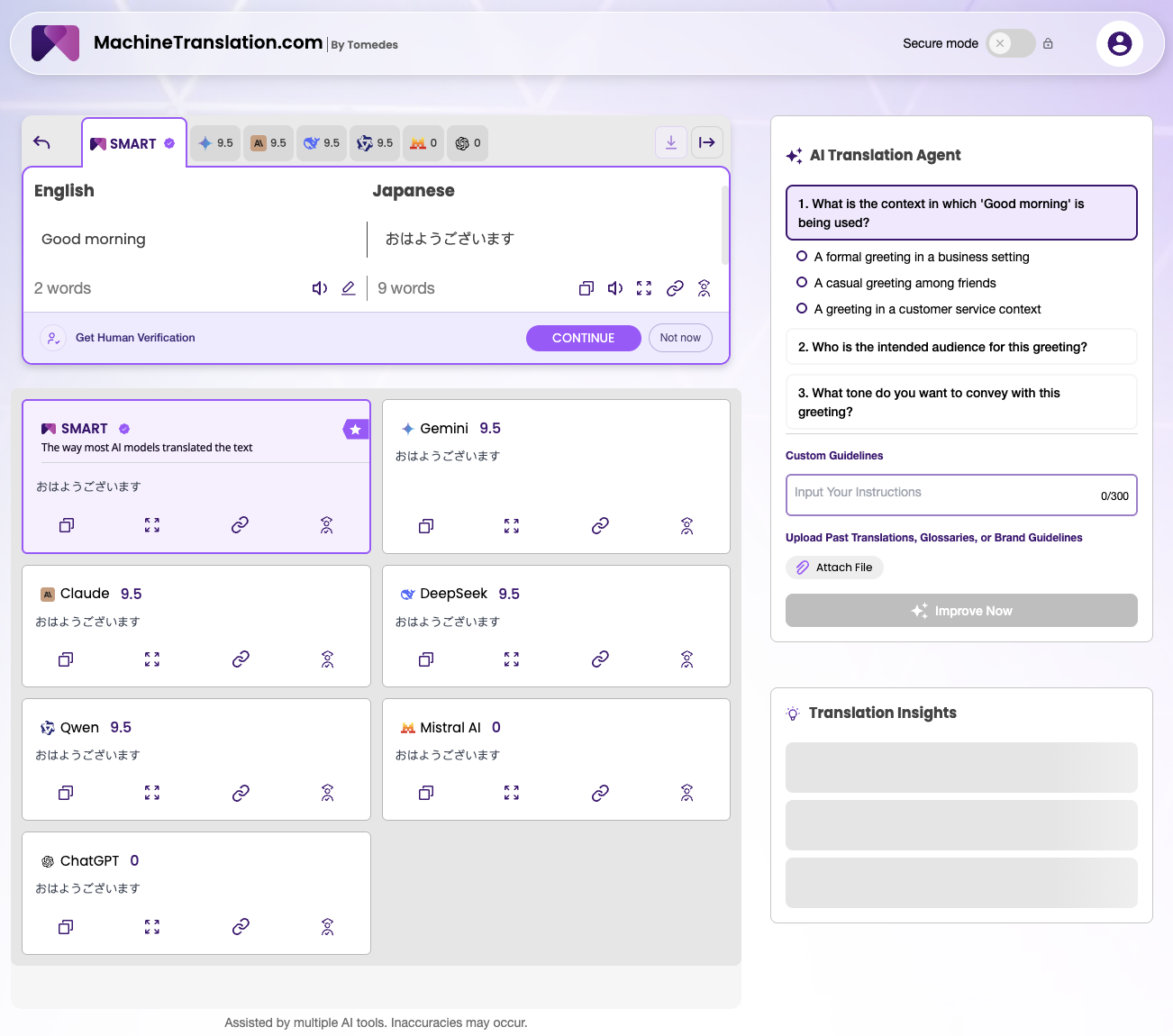
All seven visible models produced おはようございます — the formal, polished form of "good morning" in Japanese. Not a single model chose おはよう, the casual form used among friends, family, or peers of equal standing.
This is a decision with real social consequences in Japanese communication. Using the formal おはようございます with a close friend can feel overly stiff; using the casual おはよう with a senior colleague is a social misstep. The models collectively made the safe choice (formal over casual) but they made it without flagging it.
MachineTranslation.com's AI Translation Agent, by contrast, asked directly: is this greeting for a formal business setting, a casual interaction among friends, or a customer service context? That question is the difference between a translation tool and a translation system that understands what you are trying to communicate, not just what you typed. The verified translation of "good morning" in Japanese documents this formality decision in full.
"Please" in Russian, a word that doubles as something else entirely
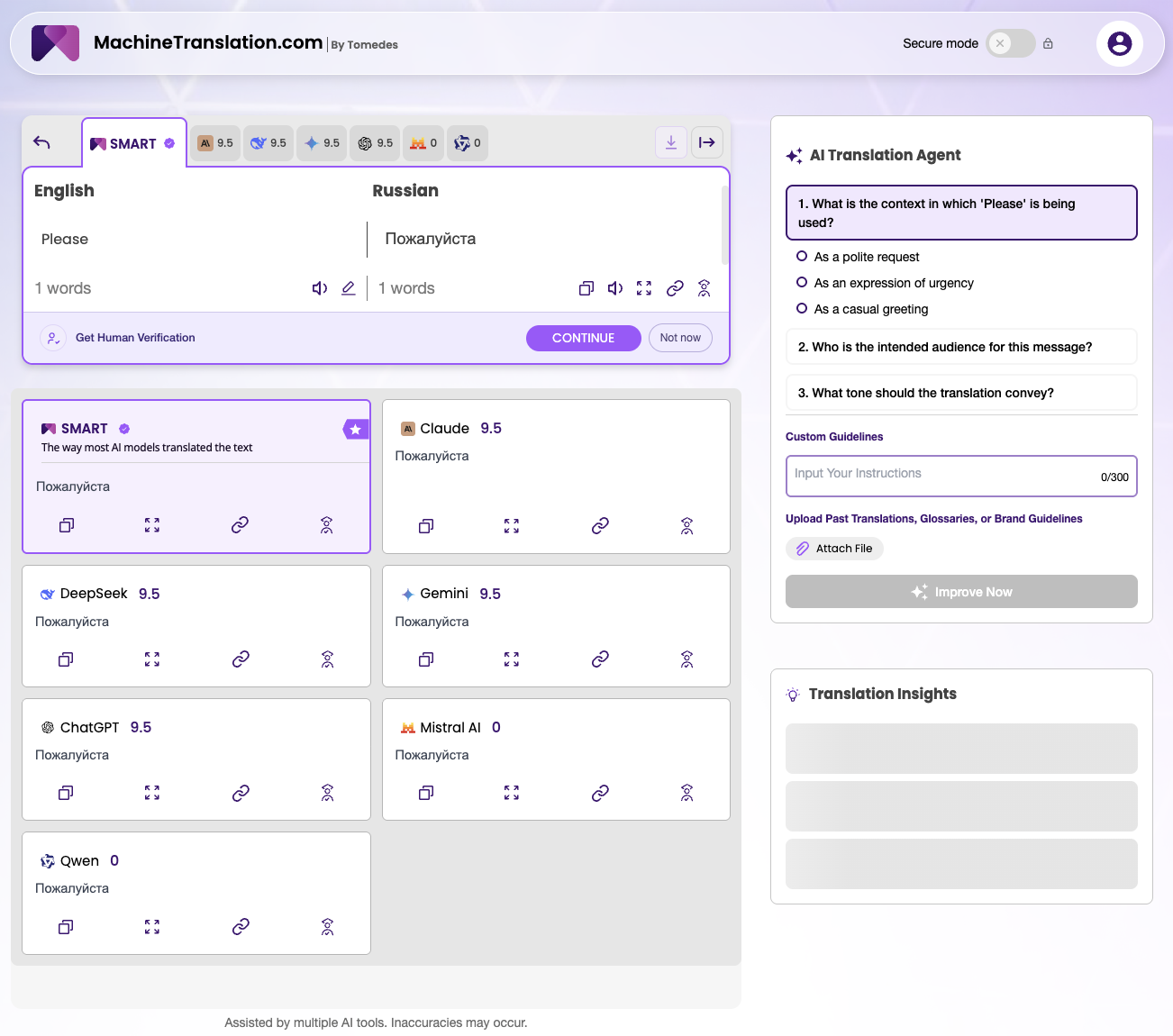
Every model agreed: Пожалуйста. And again, the agreement is correct — Пожалуйста is the standard Russian equivalent of "please."
What the translation doesn't show is that Пожалуйста also means "you're welcome." In Russian, the same word serves two functions that English keeps entirely separate. The AI Translation Agent's question (is this a polite request, an expression of urgency, or a casual greeting?) surfaces this exactly. The word is right. The context determines what it communicates.
MachineTranslation.com processed more than 15,000 English-to-Russian translation jobs in a single 90-day period, making Russian the highest-volume language pair on the platform. The verified translation of "please" in Russian exists precisely because high-frequency pairs deserve more than a quick answer.
When the models split, what "sorry" in Arabic reveals
This is where the 22-model approach earns its premise.
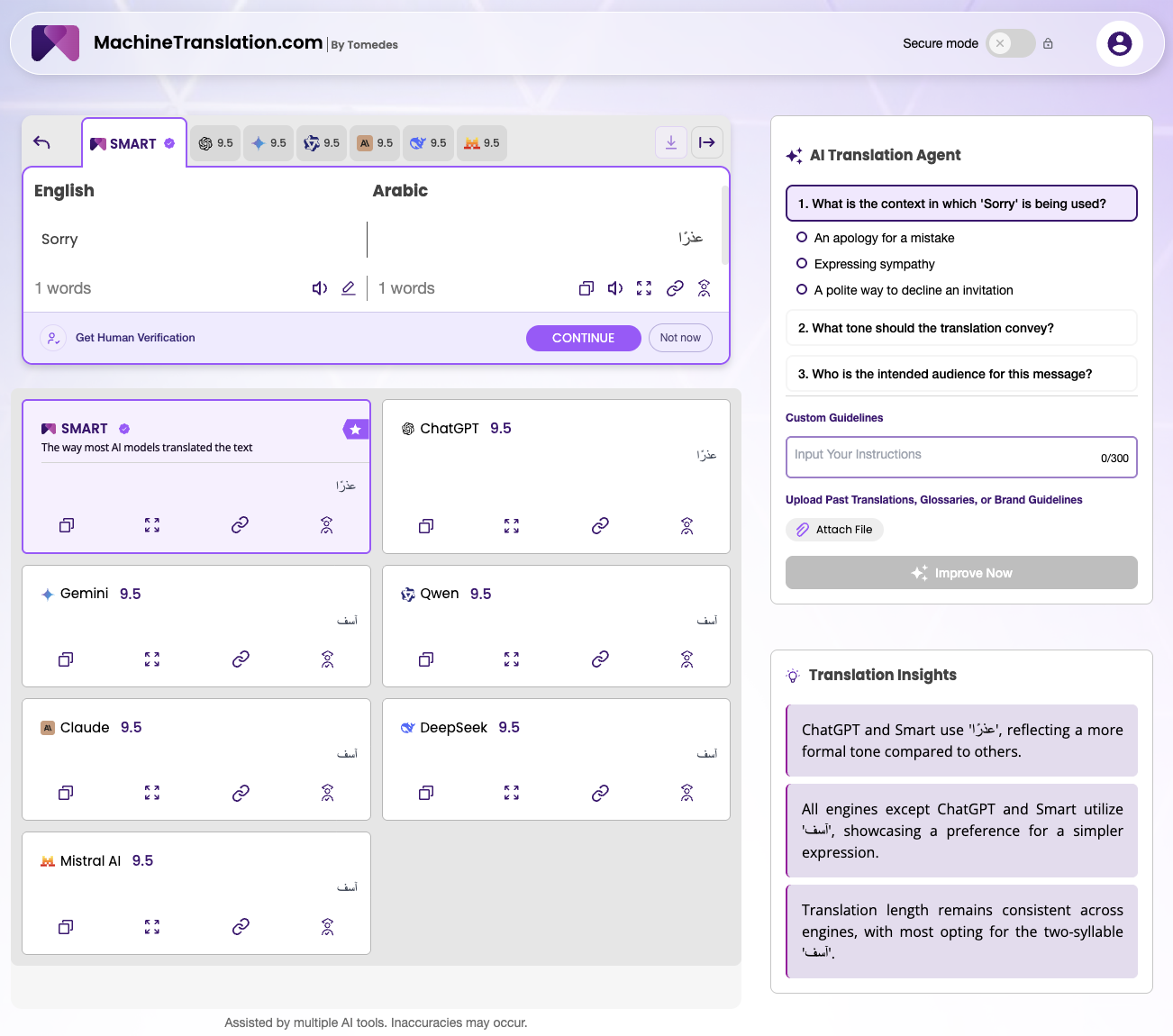
"Sorry" in Arabic is not one word. It is a register decision. عذرًا (udhraan) is the formal, literary expression — the kind used in written apologies, official correspondence, and measured professional contexts. آسف (aasif) is the everyday spoken form — direct, common, and appropriate for most real-world interactions.
When MachineTranslation.com ran "sorry" through the models, the result split almost exactly along that register line. SMART and ChatGPT chose عذرًا. Gemini, Qwen, Claude, DeepSeek, and Mistral chose آسف. Every model produced a score of 9.5, all outputs were considered high quality. The disagreement was not about correctness. It was about context.
MachineTranslation.com's Translation Insights documented the split plainly: ChatGPT and SMART reflect a more formal tone; the remaining five engines showcase a preference for a simpler expression. The AI Translation Agent asked three questions: is this an apology for a mistake, an expression of sympathy, or a polite way to decline an invitation? Because those three uses of "sorry" in English map to different levels of formality in Arabic, and the right word depends on which one you mean.
A single-model tool gives you one of those words and presents it as the answer. The verified translation of "sorry" in Arabic gives you both, explains the distinction, and lets you choose with full information.
"The Arabic 'sorry' result is a good illustration of what we're trying to do with this series," says Rachelle, AI Lead at Tomedes. "It's not that one group of models was right and the other wrong. Both translations are correct Arabic. The split tells you something real about the phrase, that it carries register weight that English doesn't encode. Showing that split is more useful than hiding it behind a single output."
The phrase that made the AI ask a cultural question, "goodbye" in Korean
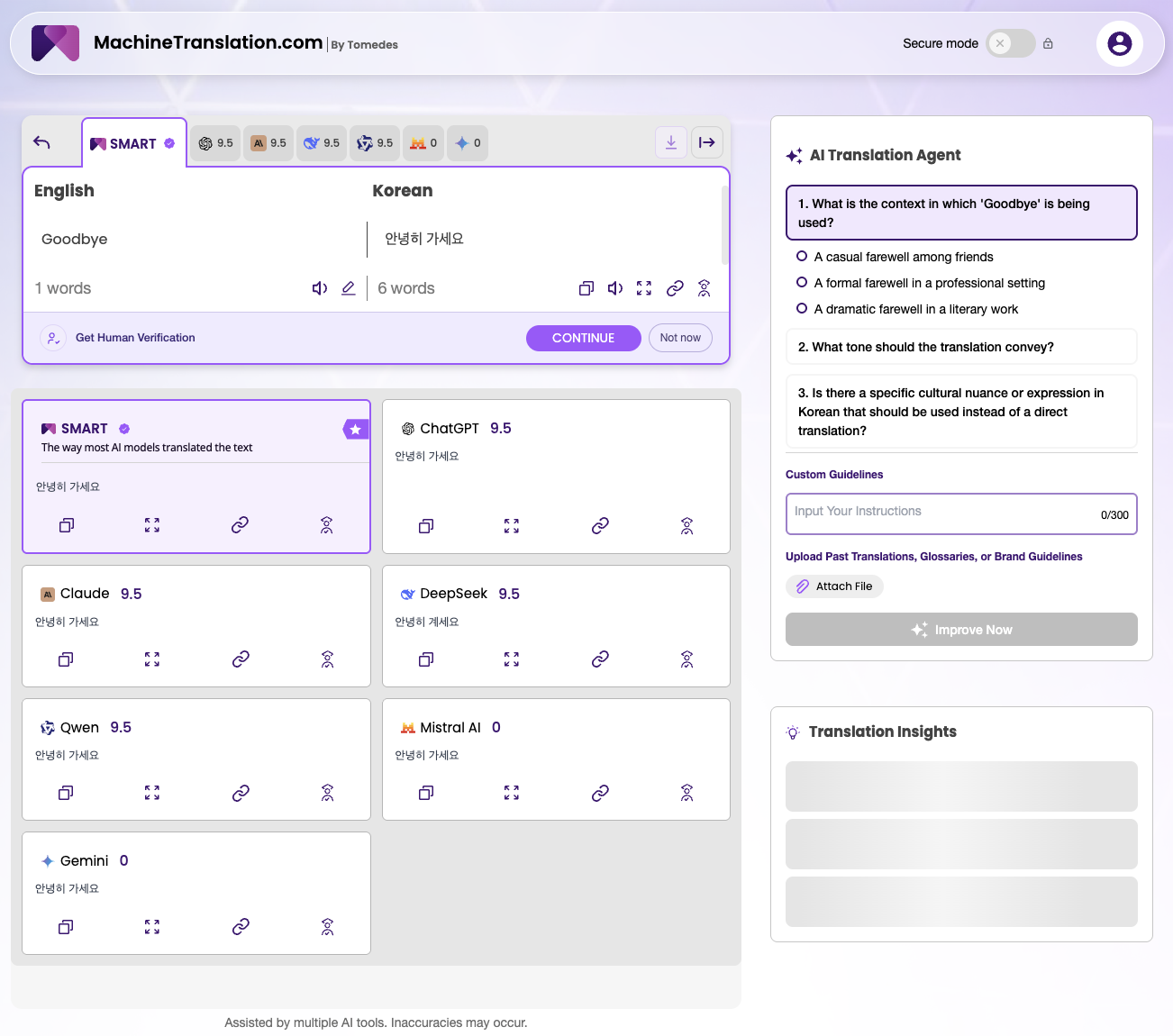
Most of the models agreed on 안녕히 가세요, and that agreement is directionally correct. But the AI Translation Agent asked a question that went further than any of the other phrases prompted: is there a specific cultural nuance or expression in Korean that should be used instead of a direct translation?
The reason that question exists is worth explaining. Korean has two farewells where English has one. 안녕히 가세요 means "go peacefully", it is said to the person who is leaving. 안녕히 계세요 means "stay peacefully", it is said by the person who is leaving to the person who remains. Which one is correct depends entirely on who is departing the conversation.
English "goodbye" does not encode this. A translator working from English into Korean has to make a choice that the source language doesn't make for them. The models that produced 안녕히 가세요 made that choice — correctly for many contexts, but not for all. The AI Translation Agent's cultural nuance question is the platform's mechanism for flagging that a direct translation may not be the complete translation.
This is not a failure of AI. It is a feature of Korean. And it is exactly the kind of thing that the verified translation of "goodbye" in Korean is designed to surface. See also the verified translation of "how are you" in Italian and "welcome" in Chinese for similar register and cultural layering.
What 22 models give you that one model will never show you
The six phrases above illustrate three distinct outcomes that the 22-model approach produces, none of which a single-model tool can replicate:
| Phrase | Language | Consensus? | Key finding |
|---|---|---|---|
| I love you | French | ✅ Full agreement | Agreement is real, but register (romantic/platonic/familial) remains open |
| Thank you | Spanish | ✅ Full agreement | Gracias is correct; formal vs. informal context still shapes delivery |
| Good morning | Japanese | ✅ Full agreement | All models chose formal form, a silent decision with social consequences |
| Please | Russian | ✅ Full agreement | Пожалуйста is correct; also means "you're welcome", context determines meaning |
| Sorry | Arabic | ⚠️ Split | عذرًا (formal) vs. آسف (casual) — both correct, register determines which |
| Goodbye | Korean | ✅ Mostly agreed | 안녕히 가세요 chosen, but cultural question surfaced: who is leaving? |
"What people are really searching for when they look up phrase translations isn't just a word," says William, CMO at Tomedes. "They want to know if the word is right for their situation. The verified series answers that question — not with a single output, but with the reasoning behind it."
When all 22 models agree, you have strong evidence that the consensus output is reliable. When they split, you have evidence that the phrase carries genuine linguistic complexity — and that choosing between the options requires contextual information. In both cases, you know more than you would from a single result.
The single-model alternative is not wrong. It is just incomplete. It gives you an answer without showing you the question.
"Confidence in a translation should come from convergence, not assumption," says Ofer, CEO of Tomedes. "When 22 independent models reach the same output, that convergence is meaningful. When they don't, that divergence is equally meaningful — and it belongs in front of the person making the translation decision, not filtered out before they see it."
The full verified phrase series on MachineTranslation.com
All ten verified phrase translations are live and searchable. Each one documents the 22-model consensus, any notable divergence, the AI Translation Agent's contextual questions, and the linguistic reasoning behind the verified result.
- Best translation of "I love you" in French
- Best translation of "Please" in Russian
- Best translation of "Goodbye" in Korean
- Best translation of "Welcome" in Chinese
- Best translation of "Sorry" in Arabic
- Best translation of "Congratulations" in Portuguese
- Best translation of "How are you" in Italian
- Best translation of "Happy birthday" in German
- Best translation of "Good morning" in Japanese
- Best translation of "Thank you" in Spanish
For longer-form translation between these languages, MachineTranslation.com's French to English and English to Spanish and English to Japanese translation tools apply the same multi-engine methodology at document scale.
FAQ
1. What does "verified by 22 AIs" mean on MachineTranslation.com?
It means the phrase was submitted simultaneously to 22 AI translation models. Each model produced its output independently. The verified result reflects the consensus output, the translation the majority of models agreed on. Where models diverged, both outputs are shown with an explanation of the linguistic distinction between them.
2. Why do some phrases produce splits between AI models?
Because some phrases carry register, formality, or cultural weight that the source language doesn't encode. "Sorry" in Arabic has a formal version (عذرًا) and a casual version (آسف) — both are correct, but they carry different tone. When models split along that line, it means the phrase is genuinely ambiguous without context. The split is information, not an error.
3. Is the consensus translation always the best one to use?
It is the most reliably correct starting point. Whether it is the best choice for your specific situation depends on context, which is why MachineTranslation.com's AI Translation Agent surfaces contextual questions when a phrase carries meaningful ambiguity. For most everyday uses, the consensus output is exactly what you need. For professional, formal, or culturally sensitive contexts, reading the full verified page gives you the additional reasoning to make the right call.
4. Why does "goodbye" in Korean have a cultural nuance question?
Because Korean has two different farewells: one said to the person leaving (안녕히 가세요) and one said by the person leaving to the person staying (안녕히 계세요). English "goodbye" doesn't encode this distinction. The AI Translation Agent flags it because the correct Korean expression depends on a piece of information the English source doesn't provide.
5. Can I use MachineTranslation.com for phrases beyond this series?
Yes. The verified phrase series covers ten high-frequency common expressions. For any other phrase or full document translation, MachineTranslation.com applies the same multi-engine methodology (running your text across multiple AI models, surfacing consensus, and flagging divergence) across more than 100 language pairs.

By William Mamane
Connect on LinkedInWilliam leads marketing and growth at Tomedes, where he turns SEO experiments and real campaign data into the strategy behind MachineTranslation.com's reach. He writes about how AI products actually get found and trusted plus the tactics that work, the ones that don't, and what search is rewarding right now.
Share:


