April 15, 2025
Global Trade Shifts Demand More Non-English Language Pairs in Translation
As the world economy shifts under the pressure of ongoing recessions and geopolitical realignments, something interesting is happening in the world of business communication: English is no longer enough.
You’ve probably seen the effects yourself. Whether you're working in international trade, manufacturing, tech, or marketing, you're noticing that business doesn't flow in one direction anymore. It's multi-directional. Countries in Latin America are trading directly with Asia. Africa is deepening ties with the Middle East. Eastern Europe is collaborating with Southeast Asia.
This rise in South–South commerce—trade between developing nations—is making non-English language pairs more relevant than ever. And in this new world order, if you want to thrive, you’ll need more than just English–Spanish or English–Mandarin translations.
Enter AI-powered translation tools designed to support more different languages, it’s made for global players of all sizes—from multinational corporations to small businesses dreaming big. Whether you need technical manuals translated from Chinese to Portuguese, or ecommerce listings adapted from Spanish to Arabic, this platform helps you get there—faster, cheaper, and smarter.
Why non-English pairs now matter more than ever
In the past, English was the global default. It was the language of aviation, diplomacy, finance—you name it. But now? That’s changing. Trade routes are evolving. Supply chains are diversifying. And regional power centers are rising.
Let’s break it down:
China is the number-one trading partner for many countries in Latin America and Africa.
Gulf nations like the UAE and Saudi Arabia are investing heavily in East Asia and North Africa.
Russia is leaning into new relationships with the Middle East and beyond due to sanctions.
Japan and Germany remain engineering and tech leaders, and their global partners are expanding east and south.
What do all these shifts have in common? They demand accurate communication in non-English language pairs.
And we’re not just talking about boardroom meetings or formal agreements. We're talking about everything from technical documentation, local government permits, and marketing content, to customer service scripts and product listings.
MachineTranslation.com tackles this complexity with ease. Using tools like the AI Translation Agent, segmented bilingual view, and key term glossaries, you get translations that reflect your voice, your industry, and your region—even if you're working in Japanese–Chinese or Russian–Arabic.
Top emerging non-English language pairs
Let’s take a closer look at the language pairs making the biggest impact—and where MachineTranslation.com fits in.
Chinese (Mandarin) – Spanish
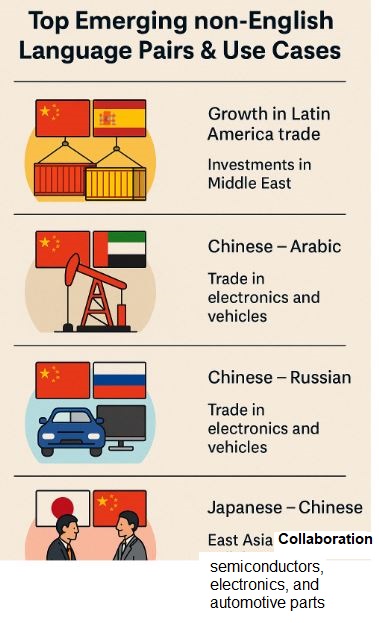
China’s growing economic footprint in Latin America is transforming how business is conducted across the hemisphere. In 2023, China–Latin America trade hit $489 billion, a record high. China now sources one-third of its food imports from Latin America, including soybeans, beef, and sugar. At the same time, over 22 countries in the region have signed onto China’s Belt and Road Initiative (BRI), spurring collaboration in infrastructure, agriculture, and mining.
Chinese – Arabic
The Middle East is China’s fastest-growing trade partner. Between 2017 and 2022, China–Arab world trade nearly doubled, reaching $507 billion. Over 50% of China’s oil imports now come from the Gulf, and China is investing billions into regional telecom, infrastructure, and smart city projects.
Chinese – Russian
Sanctions have pushed Russia to rely more on China, strengthening their partnership. In 2023, trade between the two countries reached a record $240 billion. China now supplies key goods like electronics, vehicles, and parts that Russia can no longer get from the West.
Japanese – Chinese
Japan and China—East Asia’s two largest economies—trade more than $330 billion in goods annually. The partnership is especially strong in semiconductors, electronics, and automotive parts, making localized communication critical for ongoing collaboration.
German – Chinese
Germany and China are Europe and Asia’s industrial giants. Despite slower growth in 2023, their trade volume remained at €253 billion, centered around automotive, renewable energy, and high-tech manufacturing.
Spanish – Portuguese
Latin America is leaning into regional integration, especially via the Mercosur trade bloc (Brazil, Argentina, Paraguay, Uruguay). Mercosur recognizes only Spanish and Portuguese as working languages, and intra-regional trade is growing as economies look inward during global slowdowns.
French – Arabic
This language pair is crucial for trade and diplomacy across North Africa, the Gulf, and Francophone Africa. In 2024, the UAE signed $19 billion in defense deals with France, all conducted in French and Arabic.
Russian – Arabic
Russia exports wheat, arms, and energy tech to the MENA region. In 2024, 77% of Egypt’s wheat imports came from Russia. This flow of goods requires precise and rapid translation of shipping documents, contracts, and safety specs.
How English language pairs are still thriving
While non-English language pairs are rapidly gaining importance, English-based translation remains foundational in global commerce, especially in sectors driven by Western trade, international regulation, and digital infrastructure. In fact, according to CSA Research, English is still involved in over 60% of all translated content globally, making it a persistent linchpin in global business communication.
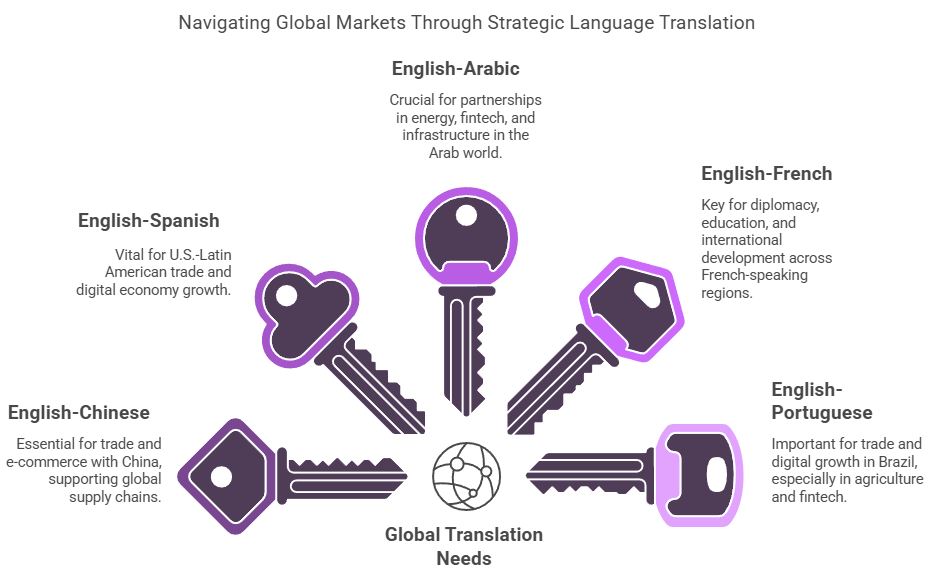
Here are five English + strategic language pairs that continue to dominate high-volume industries:
1. English–Chinese (Mandarin)
China is the world’s top exporter and a vital player in global manufacturing, e-commerce, and SaaS. English–Chinese translation is essential for businesses importing Chinese goods or marketing to Chinese-speaking users.
Key stats:
In 2023, China’s exports reached $3.38 trillion, with the U.S. and EU as top buyers (WTO).
Alibaba’s cross-border ecommerce unit Cainiao operates in over 200 countries, primarily using English for interface and support.
China remains a dominant player in global supply chains, so English–Mandarin documentation is critical across B2B, logistics, and compliance.
2. English–Spanish
Spanish is the second-most spoken language in the world by number of countries and a key language for the U.S.–Latin American trade corridor, which accounts for $1.3 trillion annually (USTR, 2023). It’s also vital in healthcare, education, fintech, and mobile apps.
Key stats:
Over 42 million Spanish speakers live in the U.S. alone (U.S. Census).
Latin America’s digital economy is projected to reach $700 billion by 2025 (Statista).
Spanish is one of the top 3 languages for app localization, after English and Chinese.
3. English–Arabic
The Arab world, especially the Gulf Cooperation Council (GCC) countries, is booming in energy, fintech, and infrastructure. English–Arabic is the default language pair for multinationals partnering with regional governments, banks, and investors.
Key stats:
The GCC’s combined GDP exceeded $2.1 trillion in 2023 (World Bank).
Dubai and Riyadh are emerging as fintech and AI innovation hubs, attracting global firms that rely on English–Arabic communication.
English is often the language of record in the UAE and Saudi Arabia, but Arabic is mandatory for legal and consumer-facing documents.
4. English–French
French is spoken in over 29 countries, including major economies like France, Canada, and several African nations. It’s a cornerstone in diplomacy, education, healthcare, and international development.
Key stats:
French is the second most used working language in international organizations (UNESCO).
Canada mandates bilingual documentation for federal services (English and French).
French-speaking African markets are projected to reach $700 billion in consumer spending by 2030 (McKinsey).
5. English–Portuguese (Brazilian)
Brazil is Latin America’s largest economy and a growing force in agriculture, fintech, renewable energy, and ecommerce. English–Portuguese translations are critical for multinationals entering or operating in Brazil.
Key stats:
Brazil’s ecommerce market surpassed $40 billion in 2023 (eMarketer).
The country is among the top soybean and beef exporters globally, with trade deals often involving English documentation and Portuguese execution.
Brazil’s mobile-first population drives demand for localized apps, games, and fintech tools.
AI translation is a game-changer for small and medium businesses going global
Let’s talk about your business. Maybe you’re a boutique marketing agency, an ecommerce brand, or a SaaS company. You’re eyeing international growth, but hitting a familiar wall:
Translation is expensive. Localization is complex. Time is short.
Hiring a full-time translator or a localization team? That might not be in your budget. But skipping proper translation risks brand damage, compliance issues, or customer confusion.
That’s where AI translation tools for SMBs like MachineTranslation.com are game-changers.
Here’s how it helps
Translate thousands of words for free. Registered users get 100,000 free words every month—perfect for newsletters, listings, or knowledge base articles.
Bulk-translate files instantly. Upload your contracts, brochures, or product specs. MT.com extracts and translates text from PDFs, DOCX, CSV, and JPG formats.
Customize tone and terminology. The AI Translation Agent asks questions about your content (Is this for customers or partners? Do you want formal or casual tone?) and adjusts accordingly.
Remember your preferences. The platform learns from your past edits, so your future translations stay consistent across projects, teams, and regions.
Professional human review when needed. For legal disclaimers, packaging, or investor documents, just add Human Certification to polish your content to perfection.
You don’t need a huge localization budget anymore. You just need a smart workflow—and MachineTranslation.com gives you exactly that.
Conclusion
Here’s the truth: non-English language pairs are no longer niche. They are now central to global commerce, diplomacy, and regional growth. If your business isn't equipped to handle Mandarin–Arabic, Spanish–Portuguese, or Russian–French communications, you’re at risk of falling behind.
But the good news? You don’t need to be a multinational to play on the global stage. So whether you’re localizing an app, negotiating a trade deal, or preparing multilingual packaging, you have everything you need to succeed globally—without breaking the bank.

By Clarriza Heruela
Clarriza Mae Heruela graduated from the University of the Philippines Mindanao with a Bachelor of Arts degree in English, majoring in Creative Writing. Her experience from growing up in a multilingually diverse household has influenced her career and writing style. She is still exploring her writing path and is always on the lookout for interesting topics that pique her interest.
Share:


