April 15, 2026
France vs. Quebec French: Which AI translation models actually get it right?
Here is a test. Take this sentence: "Send me an email when the shopping is done." Run it through five major AI translation models targeting French. You will likely get five outputs that all look correct to someone who learned standard French. But a Quebec reader will immediately notice if the translator chose "e-mail" over "courriel," "faire les courses" over "faire le magasinage," and whether the overall register sounds like a French newscast or like the person actually writing from Montreal.
These are not stylistic preferences. They are the markers of two distinct, professionally recognised French language standards (one anchored to France, one governed by Quebec's Office québécois de la langue française) and they have measurably different implications for whether your translated content lands naturally with its intended audience or reads as a foreign product.
The question this article addresses is not whether AI translation can handle French. It clearly can, at a general level. The question is whether it can handle which French you need, and which models perform better for each market.
Why "French" is not one translation target, it is two
The French spoken and written in France and the French used in Quebec are not dialects. They are distinct codified standards, each with its own regulatory bodies, style guides, official terminology databases, and professional expectations for published content.
In France, the Académie française and the Délégation générale à la langue française et aux langues de France (DGLFLF) set language standards. In Quebec, the Office québécois de la langue française (OQLF) maintains the Grand dictionnaire terminologique – a database of over four million terminology entries that specifically addresses how technical, commercial, and professional French should be rendered in the Quebec context.
These institutions make different choices. Deliberately, systematically, and with legal backing in Quebec's case, where the Charter of the French Language (Bill 101) requires that commercial communications directed at Quebec consumers be available in French that meets OQLF standards.
The vocabulary gap
The vocabulary differences between France French and Quebec French extend well beyond the frequently cited examples of "voiture" vs. "char" (car) or "courriel" vs. "e-mail" (email). They operate systematically across entire domains.
Domain | France French | Quebec French |
e-mail / mail | courriel | |
Shopping | faire les courses / les achats | faire le magasinage |
Car | voiture | char (informal) / automobile (formal) |
Parking lot | parking / parc de stationnement | stationnement |
Lunch | déjeuner | dîner |
Dinner | dîner / souper | souper |
Smartphone | smartphone | téléphone intelligent |
Software | logiciel | logiciel (aligned) |
Breakfast | petit-déjeuner | déjeuner |
The meal-timing vocabulary alone (where "déjeuner" means lunch in France and breakfast in Quebec) is a reliable source of genuine confusion in translated menus, catering materials, event invitations, and hospitality content.
Beyond specific lexical choices, Quebec French has been significantly more active than France French in developing native-language terminology for technology and digital concepts. The OQLF has issued official Quebec French equivalents for hundreds of English technology terms that France has largely adopted as anglicisms. A translation model trained predominantly on European French text will often default to the anglicism; one with stronger representation of Quebec sources may correctly use the OQLF-approved term.
Register, spelling, and tone
Quebec French also operates at different formal register levels than France French in ways that go beyond accent. Business communications in Quebec typically use a more direct, accessible register than equivalent communications in France, where a higher degree of formal distancing is standard in professional writing. Marketing copy, product descriptions, and customer service language that sounds appropriately professional in France French can read as cold or bureaucratic to a Quebec audience – and vice versa, where Quebec-register text can sound informal or even flippant in a France French context.
Spelling conventions also differ in some cases: Quebec French has historically resisted some of the 1990 French spelling reforms that France adopted, though this is an inconsistent area that varies by publisher and style guide.
What the data shows: AI model performance across both variants
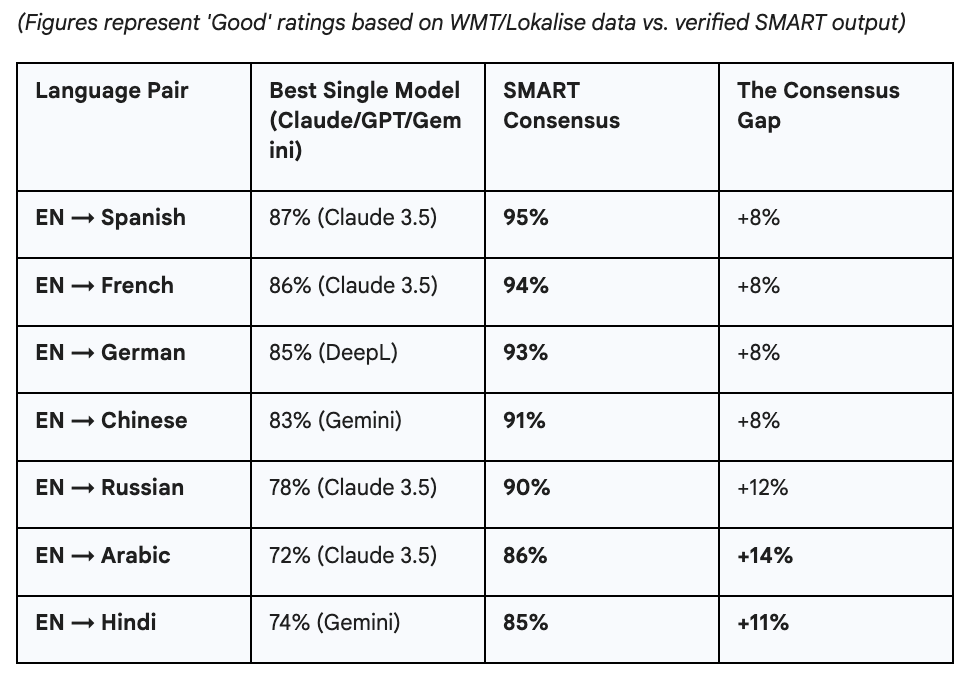
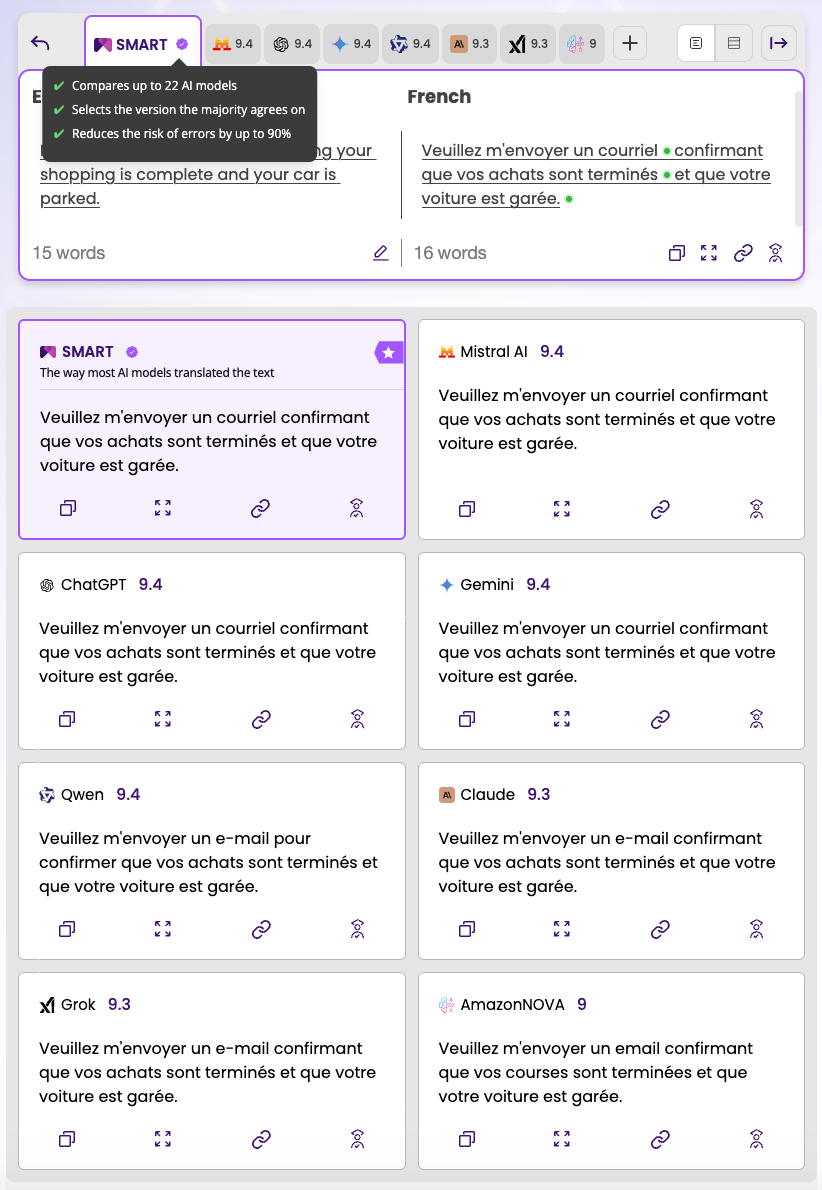
When the same English content is run through multiple AI translation models targeting French via MachineTranslation.com's SMART multi-model comparison, the outputs do not converge. They diverge, and the pattern of divergence maps predictably onto training data composition.
Where models converge
On general-purpose, neutral French content (news summaries, straightforward informational text, formal business correspondence with no domain-specific terminology), the leading AI translation models (DeepL, Google Translate, Microsoft Translator, and the others available through MachineTranslation.com) produce outputs that are largely interchangeable for both France and Quebec audiences. A neutral sentence like "The meeting is scheduled for Thursday morning" will translate in a way that is appropriate for both markets across all major models.
This convergence zone is where the simplistic view of AI translation quality ("it's basically good enough now") comes from. It is not wrong – for this category of content, the models are competitive and reliable.
Where models diverge, and why it matters commercially
The divergence starts at the edges: technical terminology, marketing register, idiomatic expressions, and any content that touches the domain-specific vocabulary differences between the two variants.
DeepL, which has historically been trained on a corpus with strong European French representation, tends to default to France French choices for terminology that has distinct versions in each market. Google Translate's approach has shifted significantly with its neural translation updates, and its performance on Quebec French has improved substantially, though it still shows France French bias on terminology where OQLF alternatives exist. Microsoft Translator, drawing on its enterprise document corpus, performs well on formal register in both markets but shows inconsistency on consumer-facing copy.
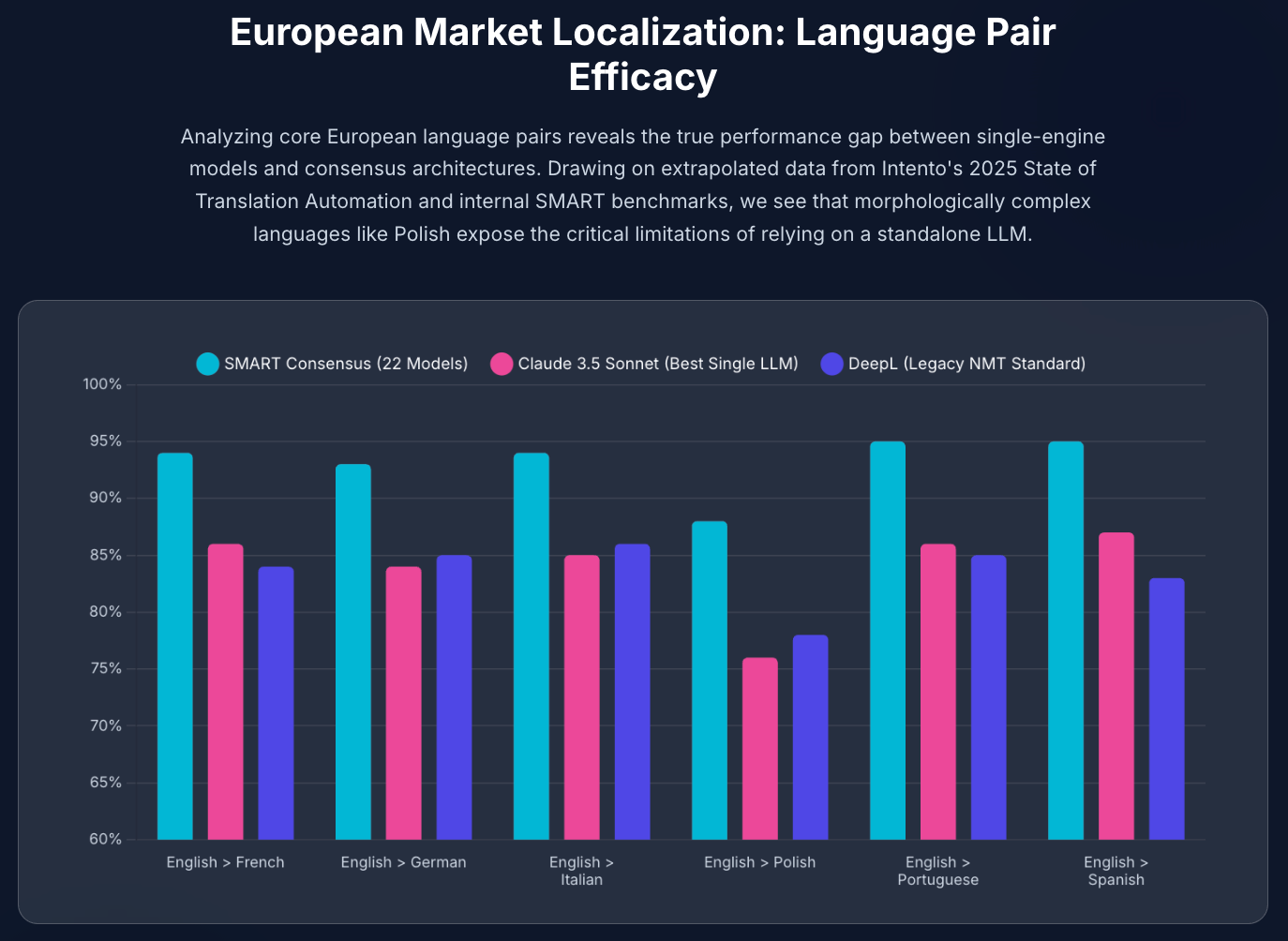
The practical consequence of this divergence is not theoretical. A Quebec consumer reading France-French marketing copy knows immediately that the content was not written for them. Research on linguistic accommodation in marketing consistently shows that audiences respond better to content that uses their specific register and vocabulary. For a business selling into Quebec, a France French translation is not a neutral starting point – it is a signal that the brand has not invested in understanding the market.
A domain-by-domain comparison: Which models win where?
The pattern of model performance is not uniform across content types. Below is a domain-by-domain analysis based on MachineTranslation.com's observations across translation use cases.
Legal and administrative content
France French. DeepL performs strongly on formal French legal register, correctly applying the distancing conventions and formal vocabulary required in French administrative and legal documents. Its training data includes strong representation of formal European French text.
Quebec French. For content governed by Quebec civil law or OQLF terminology standards, the picture is more complex. Legal terminology in Quebec follows its own conventions, rooted in the civil law tradition but with distinct terms compared to French civil law. Model performance on Quebec-specific legal terminology is less consistent across all major models, and human review by a Quebec-trained legal translator remains important for official documents.
Recommendation: For formal legal content, use MachineTranslation.com to identify the model with the most consistent terminology choices, then verify against OQLF's Grand dictionnaire terminologique for Quebec content.
E-commerce and marketing copy
This is where the regional variant gap has the highest commercial impact, and where model divergence is most pronounced.
France French marketing copy. Benefits from models that apply appropriate formal distancing and European consumer vocabulary. DeepL's France French output reads naturally for French consumer audiences and handles the slightly higher formality register of France-French marketing well
Quebec French marketing copy. Requires a fundamentally different register approach. Quebec marketing tends toward more direct, accessible, and conversational French – closer to how people actually speak in the province. Models that default to France French register produce marketing copy that sounds stiff and imported to Quebec readers.
Recommendation: For Quebec French consumer marketing, run the content through MachineTranslation.com's full multi-model comparison and evaluate outputs specifically for regional vocabulary markers (courriel vs. e-mail, magasinage vs. courses, téléphone intelligent vs. smartphone). The model that uses OQLF-aligned terminology consistently is the strongest baseline for this market.
Technical documentation
Technical documentation is the domain where Quebec French has made the most systematic effort to maintain distinct terminology from France French, driven by OQLF's extensive technical terminology database.
France French technical content. Increasingly incorporates English technical terms as loanwords, following the global technology industry's tendency toward English terminology with local pronunciation adaptation
Quebec French technical content. Has official OQLF equivalents for a wide range of technical terms – and in professional and regulated contexts, using the French term over the anglicism is expected. "Logiciel" for software is standard in both variants; but less common technology terms often have OQLF entries that France French would leave in English
Recommendation: For technical documentation targeting Quebec, use MachineTranslation.com's SMART comparison and cross-reference terminology choices against the Grand dictionnaire terminologique. Models with stronger Quebec corpus representation will perform better on this content type.
How MachineTranslation.com's multi-model comparison reveals regional gaps before they reach your audience
The central argument for using MachineTranslation.com's English–French translation tool for content destined for either the France or Quebec market is not that MachineTranslation.com has solved the regional variant problem. It is that MachineTranslation.com makes the regional variant gap visible before it becomes a problem with your audience.
When you run the same content through five or more AI translation models simultaneously and compare the outputs side by side, the divergence on regional vocabulary markers becomes immediately apparent. You can see in one view that Model A chose "e-mail" while Model B chose "courriel," that Model C rendered "parking" while Model D wrote "stationnement." These choices are invisible when you use a single-model tool. They are obvious when you have a comparison.
This visibility serves a practical workflow function. For a business producing content for both markets, a SMART comparison run immediately identifies sentences where regional variant choices are at stake – saving the reviewer from having to read the entire translation word by word. The comparison flags the divergence points automatically, and the reviewer's attention can be directed to those sections.
For businesses that produce content for both France and Quebec, this means running two separate translation passes (one reviewed and approved for France French, one reviewed and approved for Quebec French) rather than assuming that a single "French" translation will serve both markets. MachineTranslation.com's comparison output makes this two-pass workflow significantly faster than it would be if each model had to be queried separately.
Practical decisions: Choosing your approach for each market
The following framework applies to businesses translating English content into French for either market.
Step 1: Define which French market you are targeting.
France French and Quebec French are not interchangeable. If your content will be read by both audiences, you need two translation passes – not one "generic French" translation. This is a workflow decision, not a translation quality question.
Step 2: Use MachineTranslation.com's SMART comparison to identify your best-performing translation baseline for each market.
For France French: evaluate model outputs on formal register, administrative vocabulary, and EU-specific context.
For Quebec French: evaluate model outputs specifically on OQLF-aligned terminology, register, and idiom.
Step 3: Set regional vocabulary markers as your primary review criteria.
Regardless of which model you use as your baseline, define a short list of regional vocabulary markers relevant to your content domain and review each output against them explicitly. For most businesses, 10-20 key terms are sufficient to cover the vocabulary divergence points most likely to appear in your specific content type.
Step 4: Apply human review for Quebec French content more extensively than for France French.
Because major AI models have historically been trained on larger Europe French corpora, the Quebec French output requires more careful review – particularly for marketing copy and domain-specific technical content. Budget for this in your localization workflow.
Step 5: For regulated or legally sensitive Quebec content, verify terminology against the Grand dictionnaire terminologie.
This is non-negotiable for content in regulated industries (healthcare, legal, financial services, government contracting) where OQLF compliance is a requirement.
Content type | Recommended model baseline (France FR) | Recommended model baseline (Quebec FR) | Human review level |
Marketing copy | DeepL | MachineTranslation.com SMART comparison + QC review | High |
Legal/contracts | DeepL | MachineTranslation.com comparison + specialist review | Required |
Technical docs | DeepL or Microsoft | MachineTranslation.com comparison + OQLF verification | Medium-High |
Product descriptions | Google or DeepL | MachineTranslation.com comparison + native QC reviewer | Medium |
Internal communications | Any major model | Any major model | Low |
FAQs
1. Is Quebec French significantly different from France French in ways that affect AI translation?
Yes, in several practically important ways. Quebec French and France French use different vocabulary for everyday concepts (meals, technology, shopping, transport), operate at different formal register levels in professional and marketing communication, and are governed by different official terminology standards – the OQLF's Grand dictionnaire terminologique in Quebec versus the Académie française and DGLFLF in France. For general informational text, AI translation models produce acceptable output for both markets. For domain-specific, marketing, legal, or technical content, the differences matter and require targeted review.
2. Which AI translation model performs best for Quebec French?
No single model consistently outperforms all others for Quebec French across all content types. MachineTranslation.com's SMART multi-model comparison is the most reliable method for identifying which model produces the best output for a given piece of Quebec French content, because it lets you compare outputs simultaneously and identify where regional vocabulary divergence occurs. For content where OQLF terminology compliance is required, model output should be verified against the Grand dictionnaire terminologique regardless of which model is used.
3. Can I use a single French translation for both France and Quebec audiences?
For neutral, general-purpose informational content, a single French translation may be acceptable for both audiences. For marketing copy, legal documents, technical documentation, and any content where regional vocabulary, register, or terminology compliance matters, a single translation will not be appropriate for both markets. Using France French content in Quebec (or vice versa) signals to the audience that the content was not produced for them – which has measurable commercial effects on engagement, trust, and conversion.
4. How does MachineTranslation.com's aggregation system help with regional French translation?
MachineTranslation.com's multi-model comparison runs the same content through multiple AI translation models simultaneously and displays all outputs side by side. For France vs. Quebec French translation, this makes vocabulary divergence immediately visible – you can see in one view which models chose France French terminology and which chose Quebec French equivalents. This identifies exactly which sentences need regional review without requiring a word-by-word read of the entire translation. Access this through the English–French translation tool.
5. Is DeepL better than Google Translate for French translation?
For France French, DeepL has historically shown stronger performance on formal register and professional content. For Quebec French, the comparison is less clear-cut – Google Translate's neural translation updates have improved its Quebec French output, and neither model consistently outperforms the other across all content types. The most reliable approach is to compare both models (and others) simultaneously using MachineTranslation.com's SMART technology, evaluate the outputs against your specific regional vocabulary requirements, and get the translation that most models agree on for each piece of content rather than committing to a single model.