September 24, 2026
The German formality problem most AI translators leave to you
A client email lands in your inbox with no instructions about tone. A Slack message from a German office asks for a quick translation of a product update. Neither one tells you whether the reader expects Sie or du, and most AI translation tools need you to tell them before they'll get it right.
That's a bigger problem than it sounds. German is one of a handful of major business languages where formality is grammatical, not stylistic. A phrase as routine as "to whom it may concern" in German carries a formality decision built into the words themselves. Get that decision wrong in a B2B context and the translation doesn't read as slightly off in tone. It reads as if the company doesn't know who it's talking to.
Why German formality isn't a toggle you set once
Several established AI translation tools handle this with a manual formality parameter: pick formal or informal before you translate, and the system applies it consistently. That works for content where the register is already decided. It stops working the moment formality isn't specified in advance, which in practice is most day-to-day business correspondence. A support ticket, an internal memo forwarded externally, a quick translation of a line like "please find attached" in German: none of these arrive with a formality flag attached. A tool that requires one either forces the user to guess or defaults silently to whichever register the underlying model happened to prefer.
The silent default is the real risk. It stays invisible until a client, a regulator, or a hiring manager on the other end notices the wrong Sie/du choice three sections into a document.
What happens when the source text doesn't say
We ran two ordinary business sentences through MachineTranslation.com's English-to-German translator, deliberately without specifying a register, the way most real requests arrive. In traditionally conservative German industries such as banking, management consulting, and insurance, the convention leans toward Sie as the default, a belief examined in Wharton's research on German workplace address.
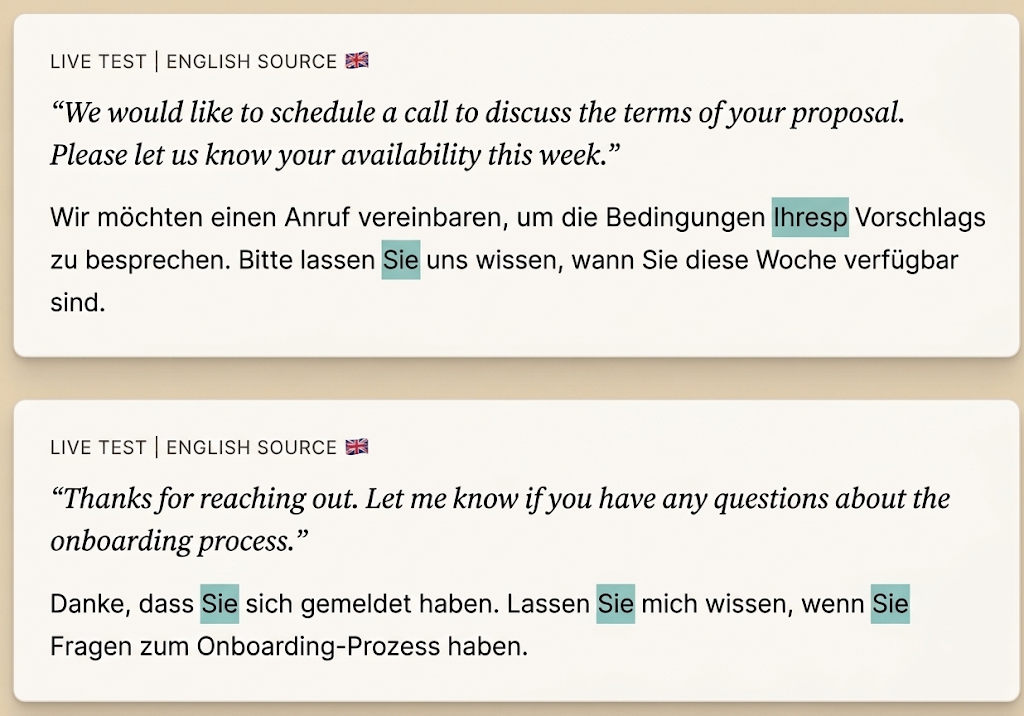
Both landed on the formal register without being told to. Neither sentence signals formality explicitly in English. "You," "let me know," and "thanks" carry no register information at all, since English doesn't grammaticalize the distinction. The consensus across MachineTranslation.com's compared models converged on Sie in both cases, the safer default for unlabeled B2B correspondence.
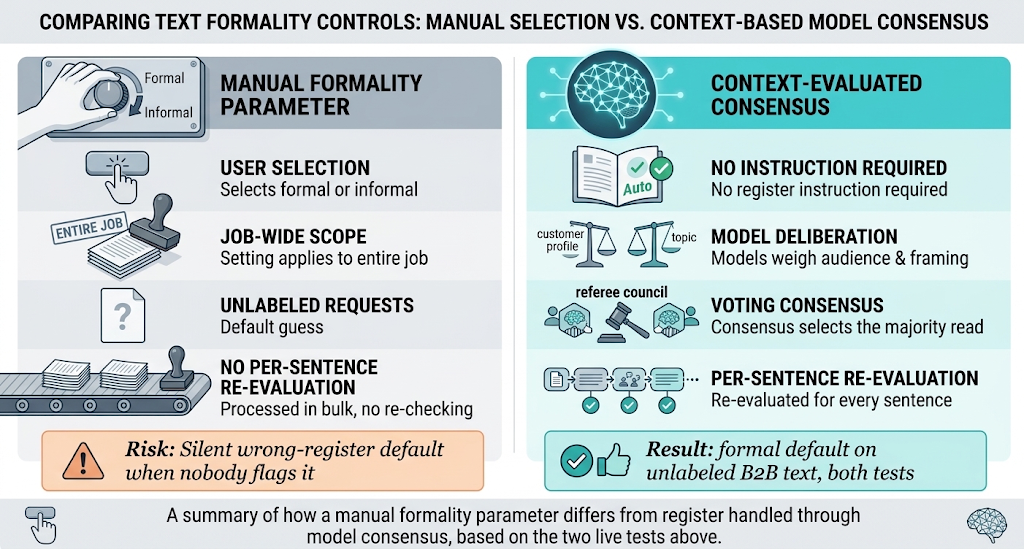
A manual toggle applies a rule the user already decided on. What's shown here works differently: the models being compared are weighing the same contextual signals a human reviewer would (audience framing, subject matter, sentence structure) for every sentence, rather than reading a single flag set once at the start of a job.
A formality parameter only works if someone has already decided the answer. Most requests that reach a translation tool don't arrive that way. They come as a forwarded email or a support ticket someone needs handled in five minutes, with no register specified anywhere in the text. When models converge on Sie in that situation, they're reading the same signals a native reviewer would: subject matter, sentence structure, who's likely on the other end. That convergence is the answer, evaluated fresh each time rather than set once and applied blindly.
Manual toggle vs. context-evaluated register
A note on how this is implemented
The two tests above ran through MachineTranslation.com's core translation endpoint directly, with no formality instructions supplied. MachineTranslation.com also offers an AI Translation Agent for cases where a user wants to specify tone and terminology explicitly through custom instructions. Which layer is responsible for the automatic register handling shown here, the base consensus process or the Agent working in the background, is a product detail worth confirming rather than assuming. A related test on English-to-German business text found 14% of engines defaulting to informal phrasing when the source used a plain "you" with no formality cue, the same ambiguity behind both live tests above.
When you should still specify formality yourself
Context-evaluated register isn't a reason to stop specifying formality when you already know the answer. If a brand has deliberately chosen an informal du voice for consumer marketing, or a governing law clause in a formal contract calls for Sie as a matter of professional convention, that decision should still be stated explicitly rather than left to a default, even a well-informed one. The value of automatic detection is narrower and more specific: it's what happens in the much larger number of cases where nobody has made that decision yet, and the request still needs to go out today.
Frequently asked questions
1. How do I translate informal language to German?
Specify the informal register directly if you already know your audience expects it, since English carries no grammatical marker for German to infer it from. On MachineTranslation.com, register is evaluated as part of the translation itself using the surrounding context, so common business phrasing defaults correctly without a manual setting in most cases, though a deliberately casual du brand voice should still be stated explicitly.
2. Is there an AI translator that can translate German formally and informally?
Yes. Most AI translators support German formality through a manual parameter set before translation. MachineTranslation.com compares the output of 22 AI models and evaluates formality as one of the contextual signals in that comparison, rather than requiring it as a separate input every time.
3. Is ChatGPT better than DeepL for German business translation?
Both handle general German translation well, and both can miss a register decision the source text doesn't make explicit. Comparing outputs across more models, rather than relying on any single engine, is what catches a formality mismatch before it reaches a German client or regulator.

By Rachelle Garcia
Connect on LinkedInRachelle leads product and AI at Tomedes, where she runs the experiments that turn internal data into better translation experiences. She writes about what actually happens when you build AI products such as MachineTranslation.com — the numbers, the surprises, and the parts that don't go to plan.
Share:


