March 27, 2026
What Grok brings to translation on MachineTranslation.com
When Grok first joined MachineTranslation.com's platform, it arrived as a first-generation model — capable, distinctive, but still establishing itself. Since then, xAI (now part of SpaceX following its February 2026 acquisition) has released Grok through four major versions. As of March 2026, Grok 4.1 represents one of the most capable frontier models available, with a 131K-token context window, real-time search integration, and multilingual capabilities that have improved substantially across each generation.
This article explains what Grok specifically contributes to translation on MachineTranslation.com, how its capabilities have evolved, and what it means for translation quality that Grok runs as one of 22 models in MachineTranslation.com's SMART consensus system.
In this article
- What is Grok, and what version is it on MachineTranslation.com?
- What does Grok bring to translation that other models don't?
- How does Grok work inside MachineTranslation.com?
- Which translation tasks benefit most from Grok?
- FAQs
What is Grok, and what version is it on MachineTranslation.com?
Grok is a large language model developed by xAI, founded in 2023 by Elon Musk and now part of SpaceX following an acquisition in February 2026. The Grok series has progressed through four major model generations: Grok 1 (2023), Grok 2 (2024), Grok 3 (February 2025), and Grok 4 (July 2025), with Grok 4.1 available as of late 2025.
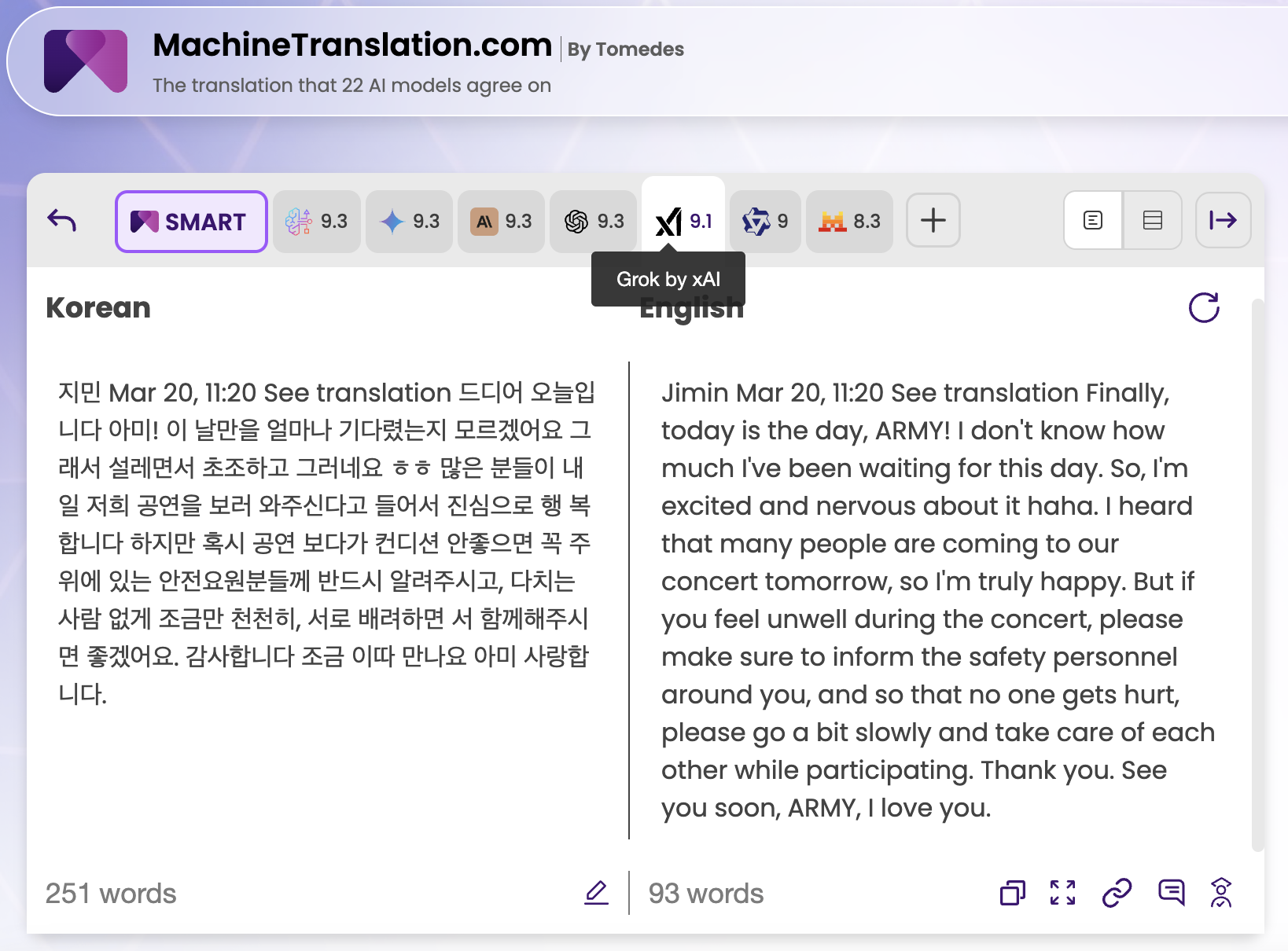
Grok's defining architectural characteristic is its integration with X (formerly Twitter) platform data and live internet search. Unlike most large language models trained on static datasets, Grok is designed to incorporate real-time information (current events, recent developments, emerging terminology) into its outputs. This gives it a specific capability advantage for time-sensitive, contextually current content that general-purpose models trained on older data may not match.
Grok 4.1 features a 131K-token context window, improved multilingual support across successive releases, and native tool use with real-time search integration. The model is accessible via the xAI API and through MachineTranslation.com's platform, where it operates as one of 22 models inside the platform.
What does Grok bring to translation that other models don't?
Most of the 22 models on MachineTranslation.com are trained on static datasets with knowledge cutoffs. They excel at established language, domain-specific terminology, and high-resource language pairs — but they have no access to content that emerged after their training cutoff.
Grok's real-time data access changes this for a specific class of translation content:
1. Current events and news translation. Translating news articles, press releases, or reports about recent events involves terminology, names, and context that static models may not have. Grok's live search integration means it can draw on current information when translating content about recent developments — elections, market events, product launches, geopolitical situations.
2. Emerging terminology. Technical fields, industries, and cultural contexts produce new terminology continuously. For translation tasks involving recently coined terms, evolving regulatory language, or new product nomenclature, Grok's updated training and real-time search give it access to usage patterns that older snapshots of training data don't capture.
3. Contextually current brand and cultural references. Marketing content, social media, and consumer-facing copy frequently reference current cultural moments. Grok's X-platform data foundation gives it strong coverage of contemporary language use (slang, cultural references, platform-specific register) that enriches translation for consumer-facing content.
4. Reasoning-depth for complex content. Grok 4's improvements in reasoning capabilities extend to complex, multi-layered documents (legal agreements, technical specifications, research reports) where understanding implicit relationships between clauses and maintaining logical coherence across the document matters as much as word-level accuracy.
None of these capabilities mean Grok is better than other models across all translation tasks. They mean Grok has specific advantages for specific content types, and that including Grok in a 22-model consensus system captures those advantages without requiring users to know when to apply them.
How does Grok work inside MachineTranslation.com?
Grok is one of 22 AI models that MachineTranslation.com runs simultaneously for every translation. The full list includes ChatGPT, Claude, Gemini, DeepSeek, DeepL, Google, Grok, LibreTranslate, Lingvanex, Llama, Microsoft, Mistral AI, Modern MT, Moonshot, Niutrans, Qwen, Royalflush, AI21, Amazon, Amazon Nova, Facebook, and GLM.
MachineTranslation.com's SMART mechanism: all 22 models translate the same input simultaneously. SMART identifies the output the majority of models agree on and returns it as the consensus (SMART) translation.
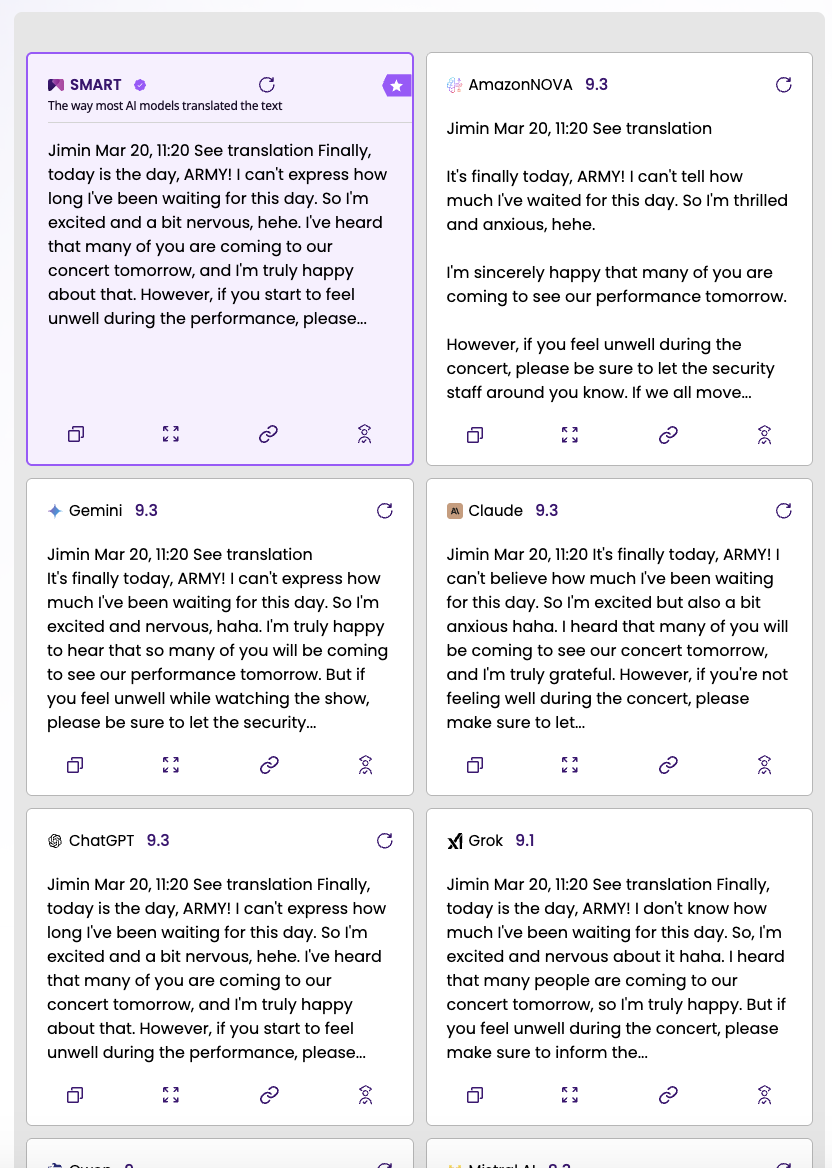
What this means for Grok specifically: when Grok's output agrees with 15, 18, or 20 other models, that agreement is strong confirmation that the translation is reliable. When Grok's output diverges from the majority (particularly on content involving recent terminology or current events) that divergence surfaces as a signal worth examining, rather than silently appearing in the final output.
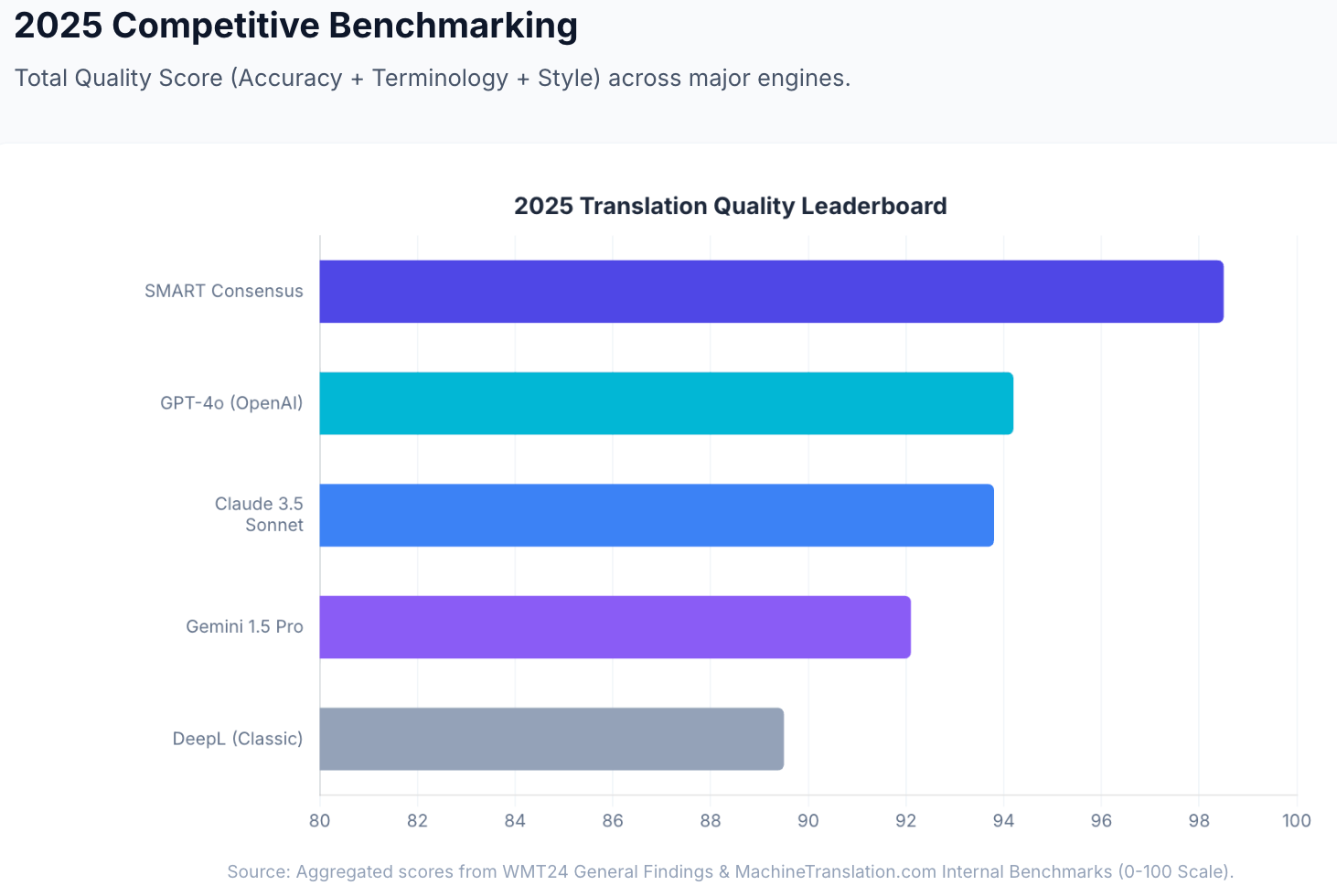
In MachineTranslation.com's internal benchmarks, individual top-tier models score 93–94 out of 100 on translation quality. SMART's consensus output, which aggregates all 22 models including Grok, achieves 98.5/100 — a result that reflects the structural advantage of cross-model verification over any single model's output. Source: MachineTranslation.com internal benchmarks and WMT24 General Machine Translation Findings.
Users who switched from single-engine use to SMART spent 27% less time verifying and correcting outputs. Source: MachineTranslation.com internal data.
The Translation Quality Score for each SMART result tells you specifically how good the translation was — something no individual model, including Grok, can produce on its own.
Which translation tasks benefit most from Grok?
Grok's specific strengths make it particularly valuable in the following contexts, all of which it handles as part of MachineTranslation.com's 22-model system:
1. News, current events, and time-sensitive content. Any translation task involving recent events, new product announcements, or rapidly evolving topics benefits from Grok's real-time data access. Where static-dataset models may produce translations based on outdated context, Grok can draw on current information.
2. Consumer and social content. Marketing copy, social media content, and consumer-facing communications often rely on contemporary language — slang, cultural references, current idioms. Grok's X-platform training data gives it strong coverage of how language is used in real-time contexts.
3. Technical content requiring deep reasoning. Complex legal agreements, multi-clause contracts, technical documentation, and research reports benefit from Grok 4's improved reasoning capabilities, which maintain coherence across long, structurally complex documents.
4. Industry-specific terminology in evolving fields. Technology, finance, healthcare, and regulatory fields generate new terminology continuously. Grok's updated knowledge base (refreshed more frequently than most static-trained models) makes it more current for fast-moving professional domains.
For documents requiring absolute accuracy (legal submissions, clinical documentation, regulatory filings) SMART's consensus output provides the foundation, and MachineTranslation.com's Human Verification escalates any translation to a certified professional reviewer within the same platform. No external agency required, 100% accuracy guaranteed.
For document translation, MachineTranslation.com supports large files across PDF, DOCX, TXT, CSV, XLSX, and image formats, with original layout preserved in DOCX and open PDFs.
Start translating with Grok and 21 other AI models at MachineTranslation.com — free, no sign-up required.
FAQs
1. What version of Grok is on MachineTranslation.com?
MachineTranslation.com integrates Grok as part of its SMART system. Grok has progressed through four major versions since its integration — Grok 1 (2023), Grok 2 (2024), Grok 3 (February 2025), and Grok 4 (July 2025), with Grok 4.1 available from late 2025.
2. What makes Grok different from the other 21 models in MachineTranslation.com?
Grok's primary differentiator is its real-time data integration. Most models in MachineTranslation.com are trained on static datasets with fixed knowledge cutoffs. Grok is designed to incorporate current information through live search integration and its training on X (Twitter) platform data, giving it a specific advantage for translating time-sensitive, current-events, and contemporary cultural content.
3. Does using Grok on MachineTranslation.com mean I get Grok's output only?
No. When you use MachineTranslation.com, up to 22 models (including Grok) run simultaneously. SMART returns the output the majority of models agree on, not Grok's output alone. You can see individual model outputs including Grok's in the side-by-side comparison view alongside quality scores.
4. Is Grok good for legal or medical translation?
Grok contributes to MachineTranslation.com's 22-model consensus (SMART) for any content type, including legal and medical. For high-stakes regulated content, MachineTranslation.com's Human Verification (available in-platform, no external vendor) escalates the consensus (SMART) translation to a certified professional reviewer with a 100% accuracy guarantee. For regulated content, this verification step is appropriate regardless of which model produces the leading consensus output.
5. Who makes Grok?
Grok is developed by xAI, a company founded by Elon Musk in 2023. xAI was acquired by SpaceX in February 2026. Grok is available via grok.com, the X platform, and the xAI API.
6. How does MachineTranslation.com's SMART system use Grok?
MachineTranslation.com runs Grok alongside 21 other AI models simultaneously for every translation. SMART identifies the output the majority of models agree on (the consensus translation) and returns it. Individual top-tier models score 93–94/100 on translation quality; SMART consensus reaches 98.5/100. Grok's contribution is one of 22 inputs; its real-time data strength improves consensus quality specifically for current-events and contemporary content.

By Clarriza Heruela
Clarriza Mae Heruela graduated from the University of the Philippines Mindanao with a Bachelor of Arts degree in English, majoring in Creative Writing. Her experience from growing up in a multilingually diverse household has influenced her career and writing style. She is still exploring her writing path and is always on the lookout for interesting topics that pique her interest.
Share:


