May 21, 2026
The one thing most AI translation tools are missing
I have spent nearly two decades in the translation industry. I have watched it go from rule-based systems that produced near-unreadable output, to neural machine translation that could handle standard content reliably, to today's large language models that genuinely impress professional linguists on their best days.
The technology has moved faster than most people in the industry predicted. And I say that as someone who was skeptical for a long time.
But the more I have watched AI translation mature, the more one gap stands out. Not in the quality of the models themselves, that has improved dramatically. The gap is in what happens when the model gets it wrong. Specifically: what happens to the person who sent that translation before they found out.
The problem with "probably accurate"
When you use any AI translation tool today, you get an answer. It looks confident. The grammar is clean. The phrasing is fluent. And most of the time, it is accurate enough for what you need.
The problem is that small fraction of the time when it is not. Because the output looks exactly the same whether the model got it right or not.
Internal analysis tracking AI translation errors over the past five years shows something important about where the industry stands in 2026. In 2020, the majority of AI translation errors were syntactic — wrong word order, incorrect conjugation, clumsy sentence construction. You could spot them on a read-through. Today, surface errors have dropped to near zero. What remains are semantic errors: wrong register, wrong cultural framing, a term that is technically correct but lands differently in the target language than it did in the source.
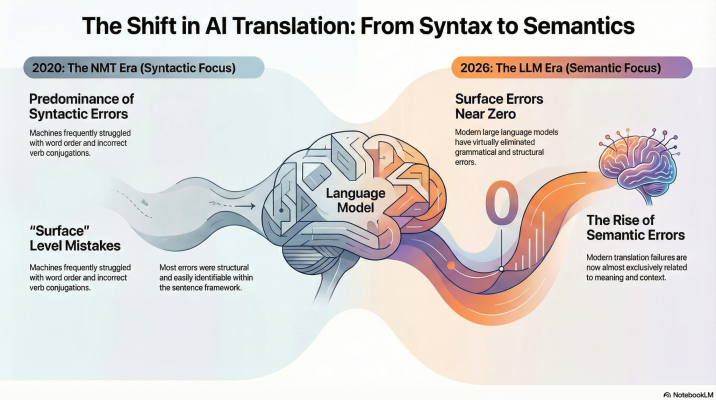
Those errors do not announce themselves. They read fluently. The person receiving the translation has no reason to question it. And the person who sent it often does not speak the target language, which is the whole reason they used a translation tool in the first place.
This is not a criticism of any specific tool. It is the structural condition of single-model AI translation. A model produces its best answer. It has no mechanism to tell you when that answer is wrong. And you have no mechanism to check it without going somewhere else entirely.
What most tools do, and do not do
Go try any of the major AI translation tools right now. DeepL, Google Translate, ChatGPT, any of them. Put in a sentence, get a translation, walk away. The workflow ends there.
Some tools show you quality indicators. Some let you compare outputs side by side. A few enterprise platforms offer human translation as a separate service, through a different product, a different contract, sometimes a different company altogether.
What none of them do is let you escalate a specific translation to a verified human expert from inside the same tool, for a single document, without an agency relationship or a procurement process.
That gap matters more than it sounds. Most people using AI translation for real work are not running enterprise localization pipelines with dedicated vendor management teams. They are freelancers sending deliverables to clients. They are small business owners filing documents with foreign authorities. They are healthcare providers handling patient materials in a language they do not speak. They are individuals navigating bureaucratic processes where a mistranslated phrase has real consequences.
For all of them, "the AI output looks good" is not a professional standard. It is a hope.
Why this gap exists
The reason no other consumer-facing AI translation tool offers seamless human verification is not that nobody thought of it. It is that building it properly requires two things that most AI companies do not have.
The first is a network of qualified professional linguists across dozens of language pairs, available to review and verify AI output on demand. That takes years to build and requires ongoing management, quality control, and accountability structures. It is not something you spin up alongside a software product.
The second is the workflow infrastructure to connect that network to individual users in real time — not through a sales process or a project management portal, but through a button in the same interface where the AI translation happened.
Tomedes has been building and managing professional translation networks since 2007. That history is what makes the human verification feature on MachineTranslation.com possible. Over 70% of Tomedes projects now start with AI pre-translation before being refined by human linguists, according to our internal data. The infrastructure was already there. The question was how to make it accessible to people who need it without requiring a full agency engagement.
How it actually works
The workflow is straightforward.
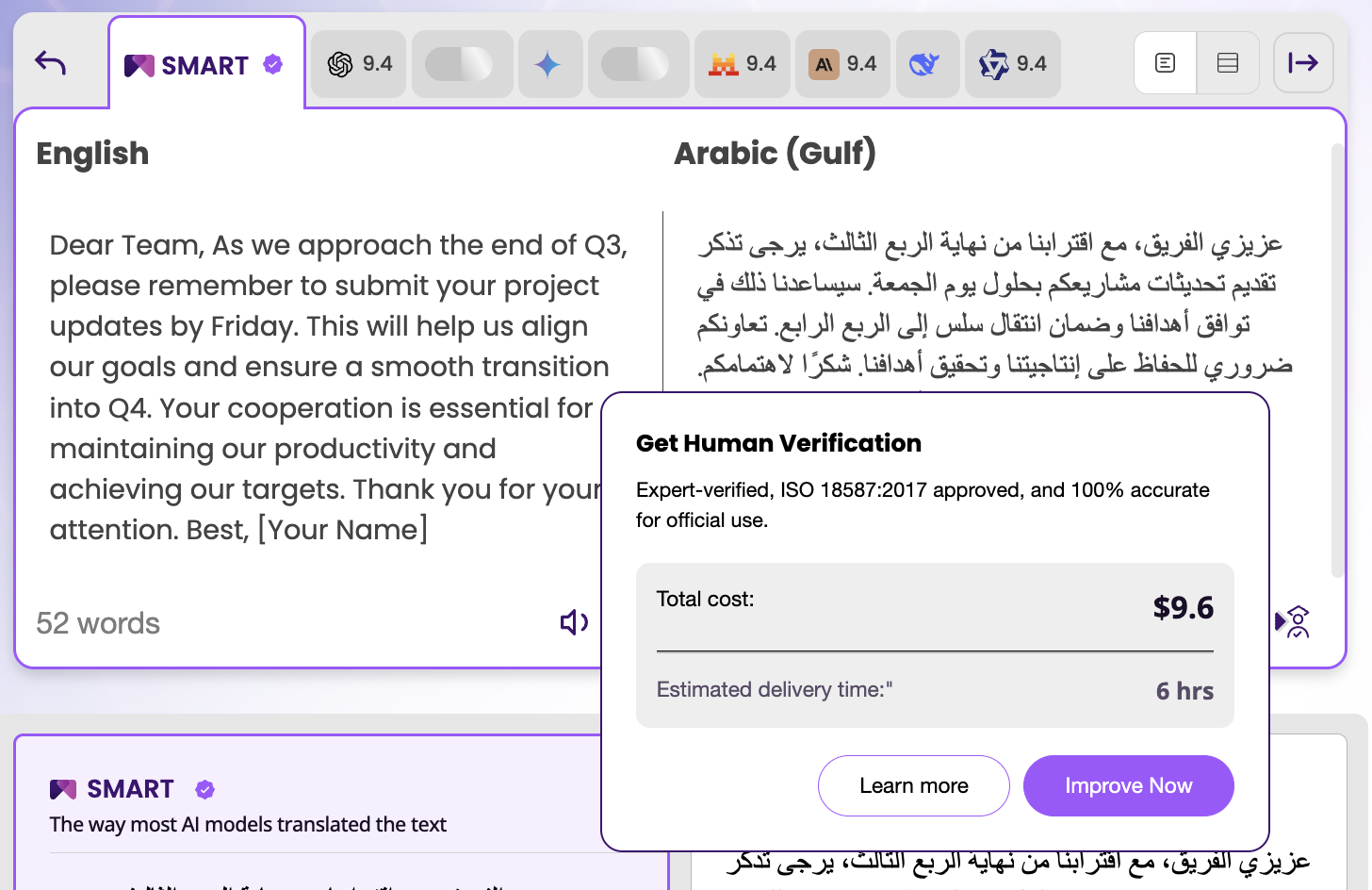
You run a translation on MachineTranslation.com. The platform runs your text through 24 AI models simultaneously and uses a consensus mechanism called SMART to surface the output the majority of models agree on. That alone cuts critical translation error risk by 90% compared to relying on a single engine. For most content, that is where the workflow ends.
But for content where that is not enough (a contract, a regulatory filing, a patient document, anything where an error would have real consequences), you can request human verification directly from that same screen. A professional translator reviews the AI output, makes whatever corrections are needed, and returns it with a 100% accuracy guarantee.
Client retention at Tomedes is 1.8 times higher when a translation project includes at least one human verification stage, per internal tracking. That number makes sense. People are not just looking for a fast answer. They are looking for a result they can stand behind.
What this has done to the translators themselves
Something worth saying, because I hear the "AI is replacing translators" argument constantly and I think it misses what is actually happening.
In a survey of 50 professional translators who work alongside AI tools, conducted by the Tomedes team, 82% said they no longer think of themselves primarily as writers. They identify as architects. In a traditional workflow, a translator spent about 60% of their energy on construction (grammar, syntax, sentence structure) and 40% on design: tone, cultural nuance, register. Those numbers have now flipped. Linguists spend 90% of their time on design.
When asked whether they would go back to a fully manual workflow if they could, 92% said no.
This is what human-in-the-loop translation looks like from the inside. The AI handles the parts of the job that do not require human judgment. The human handles the parts that do. As the 2025 Slator Pro Guide on Translation AI put it, AI is transitioning translators from task-level execution to outcome-driven supervision. The expert is not at the start of the workflow doing everything from scratch. They are at the end, making the call that matters.
In a survey of professional linguists reviewing SMART outputs specifically, 9 out of 10 said they would feel comfortable recommending the result to a user who does not speak the target language. That is a strong signal about where AI translation quality actually stands today, and equally about how much more confident human experts feel when they are working with a consensus starting point rather than a single model's output.
Who needs this, and who does not
To be direct: not everyone does.
If you translate occasionally, the content is low-stakes, and you are the only one affected by the output, the AI translation on its own is fine. SMART's consensus output is reliable for everyday use. You do not need to escalate every translation to a human reviewer.
The question to ask yourself is simpler: if this translation turns out to be wrong, what happens?
If the answer is "not much," use the AI output and move on. If the answer involves a client, a legal document, a medical record, a regulatory submission, or anything where someone else is relying on the accuracy of what you send — that is when the verification step earns its value many times over.
Most AI translation tools leave that question unanswered. The answer we built is in the platform itself.
Try MachineTranslation.com — Pro Plan from $19/month · 24-Hour Unlimited Translations from $6
Pricing current as of May 2026 and subject to change.
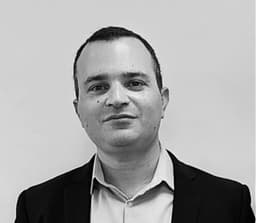
By Ofer Tirosh
Connect on LinkedInOfer founded Tomedes in 2007 and now leads the company's push to combine two decades of human translation expertise with AI. He writes about where the language industry is actually heading and the shifts nobody's ready for, the bets that paid off, and the ones that didn't.
Share:


