September 24, 2026
Is it safe to use ChatGPT to translate a confidential business email?
Not by default, no. On ChatGPT's personal plans, Free, Plus, and Pro alike, your content can be used to train future versions of the model unless you go find a setting and turn it off yourself. A client email, a customer-service reply, an internal memo, a quick message to a vendor, whatever business text someone pastes in for a fast translation is training data unless that setting's already been changed. Most people haven't touched it.
That's the part everyone asks about. It's not the part that should worry you most.
What actually happens to your email when you paste it into ChatGPT?
OpenAI is straightforward about this once you know where to look. Its own policy states that content from ChatGPT, Sora, and Operator may be used to train its models, and that you have to actively opt out through a privacy portal or your account's Data Controls settings if you don't want that. Business, Enterprise, Edu, and API accounts are excluded from training by default. Personal accounts are not, and a personal account is exactly what most employees are using when they open a browser tab to translate something quickly.
In practice, that means a customer-service reply, an internal memo, or a client email pasted into a personal ChatGPT account becomes part of the pool of text OpenAI uses to improve future models, names, figures, client details, and all, unless someone on your team has already gone into settings and turned that off. Most people simply never open that settings menu before pasting in a paragraph they need translated in the next two minutes.
Does paying for ChatGPT fix the privacy problem?
This is the assumption that trips up a lot of otherwise careful teams: that upgrading to a paid personal plan solves it. It doesn't. ChatGPT Plus and Pro are still personal accounts, and both default to training on your content the exact same way the Free plan does. What actually matters is personal versus business, not Free versus paid. Only ChatGPT Business, Enterprise, Edu, and API-based access exclude your content from training by default, and those come with a very different setup than someone typing into chat.com on their lunch break.
What actually changes between plans
- Free, Plus, Pro (personal): trains on your content by default. Opt-out exists, but requires manually disabling it in Data Controls.
- Business, Enterprise, Edu, API: excluded from training by default. Built for organizations that set this up deliberately, not for pasting one email between meetings.
Paying more for a personal plan changes speed and features. It does not, on its own, change what happens to the content you paste in.
What does MachineTranslation.com do differently?
This is the part where I'd rather show you than just assert it. It's also stated plainly on the pricing page: content isn't used for training or shared with third parties, full stop, not a setting you opt into.
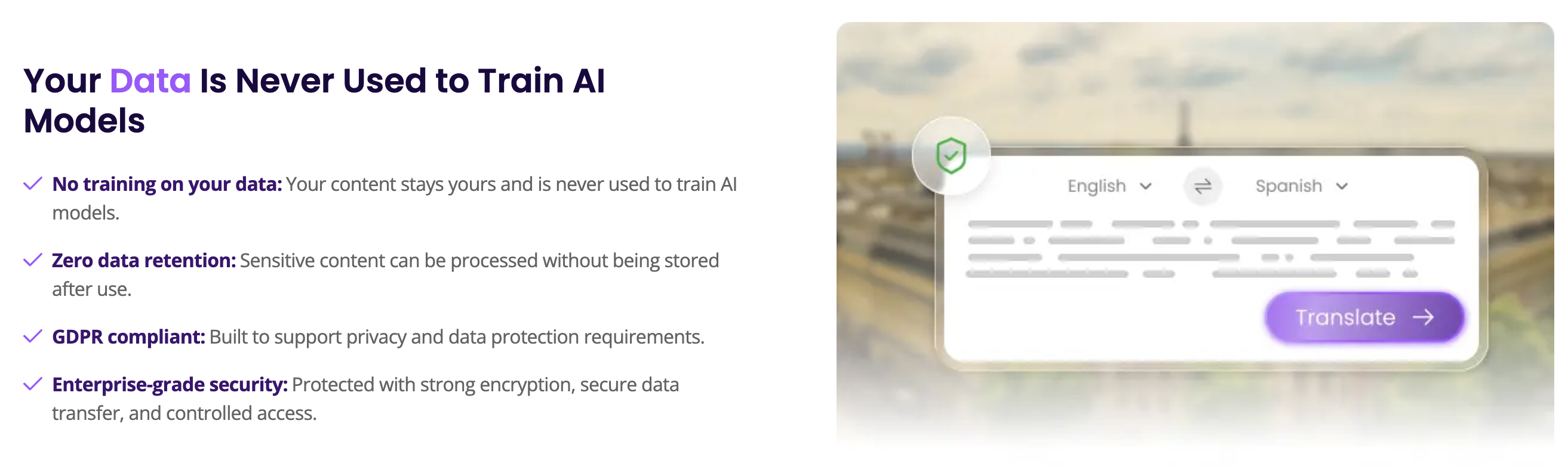
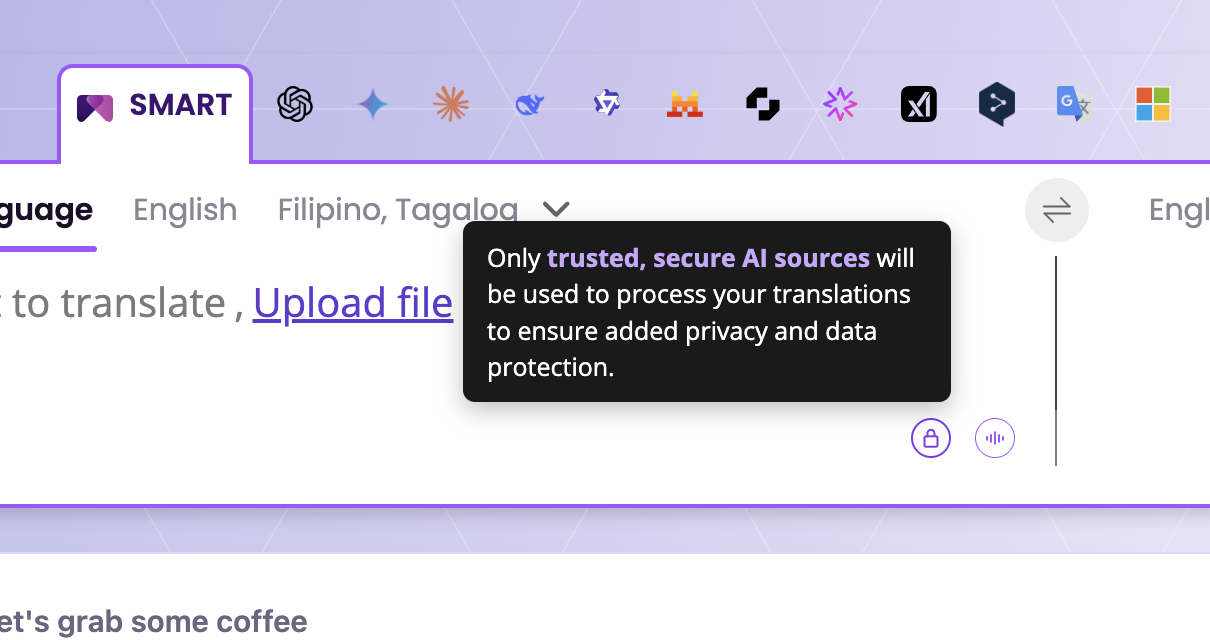
Those four protections apply at the account level. You don't need to find a setting before pasting in a client email, because the default works the other way around: you're excluded from training unless you choose otherwise. On top of that, Secure Mode restricts processing to AI sources the platform has already vetted as SOC 2-compliant, so sensitive content isn't routed through whichever engine happens to be fastest that day. As Shashank Jain, Head of Technology at Tomedes, put it when the feature launched: not all AI is created equal, and the point of Secure Mode is to remove the burden of researching every engine's data practices yourself.
Can you get this without leaving ChatGPT?
Yes, and this is worth knowing before you assume the fix means switching tools every time. MachineTranslation.com's MCP connector lets you connect the platform directly to ChatGPT itself, or Claude, or Cursor, or any other MCP-compatible assistant. Once it's connected, you can ask ChatGPT to translate something and it calls MachineTranslation.com behind the scenes, running the text through 22 models and returning the version they agree on, in the same chat window you were already using.
Two things worth knowing so this doesn't sound like more than it is: the MCP connector is available to paid subscribers, not the free plan, and connecting it means signing into your MachineTranslation.com account. What it does solve is the tab-switching excuse. If the reason a business email gets pasted into plain ChatGPT is that opening another tool feels like friction, that friction is now optional.
Does a private translation mean it's also accurate?
No, and this is the question almost nobody in the privacy conversation is asking. Keeping a translation private controls who sees the text and what happens to it afterward. It says nothing about whether the translation itself is correct. A tool can meet every privacy standard on the list above and still mistranslate a term, soften a deadline, or shift the tone of an email from firm to casual, and there's nothing in a fluent, confident-sounding output that would tell you it happened.
Take an ordinary line from the kind of email this whole piece is about: "Please confirm the updated delivery date works on your end. If the shipment doesn't leave by Thursday, we'll need to push the launch back a week." Nothing unusual about it, the kind of sentence that gets pasted into a translator a hundred times a day. But it's carrying a firm deadline, a conditional consequence, and a request for confirmation all at once, exactly the kind of sentence where tone and formality can quietly shift between models even when the surface meaning holds.
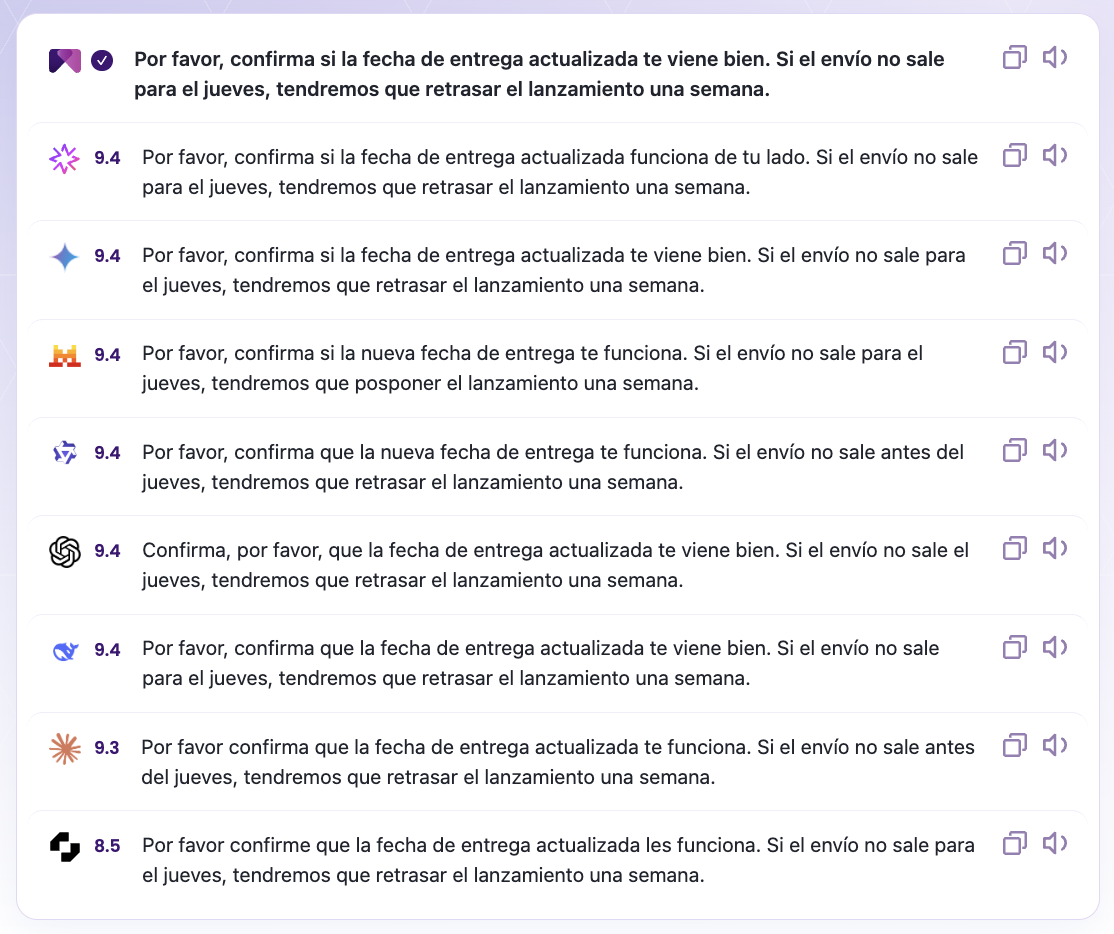
The divergence here wasn't dramatic, nothing reversed the meaning of the sentence. But it was real and visible: seven models agreed closely on tone, one didn't, and the one that didn't scored lower for it. That's the whole point. A single model gives you one confident-sounding answer with no way to know which side of that split it landed on. Seeing all eight side by side is what turns an invisible risk into a visible one.
Privacy and accuracy solve two different problems, and it's easy to assume that fixing one fixes the other. Secure Mode and zero data retention control who can see the text and what happens to it afterward. Neither one checks whether the translation itself is right. That's a separate question, and it's the one you catch by comparing what multiple independent models produce for the same sentence, not by locking the sentence away more tightly.
That's what MachineTranslation.com is actually for. Every translation runs through multiple independent AI models at once, and the version they agree on is the one you get. When the models land on the same answer, that agreement means something. When they don't, that's exactly the signal that a term or a phrase needs a second look before the email goes out, a pattern we've documented directly in our own head-to-head model testing.
Before you translate a business email with any AI tool
A short list worth pinning somewhere your team will actually see it:
1. Check whether it's a personal or business account. Personal ChatGPT accounts, even paid ones, train on your content by default. Business and Enterprise accounts don't.
2. Look for a default that protects you, not a setting you have to find. A tool that requires you to locate an opt-out is a tool that's private for the people who already knew to look.
3. Remember that privacy and accuracy are separate questions. A private translation can still be wrong. Ask both questions, not just one.
4. Treat model disagreement as useful information, not noise. A tool that shows you where independent models disagree is giving you a real signal. A single confident answer isn't.
Personal ChatGPT vs. MachineTranslation.com, for a pasted business email
| Question | ChatGPT (personal account) | MachineTranslation.com |
|---|---|---|
| Trains on your content by default? | Yes, unless you opt out | No |
| Data retained after use? | Yes, per account settings | Zero data retention available |
| Restricted to vetted, compliant sources? | No | Yes, via Secure Mode |
| Output checked against other models? | No, single model | Yes, consensus across multiple models |
None of this makes ChatGPT a bad tool. It makes it a tool built for a different default than a business handling a client's email. The fix is straightforward: make sure the defaults you're relying on actually match what you're using the tool for, and check both questions separately, who can see this text, and is the translation actually right, rather than assuming a good answer to one means a good answer to the other.
Frequently asked questions
1. Is it safe to use ChatGPT to translate a confidential business email?
Not by default. On ChatGPT's Free, Plus, and Pro personal plans, your content can be used to train future models unless you manually opt out in settings. A confidential business email pasted in for translation isn't private unless you've changed that setting yourself.
2. Does ChatGPT use my data to train its models?
Yes, on personal accounts. OpenAI's own policy states that content from ChatGPT, Sora, and Operator may be used to train its models unless you opt out through the privacy portal or your Data Controls settings. Business, Enterprise, and API accounts are excluded from training by default.
3. Does paying for ChatGPT Plus make my data private?
No, not automatically. ChatGPT Plus and Pro are personal plans, and both default to training on your content the same way the Free plan does. Only Business, Enterprise, Edu, and API accounts are excluded from training by default.
4. What does MachineTranslation.com do differently for sensitive business content?
Content is never used to train AI models, sensitive material can be processed with zero data retention after use, and Secure Mode restricts processing to SOC 2-compliant AI sources only. These are default account-level protections, not a setting you have to find and enable yourself.
5. Does a private translation mean it's also accurate?
No. Privacy controls decide who can see your text and what happens to it afterward. They don't check whether the translation itself is correct. A single AI model can produce a fully private translation that still gets a term or a tone wrong, which is a separate problem that requires comparing multiple models against each other.
6. What should you never paste into ChatGPT to translate?
Anything you wouldn't want to end up in a future model's training data on a personal account: client names, contract terms, financial figures, health information, or credentials. If the content needs to stay private, use a business account or a tool that excludes your content from training by default, rather than relying on a personal ChatGPT account.
7. Can you get MachineTranslation.com's consensus translation inside ChatGPT?
Yes, through MachineTranslation.com's MCP connector, available to paid subscribers. Once connected, ChatGPT can call MachineTranslation.com directly, so a translation request in the same chat window runs through 22 models and returns the version they agree on, instead of a single model's answer.

By William Mamane
Connect on LinkedInWilliam leads marketing and growth at Tomedes, where he turns SEO experiments and real campaign data into the strategy behind MachineTranslation.com's reach. He writes about how AI products actually get found and trusted plus the tactics that work, the ones that don't, and what search is rewarding right now.
Share:


