May 21, 2026
We built a daily language puzzle — Here's why MachineTranslation.com made a game
We are an AI translation platform. Our job is to help people move words between languages — fast, accurately, and without friction. So why did we just launch a game?
That's exactly the question worth answering. Today we're shipping LinguaBoard, a free daily language puzzle built by MachineTranslation.com. A new puzzle drops every day. You get 9 guesses to fill a 3×3 grid. And somewhere in the process, you'll probably realize how little you knew about the languages you thought you knew well.
This post is about the game — how it works, what it's testing, and why we built it. Consider this our official launch dispatch.
What is LinguaBoard?
LinguaBoard is a daily language trivia puzzle. The setup is deceptively simple: a 3×3 grid, with three row categories and three column categories. Every cell needs a language that satisfies both its row and its column at the same time.
Puzzle #2 (May 21, 2026), for example, gave players this board:
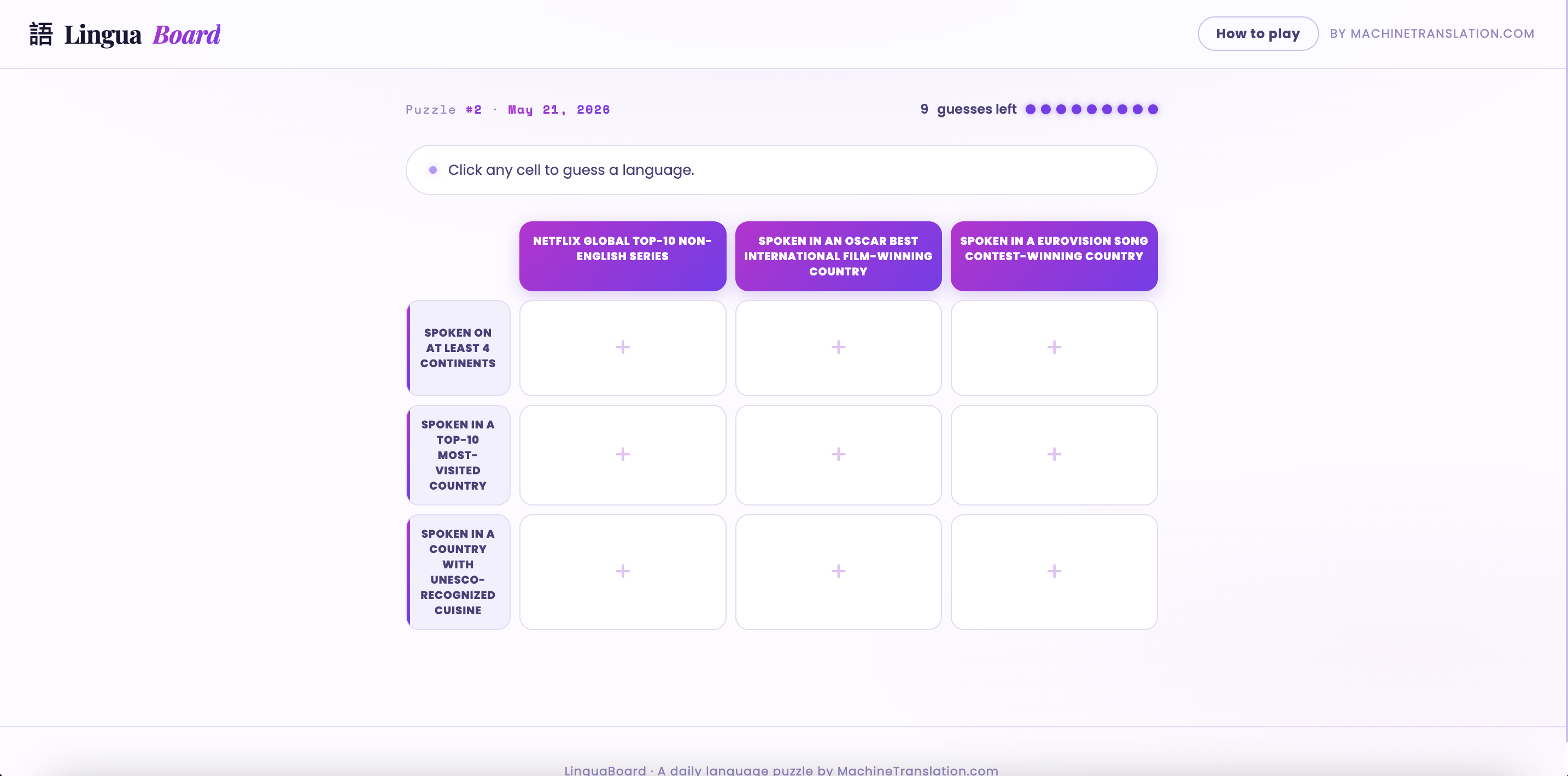
You're not filling in words. You're filling in languages. A language that appears in a Netflix Global Top-10 non-English series and is spoken on at least four continents. A language spoken in a Eurovision Song Contest-winning country and in a country with UNESCO-recognized cuisine. The categories are cultural, geographic, and cinematic — and they overlap in ways that make your brain run through everything it vaguely remembers about where languages are spoken and why.
How the grid works
The grid has 3 rows and 3 columns, 9 cells total. Each cell sits at the intersection of one row category and one column category. To fill a cell correctly, the language you enter must fit both categories simultaneously.
You have 9 guesses across the entire board, not per cell. That means if you use all your guesses testing obvious candidates, you may run out of chances before filling the grid.
What makes it hard (and fun)
The difficulty isn't vocabulary, there's no spelling involved. The challenge is that the categories are designed to create real ambiguity. Many languages will partially fit multiple cells. Spanish is spoken on more than four continents and in several UNESCO-recognized cuisine countries — but does that combination land in the right cell, and is Spanish too obvious an answer to score well?
That last question is the real hook.
Why did a translation tool build a word game?
💬 "We built LinguaBoard because we think about languages the way sports fans think about stats — obsessively, and for the love of it. MachineTranslation.com exists to make translation useful, but we also wanted to create something that celebrates how interesting languages are in their own right. A daily puzzle felt like the right format: quick, competitive, and genuinely difficult if you're not paying attention to the world."
— Ofer Tirosh, CEO, MachineTranslation.com
The honest answer: we think about languages all day. Not just as strings of text to be converted from one format to another, but as living systems — bound to cultures, geographies, film industries, food traditions, and song competitions. That's actually the domain knowledge that makes good translation possible.
LinguaBoard is a way to share that perspective with people who might never need a translation tool today, but who find languages interesting in the same way we do.
There's also a practical observation behind it. The people who care most about translation quality tend to be the same people who are curious about languages in general — who notice when a subtitle feels wrong, who wonder what language that film was originally made in, who can name the countries where French is spoken without looking it up. LinguaBoard is built for that person.
Engagement beyond the translation box
We ship a lot of things that are clearly functional. A translation interface. API access. Document upload. Human verification. All of it is useful in a specific transactional moment — you need something translated, you use the tool, you move on.
A daily puzzle is different. It creates a reason to come back that isn't tied to having a translation job to do. And in building it, we learned that the categories we find most interesting to design are the same categories that reveal how interconnected languages, cultures, and creative industries actually are.
The connection between trivia and language curiosity
The best categories in LinguaBoard aren't the ones with obvious answers. They're the ones where you're genuinely uncertain — where you work through your mental map of languages spoken in Eurovision-winning countries and realize you know less than you thought, then go away and know more than you did. That's the same mechanism that makes language learning work: productive uncertainty followed by resolution.
We're not claiming LinguaBoard teaches you a language. But it might teach you that Korean is spoken in a country with UNESCO-recognized cuisine. And that's a start.
How to play LinguaBoard
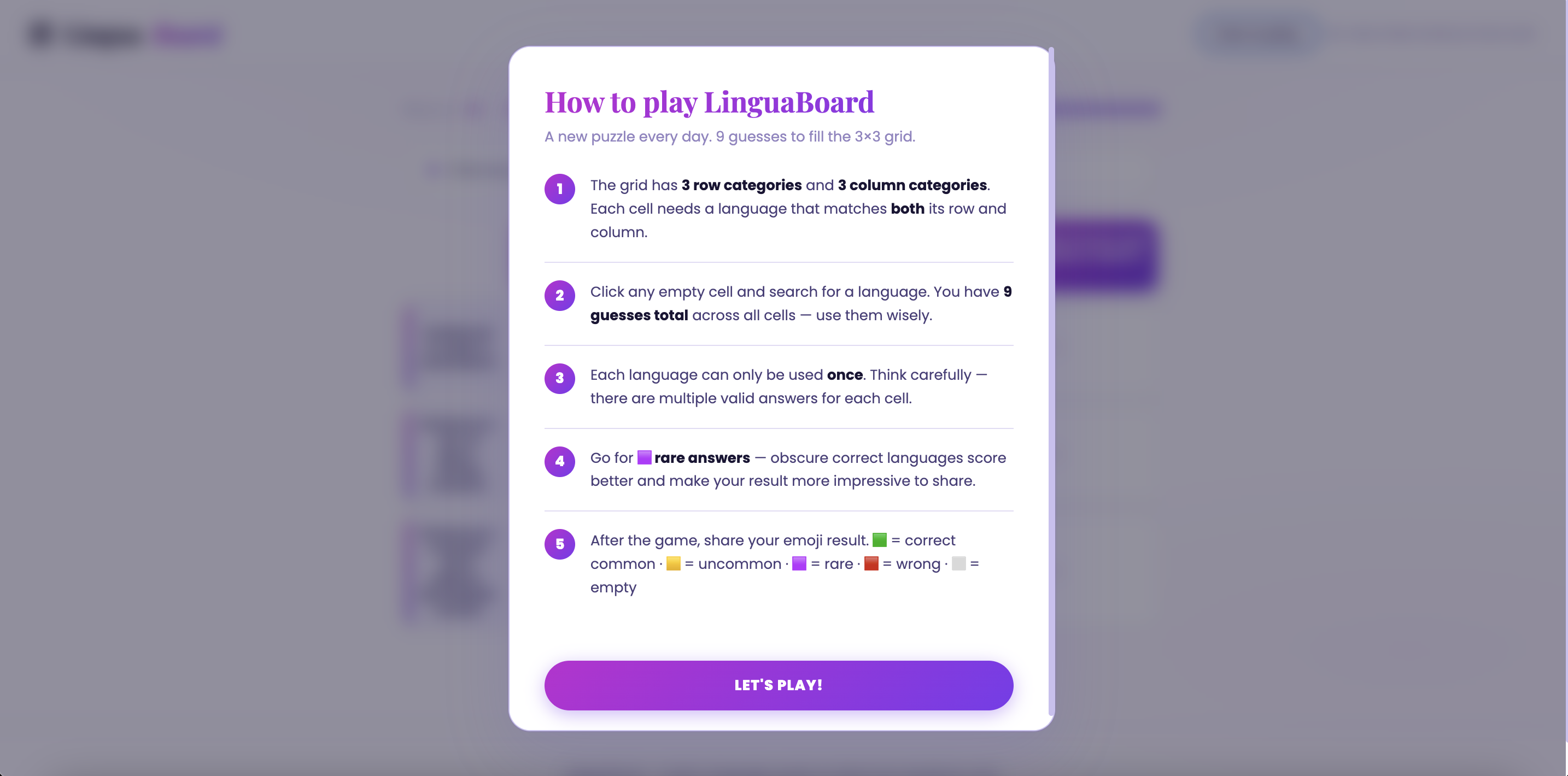
Step 1 — Read the categories
Before guessing anything, read all six category labels — three rows, three columns. Map out which cells feel immediately solvable and which require more thought. Don't guess yet.
Step 2 — Guess a language for each cell
Click any empty cell and type a language name. If it fits both categories, it fills the cell. If it doesn't, you lose one of your 9 guesses across the whole board.
Each language can only be used once. If you've placed Spanish in one cell, you cannot use it in another — even if it technically qualifies. This forces you to think about the grid as a whole rather than solving cells in isolation.
Step 3 — Aim for rare answers
Here's the twist: common answers score lower than rare ones. If you fill a cell with Spanish or English, you'll get credit — but the obscure-correct language scores better and makes your shareable result look more impressive.
After finishing, you share your result as an emoji grid:
- 🟩 = correct, common answer
- 🟨 = correct, uncommon
- 🟪 = correct, rare
- 🟥 = wrong
- ⬜ = empty
The goal isn't just to complete the puzzle. It's to complete it with purple.
What "rare" means, and why it matters
Rarity in LinguaBoard is determined by how often players use a particular language in a given cell. If hundreds of people enter French for a cell that French technically satisfies, French becomes the "common" answer for that cell. A language that only a few players find (Catalan, Wolof, Occitan) becomes rare.
This means the puzzle is self-calibrating. The community collectively defines what counts as rare through their guesses. It also means that showing off a rare result is genuinely meaningful, you found something that most players didn't.
It's also a quietly useful signal for us. The languages players reach for first, the ones they test and abandon, the rare answers that slip through — all of that tells us something about how people think about language geography. That's interesting data for a company that thinks about languages all day.
A new puzzle every day
LinguaBoard publishes a new puzzle every day. Puzzle #1 launched this week; Puzzle #2 went up today. Each puzzle has a unique combination of row and column categories — new cultural references, new geographic criteria, new overlaps to find.
The daily cadence is intentional. The puzzle is short enough to play in a few minutes, which means it fits in a coffee break or a commute. The 9-guess limit creates enough pressure to make each session feel meaningful without being punishing. And the shareable emoji result gives you a reason to come back and compare with yesterday.
If you're the type of person who plays Wordle daily, or who has strong opinions about which countries have the most underrated cinema — LinguaBoard is probably for you.
Play LinguaBoard
Play today's LinguaBoard puzzle — it's free, no account required.
New puzzle every day. Share your result. Come back tomorrow.
LinguaBoard is built by MachineTranslation.com — an AI translation tool that, apparently, also thinks about language puzzles.
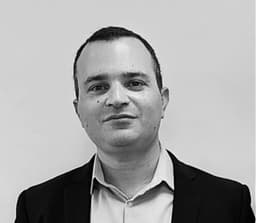
By Ofer Tirosh
Connect on LinkedInOfer founded Tomedes in 2007 and now leads the company's push to combine two decades of human translation expertise with AI. He writes about where the language industry is actually heading and the shifts nobody's ready for, the bets that paid off, and the ones that didn't.
Share:


