November 11, 2026
How to translate a manuscript or book for a foreign edition
Use AI to produce a consistent first draft of the whole manuscript, then have a native literary translator rewrite and approve it before you publish. Confirm first that you hold the right to translate the book, and declare the AI translation to your retailer where it asks, because Amazon KDP treats an AI-created translation as AI-generated even after heavy editing.
A translated manuscript looks finished long before it is. The sentences are grammatical and the chapters line up, and nothing on the screen shows that a character now addresses her mother formally or that a joke has turned into a plain statement. That gap between a draft and an edition is where the work and the risk sit, and it is what this guide covers.
It is written for a book you wrote or hold the translation rights to. It is not legal advice, and retailer rules change, so every dated check below is worth repeating before you publish.
Key Takeaways
- Rights come first. A translation is a derivative work, and only the copyright owner or someone the owner authorizes may prepare one.
- Readers still prefer human translations. In a June 2026 preprint they chose the human version in 522 of 772 side-by-side comparisons, and in a small test into non-English languages the preference was much sharper.
- An AI draft fails quietly on idioms, forms of address, register, and names. Where models disagree, send the passage to a person.
- Amazon KDP counts an AI-created translation as AI-generated, even after substantial edits. A translation a person writes and polishes with AI is AI-assisted.
- Use AI for the whole-manuscript first draft and the review list, then hand both to a native literary translator, starting with a sample chapter.
Can you publish an AI translation of your book as a foreign edition?
You can, with a person in the loop before it goes on sale. AI produces a consistent draft of a whole manuscript quickly. A native literary translator or editor decides whether it reads like your book in the new language, and your retailer may require you to declare that an AI tool created the translation.
I would not put an unreviewed AI translation of a novel on sale under my own name. The sections below show why, using a June 2026 reader study, our own tests, and the written rules that apply to a foreign edition.
Do you have the right to translate your book?
A translation is a derivative work. The U.S. Copyright Office’s circular on derivative works lists translations among them and says only the copyright owner, or someone the owner authorizes, may prepare one.
If you wrote the book and kept your rights, you can authorize the translation yourself. If you sold translation rights to a publisher or agent, they may control the foreign edition, so read the contract before you commission anything. If the book is someone else’s, you need their written permission. Amazon’s guidelines also make authors and publishers responsible for making sure their content does not violate copyright. Rules differ by country, so ask a publishing lawyer when the contract is unclear.
What do readers think of AI-translated novels?
The best recent evidence is a June 2026 preprint from Simon Fraser University and collaborators. Fifteen avid readers compared published human translations of 15 recent novels, from French, Polish, and Japanese into English, with translations from a strong agentic AI pipeline. Each excerpt ran about 8,000 words.
Readers found the AI version “fine” and still preferred the human one. They chose it in 19 of 30 excerpt comparisons, which was not statistically significant, and in 522 of 772 side-by-side chunk comparisons, which was. Human translations had four times the odds of a higher rating as an acceptable published translation. Readers also could not reliably tell the two apart, with 17 of 30 correct guesses.
Two details matter for an author. The AI translation’s quality varied more within a single book than the human one, and the share of chunks where readers preferred it ranged from 4% to 88% depending on the book. And the study mostly translated into English, which the authors chose as the strongest case for AI. In a small exploratory test into Spanish, French, Polish, and Japanese, readers preferred the human translation in 103 of 111 chunk comparisons, and the authors caution that the English results may not carry over. A foreign edition of an English book goes the other way.
It is a preprint, it used the openings of novels rather than whole books, and it had 15 readers. In the same study, automatic metrics, including AI judges, favored the AI translation, which disagrees with what readers said. We treat agreement between our 22 models the same way: it flags where to look, and a reader or editor decides whether a passage works.
Where does an AI draft go wrong in a novel?
We call the failures that matter most silent failures. The sentence is grammatical, so nothing flags it, and a consensus of models cannot catch what every model in the pool gets wrong.
Idioms show it. In our Hebrew idiom test, seven models translated “to eat movies,” a phrase meaning to be paranoid, and none produced the correct meaning. They fell into three different failure patterns. When the dominant cluster of models is wrong, consensus lands in the middle of that cluster, so the divergence among models is the signal to send a passage to a person.
Register is quieter. In our English-to-Spanish and English-to-French tests, all ten models, in both languages and both rounds, answered a customer-facing business message with informal address where formal address was called for, and expanding the pool from five models to ten did not change that. In a novel, the same default can put characters on the wrong footing with each other, on every page where they speak.
Names and recurring terms are the third. They repeat across hundreds of pages, and a fragment translated on its own can drift from the rendering used a chapter earlier. Step 3 below pins them.
What do you have to disclose when AI translates your book?
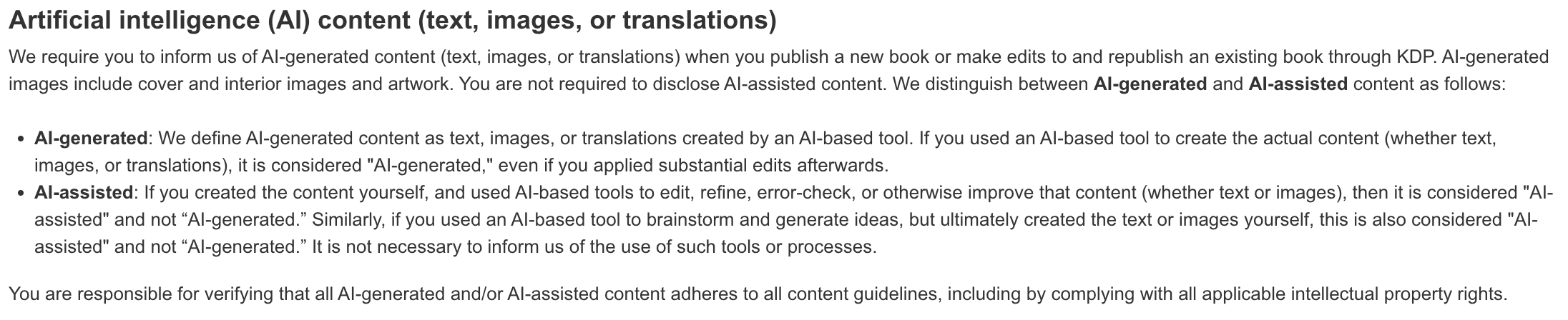
Amazon’s KDP content guidelines, read on November 11, 2026, ask you to tell Amazon about AI-generated text, images, or translations when you publish or republish a book. They define AI-generated content as content created by an AI-based tool, and they say it stays AI-generated even if you apply substantial edits afterward.
How your workflow maps to Amazon KDP's disclosure rule
| Workflow | Who creates the translated text | KDP classification | Disclose to KDP? |
|---|---|---|---|
| An AI tool translates the manuscript and a person edits the result | The AI tool | AI-generated translation | Yes |
| A person translates the book and uses AI to proofread or refine it | The person | AI-assisted | No |
Under that wording, a human edit of an AI draft belongs in the first row. A translation a person writes and then polishes with AI belongs in the second. If your workflow falls between the two, ask KDP support before you publish, and check the rules of any other retailer or distributor you use, since each sets its own. KDP also requires a translated book to credit the translator and the original author in the contributor field.
How do you translate a manuscript for a foreign edition, step by step?
Seven steps, in the order that protects the book.
Step 1: Confirm your rights and pick the route
Check that you hold the translation rights, or get them in writing, as described above. Then decide how the translated text will be written: by a person who may use AI to polish it, or by an AI tool that a person then edits. The table above shows what each choice means at checkout.
Step 2: Lock the English text and prepare the file
Translate after the source text is final, because every later change has to be made again in every language. Use the Word source with tracked changes accepted and comments removed, and keep chapter headings consistent. MachineTranslation.com accepts DOCX, PDF, TXT, RTF, ODT, and other formats up to 70MB. EPUB and Kindle formats are not on that list.

Step 3: Write a one-page style sheet and pin your names
List the main characters and places and say whether each name stays or adapts. Note how characters address each other, formally or informally, and in which relationships. Key Term Translations pins up to 10 names and terms per document, shows the share of the 22 models that agree on each rendering, and lets you choose one for the whole file. Keep the sheet, because the human translator will need it too.
Step 4: Translate the whole manuscript as one file
Upload the manuscript on the Document translation page as one file instead of pasting chapters into a chat window. A 90,000-word novel is far under the 70MB limit and under the 100,000-word daily fair-use limit for layout downloads. MachineTranslation.com processes documents without storing them or using them for AI training.
Step 5: Read the agreement signals and build the review list
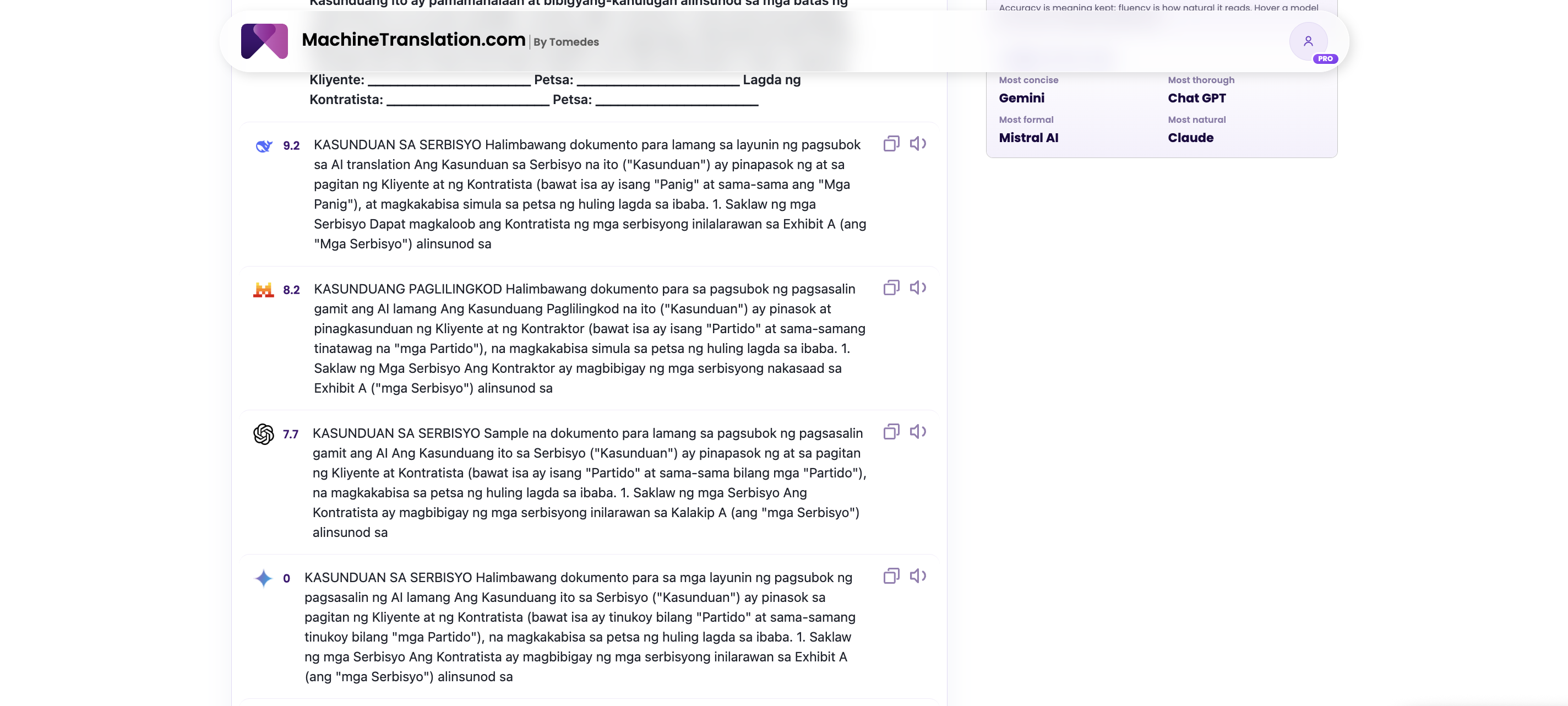
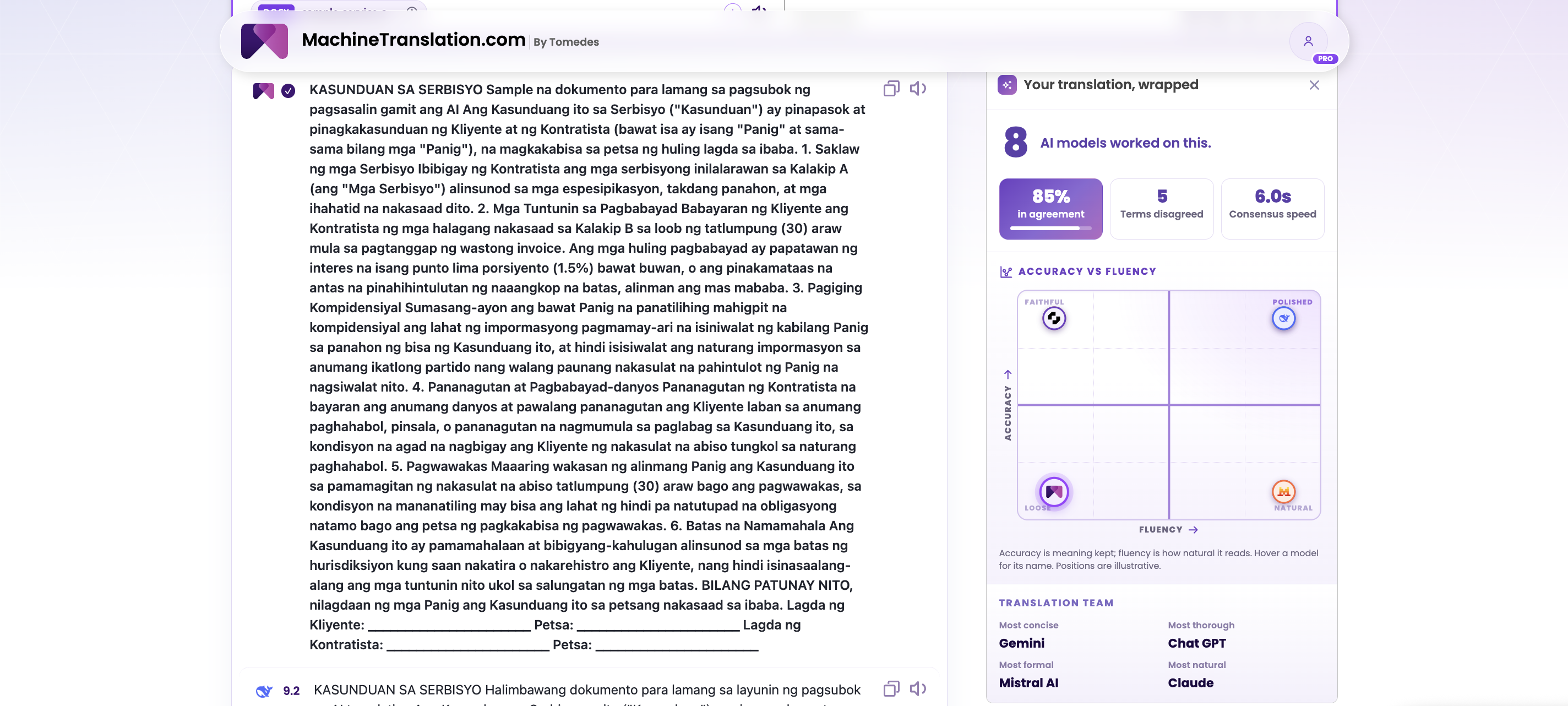
Open the consensus view. It shows how many models worked on the file, the percentage in agreement, and how many terms they disagreed on. Our rule of thumb is that 90% agreement with zero or one disputed term is a strong candidate to read as it is for everyday text, and that agreement in the mid-80s or several disputed terms is a reason to bring in a person.
For a novel I would go further. List every disputed term, every idiom, every joke, and every exchange where characters change how they address each other. That list is the brief for the human pass.
Step 6: Hand the draft to a native literary translator, starting with a sample
Give the translator the source, the AI draft, your style sheet, and the review list, and ask for a sample chapter before you commit to the whole book. Tomedes’ literary translation team works with native literary translators, and its own guidance lists poetry and literary works among the least suitable cases for machine translation, which is a fair reason to budget for this step.
If you want a professional linguist to check a short sample first, Human Verification includes 2,000 words a month on Pro and is available as an add-on at $0.04 per word. It is an accuracy review, so keep the literary pass for a literary translator.
Step 7: Credit, declare, and translate the metadata
Add the translator and the original author to the contributor field, declare the AI translation if your route requires it, and translate the title, subtitle, and description as part of the edition so they read the way the book does. Keep the final translated file, the style sheet, and the review list together. A second language or a revised edition starts from them.
With the rights confirmed, the draft built from one file, and the disagreements listed, you can hand a translator a brief that already marks where the problems are. You can upload your manuscript on the Document translation page to produce that first draft.
Frequently asked questions
1. Can I use AI to translate my novel and publish it?
Yes, with a person in the loop before publication. AI can draft a consistent translation of a whole manuscript quickly, but readers in a June 2026 preprint still preferred human translations, and drafts miss idioms and forms of address. Have a native literary translator rewrite and approve the draft, and declare the AI translation where your retailer requires it.
2. Do I have to tell Amazon my book was translated with AI?
Under Amazon's KDP content guidelines, yes, if an AI tool created the translation, even when you edit it substantially afterward. A translation a person writes and then polishes with AI is AI-assisted and needs no disclosure. KDP also requires a translated book to credit the translator and the original author in the contributor field.
3. Do I need permission to translate a book?
Yes, from the copyright owner. The U.S. Copyright Office lists translations as derivative works and says only the owner, or someone the owner authorizes, may prepare one. If you wrote the book and kept your rights, you can authorize the translation yourself. If a publisher holds translation rights, check your contract first.
4. How do I translate a Word manuscript with AI?
Upload the DOCX on the Document translation page as one file, choose the target language, and pin up to 10 names and terms with Key Term Translations first. Read the agreement signals, then pass the draft and your list of disputed passages to a native literary translator. EPUB and Kindle files are not supported, so use the Word source.
5. Can AI translate dialogue and idioms in fiction?
It can translate them, but it misses some. In our Hebrew idiom test, none of seven models produced the correct meaning, and in Spanish and French tests all ten models used informal address for a business message that called for formal address. Flag every idiom and every exchange between characters for a native reader to check.
6. Is my unpublished manuscript safe to upload?
MachineTranslation.com's Document translation page says it processes documents without storing them or using them for AI training, and its pricing page says the Free plan does not store or use your data. If a publisher's contract covers the manuscript, check what it says about sharing text with outside tools before you upload.
7. How much does it cost to translate a book with AI?
It depends on your plan. The Free plan previews long text and unlocks it at $2.50 per 300 words, so a 90,000-word novel is 300 blocks, while Pro and 24-hour plans unlock translations automatically. Human Verification is an add-on at $0.04 per word, and Pro includes 2,000 words a month. A literary translator is a separate cost.

By Rachelle Garcia
Connect on LinkedInRachelle leads product and AI at Tomedes, where she runs the experiments that turn internal data into better translation experiences. She writes about what actually happens when you build AI products such as MachineTranslation.com — the numbers, the surprises, and the parts that don't go to plan.
Share:


