March 26, 2026
How to translate legal and technical documents from English to German
A German contract that says geeignete Garantien where it should say angemessene Garantien is not a style preference. It is a legal distinction. Geeignet means suitable. Angemessen means appropriate in the sense of proportionate. In GDPR compliance language, only one of those terms matches the regulatory standard used by German courts.
When we ran a GDPR clause through MachineTranslation.com's English-to-German translator, 43% of the 22 AI models tested chose the wrong term. They were not making a grammatical error. They were making a legal one.
This article breaks down where AI models fail on German legal and technical documents translation, which specific terms trigger the most disagreement, and how to build a workflow that catches these failures before they reach a client or a regulator.
What makes legal German translation different from general translation
General translation tolerates synonyms. Legal translation does not. In German legal drafting, term selection is governed by established usage in legislation, court decisions, and regulatory frameworks. Swapping one term for a near-synonym can change the legal effect of a clause.
Regulatory terminology that changes meaning with one word
Consider the English phrase "appropriate safeguards" from Article 46 of the GDPR. In German, this has an established translation: angemessene Garantien. The word angemessen carries a specific legal weight – it implies proportionality, a concept embedded in German administrative law.
When we tested this on MachineTranslation.com, 57% of engines correctly produced angemessene Garantien. The remaining 43% chose geeignete Garantien – a term that means "suitable safeguards," which sounds reasonable but does not match the regulatory standard. In a compliance audit, that difference matters.
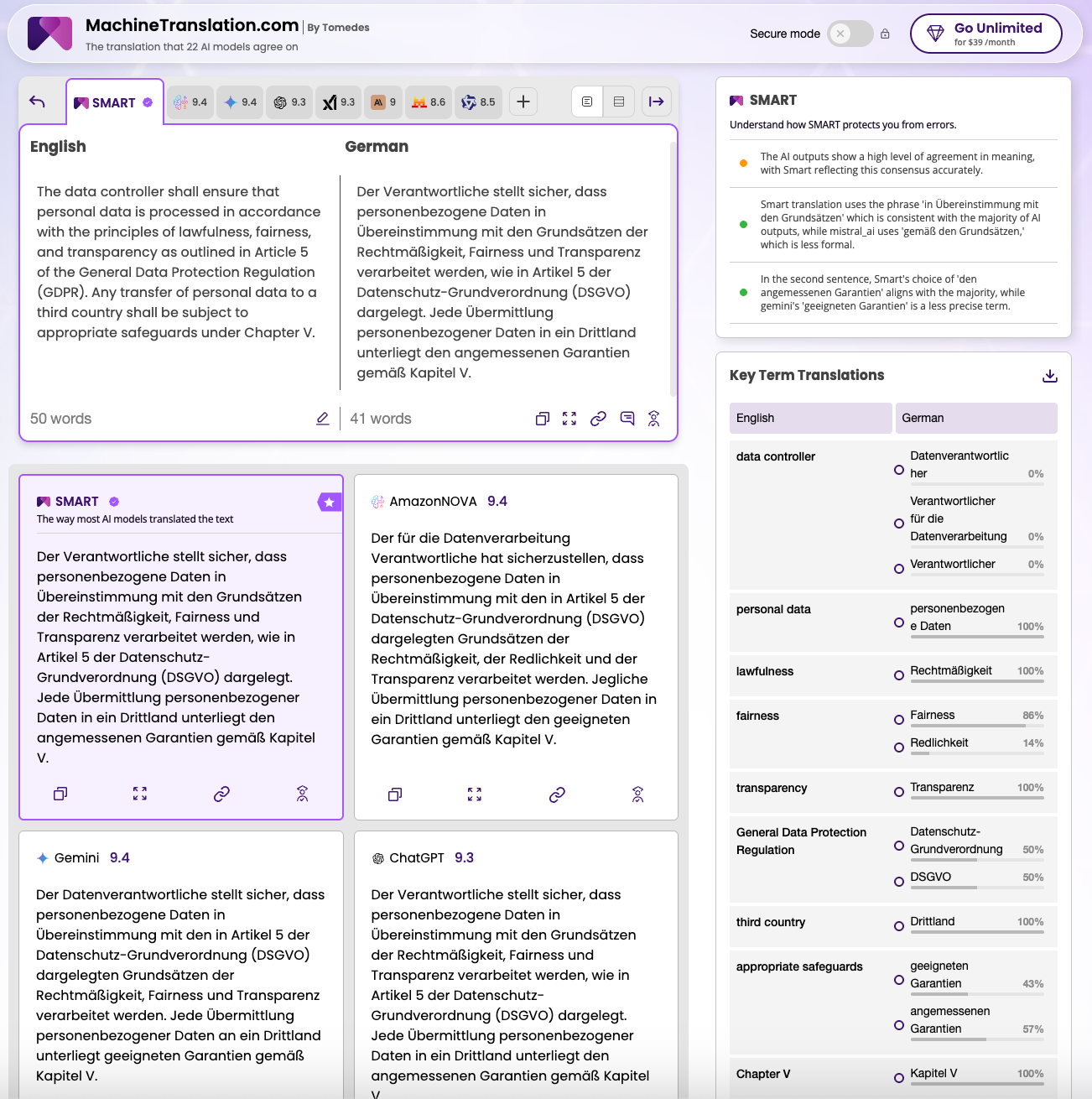
MachineTranslation.com's SMART system resolved this by selecting the term backed by the majority of 22 models. More importantly, the Key Term Translations panel flagged the disagreement visually, so a reviewer can see the split before the translation is finalised
The DSGVO problem: when engines cannot agree on compliance language
The same GDPR test revealed another split: 50% of engines rendered "General Data Protection Regulation" as the full German name Datenschutz-Grundverordnung, while the other 50% used the abbreviation DSGVO. Both are correct in isolation. In a legal document that already uses the abbreviation, introducing the full name mid-paragraph creates inconsistency. In a document that has not yet defined the abbreviation, using DSGVO without introduction violates German legal drafting conventions.
No single model considers this context. The Key Term Translations panel on MachineTranslation.com shows the 50/50 split, giving the reviewer the information needed to choose the right form for their specific document.
The term "fairness" produced an 86/14 split: most engines kept the English loanword Fairness, which is standard in German GDPR texts. But 14% used Redlichkeit, a more traditional German legal term that shifts the register toward older statutory language. For a modern compliance document, Fairness is the correct choice. For a document referencing pre-GDPR German data protection law, Redlichkeit might be appropriate. Again, a single engine gives you one answer. The consensus panel gives you the data to choose.
Where AI engines disagree on German legal terms
Across our GDPR compliance test, the Key Term Translations panel on MachineTranslation.com showed disagreement on 4 out of 9 key terms. Here is the full breakdown:
English term | Majority translation | Consensus % | Minority translation | Minority % |
appropriate safeguards | angemessene Garantien | 57% | geeignete Garantien | 43% |
fairness | Fairness | 86% | Redlichkeit | 14% |
General Data Protection Regulation | Datenschutz-Grundverordnung | 50% | DSGVO | 50% |
data controller | Datenverantwortlicher | 0%* | Verantwortlicher / Verantwortlicher für die Datenverarbeitung | varies |
*Note: the "data controller" term produced three distinct translations with no single variant commanding a clear majority, a signal that human review is essential for this term.
The terms with 100% agreement were: personenbezogene Daten (personal data), Rechtmäßigkeit (lawfulness), Transparenz (transparency), Drittland (third country), and Kapitel V (Chapter V). These are safe to use directly from any engine.
The pattern is clear: foundational legal concepts that appear frequently in German legislation have high engine agreement. Terms that require interpretive judgment (proportionality, suitability, regulatory naming conventions) produce significant splits.
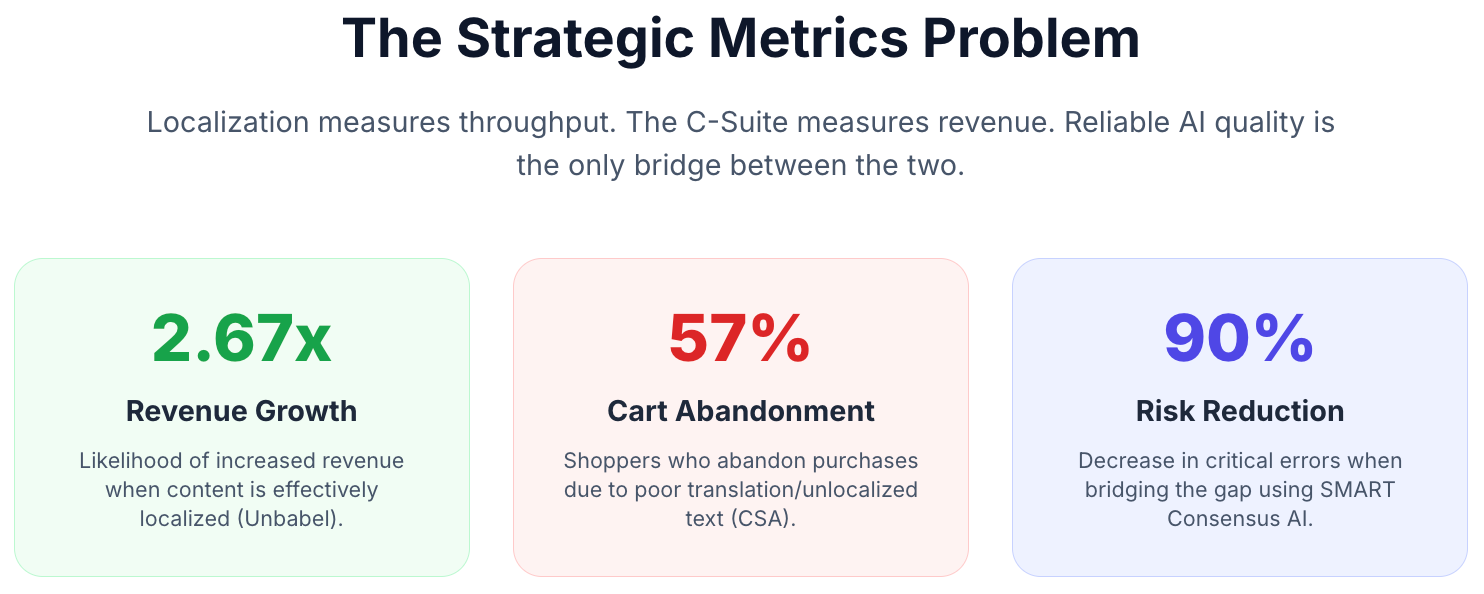
Internal benchmarks from MachineTranslation.com show that the SMART consensus approach reduces translation errors by up to 90% compared to relying on any single engine. For legal documents, this reduction is concentrated in exactly the high-stakes terms shown above. (Source: Unbabel Global Multilingual CX Report; CSA Research (2020); MachineTranslation.com internal quality benchmarks.)
Technical documents: why compound nouns are a reliability test
German technical documentation relies on compound nouns that can stretch to 30, 40, or 50 characters. These are not decorative. They are precise identifiers that map to specific standards, regulations, or product classifications.
How a 46-character word exposes engine quality
We tested a sentence containing "telecommunications surveillance regulation", which in German becomes Telekommunikationsüberwachungsverordnung. Every engine handled this particular compound correctly. The failures appeared in the surrounding terms.
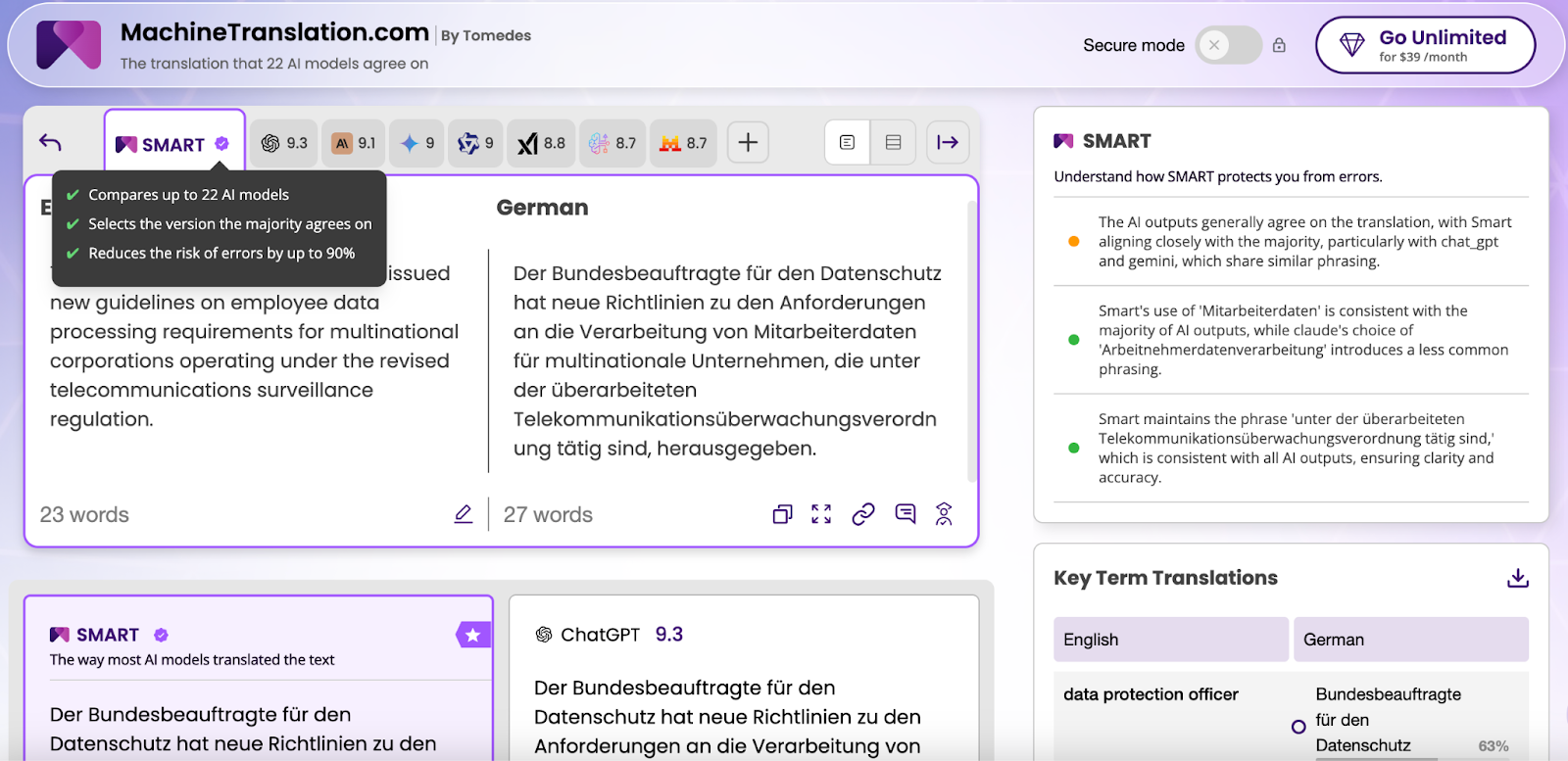
For "employee data processing," the majority of engines used Mitarbeiterdaten – the standard term in German corporate HR and data protection contexts. Claude chose Arbeitnehmerdatenverarbeitung, a grammatically valid compound that would read as unusual in practice. A German compliance officer reviewing this translation would recognise it as machine-generated.
The difference between Mitarbeiterdaten and Arbeitnehmerdatenverarbeitung is not a matter of correctness. It is a matter of convention. German technical and legal writing follows strict terminological norms. Using an unconventional compound signals that the document was not reviewed by someone who works with these terms daily.
The compound noun consensus gap
In our testing, the term "data protection officer" produced only 63% consensus among engines. The majority favoured Bundesbeauftragte für den Datenschutz, but alternatives included Bundesdatenschutzbeauftragter and Datenschutzbeauftragter. Each is valid in a different context: the first refers specifically to the federal commissioner, the second is a less formal compound, and the third is the generic term for any organisation's data protection officer.
A single model picks one. The SMART panel on MachineTranslation.com's English-to-German translator shows all three options with their respective support levels, so the translator or reviewer can match the term to the document's specific context.
A decision framework for legal and technical German translation
Not every term in a legal or technical document carries the same risk. Here is a framework for deciding when AI consensus is sufficient and when human review is required:
Consensus level | Action | Example |
High agreement | Use SMART output directly | personenbezogene Daten, Transparenz |
Average agreement | Review the Key Term panel, select the variant that matches your document context | Fairness (86%) vs. Redlichkeit (14%) |
Low agreement | Flag for human specialist review before publishing | angemessene Garantien (57%) vs. geeignete Garantien (43%) |
No agreement | Mandatory human translation for this term | Datenverantwortlicher (no clear majority) |
This framework turns a subjective quality judgment into a data-driven decision. Instead of asking "is this translation good enough?", you ask "what percentage of 22 engines agree on this term?" That question has a measurable answer.
How to use MachineTranslation.com for German legal and technical texts
Step 1: Run the text through 22 models
Paste your English legal or technical text into MachineTranslation.com's English-to-German translator. The platform processes it through up to 22 AI models simultaneously and produces a SMART consensus translation.
Step 2: Read the key term translations panel
Below the translation output, the Key Term Translations panel shows every critical term, how each engine rendered it, and the consensus percentage. Focus on terms below 80% agreement, these are your review priorities.
Step 3: Decide what needs human review
Apply the decision framework above. Terms with 90%+ consensus can be used directly. Terms with split consensus go to a subject matter expert. For legal documents, any term below 70% consensus should be flagged for review by a qualified German legal translator.
The workflow is: AI does the heavy lifting across 22 models, SMART identifies the reliable output, and human expertise is applied precisely where the data shows it is needed. This is the opposite of the traditional approach, where a human translates everything and hopes they chose the right term for each phrase.
The EU product liability shift that changes the stakes
Starting in 2026, the EU's revised Product Liability Directive extends liability to defective digital content – including translation errors in product documentation, safety instructions, and compliance materials. Companies that publish German-language product information based on a single-engine AI translation now carry direct liability risk if that translation contains a material error.
This regulatory shift makes the case for consensus-based translation stronger than it has ever been. A company that can demonstrate it used 22 models and selected the majority-backed translation for every critical term has a defensible quality process. A company that used one model and accepted its output without verification does not.
MachineTranslation.com's English-to-German translator provides the audit trail: which models were consulted, what each produced, and why the consensus term was selected.
FAQs
1. Can AI accurately translate German legal documents?
AI can produce a strong first draft, but our testing shows that 4 out of 9 key legal terms in a GDPR clause had split consensus among 22 models. The terms with highest disagreement – "appropriate safeguards" (57/43 split) and "data controller" (no clear majority) – are exactly the terms that carry legal consequences. Use SMART as a starting point and apply human review where agreement falls below 70%.
2. What is the biggest risk in English-to-German technical translation?
Compound noun convention. German technical writing follows strict terminological norms, and using an unconventional compound (even if grammatically correct) signals that the document was not reviewed by a domain specialist. In our test, only 63% of engines agreed on the standard rendering of "data protection officer" in German.
3. How does SMART consensus improve legal translation accuracy?
SMART compares up to 22 AI model outputs for the same text and identifies where they agree. For legal terms, this means you see exactly which terms have strong consensus (safe to use) and which have split opinions (need human review). Internal benchmarks show this approach reduces translation errors by up to 90% compared to single-model translation.
4. Should I use DeepL or Google Translate for German legal texts?
Neither alone is sufficient. Both are strong models, but they make different choices on critical legal terms. The question is not which model is better, it is whether either model’s choice matches what the majority of 22 models agree on. MachineTranslation.com lets you see both outputs alongside 20 other models and make a data-driven decision.
5. What changed with EU product liability in 2026?
The revised EU Product Liability Directive now covers defective digital content, including translation errors in product documentation and safety instructions. Companies publishing AI-translated German product information carry direct liability risk if the translation contains material errors. This makes verifiable, multi-model translation workflows a compliance requirement, not just a quality preference.