April 2, 2025
Inside the AI Mind: Balancing Transparency and Overtraining Risks in Multilingual Translation
Have you ever wondered what your AI translator is really doing when it gives you that polished line of text in a different language? You type in a phrase, hit "translate," and within seconds—voilà!—you’ve got your result. But beneath that instant response lies a whirlwind of computational logic, language prediction, and pattern recognition. Recent research is now giving us a window into these complex inner workings.
As exciting as this sounds, there’s another side to the story. Along with growing interpretability comes the threat of catastrophic overtraining—a condition where a language model becomes so "trained" it forgets how to adapt. And when it comes to multilingual translation, where context and nuance are everything, that’s a serious issue.
In this article, we're diving deep into what this means for AI-powered translation, what risks and rewards are ahead, and how platforms like MachineTranslation.com are stepping up to ensure you get smarter, more transparent, and more flexible translations.
How AI translations work: A peek into the LLM mind
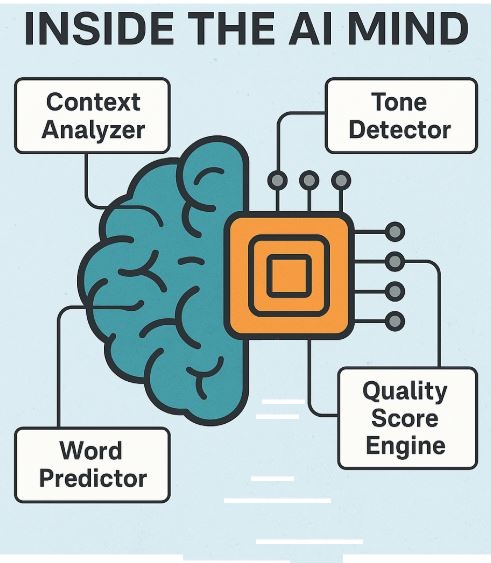
Let’s start by simplifying the tech. Large Language Models (LLMs)—like OpenAI’s GPT, Claude, or Meta’s LLaMA—are trained on massive datasets to predict what word should come next in a sentence. When used for translation, these models do more than swap words—they understand structure, tone, and context to generate natural-sounding sentences in another language.
But how do they decide what to say?
A fascinating study by Anthropic, called “Tracing the Thoughts of Language Models”, explores how researchers are now able to follow these decision-making steps. They’ve mapped how models “think” during translation—how they weigh word meanings, sentence structure, and context from one word to the next.
Why should you care?
Because when you know how your AI translator is working, you’re better equipped to trust or tweak its results. Translation tools that offer this kind of transparency give you more control over the final output.
Translation that explains itself
Traditional machine translation was a black box: it gave you results, but not reasons. Modern platforms like MachineTranslation.com are changing that. Their translation quality insights give you scores from 0 to 10 for each AI-generated output, so you can quickly assess quality. But they go further by providing tone comparisons, terminology differences, and even highlights of what multiple AI engines agreed on.
If you’re translating a press release, for example, and the tone shifts from professional to overly casual, these insights will let you catch and correct it before hitting publish. This is the power of context-aware translations—translations that don’t just sound right, but feel right for your audience.
And if you need to maintain brand voice across languages? MachineTranslation.com gives you tools to customize tone, style, and terminology with its AI Translation Agent.
Overtraining: When AI gets too smart for its own good
So what’s the problem with models getting smarter?
It’s what researchers call catastrophic overtraining. According to a VentureBeat article, when models are repeatedly trained on the same data, they can become too rigid. They lose their ability to generalize or adapt to new, nuanced inputs.
Here’s an analogy: imagine someone who memorizes a textbook but has never had a real conversation. They might sound impressive, but ask them to handle a new topic or respond to cultural nuance—and they stumble.
In translation, this is a serious issue. A model that rigidly translates idioms or industry jargon without adjusting for tone or audience could confuse or alienate readers. Worse, it could distort meaning in legal, medical, or marketing materials.
Multilingual translation demands flexibility
Language is alive. It evolves, adapts, and reacts to its environment. So should your AI translator.
Consider translating “That deal was a home run” into German. A rigid model might give you something like “Dieses Geschäft war ein Homerun”, which literally says “home run” but may confuse readers unfamiliar with baseball idioms. A flexible model might instead opt for “Das Geschäft war ein voller Erfolg” (The deal was a complete success).
The point? Multilingual translation isn’t just about language—it’s about cultural context. That’s why MachineTranslation.com includes features like:
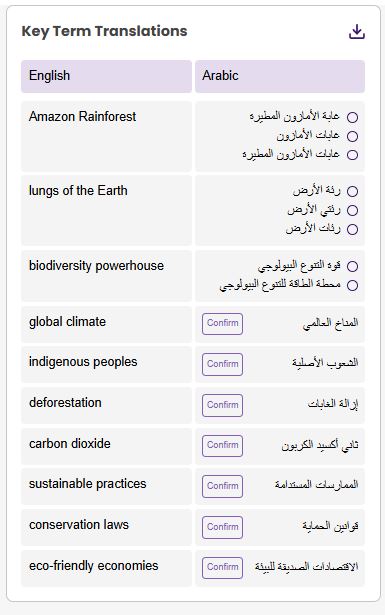
Key Term Translations: Highlighting 10 specialized terms and giving you up to three translations for each from top AI sources.
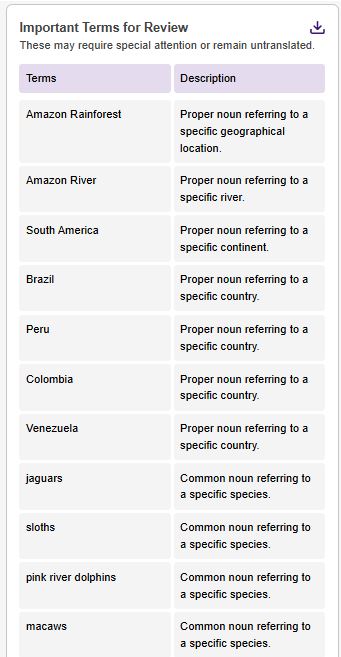
Important Terms for Review: Flagging brand names, acronyms, or sensitive words that may require human judgment.
Segmented Bilingual View: Showing source and target text side-by-side in editable segments for easy refinement.
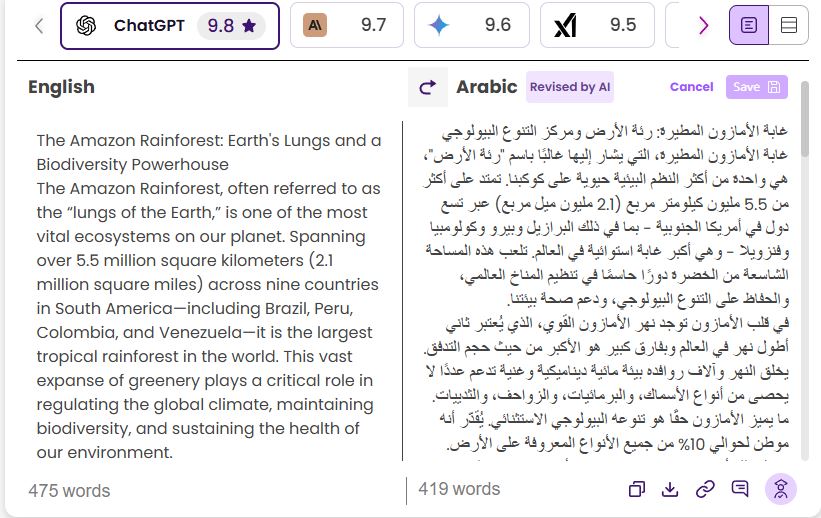
These features help ensure your translations are not just accurate, but culturally intelligent.
Let the AI learn from you—Not just the internet
One of the most exciting developments in AI translation is learning from the user, not just from datasets. MachineTranslation.com recently launched its AI Translation Agent with Memory, which remembers your:
Preferred translations
Custom instructions
Glossary entries
Tone and formatting preferences
If you always translate “terms and conditions” as “Condiciones de uso” in Spanish (rather than “Términos y condiciones”), the system will remember that. This turns your translator into a personalized AI assistant that gets better every time you use it.
This memory feature is available to registered users and helps ensure customizable translation at scale—perfect for businesses maintaining brand consistency across markets.
Human + AI = The perfect combo
No matter how smart your AI gets, some texts just need a human touch. Whether it’s legal disclaimers, ad slogans, or academic work, human review is often the best way to ensure clarity, tone, and context.
That’s why MachineTranslation.com offers a Human Review approach for those high-stakes projects. And the good news? You don’t have to edit blindly. With the segmented editing interface, you can spot-check and refine only the parts that need it.
Let’s say you’re working on a multilingual e-commerce site. You’ve translated 500 product descriptions into French. With segment-level editing, you can quickly review and correct just the terms that relate to materials (like “faux leather” or “organic cotton”) instead of combing through each sentence.
This hybrid approach saves you time, improves consistency, and drastically cuts costs—up to 90% compared to traditional translation.

Because global is the new local
Many translation platforms support 20, 50, maybe 100 languages. MachineTranslation.com supports over 270, including low-resource languages like Luo, Hunsrik, and Romani. This makes it one of the most inclusive AI translation software options available.
That means you’re not limited by language availability. Whether you’re translating for indigenous communities, niche global markets, or rare dialects, the platform is ready to support your mission.
And with automatic language detection, even if you're not sure what language your document is in, the system will figure it out for you. Just upload your file, and the tool takes care of the rest.
Conclusion: Smarter tools for smarter communication
Language is complicated. It’s personal. It’s messy. And that’s what makes AI-powered translation such a powerful, yet delicate, tool. As we unlock the minds of LLMs and better understand how they think, we also uncover the need to guide them carefully.
Whether you're translating a contract, launching a global brand, or just trying to communicate clearly across borders, you deserve tools that are:
Transparent
Flexible
Personalized
Affordable
Scalable
So the next time you use an AI translator, don’t just ask for a result—ask for understanding. Because when your tools think clearly, your message can be heard loudly—no matter the language.
Unlock 100,000 words of high-quality AI-powered translation—absolutely free for a limited time. Whether you're localizing content, translating documents, or scaling globally, MachineTranslation.com gives you fast, accurate, and customizable results. Don’t miss this exclusive offer—subscribe now and start translating smarter today!

By Clarriza Heruela
Clarriza Mae Heruela graduated from the University of the Philippines Mindanao with a Bachelor of Arts degree in English, majoring in Creative Writing. Her experience from growing up in a multilingually diverse household has influenced her career and writing style. She is still exploring her writing path and is always on the lookout for interesting topics that pique her interest.
Share:


