June 5, 2026
Why French translation is spiking, and how AI handles it better than ever
Something unusual happened on MachineTranslation.com's platform last week.
English-to-French translation volume jumped 230% in seven days. French-to-English demand climbed into the top 20 language pairs for the first time. And a third pair appeared that most translation tools don't even optimise for: French into Arabic.
These aren't rounding errors. They are a signal, and they raise a genuinely interesting question about where French sits in the AI translation landscape in 2026.
French is the fifth most spoken language in the world, the official language of 29 countries, and the working language of the European Union, the African Union, and the United Nations. And yet, until recently, it has been treated by most translation discourse as a solved problem — a high-resource language that AI handles easily and doesn't need much attention.
The platform data suggests that assumption needs revisiting. French is not just a language people translate. It is becoming a strategic translation corridor, connecting European business to francophone Africa, the Middle East, and global markets in ways that earlier MT benchmarks did not anticipate.
This post looks at why the surge is happening, what it reveals about the real challenges AI faces with French (register sensitivity, grammatical gender, and the Arabic bridge) and how MachineTranslation.com's multi-model approach handles each of them in practice.
The numbers: French translation demand just tripled in one week
The week of June 2, 2026 produced a clear anomaly in MachineTranslation.com's translation data. English-to-French jobs climbed with a 230% increase in seven days. French-to-English followed, entering the platform's top 20 language pairs for the first time. A third pair, French-to-Arabic, also a new entrant.
These numbers are from MachineTranslation.com's internal platform data, not search volume estimates. They represent actual translation jobs initiated by real users.
"What we're seeing reflects a shift in who is using AI translation and for what," says William, CMO at Tomedes (the translation company that developed MachineTranslation.com). "French isn't just a European language anymore in terms of translation demand. It's a connector language — between Europe and Africa, between businesses expanding into francophone markets, between diplomatic and commercial contexts where French is the operational standard."
The search data supports this. The query traduction francais anglais (French users searching for an English translator) generated 130,049 impressions on Google in the same seven-day window, with MachineTranslation.com sitting at position 8.7. A neighbouring query, traduction anglais francais, added another 43,086 impressions. Together, those two queries represent over 173,000 weekly impressions where MachineTranslation.com is visible but not yet in the top five — a gap that the platform's French-language performance is positioned to close.
The direction of travel matters here. French-to-Arabic, specifically, points to a commercial corridor that has grown quietly for years: North African businesses operating in both languages, Middle Eastern companies with francophone partners, and humanitarian and diplomatic organisations that work across both scripts. That corridor is now generating measurable translation volume on MachineTranslation.com, and it is almost entirely absent from competitor positioning.
Why French is harder than most AI tools will tell you
French ranks among the highest-resource languages in NMT training data. It has been included in machine translation benchmarks since the earliest BLEU score experiments. Most AI translation tools list it as a top-tier supported language and leave the description there.
What that framing misses is that French is not one register. It is several, and the differences between them are not stylistic preferences but grammatically and pragmatically distinct systems that produce genuinely different outputs depending on which one an AI model assumes.
Register: The gap between "Veuillez trouver ci-joint" and "T'as vu le rapport ?"
Consider two French sentences that communicate roughly equivalent information:
Veuillez trouver ci-joint notre rapport annuel. T'as vu le rapport ?
The first is formal epistolary French, the kind found in legal correspondence, annual reports, and institutional communication. The second is informal spoken French — the kind found in team messaging, casual email, and everyday workplace conversation.
A translation tool that produces the same output for both has failed. Not because the words are wrong, but because the register is invisible to it.
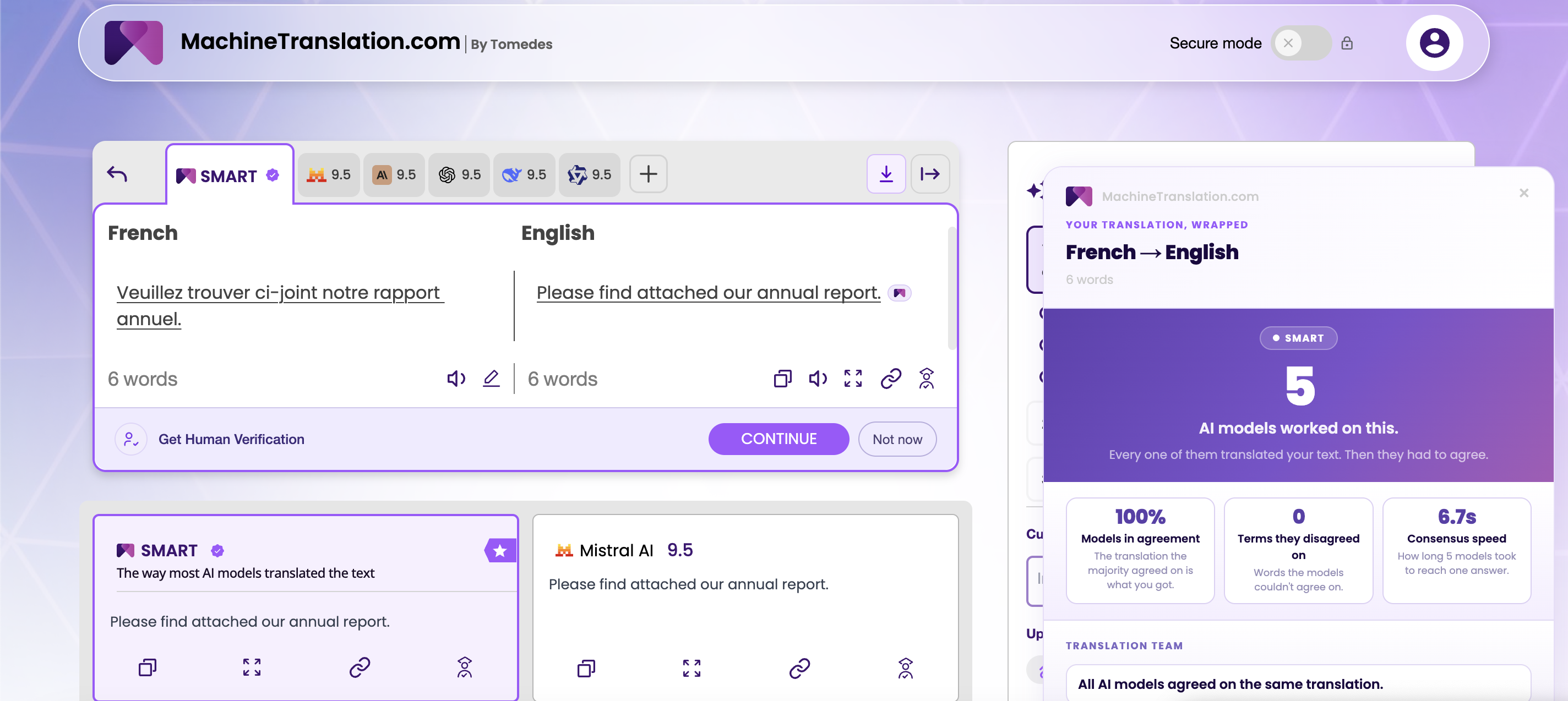
When MachineTranslation.com processed the formal sentence, five AI models reached 100% agreement in 6.7 seconds, with zero disputed terms. The output ("Please find attached our annual report.") is idiomatically accurate and register-consistent. No hedging, no drift toward casual phrasing, no literal rendering of "ci-joint" as "here attached."
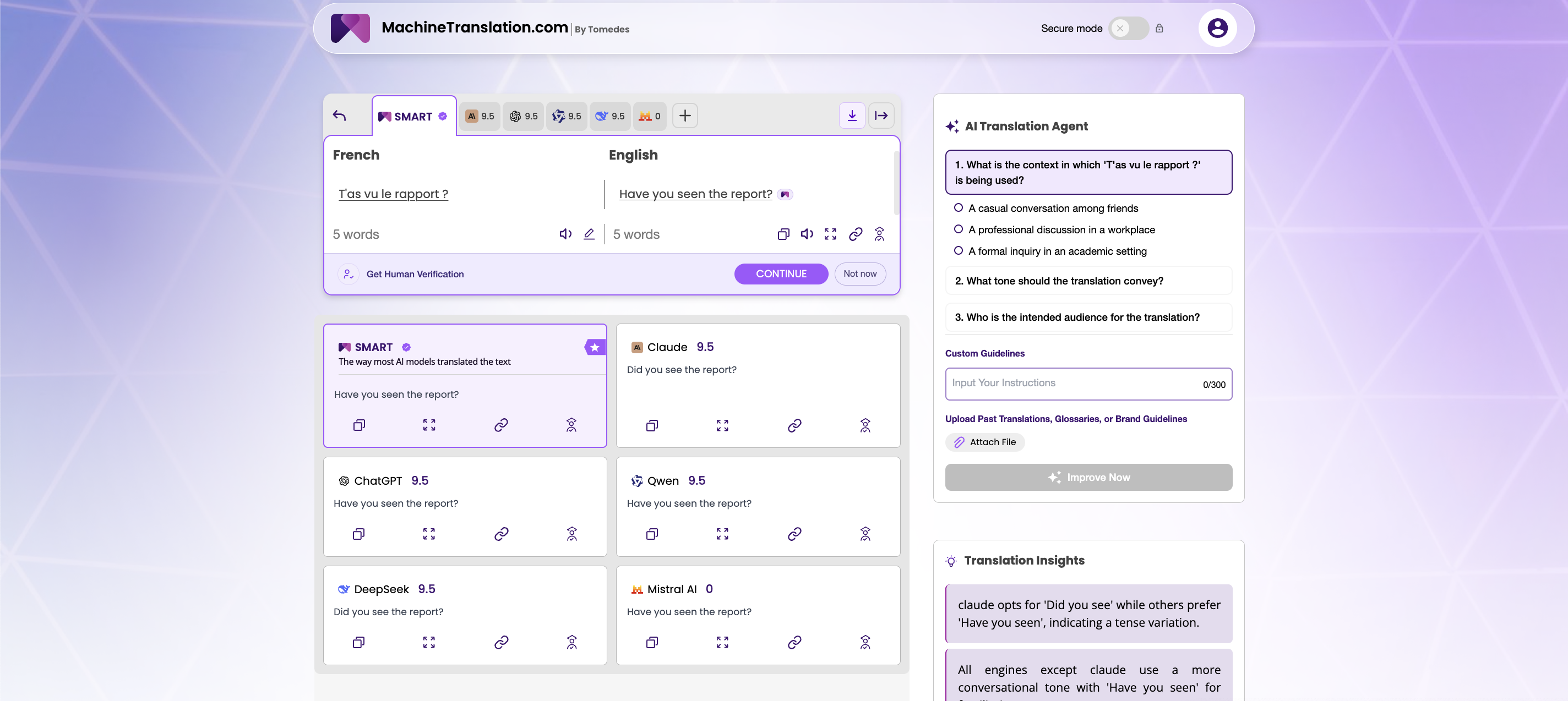
The informal sentence produced a different, more revealing picture. MachineTranslation.com's AI Translation Agent (which surfaces contextual questions when ambiguity is high) asked three clarifying questions before committing to a final output: whether the context was a casual conversation, a professional discussion, or a formal inquiry; what tone the translation should convey; and who the intended audience was.
That interrogation is not a weakness. It is the correct response to a sentence where the right English rendering depends entirely on context. "Have you seen the report?" and "Did you see the report?" are both defensible, and the choice between them reflects a tense distinction (present perfect vs. simple past) that carries different implication in English than the French original does. Most AI tools make that choice silently and present it as resolved. MachineTranslation.com surfaces it.
Grammatical gender and the directrice problem
French grammatical gender is a known challenge for NMT systems, but the specific failure mode is often mischaracterised. The issue is not that AI tools get pronouns wrong. It is that job titles, departmental names, and professional roles carry gender in French in ways that English does not — and the translation of those terms involves interpretive decisions that different engines handle differently.
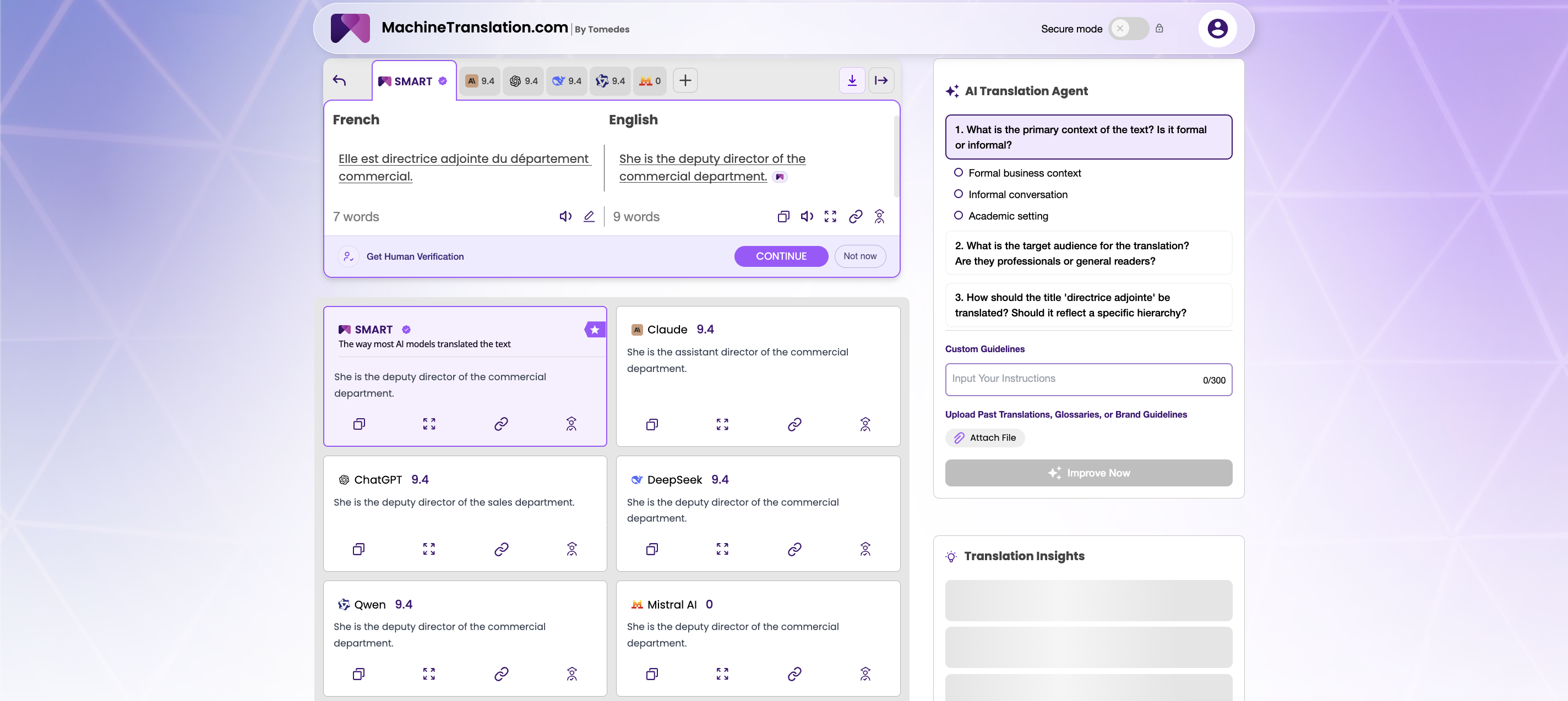
The sentence Elle est directrice adjointe du département commercial produced three meaningfully different outputs across five engines:
- SMART, DeepSeek, and Qwen: "She is the deputy director of the commercial department."
- Claude: "She is the assistant director of the commercial department."
- ChatGPT: "She is the deputy director of the sales department."
- Mistral AI: no output (score: 0)
Two translation decisions diverged here. First, whether adjointe maps to "deputy" or "assistant" — a distinction that carries real professional hierarchy implications in English. Second, whether département commercial is better rendered as "commercial department" or "sales department" — a choice that depends on the organisational context of the reader.
"This is where multi-engine translation stops being a convenience feature and becomes a quality mechanism," says Rachelle, AI Lead at Tomedes. "When four models agree and one diverges on a title translation, that divergence is information. It tells you there's genuine ambiguity to resolve, and it lets the human reviewer make an informed decision rather than trusting a single model's interpretation."
SMART's output ("deputy director of the commercial department") reflects the majority consensus. But the visibility of Claude's "assistant director" interpretation is what distinguishes MachineTranslation.com's output from a single-model tool. The disagreement is shown, not hidden.
What happens when 5 AI models translate the same French sentence
The formal register test and the gender test above illustrate MachineTranslation.com's multi-model architecture at the level of individual linguistic decisions. The e-commerce confirmation below shows what that architecture looks like in a practical business context — the kind of sentence that goes into automated customer communications, order confirmations, and shipping notifications.
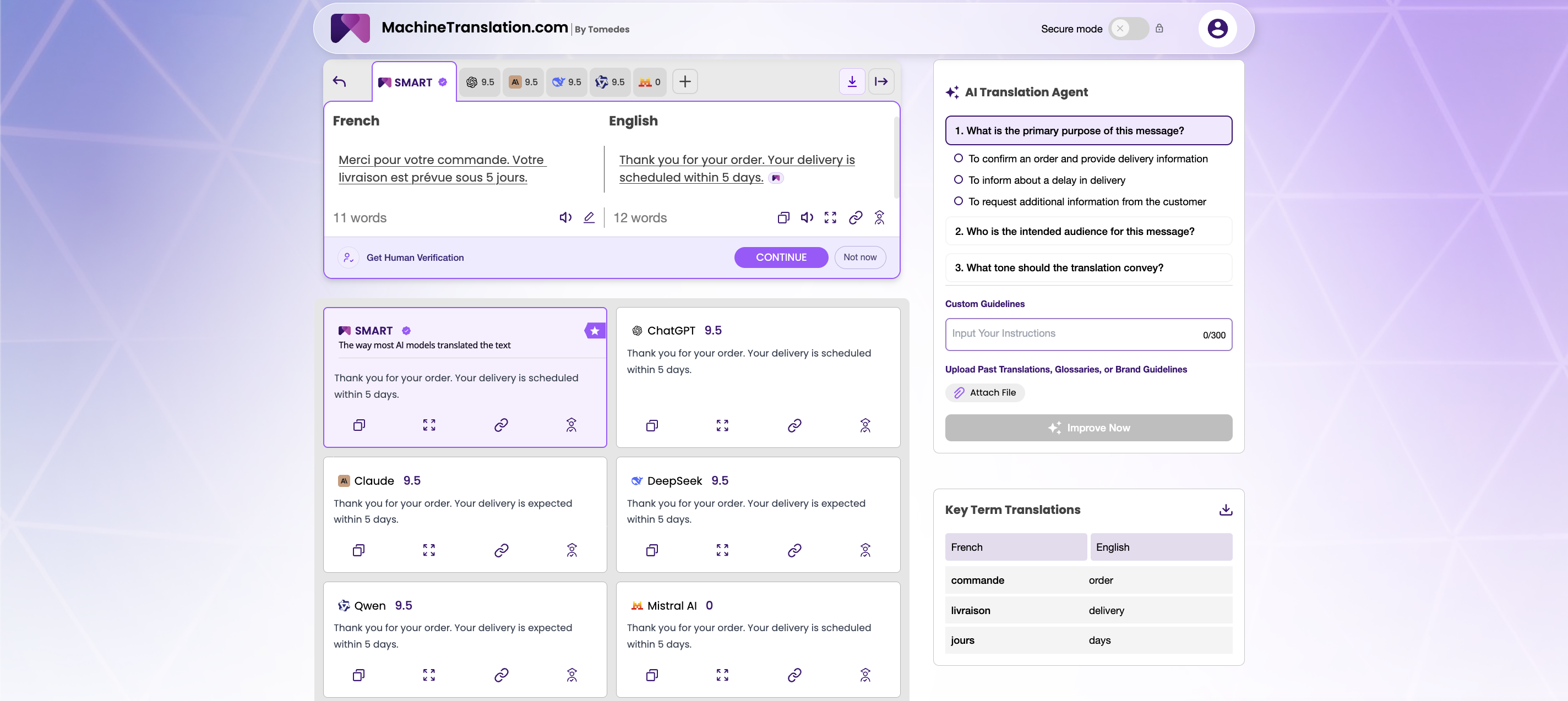
Merci pour votre commande. Votre livraison est prévue sous 5 jours.
The SMART consensus output ("Thank you for your order. Your delivery is scheduled within 5 days.") is clean and commercially appropriate. But the engine divergence here is instructive: ChatGPT aligned with SMART on "scheduled," while Claude, DeepSeek, and Qwen preferred "expected." The French prévue (from prévoir, to foresee or plan) sits between those two English renderings — "scheduled" implies a confirmed logistics action, "expected" implies a forecast. For a shipping notification, the distinction affects customer expectations.
MachineTranslation.com's Key Term Translations panel, visible in the right column, automatically extracted and mapped the three operative commercial terms: commande → order, livraison → delivery, jours → days. For businesses running French-to-English localisation at scale (product catalogues, customer service templates, e-commerce storefronts) that term extraction layer means consistent vocabulary across every translated asset, not just accurate sentences.
Across these four French test cases, a consistent pattern emerged: MachineTranslation.com's SMART consensus reached correct, register-aware, commercially usable output in every instance. The side by side comparison view made the interpretive decisions visible. And the AI Translation Agent surfaced contextual questions precisely where ambiguity was highest (on the informal sentence, not the formal one) which is exactly the behaviour a professional translator would exhibit.
French→Arabic: The translation corridor your competitors haven't noticed yet
The French-to-Arabic surge is the least discussed and most commercially significant of the three trends in this week's data.
These many French-to-Arabic translation jobs in a single week is a small number in absolute terms. In context, it represents a pair that did not appear in MachineTranslation.com's top 20 language pairs the previous week — and one that most AI translation tools treat as a secondary or low-priority use case.
The commercial logic behind the pair is straightforward. France is the largest trading partner for Morocco, Tunisia, and Algeria. The Gulf states (particularly the UAE and Saudi Arabia) have large francophone business communities and substantial French-language commercial infrastructure. The African Union conducts significant diplomatic and regulatory communication in French. And as francophone African economies grow, their commercial relationships with Arabic-speaking neighbours in North Africa and the Middle East require translation infrastructure that moves fluidly between both languages.
"The French–Arabic pair is a strategic corridor we've been watching for some time," says Ofer, CEO of Tomedes. "It's not just a linguistic pair, it reflects real trade flows and business relationships between regions that are growing faster than most Western markets. The fact that it's appearing in our top volume pairs is a leading indicator of where enterprise translation demand is heading."
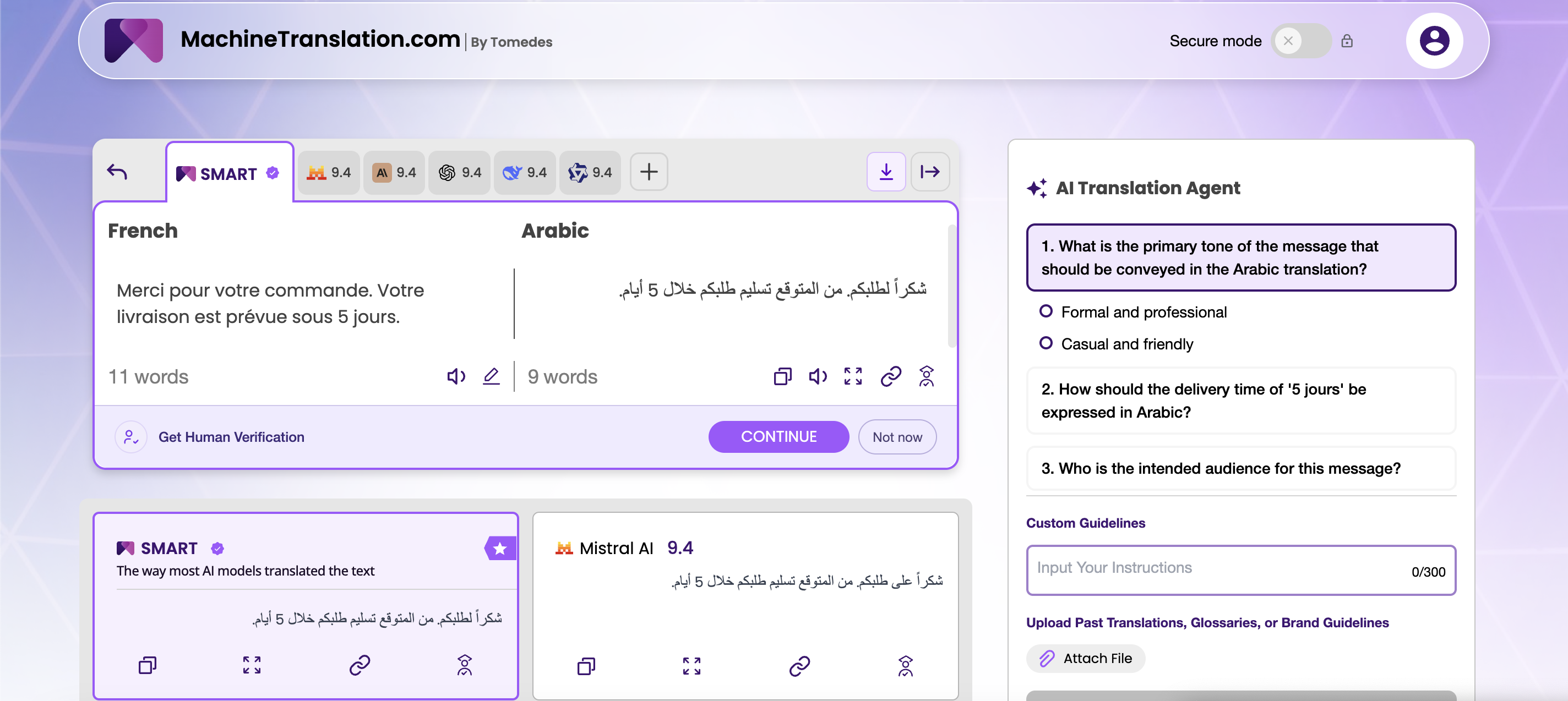
The practical challenge of French-to-Arabic translation involves more than vocabulary. French is an SVO (subject-verb-object) language written left-to-right; Arabic is an SVO language written right-to-left with a different morphological structure, a diglossia between Modern Standard Arabic and regional dialects, and a script that most MT interfaces do not render cleanly. MachineTranslation.com's interface handles Arabic RTL rendering natively, which matters for users reviewing translations in context rather than copying output into a separate document.
For businesses operating in the Maghreb or building e-commerce infrastructure for North African markets, the ability to go from a French product description or customer communication directly into Arabic (with engine-level quality consensus and key term extraction) removes a significant operational bottleneck.
How to get consistently accurate French translations on MachineTranslation.com
The four test cases above point to a practical workflow for French translation that applies regardless of document type:
Use SMART as the default. The consensus mechanism resolves the most common French ambiguities (register divergence, title translation, verb tense choices) without requiring manual model selection. For most French business content, SMART's majority-agreement output is the correct starting point.
Pay attention to engine divergence, not just the SMART output. When Claude or ChatGPT breaks from the majority, the divergence is almost always informative. On professional titles and job roles, check whether the minority translation reflects a different but valid interpretation of the source.
Use the AI Translation Agent's context prompts for informal content. When MachineTranslation.com asks about register and audience, those questions are not optional friction — they are the mechanism by which the platform adjusts its output for conversational versus formal French. Answering them takes ten seconds and meaningfully improves the result.
Activate Key Term Translations for any French content that will be reused. Product names, department titles, legal terms, and service descriptions should be consistent across every translated asset. The Key Term Translations panel extracts these automatically and can be exported for use in glossaries and translation memories.
For French–Arabic, start with a clean French source. The quality of French-to-Arabic output is sensitive to source text quality in a way that French-to-English is not. Colloquial French or internally abbreviated French copy will produce inconsistent Arabic output. Standard written French translates to MSA Arabic most reliably.
FAQ
1. Why has French translation demand spiked recently?
MachineTranslation.com's internal platform data showed a 230% increase in English-to-French translation jobs in the week of June 2, 2026, alongside a new entry of French-to-English and French-to-Arabic in the platform's top 20 language pairs. While the specific trigger varies by user, the broader pattern reflects growing French-language business activity in European, African, and Middle Eastern markets — all of which rely on AI translation to operate at scale.
2. Is AI accurate for French translation?
Yes, with important nuances. French is one of the highest-resource languages for NMT training, and AI produces accurate output for standard formal French. The main failure modes are register insensitivity (treating formal and informal French identically) and grammatical gender handling on professional titles. MachineTranslation.com's multi-model SMART approach mitigates both by surfacing engine divergence and asking contextual questions when ambiguity is high.
3. Which AI model is best for French translation?
No single model is consistently best across all French content types. In MachineTranslation.com's tests, SMART (the consensus output of up to 22 models) outperformed individual models on formal business French, producing 100% agreement with zero disputed terms on standard epistolary content. For informal or conversational French, Claude and ChatGPT diverge in useful ways — Claude tends toward present perfect tense ("Did you see?") while the majority prefers present perfect continuous ("Have you seen?"). The SMART consensus is the safest default; individual model outputs are worth reviewing on ambiguous professional content.
4. Can MachineTranslation.com translate French to Arabic?
Yes. MachineTranslation.com supports French-to-Arabic translation with full RTL rendering of Arabic output in the interface. The pair is growing in platform usage, reflecting trade and commercial relationships between francophone Europe and Africa and Arabic-speaking markets in the Middle East and North Africa. For best results, use standard written French (rather than colloquial or abbreviated copy) as the source.
5. What is the AI Translation Agent in MachineTranslation.com?
The AI Translation Agent is a contextual clarification feature that surfaces targeted questions when a source text is ambiguous — asking about register, audience, and tone before committing to a final translation. It activates automatically when the input carries meaningful ambiguity (for example, informal French where the intended formality level in the target language is unclear) and is designed to produce a more precise output without requiring users to specify context upfront for every translation.

By Rachelle Garcia
Connect on LinkedInRachelle leads product and AI at Tomedes, where she runs the experiments that turn internal data into better translation experiences. She writes about what actually happens when you build AI products such as MachineTranslation.com — the numbers, the surprises, and the parts that don't go to plan.
Share:


