May 28, 2026
Your translation, wrapped: Meet the feature that shows you what happened behind the scenes
You have probably seen Spotify Wrapped. At the end of the year, Spotify tells you which songs you listened to the most, which artists you could not stop playing, and what your taste in music says about you as a person. It is not new information, the data was always there. But making it visible changed how people thought about what they were doing.
We built something similar for translation. Not for the end of the year. For the end of every single translation.
It is called Your Translation, Wrapped. And it answers the question that every AI translation tool has quietly been ignoring: what actually just happened?
The problem with "here is your translation"
Every AI translation tool gives you the same experience. You put text in. You get text out. The output looks confident. You either trust it or you do not.
What you never get is visibility into how that output was produced. Was it a close call? Did every model agree? Was there one term that absolutely nobody could settle on? Was the model picking between "mostly right" and "completely different"? You have no idea. You just have the translation.
For casual use, that is fine. For anything that matters (a client document, a legal filing, a professional communication in a language you do not speak), "trust me" is not actually an answer.
So we started thinking: what if we showed people what was going on under the hood?
What the modal actually tells you
When you complete a translation on MachineTranslation.com, the Wrapped modal opens and shows you four things.
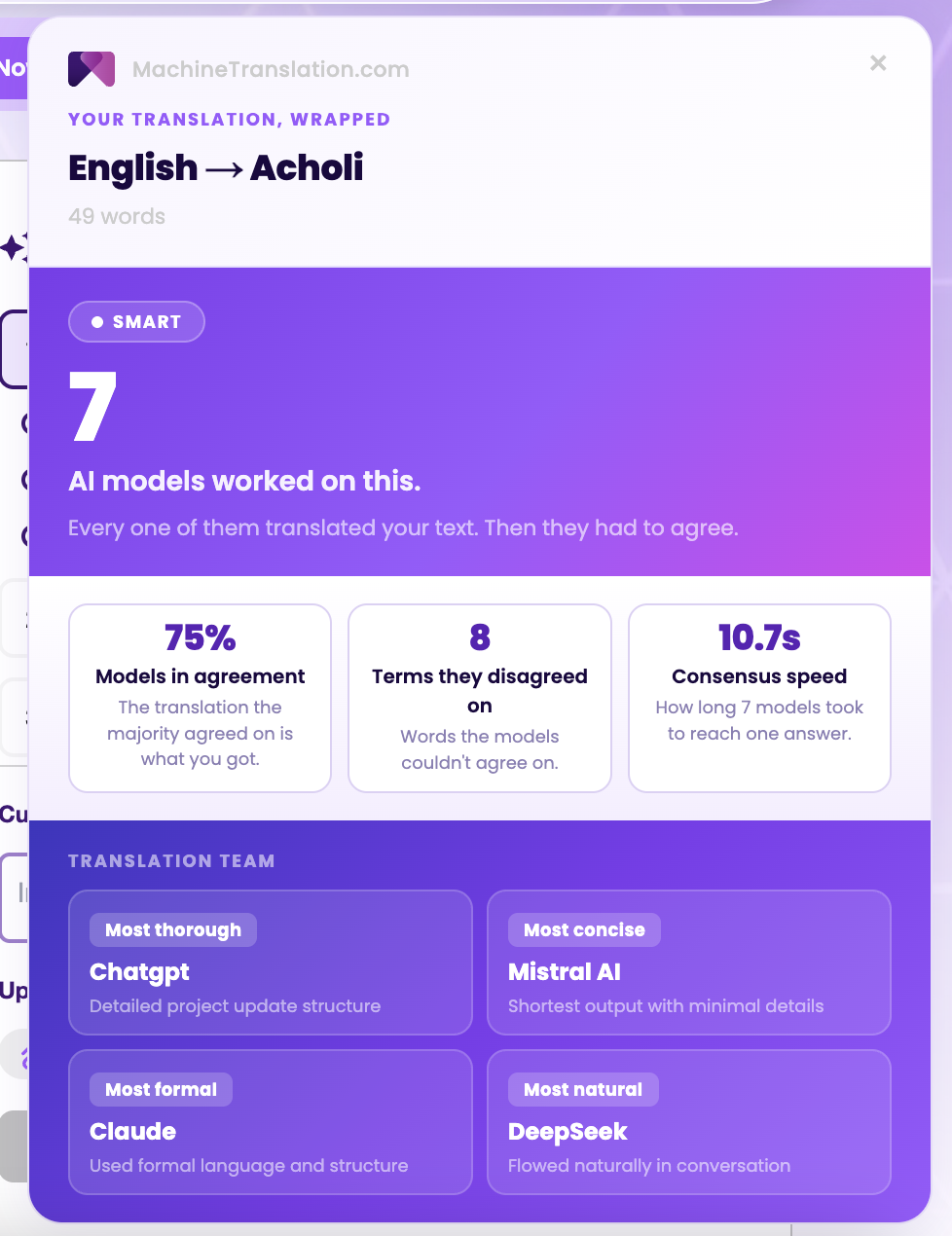
How many AI models worked on it. Not just that SMART ran, specifically how many models were active for your language pair. In the example shown here, an English to Acholi translation, 7 models ran simultaneously. Every single one of them translated the text. Then they had to agree.
The percentage of models in agreement. This is the number that tells you how confident to be. In this case, 75% of models agreed on the same output. That is a meaningful signal. A translation where 95% of models converge is a different level of confidence than one where 60% barely squeaked through.
The number of terms they disagreed on. In this example, 8 terms. Those are the words or phrases where the models came to genuinely different conclusions. That is not a failure, it is information. Those 8 terms are where the translation was hardest, where the source text had genuine interpretive latitude, or where the language pair has specific challenges that created divergence.
How fast consensus was reached. 10.7 seconds for 7 models to translate, compare, and agree on a 49-word text. That is what is running every time you press translate.
The translation team breakdown
This is the part people are going to screenshot.
The Wrapped modal shows you a "Translation Team", a breakdown of which model contributed what to the process. Not just which models ran, but what each one brought to the table.
In the Acholi example, the team looked like this:
ChatGPT was the most thorough. It produced the most detailed output, capturing the structure of the source text.
Mistral AI was the most concise. Shortest output, minimal elaboration — useful when you need tight, clean prose.
Claude was the most formal. It used formal language and structure throughout, the model you would want for something official.
DeepSeek was the most natural. Its output flowed naturally in conversation, closer to how a native speaker would actually say it.
Four models, four different takes. All running at the same time. SMART picked the one they most agreed on. But now you get to see what the rest of the team was thinking.
Why this matters more than it looks like it does
Here is what this feature is actually doing beneath the surface.
For years, the translation experience has been opaque by design. You trust the model because you have no other choice. The output is confident, the interface is clean, and the whole point is that you do not have to think about what happened inside.
But that opacity has a cost. It means you cannot calibrate your trust. You cannot tell whether the translation you received was a slam dunk or a coin flip. You cannot identify which part of your text was genuinely hard to translate and might be worth checking. You are just hoping.
The Wrapped modal breaks that opacity without adding cognitive load. It is not asking you to evaluate the models yourself. It is not showing you 7 different outputs and asking you to pick. It is showing you, after the fact, what the process looked like — and giving you enough information to understand how much you can rely on the result.
A 75% agreement rate on a low-resource language like Acholi, with 8 disputed terms, is a different story than a 95% agreement rate on an English to Spanish translation with 1 disputed term. Both are useful outputs. But they deserve different levels of confidence, and now you have the information to feel that difference rather than just guessing.
A small detail that says something bigger
Look at the language pair in the screenshots: English to Acholi.
Acholi is a Nilotic language spoken primarily in northern Uganda and parts of South Sudan. It is not a language most translation tools even attempt. The fact that MachineTranslation.com not only ran it (but ran 7 models on it, measured their agreement, identified disputed terms, and characterised each model's contribution) says something about where the platform sits relative to the rest of the market.
This is not a feature built for easy language pairs. It is a feature built for every translation, including the ones that are genuinely hard.
How to see it yourself
The Wrapped modal appears automatically after any translation on MachineTranslation.com. You do not need to turn it on or look for it. Translate something. It is there when you finish.
If you have been using single-model translation tools and wondering whether the output was actually the best available, this is a useful experience. Seven models working in parallel on the same text, reaching consensus in under 11 seconds, and then showing you their work — that is a different kind of translation tool.
Free to use. No sign-up required.
Frequently asked questions
1. What is "Your Translation, Wrapped" on MachineTranslation.com?
It is a post-translation summary modal that shows you what happened when SMART processed your text. It tells you how many AI models worked on the translation, what percentage of them agreed on the output, how many terms they disagreed on, and a breakdown of each model's distinctive contribution — most thorough, most concise, most formal, most natural.
2. How many AI models does MachineTranslation.com use per translation?
It varies by language pair. For a language like Acholi, 7 models ran simultaneously in the example shown. For major language pairs with broader model support, more models may be active. Every model that runs produces a full translation, and SMART selects the output the majority agrees on.
3. What does the "terms they disagreed on" number mean?
It refers to specific words or phrases where the AI models produced different translations rather than converging on the same choice. A high disagreement number often signals that the source text contained genuinely ambiguous phrasing, idioms without a direct equivalent in the target language, or terms where the language pair has specific complexity. It is not a quality failure, it is a transparency signal about where the hard parts were.
4. What does the model agreement percentage tell me?
It tells you how confident to be in the output. A high agreement rate, say 90% or above, means most models independently arrived at the same translation. A lower rate means the models diverged more significantly and the winning translation was chosen from a more contested field. For professional or high-stakes content, a low agreement rate is a useful prompt to consider human verification.
5. What does each model's role in the Translation Team mean?
The Translation Team breakdown characterises each model's distinctive approach to your specific text. "Most thorough" means that model produced the most detailed output. "Most concise" means it produced the shortest. "Most formal" and "most natural" describe the register and tone each model defaulted to. These are observations about behaviour on your actual translation, not fixed labels.
By Ofer Tirosh
Connect on LinkedInOfer founded Tomedes in 2007 and now leads the company's push to combine two decades of human translation expertise with AI. He writes about where the language industry is actually heading and the shifts nobody's ready for, the bets that paid off, and the ones that didn't.
Share:


