August 26, 2026
Does an AI watermark survive translation?
When Anthropic confirmed that Claude would begin invisibly marking everything it writes, the reaction was not gratitude. Users objected to the idea that their own work could carry a signal they never asked for and could not see, and the backlash intensified quickly enough that Anthropic followed up within days with a longer explanation of how the mark works and what it does and doesn't prove.
Buried inside that explanation was a narrower question that almost none of the coverage picked up: what does a watermark like this actually mean for translated text, and does it mean the same thing once the "AI" doing the translating isn't one model finishing its own sentence, but several models producing independent answers that get compared before anything reaches the reader. That second version of the question doesn't have a public answer yet. Not from Anthropic, not from the research the watermarking method is built on, and not from anyone in the translation industry either.
Why this is surfacing now
Machine translation is not new. Rule-based systems go back decades, statistical MT shipped in production translation tools years before anyone had heard of a transformer, and neural MT has been the default since the mid-2010s. So it's a fair question: if AI has been translating text for years, why is watermarking only becoming a live issue in AI translation now?
Two separate things changed, and they're worth keeping apart. First, the method itself is new. Token-level watermarking of the kind Anthropic and Google DeepMind use depends on steering word-by-word probability during generation, a technique that only exists in research from 2022 onward and only ships in general-purpose large language models being used as translators, Claude, GPT, Gemini, not in most dedicated machine translation engines built before that research existed. There was no watermark to discuss for older MT systems because the method hadn't been invented yet.
Second, and more directly, this is regulatory timing. The EU AI Act's Article 50 sets a machine-readable marking obligation for AI-generated content, and Anthropic's own rollout is tied to a specific date: models released on or after August 2, 2026, with older models being retrofitted afterward. Translation isn't becoming watermarked because the technology suddenly changed. It's becoming watermarked because a law with a real deadline is now forcing providers to say plainly what their models are already capable of doing.
What the watermark actually changes
The mechanism itself is simple to describe, even if the mathematics behind it isn't. A language model generates text by picking, one word at a time, from a set of reasonable next choices. Most of the time several of those choices are close enough in quality that picking one over another makes no real difference to the reader. Anthropic's watermark works by steering those near-ties in a consistent, hidden pattern: invisible to anyone reading the text, but detectable to anyone holding the key that defines the pattern.
This is a version of an approach Google DeepMind published as SynthID, part of a broader line of research into undetectable watermarking: schemes built so that without the secret key, there's no statistical test that can tell watermarked text apart from ordinary model output. The appeal is that it doesn't touch quality. A watermarked sentence and an unwatermarked one should read identically.
Independent robustness testing on SynthID-Text has already turned up a relevant weak point. A 2025 study from Queen's University found that paraphrasing, copy-paste edits, and back-translation all measurably degrade how detectable the watermark is. Back-translation is one hop removed from what a translation tool does by default: take a source sentence, run it through a model, and hand back the result in a different language. The research so far has tested that as an attack on an existing watermark, not as the normal, intended operation of a translation product. Nobody has yet studied it as the second case.
The premise underneath the whole method is that the model is choosing the words. For original writing, that's obviously true. For translation, Anthropic has already given a direct answer: a translation produced by Claude carries a watermark, because in that case every word is chosen by Claude too. One model, one generation, one clean answer.
What Anthropic admits the mark can't tell you
To Anthropic's credit, the public explanation is unusually candid about the method's limits. A detected watermark only establishes that a Claude model was likely involved in producing the text at some point. It cannot distinguish a model that wrote a passage from one that lightly proofread it. Anthropic has said light editing probably won't remove the pattern completely, while a full rewrite, where every word gets replaced, likely will, and at that point the company itself concedes it becomes fair to ask whether the result should still be called AI-generated at all. Notably absent from that explanation is any number. Anthropic hasn't published a percentage of words changed, a word count, or any other threshold that separates "edited enough to survive" from "edited enough to erase." Independent researchers haven't published one either. The line between the two cases is currently qualitative, not measured.
That's a reasonable place to draw the line for a single model doing single-pass work: write, edit, proofread, translate. Anthropic's own FAQ addresses all four cases directly, and translation gets the cleanest answer of the group, because the entire target-language text is new output, not a light touch-up of something that already existed.
Buried inside that explanation was a narrower question that almost none of the coverage picked up: what does a watermark like this actually mean for translated text, and does it mean the same thing once the "AI" doing the translating isn't one model finishing its own sentence, but several models producing independent answers that get compared before anything reaches the reader. That second version of the question doesn't have a public answer yet. Not from Anthropic, not from the research the watermarking method is built on, and not from anyone in the translation industry either.
What this settles, and what it doesn't
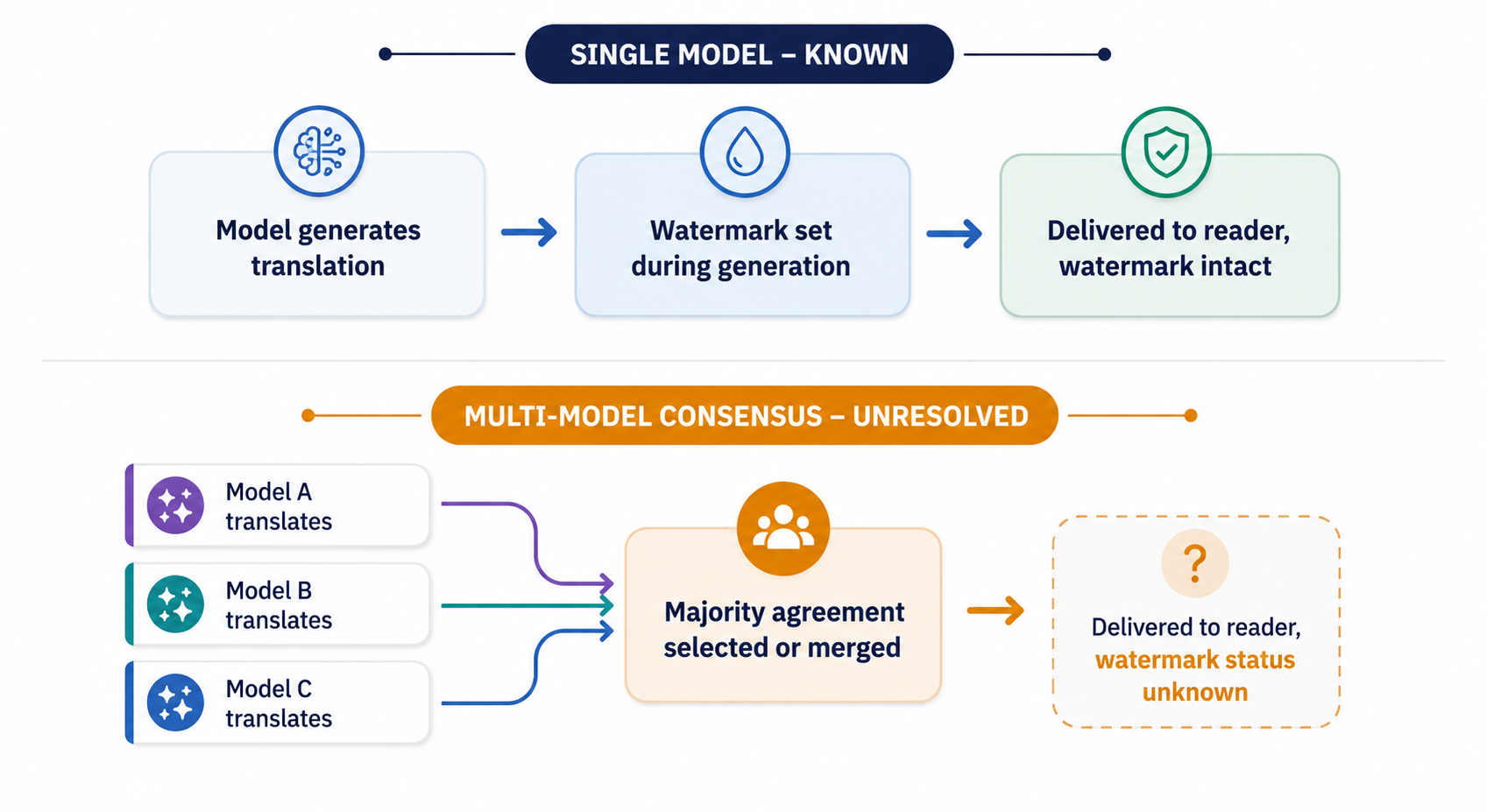
Anthropic's answer is complete for the case it was written for: one model, asked to translate a passage, generating every word of the result. It says nothing about what happens when several models each produce their own full translation and a system then has to decide which version, or which parts of which versions, the reader actually sees.
The question that answer doesn't settle
A meaningful share of AI translation today doesn't work the way the FAQ assumes. Rather than asking one model for an answer, a growing number of systems run the same source text through several independent models and then select, or in some cases merge, the result the group agrees on. The reasoning is straightforward: a single model can fail in ways a user has no way to catch, especially if they don't speak the target language, and cross-checking against other models is one of the more reliable ways to catch it before it reaches anyone.
That architecture runs directly into a watermarking method built and tested around a single model finishing its own generation. If model A, B, and C each independently translate a sentence and a system selects model B's version because it matches what the majority produced, does the watermark that was embedded in model B's original output survive that selection step unmodified? If the system instead builds a result that draws on agreement across several outputs rather than delivering any one model's answer untouched, whose token-level choices, if anyone's, is a watermark even reflecting at that point?
How different translation approaches map onto Anthropic's watermarking framework
| Translation approach | What a watermark would need to track | Is the answer settled? |
|---|---|---|
| Single model, direct translation | One model's token choices, start to finish | Yes, addressed directly in Anthropic's guidance |
| Model output lightly edited or proofread by a person | The original choices, weakened by the edit | Yes, Anthropic addresses editing and proofreading explicitly |
| Several models translate independently; one is selected as the result | Only the selected model's choices, assuming it's delivered unmodified | Unclear, no public guidance addresses selection |
| Several models' outputs are compared or merged into one result | No single unmodified generation to trace back to | Unclear, outside the scope of current watermarking research |
The watermarking method was built, reasonably, around the case that covers the overwhelming majority of AI-generated text: one model, one response. Ensemble and consensus systems are a smaller, newer piece of the landscape, and the research base undetectable watermarking comes from, including the original cryptographic framing of the idea, was built and evaluated against single-model generation. Nobody has publicly tested what happens once selection or merging enters the picture.
Why translation is the sharpest version of this question
Translation is arguably where this gap matters most, for two reasons that don't apply equally to other kinds of AI writing.
First, translation is one of the few categories of AI output where Anthropic has said, in plain terms, that the model's entire contribution counts as generation rather than editing. That makes it a clean test case: there's no ambiguity about whether the watermark question even applies, the way there might be for a lightly AI-assisted email. The only open question is architectural.
Second, translation is one of the categories of AI output where multi-model checking has the clearest, most defensible reason to exist. A mistranslated idiom, a dropped legal qualifier, or a culturally flattened phrase can be invisible to a reader who doesn't speak the target language, which is exactly the situation most business buyers of translation are in. Cross-checking a translation against other independent models is one of the more credible ways to catch that kind of silent failure, which is the whole premise behind consensus approaches like the one MachineTranslation.com's SMART system uses across its pool of AI models. That premise holds up on its own terms. Reconciling it with a watermarking framework that assumes a single generating model is the part nobody has done yet.
There's a regulatory dimension underneath this too. Article 50 of the EU AI Act requires providers of systems that generate text to mark their output in a machine-readable format, detectable as artificially generated, "as far as this is technically feasible." A business relying on an AI translation vendor to help satisfy that obligation needs a straight answer about whether its translated output is actually marked. Today, for any vendor running more than one model, that answer depends on delivery architecture decisions that most vendors, including ours, haven't spelled out publicly yet.
What would need to be true to answer this
A few concrete things would move this from an open question to a settled one, and none of them exist publicly yet.
- A watermark detection API tested against selection, not just editing. Anthropic has said a detection tool is coming. Existing public commentary on what survives, light edits versus full rewrites, is all framed around a single model's output being modified afterward. Selection among several independent generations is a different operation and hasn't been tested the same way.
- Vendors disclosing how their systems deliver a result. Whether a multi-model translation tool passes through the winning model's output unmodified, or normalizes and reformats it before delivery, is a specific, answerable, engineering question. Almost no vendor currently publishes that answer, including us.
- Independent research on watermark persistence through model selection. The existing literature on what breaks a watermark focuses on paraphrasing, translation between languages, and cross-model editing. Selecting among several already-complete generations, rather than modifying one, is a distinct case that doesn't appear to have been studied yet.
Anthropic has said a public detection tool is coming. The straightforward test, once it exists, is to run a single-model translation and a consensus translation of the same source sentence through it side by side and see what comes back: both marked, one marked, or neither. Nobody has run that test yet, us included. Until someone does, a confident answer about how watermarking behaves inside a consensus translation system is ahead of the evidence, not behind it.
Frequently asked questions
1. Why is AI translation being watermarked now, when machine translation has existed for years?
Two separate things changed. Token-level watermarking is new research from 2022 onward and only exists in general-purpose models like Claude, GPT, and Gemini, not in most older dedicated MT engines. More directly, the EU AI Act's Article 50 marking requirement, combined with Anthropic's own August 2, 2026 rollout date, is what's forcing this into the open now, not a change in translation technology itself.
2. How many edits does it take to remove an AI translation watermark?
There's no published number. Anthropic has said light editing probably won't remove the watermark and a full rewrite likely will, without specifying a word count or percentage threshold in between. No independent research has quantified that line either. It's currently a qualitative distinction, not a measured one.
3. Does an AI watermark survive translation?
Yes, when one model both generates and delivers the translation. Anthropic has confirmed that a Claude translation carries its watermark because every word in the output is chosen by the model. The open question is what happens when a translation involves more than one model and a selection step in between.
4. Do ChatGPT, Claude, or other AI models have hidden watermarks in translated text?
Anthropic has confirmed Claude does, for models released on or after August 2, 2026, with older models being retrofitted over time. Other major providers have signaled they're moving toward similar marking to comply with the same EU regulation, though implementation details and timelines vary by provider.
5. Can an AI watermark be removed from translated content?
Anthropic has said light editing probably won't remove the watermark completely, while a full rewrite where every word is replaced likely will, at which point it becomes debatable whether the result still qualifies as AI-generated. Public tools that can read Claude's watermark directly aren't broadly available yet.
6. Does the EU AI Act require AI-translated content to be labeled?
Article 50 of the EU AI Act requires providers of AI systems that generate text to mark the output in a machine-readable, detectable format, where technically feasible. Whether a specific translation tool meets that bar depends on how its underlying models handle marking and how the tool delivers its result.
7. What happens to a watermark when multiple AI models are involved in one translation?
There's no public answer yet. If a system selects one model's output unmodified, that model's watermark may carry through. If outputs are compared, merged, or reformatted before delivery, it's unclear whether any single model's mark survives. No public research currently addresses this directly.

By Rachelle Garcia
Connect on LinkedInRachelle leads product and AI at Tomedes, where she runs the experiments that turn internal data into better translation experiences. She writes about what actually happens when you build AI products such as MachineTranslation.com — the numbers, the surprises, and the parts that don't go to plan.
Share:


