May 8, 2026
What is a translation aggregator? How comparison and consensus tools differ
In 2025, Intento's State of Translation Automation 2025 evaluated 46 MT engines and LLMs for translation quality. Most users will never compare 46 tools. But in MachineTranslation.com's internal research, 46% of non-linguists said they spent more time manually comparing outputs from just two or three tools than the AI itself saved them. And 34% admitted they were not confident enough in any single AI output to publish it without checking. Source: MachineTranslation.com internal data.
This is the problem translation aggregators were built to solve. Instead of opening multiple tools, running the same text through each, and manually deciding which output is correct, an aggregator puts all of that in one interface — and the best ones go further, making the selection automatically.
This guide explains what translation aggregators are, how they work, what to look for when choosing one, and what the structural difference is between aggregators that show you options and aggregators that make the choice for you.
What is a translation aggregator?
A translation aggregator is a software platform that connects to multiple machine translation engines and large language models simultaneously, processes the same input through all of them, and presents the results in a single interface.
Instead of using one translation engine and accepting its output, an aggregator gives you access to many engines at once — letting you compare results, see where models agree or disagree, and choose the most accurate output for your content.
Translation aggregators are used by freelance translators who need client-ready output without second-guessing, by businesses that need consistent multilingual communications across content types, by localization teams evaluating which engine performs best for specific domains, and by developers building translation into products who need a quality signal alongside the translation output.
One reason aggregators have become more relevant since 2023 is that no single engine consistently leads every language pair, the best engine for English to German is not always the best engine for English to Japanese. An aggregator removes the need to track this manually.
The category has expanded significantly since 2022. Early aggregators focused on comparison, showing outputs side by side. Newer systems go further: they run multiple models simultaneously and automatically identify the output that the majority of models agree on, removing the selection burden from the user entirely.
How translation aggregators work
At a technical level, most aggregators follow the same basic architecture. A user inputs text or uploads a document. The aggregator sends that input simultaneously to multiple connected translation engines — which can include dedicated neural MT engines (Google NMT, DeepL, Microsoft), large language models (ChatGPT, Claude, Gemini, DeepSeek), and specialized domain models. The outputs are returned and displayed in a single interface.
What happens next depends on the type of aggregator.
Comparison aggregators display all outputs side by side and give the user tools to evaluate them (quality scores, segment-level breakdowns, confidence indicators) and then choose the output they want to use or post-edit.
Consensus aggregators analyze outputs from all connected models and automatically identify where the models agree. The output the majority selects becomes the recommended translation, along with a quality score showing how strong that consensus was. The user sees the result immediately, with the option to view individual model outputs underneath.
Both types provide more information than a single-engine tool. The key difference is who makes the final selection: the user, or the system.
Two types of aggregator: comparison and consensus
Understanding this distinction is the most practically important thing about choosing an aggregator.
Comparison aggregators
Comparison aggregators solve the visibility problem: instead of committing to one engine and hoping its output is correct, you can see what multiple engines produce. For users who speak the target language, this is genuinely useful — you can identify the best output directly.
The limitation: for users who do not speak the target language (the majority of professional and SMB translation users) a comparison view does not resolve the uncertainty. You are still choosing between outputs you cannot fully evaluate. The models may all look reasonable, or two may agree and one may diverge, but without language expertise the correct choice is not obvious. MachineTranslation.com's internal data shows this plays out in practice: 46% of non-linguists spent more time comparing outputs than the AI saved them.
Consensus aggregators
Consensus aggregators solve the selection problem by identifying mathematical agreement across models. When 15, 18, or 20 of 22 models produce the same output (or functionally equivalent outputs) that agreement is a strong signal that the translation is correct, regardless of whether the user speaks the target language.
MachineTranslation.com's SMART system works this way. It runs 22 AI models simultaneously (including ChatGPT, Claude, Gemini, DeepSeek, DeepL, Google, Grok, Llama, Mistral AI, Qwen, and 12 others) and selects the output the majority agrees on.
In MachineTranslation.com's internal benchmarks, individual top-tier models score 93-94 out of 100 on translation quality. SMART's consensus output reaches 98.5/100. The difference reflects the structural advantage of cross-model verification: errors specific to any individual model get outvoted before they reach the output. At WMT24 (the translation industry's primary annual benchmark competition), top individual models scored in the 93-94 range; consensus systems consistently outperformed them. Source: MachineTranslation.com internal benchmarks and WMT24 General Machine Translation Findings.
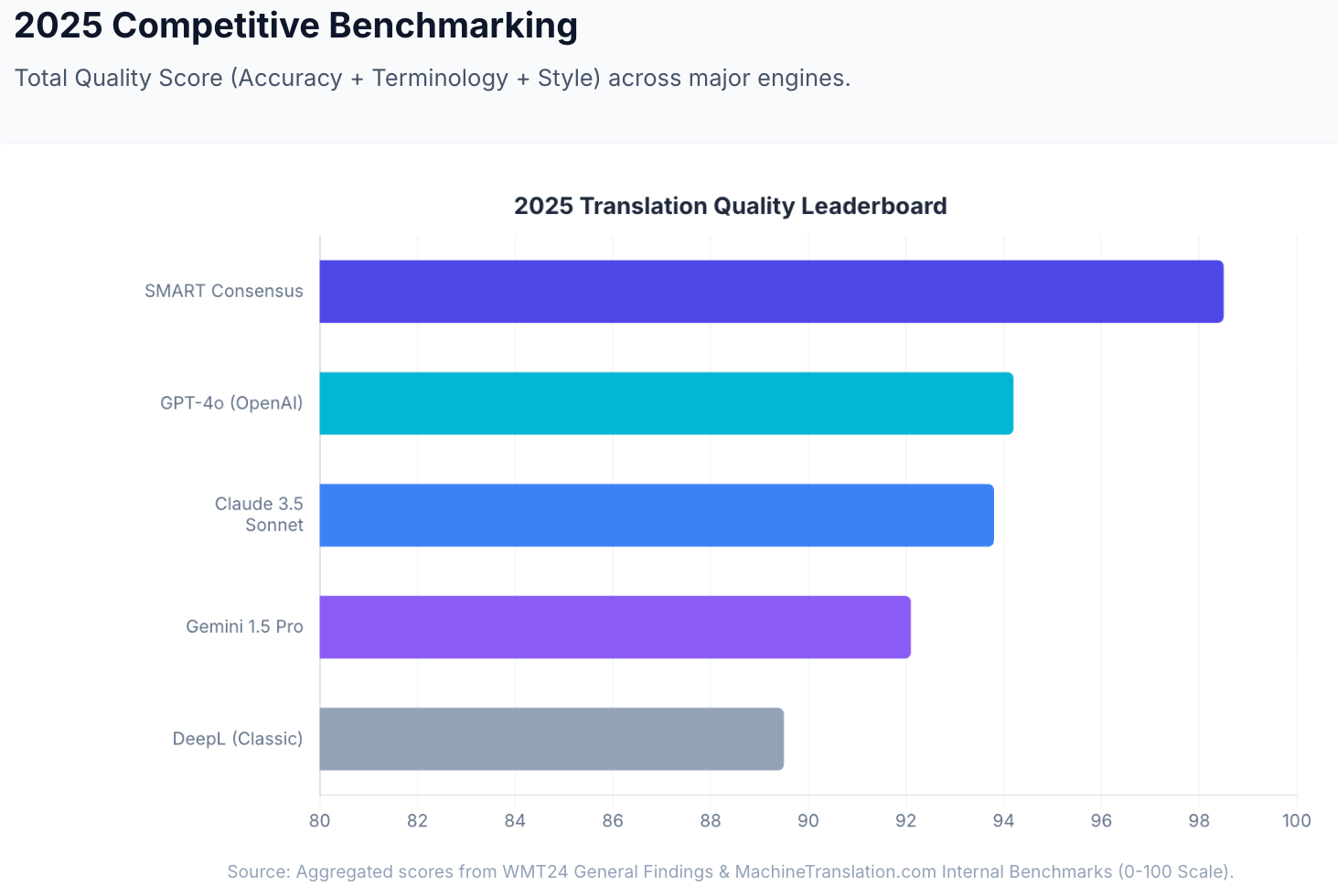
Users who switched from single-engine translation to SMART spent 27% less time verifying and correcting outputs. Source: MachineTranslation.com internal data.
The practical implication: for users who cannot evaluate target-language output themselves, a consensus aggregator provides the quality signal a comparison aggregator cannot.
What to look for in a translation aggregator
When evaluating aggregators, these criteria separate genuinely useful tools from directory-style platforms.
Number and quality of connected models. A broader model base produces more reliable consensus and better coverage across language pairs. An aggregator connecting 5 engines reflects the 2020 state of the market. An aggregator connecting 22 models (including all major frontier LLMs and dedicated NMT engines) reflects 2025–2026. Lokalise's 2025 blind study by professional translators found that model quality differences are significant enough that engine selection materially affects output quality across content types.
Quality scoring. An aggregator should tell you not just what each model produced, but how reliable that output is. Translation Quality Scores, segment-level confidence indicators, and model agreement rates all provide usable signals. Raw output display without quality indication is the minimum viable product, not a differentiator.
Whether selection is automatic or manual. This is the comparison vs. consensus distinction above. For users who speak the target language and want direct control, comparison tools are appropriate. For users who need to trust the output without personal verification of the target language, consensus selection is structurally more reliable.
Document support. Professional translation involves documents, not just text boxes. Look for maximum file size, supported formats (PDF, DOCX, XLSX, TXT, CSV, images), and whether original formatting is preserved in the output. Reformatting translated documents manually is a hidden time cost that varies significantly across platforms.
Latency and throughput. For real-time or high-volume workflows, the time each model takes to respond affects how usable an aggregator is in practice. Consensus aggregators running 22 models in parallel have a wall-clock time equal to the slowest model in the batch (not the sum of all 22) which makes parallel execution more practical than it might initially appear.
Human verification availability. For high-stakes content (translating legal documents, medical instructions, regulatory filings), no aggregator's AI output alone is sufficient. The question is whether human verification is available within the same platform or requires switching to an external agency. In-platform verification removes the workflow break; external verification adds a vendor, a contract, and a delay.
Data security. For organizations translating confidential client content or regulated documents, how the platform handles data matters. Secure mode, defined data processing terms, and no training-data retention are relevant criteria for legal and healthcare users.
Translation aggregators compared
The following tools represent the main categories of aggregator actively used in 2025-2026 by freelancers, SMBs, and localization teams. This is not an exhaustive directory, it focuses on tools with clear use cases for professional translation workflows.
MachineTranslation.com runs 22 AI models simultaneously and returns the output the majority agrees on. It supports Human Verification in-platform (100% accuracy guarantee, no external vendor), document upload up to 70MB across PDF, DOCX, XLSX, TXT, CSV, and image formats with original formatting preserved, 330+ languages, and a free plan with no sign-up required. For detail on how individual models inside SMART (such as Claude and ChatGPT) compare on translation quality, that evidence informs what the consensus is actually resolving between them.
Intento MT Hub is an enterprise-level aggregator integrating 40+ MT and LLM providers, used by large localization teams and TMS platforms. It is not self-serve, it requires integration and setup. Best suited for enterprise workflows with existing TMS infrastructure.
Lokalise AI offers smart routing within its localization platform, automatically selecting the best MT engine per content type based on quality estimation. It is not a standalone aggregator and requires a Lokalise subscription. Best suited for software localization teams.
Phrase Language AI includes MT autoselect within the Phrase TMS, selecting the optimal engine per translation job using document categorization. Enterprise-oriented and requires existing Phrase platform use.
Unbabel combines neural MT (TowerLLM) with human post-editing. Quality scores and side-by-side comparison are available. Best suited for enterprise customer support workflows.
The pattern across the enterprise tools is consistent: they offer engine selection or comparison, require enterprise contracts or existing TMS subscriptions, and are not accessible to individual users or SMBs without a procurement process. MachineTranslation.com is the only platform in this comparison that provides consensus-level quality verification, Human Verification in-platform, and immediate free access without a sales call or minimum commitment.
Frequently asked questions
1. What is a translation aggregator?
A translation aggregator is a platform that connects to multiple machine translation engines and LLMs simultaneously, processes the same input through all of them, and presents the results in a single interface. Instead of using one engine and accepting its output, you see what multiple engines produce — and in consensus aggregators, the system automatically identifies the output the majority of models agree on.
2. How is a translation aggregator different from Google Translate or DeepL?
Google Translate and DeepL are single-engine tools, each uses one model and returns one output. A translation aggregator processes your input through multiple engines simultaneously. Consensus aggregators go further, automatically selecting the output that the majority of models agree on, so you do not have to evaluate outputs yourself.
3. What is the difference between a comparison aggregator and a consensus aggregator?
A comparison aggregator shows outputs from multiple models side by side and lets you choose the best one. A consensus aggregator automatically identifies the output the majority of connected models agree on, and surfaces it as the recommended translation along with a quality score. Comparison aggregators are useful when you speak the target language and want direct control. Consensus aggregators are useful when you need to trust the output without personal verification of the target language.
4. How many models does MachineTranslation.com aggregate?
MachineTranslation.com's SMART system aggregates 22 AI models simultaneously: ChatGPT, Claude, Gemini, AI21, Amazon, Amazon Nova, DeepL, DeepSeek, Facebook, GLM, Google, Grok, LibreTranslate, Lingvanex, Llama, Microsoft, Mistral AI, Modern MT, Moonshot, Niutrans, Qwen, and Royalflush.
5. When do I need human verification on top of an aggregator?
For high-stakes content (legal documents, regulatory submissions, medical instructions, contracts), consensus AI translation provides a strong foundation but not a professional accountability layer. MachineTranslation.com's Human Verification escalates any translation to a certified professional reviewer within the same platform, with a 100% accuracy guarantee and no external agency required.
6. Are translation aggregators suitable for document translation?
Yes, provided the aggregator supports document upload. MachineTranslation.com supports files up to 70MB across PDF, DOCX, TXT, CSV, XLSX, and image formats, with original formatting preserved in DOCX and open PDFs. All 22 SMART models apply to document translation, and the consensus mechanism works at the full-document level.