April 10, 2026
Claude vs. Gemini for translation: 2026 benchmark comparison
In Intento's State of Translation Automation 2025 (the most rigorous independent benchmark of AI translation systems, evaluating 46 engines and LLMs across 11 language pairs) both Claude and Gemini appear repeatedly in the top tier. But they don't lead on the same pairs.
Claude Opus 4 and Sonnet 3.7 rank among the best solutions for German, Japanese, Korean, Dutch, and Italian. Gemini 2.5 Pro and Flash rank among the best for Chinese, Portuguese (Brazilian), Ukrainian, and French. For Arabic and Spanish, both models appear alongside others. Neither consistently outperforms the other across all language pairs. Source: Intento State of Translation Automation 2025.
That per-pair performance split is the most useful thing this comparison can tell you. It means the right answer to "Claude or Gemini for translation?" is: it depends on what you're translating into.
In this article
- How Claude and Gemini compare on translation quality
- Where Claude has a documented advantage
- Where Gemini has a documented advantage
- Language support and pricing
- What to use when the best model changes by pair
- Frequently asked questions
How Claude and Gemini compare on translation quality
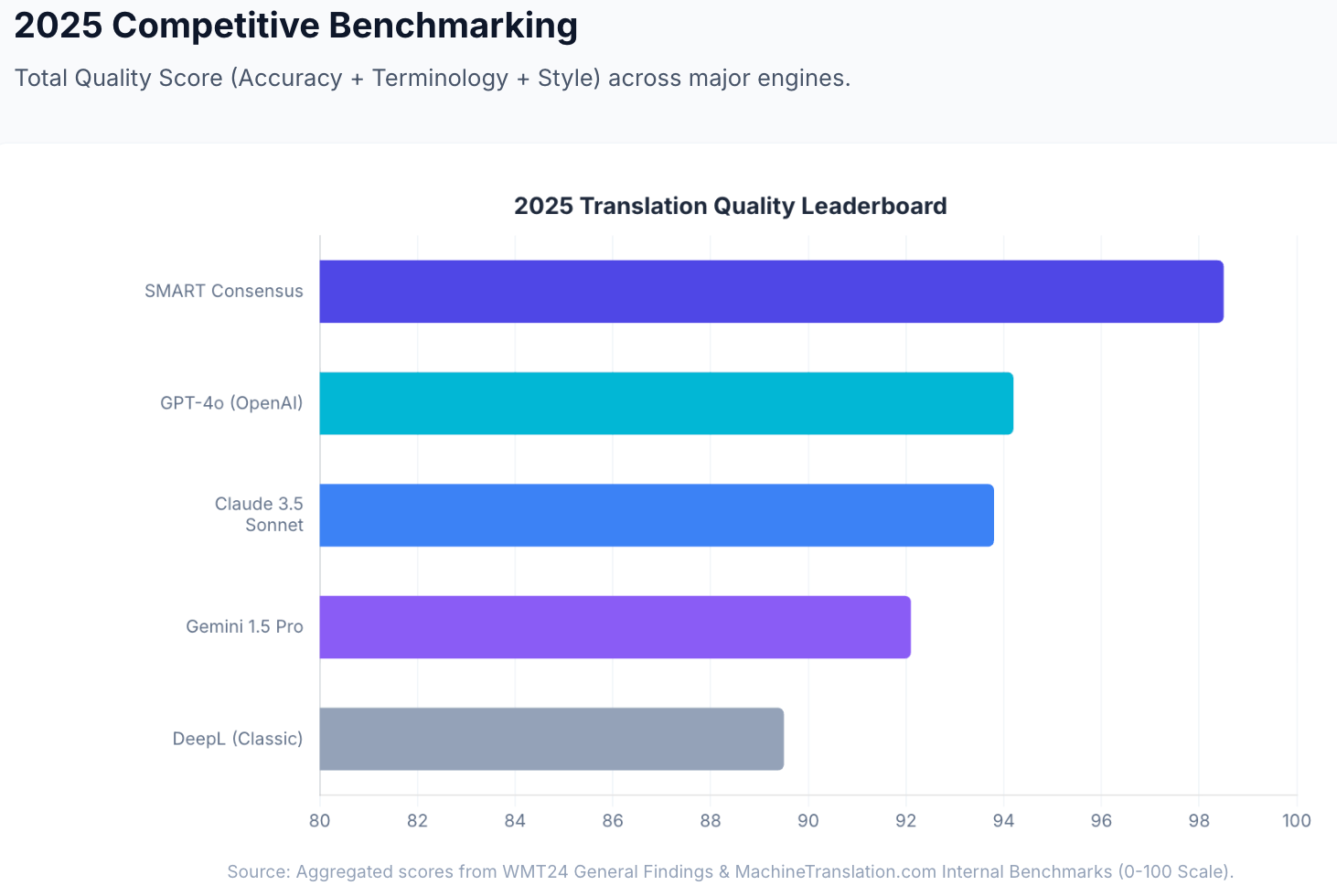
MachineTranslation.com internal benchmarks place Claude (3.5 Sonnet tier) at 93.8/100 and GPT-4o at 94.2/100 on overall translation quality. Gemini 1.5 Pro scores below both in the same benchmark set. Source: MachineTranslation.com internal benchmarks and WMT24 General Machine Translation Findings.
WMT24 (the translation industry's primary annual benchmark competition) placed Claude 3.5 first in 9 of 11 language pairs, ahead of GPT-4 and dedicated NMT engines. Gemini was not in the top tier for most pairs in the same evaluation.
Lokalise's 2025 blind study by professional translators rated 78% of Claude 3.5 translations "good", the highest of any LLM tested, including Gemini.
Intento 2025 shifts the picture when evaluated at the model-family level rather than the specific Claude 3.5 vs. Gemini 1.5 comparison. Newer Gemini models (2.5 Pro, 2.5 Flash) and newer Claude models (Opus 4, Sonnet 3.7) both appear in the top tier across multiple language pairs. GPT-4.1 and Gemini 2.5 Pro are described as the most consistently strong single-agent solutions across all language pairs evaluated. Claude Opus 4 and Sonnet 3.7 are also among the top 14 solutions showing best results across pairs.
The honest summary: in head-to-head evaluation at the 2024 generation level, Claude 3.5 led Gemini on most standard metrics. At the 2025 generation level, Gemini 2.5 Pro has closed or reversed the gap on specific language pairs while Claude 4 remains strong on others. Neither model is universally better.
| Benchmark | Claude result | Gemini result |
|---|---|---|
| MT.com internal quality score | 93.8/100 (Claude 3.5) | Below Claude 3.5 in same benchmark |
| WMT24 language pairs | 1st in 9/11 pairs | Not in top tier for most pairs |
| Lokalise 2025 blind study | 78% "good" (highest LLM) | Below Claude 3.5 |
| Intento 2025 (Gemini 2.5 Pro) | Claude Opus 4 / Sonnet 3.7 in top tier | Gemini 2.5 Pro in top tier for French, Chinese, PT, UK |
Source: MachineTranslation.com internal benchmarks; WMT24 General Machine Translation Findings; Lokalise 2025; Intento State of Translation Automation 2025.
Where Claude has a documented advantage
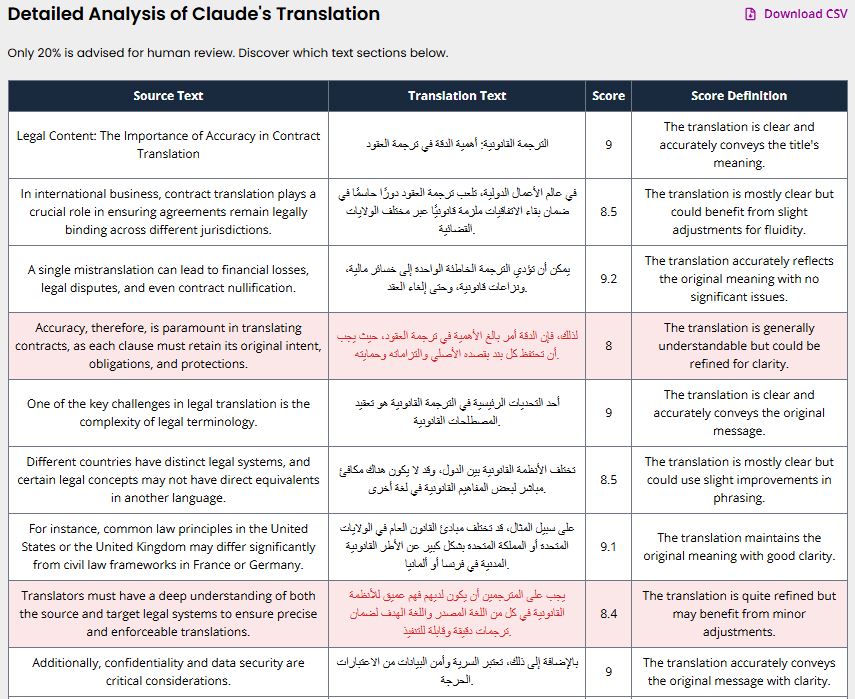
Tone precision and nuanced content. Professional translators in the Lokalise 2025 blind study preferred Claude 3.5 output more than any other LLM tested — a 78% "good" rating that reflects Claude's consistent handling of register, authorial voice, and contextual meaning. For literary translation, marketing copy, or formal communications where how something is said matters as much as what is said, Claude's output requires less post-editing.
Specific language pairs per Intento 2025. Claude Opus 4 and Sonnet 3.7 appear in the "best" category for English to German, English to Japanese, English to Korean, English to Dutch, and English to Italian in human LQA evaluation. For these pairs, Claude is the stronger choice among the two models in head-to-head comparison.
Long-document coherence. Claude 4's context window (200K tokens for Sonnet, 1M tokens in beta for Opus) enables full-document processing without chunking for most professional documents. Maintaining terminology consistency across a 200-page contract or a full technical manual in a single pass is an advantage Claude has over Gemini's standard context tiers.
Independent evaluation standing. WMT24 and Lokalise 2025 both place Claude 3.5 clearly ahead of Gemini at the 2024 model generation. These are blind evaluations by professional translators and independent researchers, not claims made by Anthropic.
Where Gemini has a documented advantage
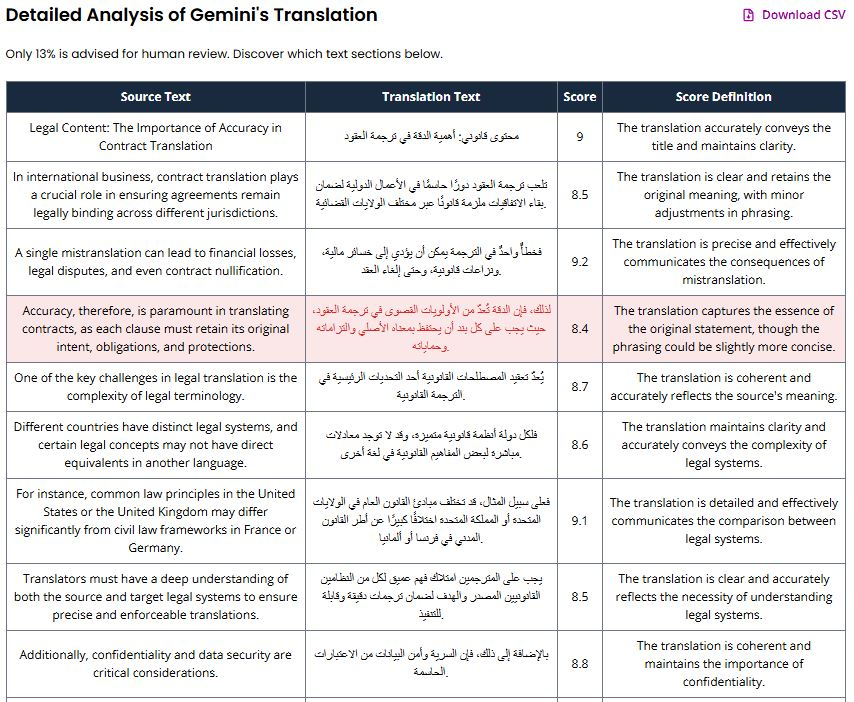
Chinese, Portuguese, and Ukrainian per Intento 2025. Gemini 2.5 Pro and Flash appear in the "best" category for English to Chinese, English to Portuguese (Brazilian), and English to Ukrainian, where Claude models do not appear in the top tier in the same evaluation cycle. For these specific pairs, Gemini is the stronger single-model choice.
Longest available context window. Gemini 1.5 Pro's 1M-token context window (and 2M in some configurations) is the largest of any standard production model. For translation tasks involving extremely long documentation sets, multi-file exports, or repositories where terminology must remain consistent across hundreds of files, Gemini's context advantage is real. Gemini 2.5 Pro maintains this advantage.
Google ecosystem integration. For teams already embedded in Google Workspace, Gemini integrates natively with Google Docs, Sheets, and other tools. Translation workflows that don't require a separate platform have a lower friction path with Gemini for Google users.
Speed at scale. Google Translation LLM (fine-tuned from Gemini) is approximately 3× faster than standard Gemini for translation tasks, per independent assessments. For high-volume batch translation where latency and throughput matter, Gemini's infrastructure advantage is meaningful.
Language support and pricing
Language support: Both Claude 4 and Gemini 2.5 Pro support most major world languages. Neither publishes a definitive count for LLM-based translation, both handle standard Unicode languages at varying quality. For high-resource pairs (European, East Asian, major world languages) both are competitive. Performance degrades for low-resource languages in both cases, though Gemini's Google NMT foundation gives it broader coverage for low-resource pairs outside of LLM-based translation specifically.
Pricing:
| Plan | Claude | Gemini |
|---|---|---|
| Consumer (monthly) | Claude Pro: $20/month | Google One AI Premium (includes Gemini Advanced): $19.99/month |
| API input (per M tokens) | Sonnet 4.6: $3 | Gemini 2.5 Pro: $1.25 (under 200K context) |
| API output (per M tokens) | Sonnet 4.6: $15 | Gemini 2.5 Pro: $10 |
| Free tier | Yes (rate-limited) | Yes (rate-limited) |
At the API level, Gemini 2.5 Pro has a meaningful cost advantage for input-heavy translation workflows, particularly at high volume. At the consumer tier, both are essentially equivalent.
What to use when the best model changes by pair
The Intento 2025 data makes a practical problem explicit: the model that leads for German (Claude Opus 4) is not the same model that leads for Chinese (Gemini 2.5 Pro). For teams translating into multiple language pairs, this creates a constant selection decision.
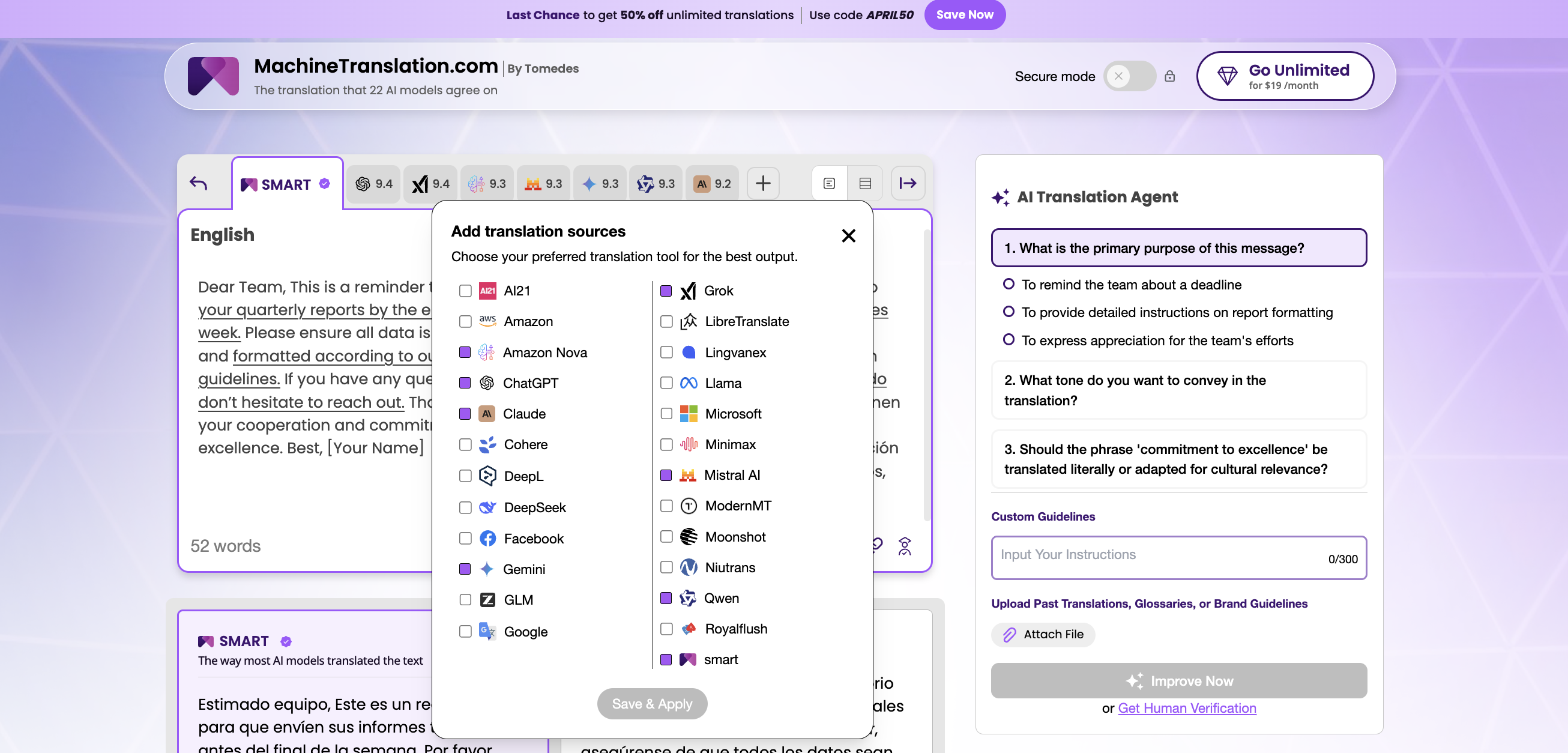
Both Claude and Gemini are among the 22 models in MachineTranslation.com. MachineTranslation.com's SMART runs all 22 models simultaneously (including both Claude and Gemini at their current versions) and returns the output the majority agree on. Instead of choosing the right model for each language pair, SMART runs the full ensemble and surfaces the cross-validated consensus output.
In MachineTranslation.com's internal benchmarks, individual top-tier models including Claude and Gemini score 93–94/100. SMART's consensus output reaches 98.5/100. The gap reflects what happens when model-specific errors are outvoted by the other 20 models before reaching the output. Source: MachineTranslation.com internal benchmarks and WMT24 General Machine Translation Findings.
Users who switched from single-model translation to SMART spent 27% less time verifying and correcting outputs. Source: MachineTranslation.com internal data.
For high-stakes content (legal filings, regulated documents, clinical material), Human Verification escalates the consensus translation to a certified professional reviewer within the same platform: no external agency, 100% accuracy guaranteed.
Translate with Claude, Gemini, and 20 other models at MachineTranslation.com — free, no sign-up required.
FAQs
1. Is Claude better than Gemini for translation?
For most standard translation use cases, Claude 3.5 led Gemini in independent 2024 evaluations: first in 9/11 language pairs at WMT24, and highest "good" rating (78%) in Lokalise's 2025 blind study. At the 2025 model generation, Gemini 2.5 Pro has closed the gap on specific pairs including Chinese, Portuguese, and Ukrainian. Neither model is universally better. Claude leads for German, Japanese, Korean, Dutch, and Italian; Gemini leads for Chinese, Portuguese, and Ukrainian per Intento 2025.
2. Which is better for legal translation: Claude or Gemini?
Both models handle legal content well, but neither is sufficient as the sole verification for legal submissions. Claude's strength in tone precision and contextual coherence makes it a strong choice for contracts and formal agreements. For legal translation requiring accountability, MachineTranslation.com's Human Verification provides 100% accuracy from a certified professional reviewer within the same platform — no external vendor required.
3. Which is better for Chinese translation?
Per Intento's 2025 human LQA evaluation, Gemini 2.5 Pro and Google NMT appear in the "best" category for English to Chinese, while Claude does not. For Chinese translation specifically, Gemini has the documented advantage at the current model generation.
4. Which model is better for German translation?
Per Intento 2025 human LQA evaluation, Claude Opus 4 and Sonnet 3.7 appear in the "best" category for English to German, alongside Gemini 2.5 Pro and Lara. Both models are strong for German; Claude's appearance in independent professional translator evaluations (WMT24, Lokalise 2025) gives it a slight edge on nuanced German content.
5. How do Claude and Gemini compare on pricing?
At the consumer level, both are approximately $20/month (Claude Pro vs. Google One AI Premium). At the API level, Gemini 2.5 Pro is cheaper for input-heavy workflows ($1.25/M tokens vs. $3/M for Claude Sonnet 4.6). For high-volume translation via API, Gemini has a cost advantage. MachineTranslation.com's free plan includes both models as part of SMART's 22-model consensus, no sign-up required.
6. Are both Claude and Gemini available on MachineTranslation.com?
Yes. Both are among the 22 models in MachineTranslation.com. Every translation on MachineTranslation.com runs Claude, Gemini, and 20 other models simultaneously, returning the output the majority agrees on along with a Translation Quality Score. Rather than choosing among them, you get the consensus of all.
7. What is the difference between Claude and Gemini for long documents?
Both have large context windows — Claude Sonnet 4.6 at 200K tokens, Gemini 2.5 Pro at 1M tokens. For extremely long documentation sets (multi-file exports, large repositories, manuscripts over ~150,000 words), Gemini's larger context window is a structural advantage. For document translation within the standard professional range (up to ~150 pages), both process the full document without chunking.

By Clarriza Heruela
Clarriza Mae Heruela graduated from the University of the Philippines Mindanao with a Bachelor of Arts degree in English, majoring in Creative Writing. Her experience from growing up in a multilingually diverse household has influenced her career and writing style. She is still exploring her writing path and is always on the lookout for interesting topics that pique her interest.
Share:


