October 28, 2026
Why we put a human project manager on the MachineTranslation.com Pro plan
Self-serve AI translation hands you a draft in seconds. Everything after the draft is still your job. You check the output, decide whether it is safe to publish, and find a human reviewer when it is not.
That gap shows up in our own research. In an internal study, 34% of people said they were not confident enough in an AI translation to publish it without checking it first.
I believe a translation platform should be judged by who takes responsibility for the result. That is why the MachineTranslation.com Pro plan includes a dedicated human project manager, and this post explains what that person does, and what they leave to the platform.
The project manager has a short entry on our pricing page, and we never wrote it up properly. I am fixing that now.
Key takeaways
- Every MachineTranslation.com Pro plan includes a dedicated project manager, a real person customers reach by email.
- The project manager uploads the document, runs it through the platform, coordinates Human Verification when the content needs it, and delivers the finished translation.
- The Pro plan includes on-demand human review for up to 2,000 words per month, with additional words available a la carte.
- In an internal study, 34% of people were not confident enough to publish an AI translation without checking it, and 46% of non-linguists said comparing AI outputs by hand cost them more time than the AI saved.
- The project manager adds ownership of the outcome.
What does the dedicated project manager on the Pro plan do?
The dedicated project manager is a real person you can email at any time. You send a document and your requirements, such as language pair, register, deadline, and terminology. The project manager uploads the file, runs it through the platform, coordinates Human Verification when the content needs it, and sends the finished translation back.
As of 2026, every MachineTranslation.com Pro plan includes a dedicated project manager, described on the pricing page as a real human contact for questions, guidance, and support. Customers reach that person by email.
SMART is the consensus mechanism behind every translation on the platform. It compares the output of up to 22 independent AI models and returns the translation most of them agree on, as our explainer on SMART describes. The project manager does not change that step.
- The customer emails the project manager with the document and the requirements, such as language pair, register, deadline, and domain terminology.
- The project manager uploads the document to the platform.
- The document runs through the platform, which compares up to 22 AI models and returns the translation most of them agree on.
- The project manager coordinates Human Verification when the content needs a professional linguist.
- The project manager delivers the finished translation back to the customer.

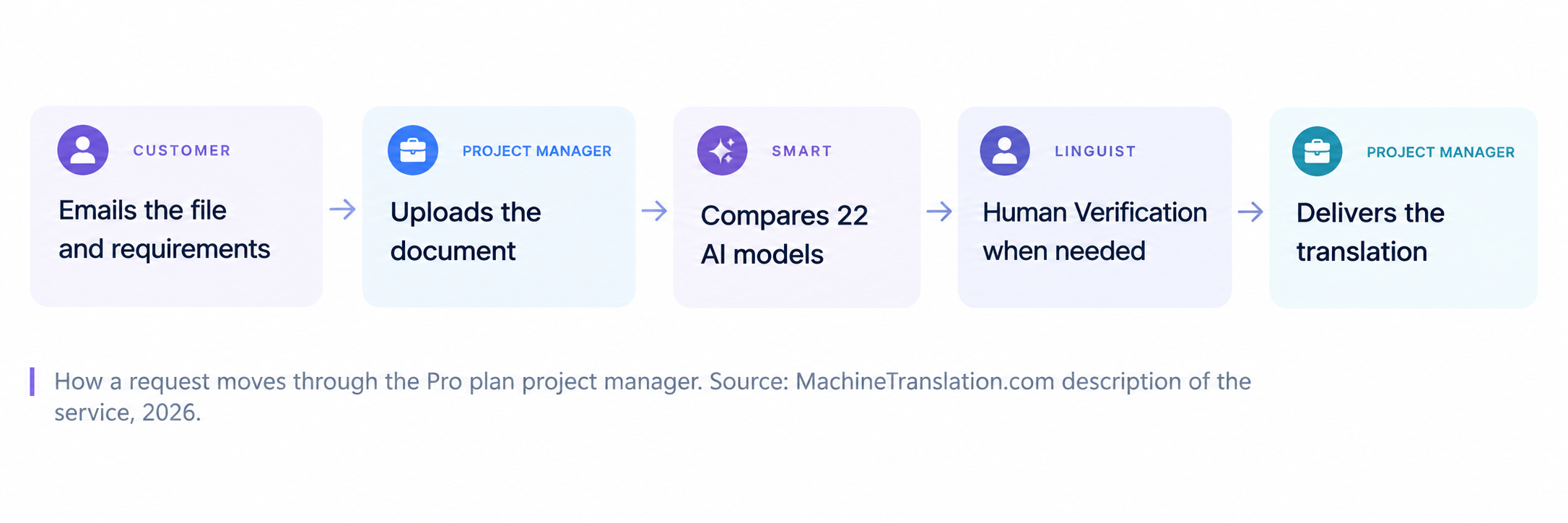
My take is that the order of these steps matters more than any one of them. The customer states the requirements once, and the rest happens without them.
Why did we put a human inside an AI translation plan?
Because reliable AI translation still leaves someone responsible for the result, and on a self-serve platform that someone is the customer. I think a business should be able to hand the whole job to a person who owns it. That is the gap the project manager fills.
The numbers show the gap. In the same study, 46% of non-linguists said they spent more time comparing AI outputs by hand than the AI saved them.
I spent nearly two decades running Tomedes, the translation company behind MachineTranslation.com, and an agency sells one thing beyond the translation itself, which is ownership of the job.
In my opinion, AI translation improved faster than the service around it. A reliable mechanism does not say who checks the result, who coordinates the reviewer, or who is accountable when something goes wrong.
Does the project manager replace the platform?
No, the project manager works through the platform because every translation still runs through SMART and any Human Verification happens inside the same platform. What changes is who does the operating. The customer no longer uploads, monitors, requests review, or collects the result, and the project manager handles each of those steps.
Who does each task on the Pro plan.
| Task | Self-serve | With the dedicated project manager |
|---|---|---|
| State the requirements | The customer sets them in the platform | The customer states them once by email |
| Upload the document and choose the language pair | The customer | The project manager |
| Monitor the output | The customer | The project manager |
| Decide on and request Human Verification | The customer | The project manager coordinates it when needed |
| Receive the finished translation | The customer downloads it | The project manager delivers it back |
What I take from the table is that the Pro plan keeps the consensus underneath and moves the operating work to a person. The platform still produces the translation, and the person handles everything around it.
What does Human Verification add, and how much is included?
Human Verification means a professional linguist reviews the AI translation inside the same platform and edits it. The Pro plan includes on-demand human review for up to 2,000 words per month, and additional words are available a la carte.
MachineTranslation.com data published in November 2025 showed client retention 1.8 times higher on AI translation projects that included at least one human verification stage. As far as I understand, that figure shows an association, and I cannot say from it that the human step caused the retention.
I could be wrong on this, but 2,000 words looks right for the highest-stakes pages of a document and too little for a full manual.
Who gets the most from a dedicated project manager?
Businesses that translate regularly across teams and time zones get the most, because their translation work repeats across departments. A freelancer with one document can manage the platform alone. Between those two sit teams with a steady flow of documents and nobody whose job is to run a translation tool, and I would expect them to notice the difference first.
My read is that the value grows with how often a team translates and how many people touch the result. Large-scale or highly specialized needs fit the Tailored plan, and customers who need human translation can contact the team.
How can a business try it?
Start with the Pro plan. Every Pro plan includes access to a dedicated project manager, and the pricing page lists the current price and limits. A business that translates regularly can send its first document and requirements to the project manager and see how the workflow runs.
Email the project manager with the document, the language pair, the register you want, the deadline, and any terminology that must stay fixed.
The next test for AI translation, in my view, is who stands behind the result. A person with an inbox is the answer we chose.
Questions about the Pro plan or the project manager? Read the MachineTranslation.com frequently asked questions.
Frequently asked questions
1. What is the dedicated project manager?
Every MachineTranslation.com Pro plan includes access to a dedicated project manager, a real human contact available for questions, guidance, and support. Customers reach the project manager by email at any time. The project manager also uploads documents, coordinates Human Verification, and delivers finished translations.
2. Is Human Verification available on every plan?
Yes, Human Verification is available on every plan as an optional service for specialized, high-stakes, or client-facing content. The Pro plan also includes on-demand human review for up to 2,000 words per month, and additional words are available a la carte.
3. How does Human Verification work?
A professional translator reviews the AI translation and posts edits to it inside the same platform. It is recommended for content where accuracy matters most.
4. Which MachineTranslation.com plan is right for me?
It depends on how often you translate, because the plans are built for different volumes. The Free plan suits occasional, casual use, the Pro plan suits growing teams that need advanced security, more file types, and AI model access, and the Tailored plan suits large-scale or highly specialized deployments.
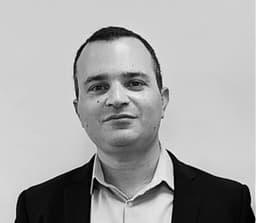
By Ofer Tirosh
Connect on LinkedInOfer founded Tomedes in 2007 and now leads the company's push to combine two decades of human translation expertise with AI. He writes about where the language industry is actually heading and the shifts nobody's ready for, the bets that paid off, and the ones that didn't.
Share:


