May 28, 2026
DeepSeek vs Google Translate: Can a Chinese LLM replace the world's most-used translation tool?
Google Translate is used by over a billion people. It is on every phone, built into every browser, and for most people on earth, it is the first answer to "I need to understand this in another language."
DeepSeek came out of nowhere. A Chinese AI lab built a model that rivaled GPT-4 in benchmark performance for roughly $5.6 million (a fraction of what Western labs were spending) and released it open-source to the world. By early 2025, it was one of the most-searched AI products globally.
The obvious question followed: if DeepSeek is this good, why am I still using Google Translate?
It is a fair question. But "this good" needs to be precise. DeepSeek is a reasoning model. Google Translate is a translation engine. They are built for different purposes, optimised for different conditions, and they genuinely excel in different situations. This article works through what the data actually shows.
What each tool is, and why that matters
This comparison is unusual because you are not comparing two translation tools. You are comparing a translation engine with a general-purpose reasoning model that happens to translate well.
Google Translate is purpose-built for translation. It runs on Google's NMT (Neural Machine Translation) architecture, continuously trained on an enormous multilingual corpus. In late 2025, Google upgraded Translate with its Gemini language model, improving quality on conversational content, idioms, and contextual phrasing. It supports 249 languages as of March 2026, following the addition of 110 new languages in 2024. The product has been refined for one job for nearly two decades.
DeepSeek-V3 is a large language model developed by DeepSeek AI, a Chinese research lab. It uses a Mixture-of-Experts architecture with 671 billion total parameters, of which only 37 billion are active per token — which is why it delivers strong performance at dramatically lower inference cost than comparable models. It was not designed specifically for translation. It was designed to reason, and it turns out that reasoning transfers well to translation, particularly for content where meaning depends on context across a full document rather than sentence by sentence.
That distinction shapes everything below.
How do they compare on translation accuracy?
The honest answer is that both are genuinely strong, and the winner changes depending on the language pair and content type.
According to Intento's State of Translation Automation 2025, Google NMT appears as a top-performing solution across English to German, Spanish, French, Italian, Japanese, Korean, Dutch, Portuguese, Chinese, and Arabic in human LQA evaluation. That is ten of the eleven language pairs Intento assessed. Google is not just good across the board, it is consistently in the top tier across almost everything.
DeepSeek-V3 also appears in that top-14 list, but in a more targeted way. It reaches the top tier for English to Italian, English to Japanese, and English to Chinese specifically. In MachineTranslation.com's internal benchmark across 5,000 words of mixed technical and marketing content, DeepSeek-V3 performed strongly on content requiring contextual reasoning across the full document, where Google Translate's sentence-by-sentence NMT architecture began to show limitations.
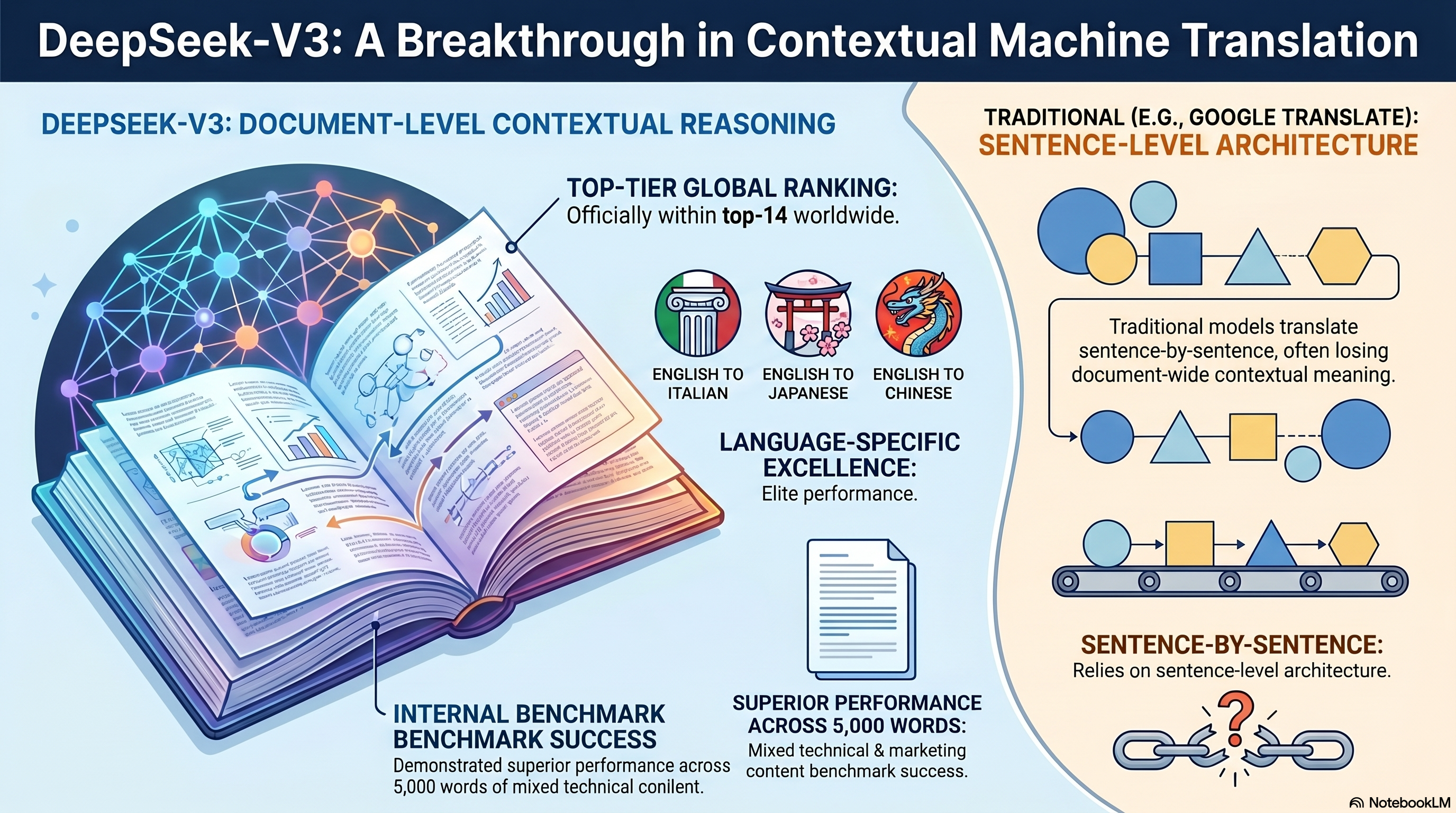
The pattern that emerges from the data is this: Google Translate is reliably good across almost every major language pair. DeepSeek is not as broad, but where it competes (particularly for Japanese, Italian, and Chinese), it competes at the very top of the field.
There is one specific place DeepSeek has a structural advantage that is worth being direct about: Chinese. DeepSeek was built by a Chinese lab and trained on an enormous corpus of Chinese-language data. Its understanding of Chinese text (including Simplified and Traditional Chinese, regional expressions, formal registers, and domain-specific terminology) is deeper than what a general-purpose translation engine can match. For anyone doing serious Chinese-English or English-Chinese translation, DeepSeek is worth testing before assuming Google Translate is sufficient.
Where Google Translate is the obvious choice
There are use cases where this comparison is not really a comparison at all.
You are in an airport. You photograph a sign and need to know what it says in the next thirty seconds. Google Translate does this. DeepSeek does not.
You are reading a foreign-language email on your phone and want to understand it without leaving your inbox. Google Translate is built into Gmail, Chrome, Android, and iOS. DeepSeek is not.
You need to quickly check a phrase, understand a menu, or get the gist of a social media post. Google Translate is instant, zero setup, works on a voice input, can read images, and supports 249 languages. You do not even need to copy and paste. You point your camera at something and it translates in real time.
For casual, quick, on-the-go use in any language, Google Translate is not competing with DeepSeek. It has infrastructure DeepSeek simply does not have in the consumer translation space. The Gemini upgrade in late 2025 also meaningfully improved its handling of conversational content and idioms, which used to be a weakness.
Google Translate also handles low-resource languages at a scale no LLM currently matches. Its 2024 expansion added 110 languages including dozens of African, indigenous, and regional languages that DeepSeek-V3 has not been formally evaluated on and likely underperforms on given its training data composition.
Where DeepSeek pulls ahead
The comparison shifts significantly when the content gets more complex.
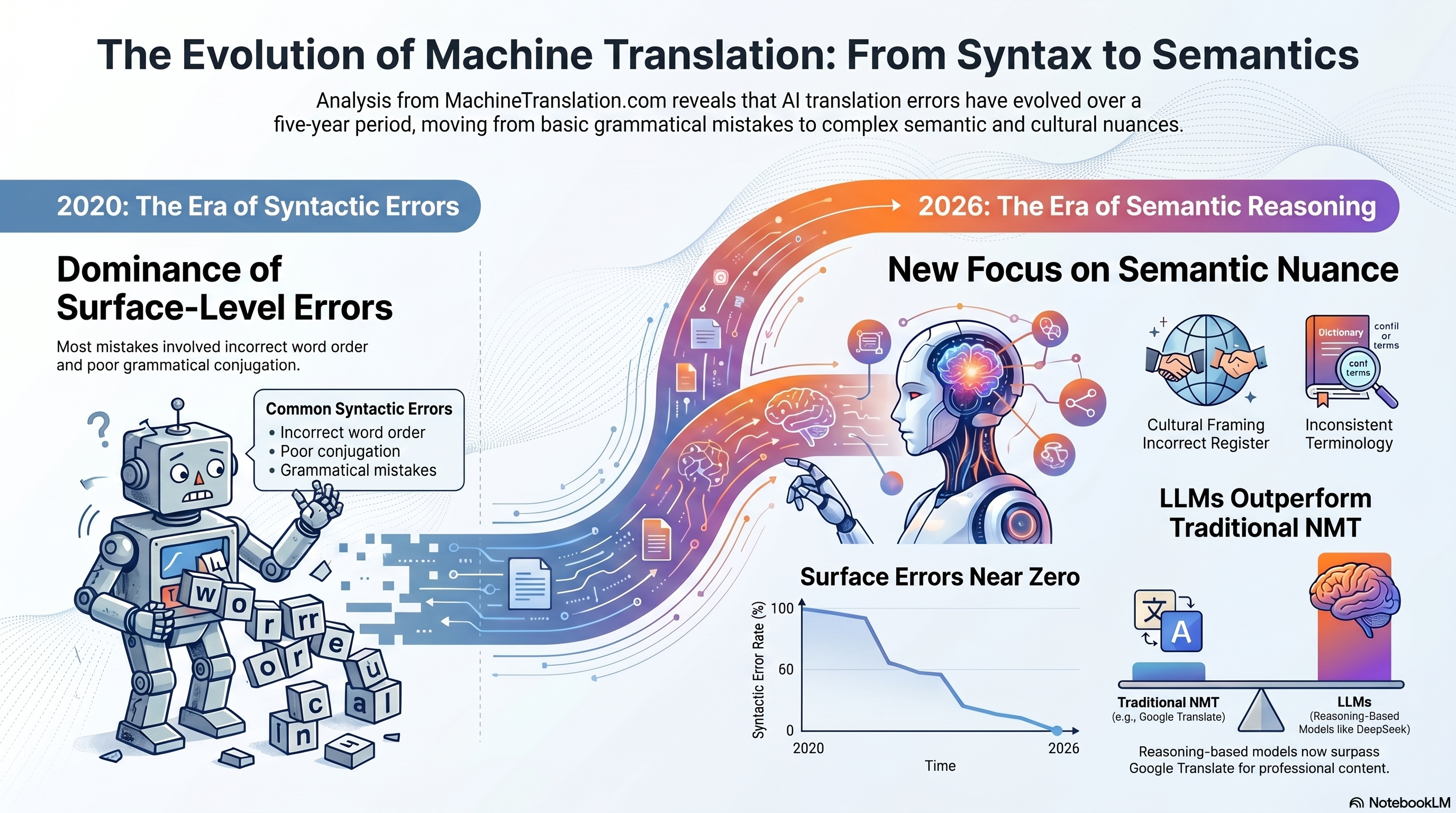
For substantive document translation (a legal agreement, a technical specification, a multi-page report, an academic paper), the sentence-by-sentence approach that underlies Google Translate starts to produce drift. Terminology gets rendered inconsistently. A term defined in paragraph one gets translated differently in paragraph seven. Formal register established in the introduction loosens by the third section. These are not catastrophic errors. They are the kind of quiet, accumulating inaccuracies that a reader in the target language notices, even if they cannot identify what is wrong.
DeepSeek-V3, as a large language model with a long context window, processes the full document as a coherent whole. It sees the relationship between paragraph one and paragraph seven. It can maintain consistent terminology across a long text in a way that segment-by-segment NMT systems structurally cannot.
Internal analysis from MachineTranslation.com tracking AI translation errors over the past five years shows that the nature of AI translation errors has shifted fundamentally. In 2020, most errors were syntactic — wrong word order, bad conjugation. By 2026, surface errors have dropped to near zero. What remains is almost entirely semantic: wrong register, wrong cultural framing, inconsistent terminology across a document. These are exactly the error types that LLM-based reasoning handles better than NMT engines, and where DeepSeek outperforms Google Translate for professional content.
DeepSeek also allows prompt-level customisation that Google Translate does not. If you are a developer or a professional handling specialised content, you can instruct DeepSeek to maintain a specific glossary, preserve certain terms untranslated, adopt a formal or informal register, or adapt content for a specific target audience. Google Translate gives you one output with limited options to shape it.
Language coverage: 249 vs. broad multilingual
Google Translate supports 249 languages. That is a real and significant advantage for anyone working with languages outside the well-resourced global pairs. African languages, indigenous languages, regional varieties, low-resource languages from Central and Southeast Asia — Google has invested specifically in this coverage with its 2024 expansion.
DeepSeek-V3 does not publish a fixed language count. As an LLM trained on multilingual data, it handles many languages, but its performance varies significantly by pair and is strongest where its training data was richest — primarily Chinese, English, and other high-resource languages. For languages outside that core, it may produce output, but the quality is less consistent and not systematically benchmarked.
The practical rule: if your language pair is a major global language, test both. If you need a less common language, start with Google Translate — the coverage is more reliable.
Pricing: Both free, very differently
Both tools are free at the consumer level. The comparison becomes more interesting for developers and teams.
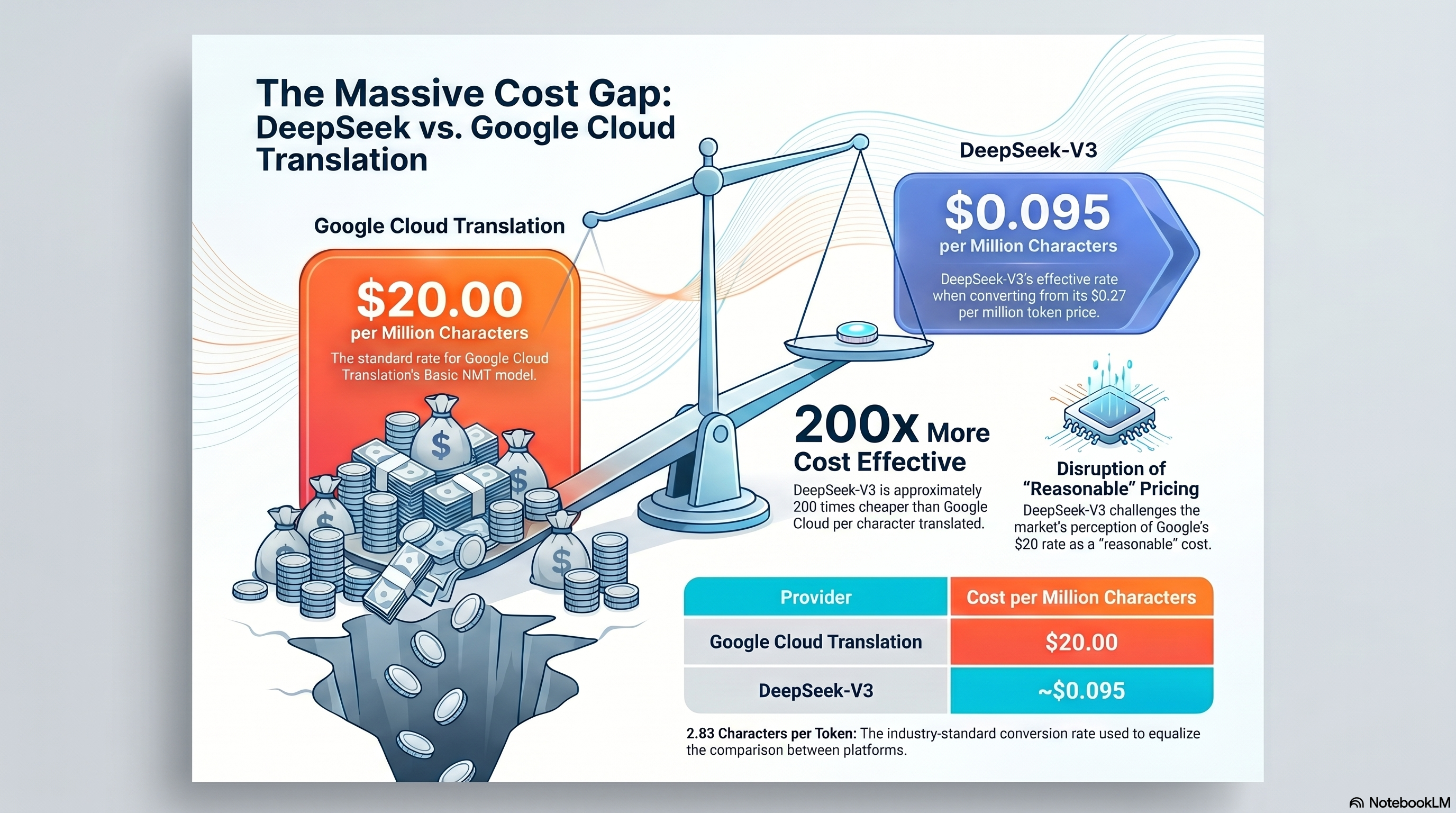
Google Translate's API (Google Cloud Translation) is priced at $20 per million characters for the Basic NMT model. For most professional use cases, that is reasonable and well-documented.
DeepSeek-V3's API is priced at approximately $0.27 per million input tokens — which, converted using the industry-standard estimate of 2.83 characters per token, works out to roughly $0.095 per million characters. That is approximately 200 times cheaper than Google Cloud Translation per character.
For API-heavy workflows (a product that needs to translate user-generated content at scale, a localization pipeline processing large document volumes), that cost difference is not marginal. It is the difference between a viable integration and one that requires budget approval every time volume increases.
The caveat: cheaper per token does not mean cheaper per outcome. If DeepSeek-V3 requires more careful prompting, more review, or produces output that needs more post-editing than Google Translate's clean NMT output, the real cost includes that overhead. For simple, standard content, Google Translate's API is extremely cost-efficient per unit of usable output.
Data handling and privacy
This is a dimension that is easy to skip in a free-vs-free comparison, but it matters for professional and enterprise users.
Google processes translation data under standard Google Cloud terms, with data handling commitments aligned to US and EU data protection frameworks. Enterprise users can configure data residency settings.
DeepSeek is a Chinese company. Data processed via the DeepSeek cloud API is handled on infrastructure subject to Chinese data security laws, including the Data Security Law (2021) and the Personal Information Protection Law (2021). For users translating sensitive business content, legal documents, or regulated-industry material, this is a consideration that needs to sit next to the quality and pricing comparison.
DeepSeek is open-source. Teams with the infrastructure to run the model locally are not sending data to DeepSeek's servers at all, and self-hosting removes the data jurisdiction concern entirely. For developers with the means to do this, it is worth noting.
Which one should you use?
There is no one answer, but there is a clear framework.
Use Google Translate when you need something immediately, in any language, on any device, with no setup. It is the right tool for casual use, quick comprehension, travel situations, and languages outside the major global pairs. The Gemini upgrade has meaningfully improved its quality on conversational content and idioms, and its 249-language coverage is in a different category from any LLM.
Use DeepSeek-V3 when you are translating substantive documents where consistency across the full text matters, when you are working with Chinese-English specifically, when you need to customise terminology or register, or when you are building an API-integrated workflow and cost at scale is a real constraint.
| Google Translate | DeepSeek-V3 | |
|---|---|---|
| Languages supported | 249 | Broad multilingual (not fixed) |
| Best for | Quick, casual, on-device translation | Substantive documents, Chinese pairs, API workflows |
| Context window | Sentence-by-sentence | Full document |
| Chinese translation quality | Strong | Best-in-class |
| Image/voice translation | Yes | No |
| API cost | ~$20/million characters | ~$0.095/million characters |
| Customisation | Minimal | Via prompt engineering |
| Data jurisdiction | US/EU frameworks | Chinese data law (cloud API) |
| Self-hosting option | No | Yes (open-source) |
The comparison most people are actually asking about is this: for the kind of translation I do day-to-day, does DeepSeek make Google Translate obsolete? The answer is no, not yet, and not for most people. But for the specific scenario of professional document translation in Chinese or Japanese, DeepSeek-V3 is a genuine challenger to every tool on the market, not just Google Translate.
What if you need both, and you need to know which one got it right?
Here is the practical problem with this comparison: most people translating real content do not have a single clean use case. You are not always translating a quick phrase, and you are not always translating a 40-page document. You are doing both, sometimes in the same week, sometimes for the same client.
Running DeepSeek for documents and Google Translate for quick lookups is a reasonable split, but it still leaves you with the same underlying problem both tools share. Neither one tells you when it is wrong. You get an output that looks confident, and you decide whether to trust it based on nothing more than how it reads.
That uncertainty is what we built MachineTranslation.com to eliminate.
Instead of choosing between DeepSeek and Google Translate, MachineTranslation.com runs both (alongside 22 other AI models) at once. Its SMART system then identifies the translation that the majority of models agree on and surfaces that as the output, alongside quality scores for each individual model. When DeepSeek and Google NMT agree, you can see it. When they diverge, you can see that too, and the divergence itself tells you something useful about the passage.
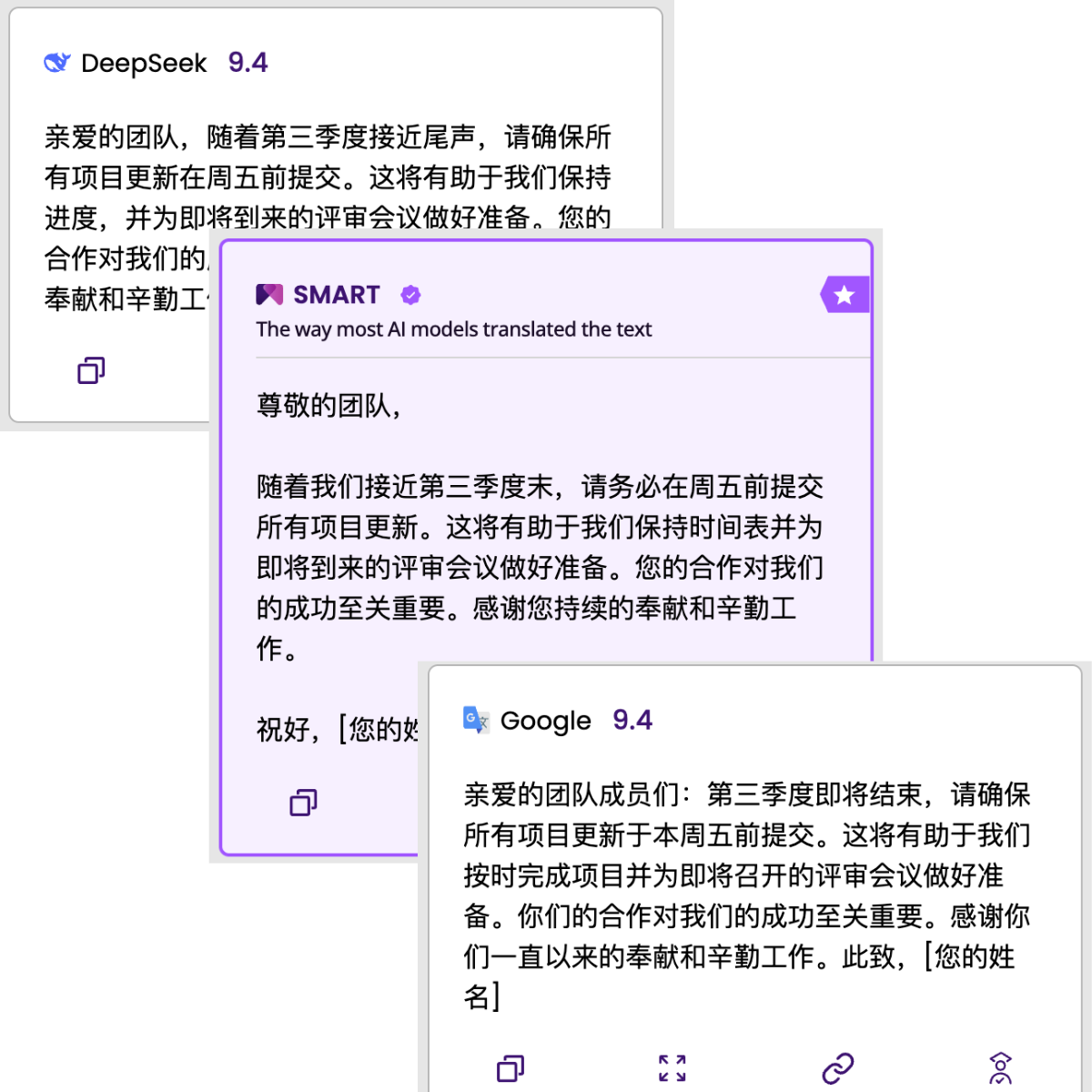
In MachineTranslation.com's internal benchmarks, the SMART consensus approach achieves an aggregated quality score of 98.5 out of 100, cutting critical translation error risk by 90% compared to relying on any single engine. The structural logic is simple: hallucinations and mistranslations are model-specific. What one model gets wrong, another is unlikely to get wrong in exactly the same way. When 20 out of 24 models agree on a translation, the probability that it is wrong drops to near zero.
For content where that still is not enough (a legal contract, a medical record, a regulatory submission), human verification is available within the same platform. A professional translator reviews and guarantees the output, without you leaving the tool or contacting a separate agency.
MachineTranslation.com is free to use, no sign-up required. If you have been bouncing between Google Translate and DeepSeek depending on what you are translating, it is worth seeing what happens when you run both at once.
Frequently asked questions
1. Is DeepSeek better than Google Translate?
For most everyday translation tasks, no. Google Translate's 249-language coverage, instant interface, image translation, and on-device integration make it unmatched for casual use. DeepSeek-V3 is stronger for substantive document translation, especially in Chinese, Japanese, and Italian, where its contextual reasoning and long-context consistency outperform Google Translate's segment-by-segment NMT architecture. The tools are built for different users in different situations.
2. Can DeepSeek translate documents accurately?
Yes, and particularly well for longer documents where full-context understanding matters. DeepSeek-V3 processes the entire document rather than translating sentence by sentence, which reduces terminology drift and register inconsistency across long texts. It appeared as a top-performing solution for English to Japanese and English to Italian in Intento's State of Translation Automation 2025 human LQA evaluation.
3. Is DeepSeek free to use for translation?
DeepSeek is free to use via the DeepSeek.com consumer interface with usage limits. API access is priced at approximately $0.27 per million input tokens, which at standard character-to-token ratios works out to roughly $0.095 per million characters — substantially cheaper than the Google Cloud Translation API at $20 per million characters.
4. What languages does DeepSeek support for translation?
DeepSeek-V3 handles a broad range of languages as a general-purpose LLM, but does not publish a verified per-pair language count the way dedicated NMT engines do. Its strongest performance is in Chinese, English, Japanese, Korean, and other high-resource languages with substantial training data. For low-resource or less common languages, Google Translate's 249-language coverage is more reliable.
5. Is it safe to use DeepSeek for confidential documents?
Through the DeepSeek cloud API, data is processed on infrastructure subject to Chinese data security laws. For confidential business content, legal documents, or regulated-industry material, that is a relevant consideration. DeepSeek is available open-source, and teams with the infrastructure to self-host the model avoid this concern entirely — data stays on their own infrastructure. Google Translate operates under US and EU data protection frameworks.
6. How does Google Translate handle Chinese translation compared to DeepSeek?
Google NMT appears as a top-performing solution for English to Chinese in Intento's 2025 human LQA evaluation, so it is genuinely strong on this pair. DeepSeek-V3 was developed by a Chinese lab with deep Chinese-language training data and also ranks in the top tier for this pair. For most Chinese-English use cases, both produce strong output. For highly specialised or domain-specific Chinese content, DeepSeek's cultural and linguistic depth for Chinese often produces more natural-sounding output in the target language.

By Ofer Tirosh
Connect on LinkedInOfer founded Tomedes in 2007 and now leads the company's push to combine two decades of human translation expertise with AI. He writes about where the language industry is actually heading and the shifts nobody's ready for, the bets that paid off, and the ones that didn't.
Share:


