February 26, 2026
How to fix terminology errors in German technical documentation
Learn how to eliminate German mistranslations in technical manuals using a consensus methodology. Reduce terminology errors by 90% with workflows that maximizes the strengths of multiple top AI models.
Why is German technical translation so difficult for AI?
In the high-stakes world of industrial engineering, a single mistranslated word isn't just a linguistic "oops" – it’s a potential safety hazard and a legal liability. German technical prose is characterized by massive compound nouns (Zusammensetzungen) and a rigid grammatical structure that often leaves standard, single AI models guessing.
For technical translators, the challenge isn't just translating text; it's ensuring that every technical term – from a hydraulic valve to a safety protocol – remains consistent across thousands of pages of documentation.
What are the most common terminology errors in German manuals?
Most technical writers have experienced the "black box" of standard AI. You paste a complex German sentence, and the AI provides a translation that looks correct but uses slightly off-kilter terminology.
The "word monster" trap: AI often breaks down compounds like Sicherheitsabschaltvorrichtung (Safety shutdown device) into individual parts, losing the industry-standard meaning.
Terminology "drift": A single AI might translate Inbetriebnahme as "commissioning" on page 5, but switch to "startup" or "initial operation" on page 50.
Instructional logic errors: German syntax often places the verb at the very end of a long clause. If the AI loses the "action" of the sentence, the instructions become technically nonsensical.
How does AI consensus fix technical mistranslations?
In 2026, the industry standard has shifted from "single AI" to consensus analysis. Rather than trusting one model, MachineTranslation.com leverages a "jury" of 22 independent AI models (including Claude, ChatGPT, and Gemini) to verify every segment of the translated text.
Real-world stress test results:
To see this in practice, we ran three common industrial engineering segments through MachineTranslation.com:
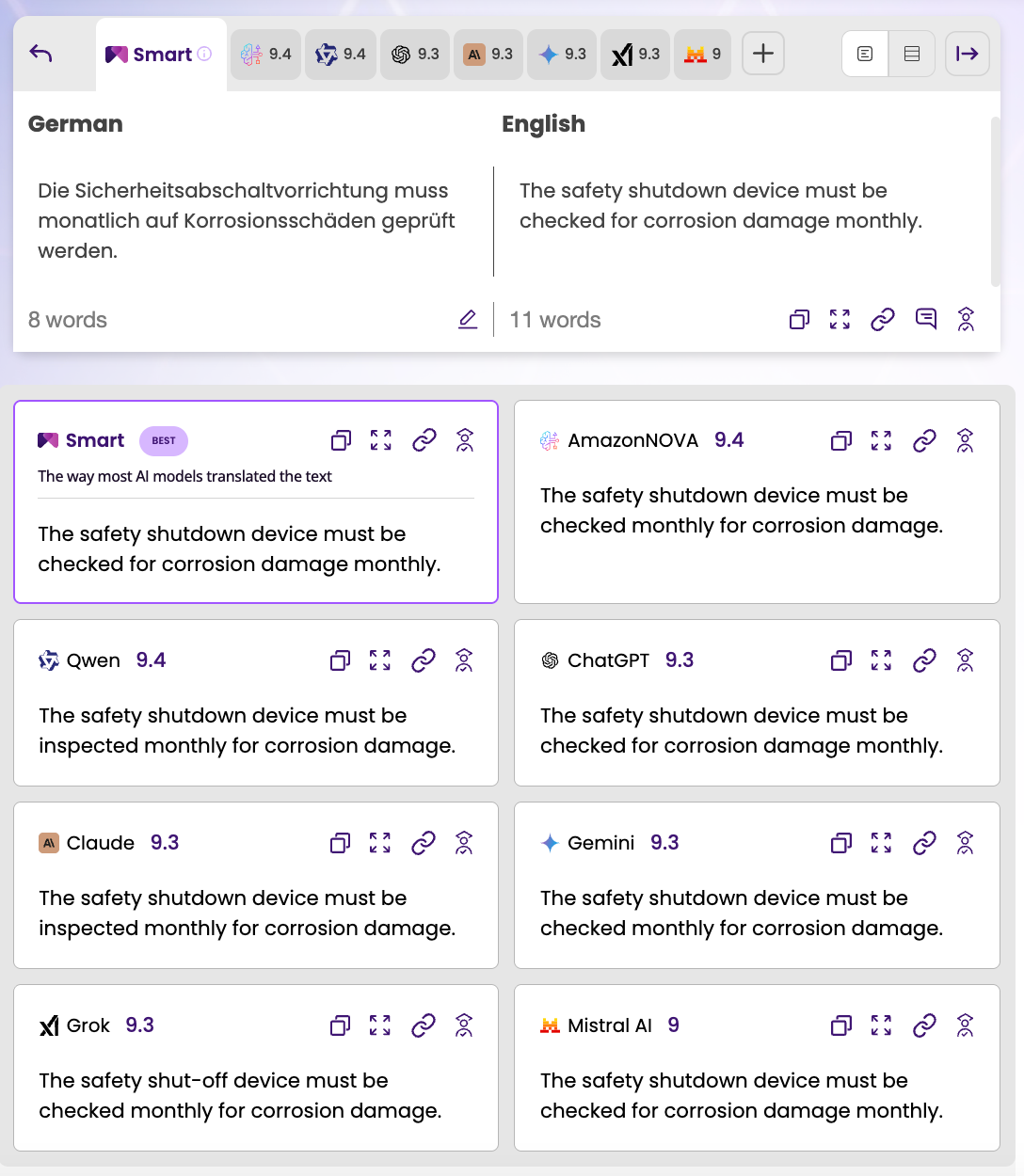
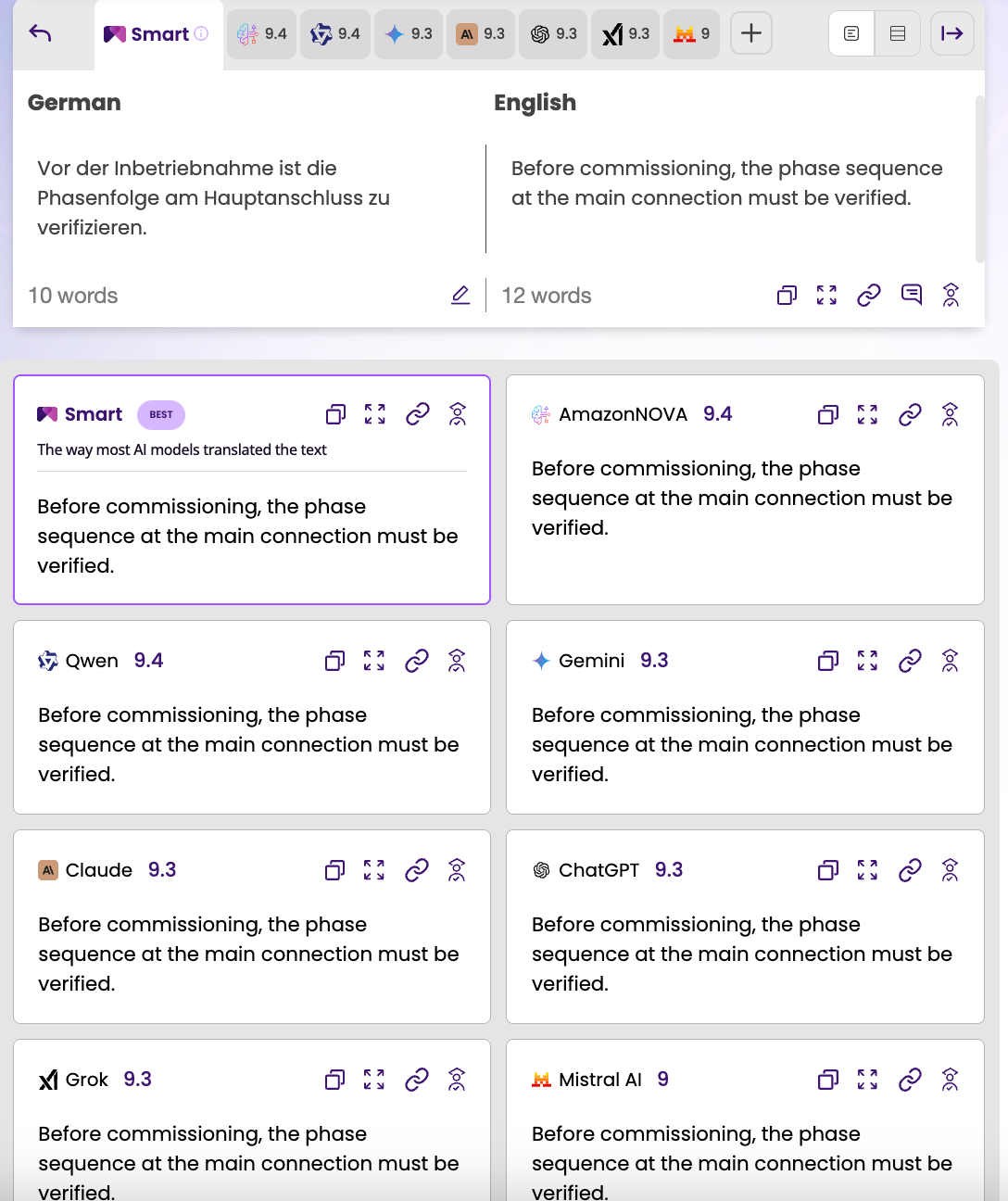
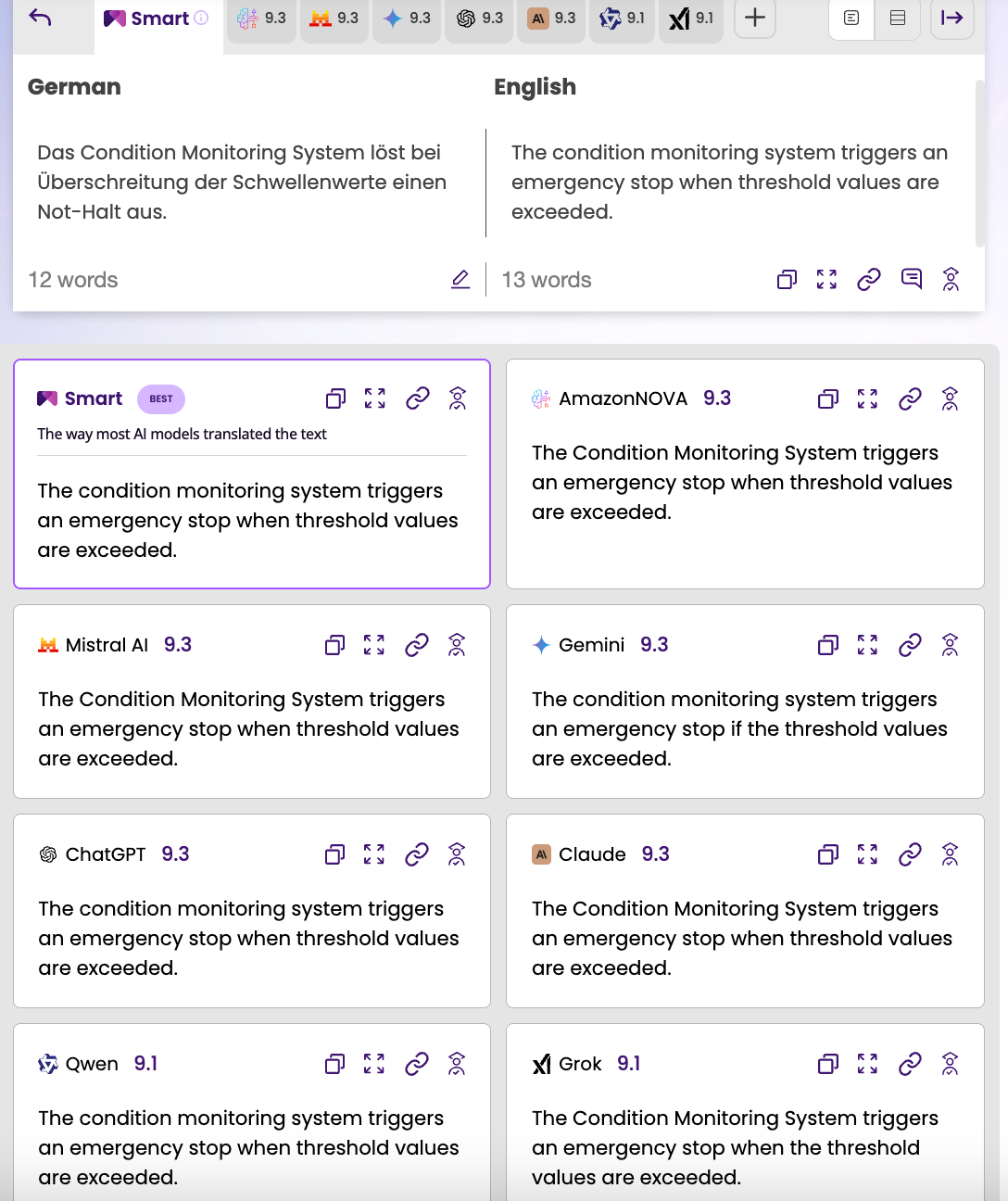
German source text | Consensus result (SMART) | Why it won |
1. Sicherheitsabschaltvorrichtung | Safety shutdown device | Correctly identified the compound noun's holistic meaning. |
2. Inbetriebnahme | Commissioning | Filtered out generic "startup" terms for professional engineering context. |
3. Condition Monitoring System | Condition Monitoring System | Recognized "Denglisch" industry standards without forced translation. |
Does multi-model translation actually perform better?
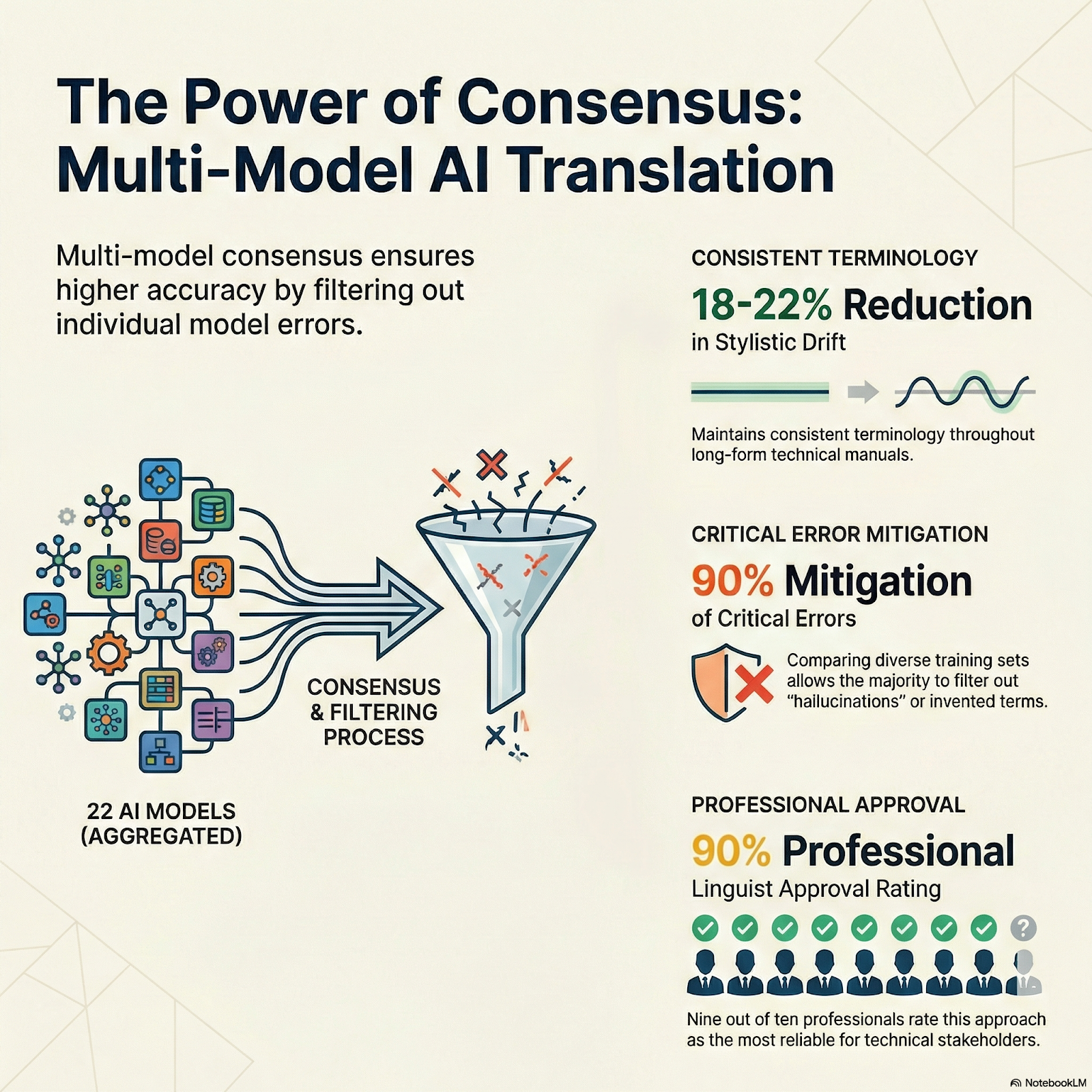
The move toward a consensus-based approach is backed by rigorous performance metrics derived from 2026 evaluations:
18-22% reduction in stylistic drift: Aggregating 22 AI models mathematically identifies the most consistent terminology, reducing the "drift" found in long-form manuals.
90% mitigation of critical errors: Because 22 different training sets are compared, "hallucinations" (invented terms) are filtered out by the majority.
9/10 professional rating: 90% of professional linguists categorize SMART as the most reliable "safe entry point" for non-native technical stakeholders.
How to use MachineTranslation.com for technical translation?
Use MachineTranslation.com’s SMART: Paste your high-risk segments to see the "consensus" result.
Identify low-score segments: If many AI models disagree, the segment requires a human expert's eye.
Analyze the results: If heavyweights like Claude and ChatGPT agree on a term, you can proceed with confidence.
Standardize via glossary: Lock in the correct term in the custom terminology feature to ensure consistency across all future documents.
If you are starting from English, using a specialized English to German translation tool that utilizes multiple AI models is the first step toward precision.
FAQs
1. Can AI correctly translate German compound nouns?
Standard AI often struggles with complex compounds. However, using a consensus (SMART) approach identifies the version most models agree upon, reducing errors in technical compounds by up to 90%.
2. What is the best AI for German technical documentation?
There is no single "best" AI. The most reliable results come from a multi-model aggregator like MachineTranslation.com that compares outputs from models like DeepL, ChatGPT, and Claude to find a consensus.
3. How do I ensure consistency in long German manuals?
Use a combination of custom glossaries and SMART consensus. This ensures that high-risk terms like Inbetriebnahme are translated the same way every time, reducing stylistic drift by 18-22%.
4. Why is my AI translation for German instructions clunky?
This is usually due to "sentence flow" issues where the AI struggles with German verb placement. A consensus-based tool prioritizes the most "natural-sounding" syntax agreed upon by the majority of top-tier models.