May 21, 2026
Gemini vs DeepL for translation: Which should you use?
If you work in Google Docs and need to translate something, Gemini is already in your sidebar. If you work in a professional translation or localisation context, DeepL is probably already open in another tab. In 2026, both tools are genuinely capable — and both have enough benchmark data behind them to justify a real comparison.
The difference is not about which one is smarter. It is about language pairs, workflow integration, and what kind of content you are handling. This article works through those three dimensions with actual data, so you can make a decision that holds up past the first paragraph of a marketing comparison.
Two different translation philosophies
Before the benchmarks, it helps to understand what each tool was actually built to do, because that shapes where each one performs well and where it has structural limits.
DeepL: Specialised for translation
DeepL is a neural machine translation service that has been refining one competency since 2017: converting text between languages in a way that sounds natural, not machine-generated. Its architecture is trained specifically on translation-relevant data, and that focus shows. For European language pairs, DeepL's output is consistently fluent — the phrasing feels idiomatic, the register is well-matched, and the grammar does not call attention to itself.
In 2024, DeepL launched DeepL next-gen, an LLM-based model built specifically for translation. According to Intento's State of Translation Automation 2025, DeepL next-gen ranks as a top-performing real-time solution across English to Spanish, French, Italian, Dutch, Korean, Portuguese, and Ukrainian. It is not DeepL's old NMT engine with a new name, it is a meaningfully different model that improves particularly on longer texts and complex sentence structures.
The tradeoff for that specialisation: DeepL supports 33 languages. Outside its core European and East Asian coverage, your options narrow quickly.
Gemini: A reasoning model that translates exceptionally well
Gemini is Google's flagship large language model, available as Gemini 2.5 Pro and 2.5 Flash as of April 2026. It was not designed specifically for translation (it is a general-purpose reasoning model) but it turns out that reasoning ability transfers unusually well to translation tasks, particularly for content where meaning depends heavily on context: legal arguments, technical specifications, nuanced marketing copy, and language pairs with complex grammatical structures.
Intento's 2025 evaluation is striking on this point. When ranking the providers whose models collectively achieved the most "best" performances across all 11 language pairs tested, Google tied with the multi-agent solution at 9 best performances each — more than any other single provider. The Google models contributing to that total included Gemini 2.5 Pro, Gemini 2.5 Flash, Google NMT, and Google Gemma 3. Gemini 2.5 Pro specifically appeared as a top-ranked solution across English to Arabic, French, Italian, Japanese, Korean, Portuguese, Spanish, and Chinese.
Gemini also has one structural advantage that no NMT engine can replicate: it is already embedded in Google Workspace. More on that below.
How do accuracy scores compare by language pair?
The headline from the benchmark data is that both tools are strong, but they win in different places.
Where DeepL leads
DeepL next-gen performs at or near the top for European language pairs, particularly English to Spanish, French, and Dutch. In human LQA evaluation (where professional linguists assess output quality rather than automated metrics), DeepL next-gen appears in the best-solution tier for nine of the eleven language pairs Intento evaluated. For EU content (marketing materials, legal documents, business communications targeting Western European markets), DeepL's output is often the most natural-sounding available.
MachineTranslation.com's internal benchmark across 5,000 words of mixed technical and marketing content scored DeepL Classic at 94.2% accuracy, the highest of any standalone NMT engine in the test. The benchmark described it as producing "the most human-sounding" output for French and Spanish specifically. DeepL next-gen pushes that further.
For professional translators using CAT tools, DeepL's ecosystem matters too. It integrates natively with most major translation management systems, offers glossary management and tone adjustment, and has a well-documented API. These are not Gemini features.
Where Gemini leads
Asian language pairs are where Gemini's contextual reasoning architecture pulls ahead most clearly. Intento's 2025 evaluation shows Gemini 2.5 Pro as a best-solution performer for English to Japanese, Korean, and Chinese — language pairs where grammatical structure, honorific systems, and topic-comment organisation differ fundamentally from European languages. These are also pairs where DeepL's specialist training is narrower, and where a model's ability to reason about the full sentence structure matters more.
According to MachineTranslation.com's internal analysis, Gemini models achieved a 94% accuracy rating on complex legal reasoning tasks for English to German — outperforming standard alternatives by 12% in scenarios requiring long-form memory and cross-sentence consistency. That long-context advantage also helps with longer documents where segment-by-segment translation introduces drift.
Arabic is another pair worth noting. Intento's evaluation places Gemini 2.5 Pro and Flash among the top-performing solutions for English to Arabic, a language with morphological complexity that trips up many engines. DeepL's Arabic support is more limited.
Where they are essentially equal
For standard content across core European pairs, the quality gap between Gemini 2.5 Pro and DeepL next-gen is small enough that other factors (speed, workflow, cost) matter more than translation quality alone. Both produce output that professional editors would find workable. The choice between them at this level should be driven by what workflow you are already in, not by chasing marginal quality differences.
The Google Workspace question
Here is the real-world decision for a large portion of people comparing these two tools: if your writing, editing, and document work lives in Google Docs, Google Slides, or Gmail, Gemini is already there.
As of 2026, Gemini is integrated directly into Google Workspace as part of the Google One AI Premium plan and Workspace Business and Enterprise plans. Users can translate documents, draft multilingual content, and adapt text for different audiences without leaving the tool they are already working in. There is no copy-paste, no export, no separate tab. For teams managing multilingual content creation directly in Google Docs, this is a workflow difference that outweighs marginal accuracy differences in most scenarios.
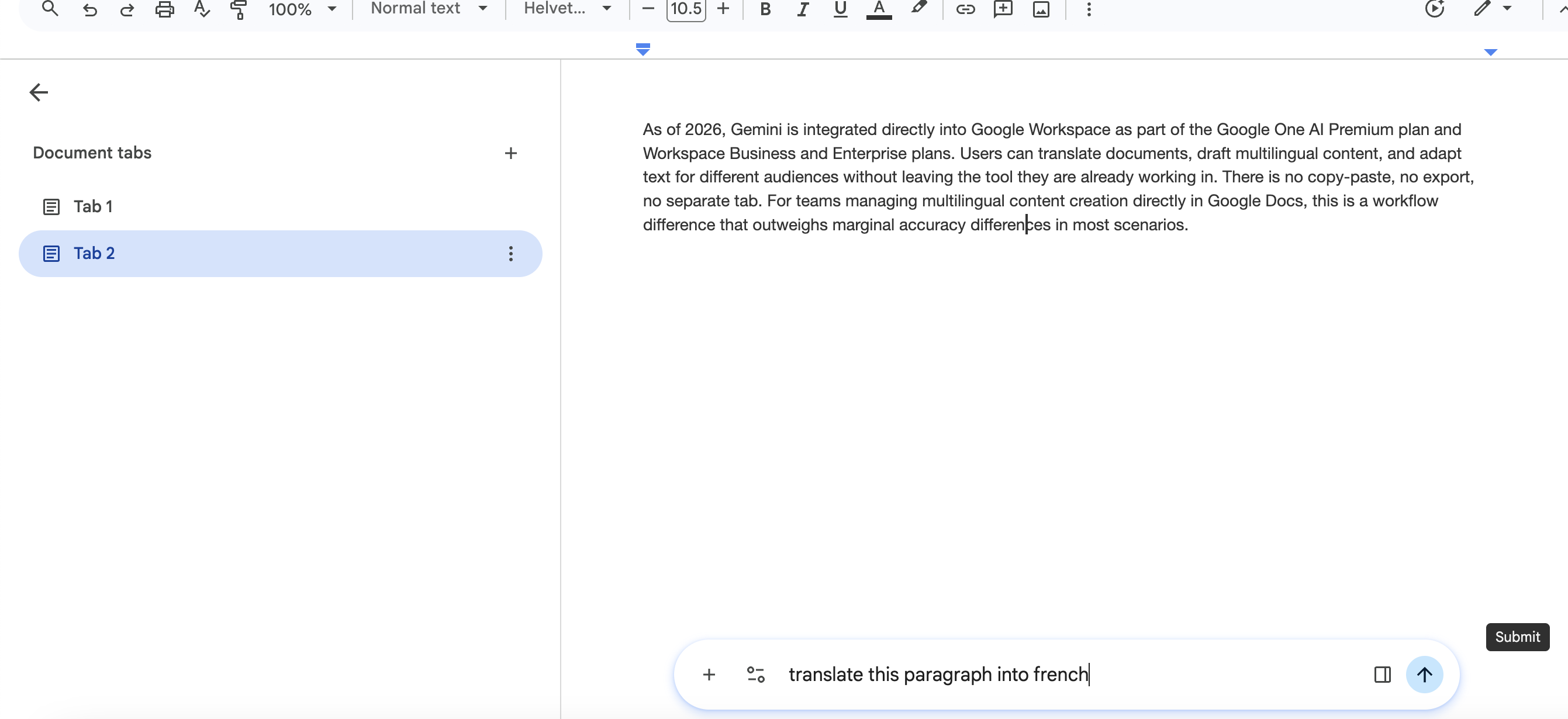
DeepL offers a browser extension and integrations for common productivity apps, but it does not live natively inside Google's ecosystem in the same way. For a Workspace-first team, Gemini removes the friction that even DeepL's extension introduces.
This does not mean Gemini wins by default for Google Docs users. If the content being translated involves specialised terminology, legal precision, or European language pairs where DeepL's naturalness is a genuine business requirement, opening DeepL's tab is still worth the extra step. But for general content (internal communications, meeting summaries, first-draft product copy), Gemini's integration advantage is real.
What DeepL does that Gemini cannot, and vice versa
| Gemini 2.5 Pro | DeepL (next-gen) | |
|---|---|---|
| Languages supported | Broad multilingual (100+) | 33 languages |
| Google Workspace integration | Native | Browser extension only |
| CAT tool integration | No | Yes (major TMS platforms) |
| Glossary management | Via prompt | Native feature |
| Tone adjustment | Via prompt | Formal/informal toggle |
| Layout-preserved document translation | Limited | Strong (DOCX, PDF, PPTX) |
| EU language pair quality | High | Best-in-class |
| Asian language pair quality | Best-in-class | Strong but variable |
| API availability | Yes (Google AI Studio / Vertex AI) | Yes (DeepL Pro API) |
| Human verification option | No | No |
| Free tier | Yes (limited) | Yes (limited) |
One practical point from the table: neither tool offers human verification within the platform. For content where an AI error would be genuinely consequential (a contract, a compliance document, a clinical summary), both tools leave the user in the same position: trusting a single model's output with no cross-check and no professional review option integrated into the workflow.
Pricing and access
Gemini:
- Gemini 2.5 Pro: available via Google One AI Premium at $19.99/month, which also includes 2TB Google Drive storage and broader Workspace AI features
- Gemini in Workspace: available on Business Starter ($12/user/month) up to Enterprise plans
- API access via Google AI Studio (free tier) and Vertex AI (pay-per-token)
- Gemini 2.5 Flash: lower cost, lower latency option for high-volume API use
DeepL:
- Free: limited characters, 3 non-editable document translations per month
- Starter: ~$10.49/user/month
- Advanced: ~$34.49/user/month
- Ultimate: ~$68.99/user/month
- API Pro: $25 per million characters
For individual professional users, the pricing comparison depends on what you already pay for. If you use Google One AI Premium or your organisation has Google Workspace with Gemini included, Gemini costs you nothing incremental for translation tasks. DeepL's Starter plan is affordable for moderate-volume use, but for teams with multiple users the per-seat cost adds up.
A real workflow problem neither tool fully solves
Here is something both tools share that is worth being explicit about.
DeepL and Gemini 2.5 Pro are both among the most capable translation models available in 2026. But they are each single-model systems: one architecture, one interpretation, one output. When either one makes a translation choice (which synonym to use, how to handle an ambiguous phrase, how to render an idiomatic expression) you receive that choice as the answer, with nothing to compare it against and no signal indicating how confident the model was.
As MachineTranslation.com's internal tracking of AI translation errors shows, the errors that remain in modern AI translation are almost entirely semantic: wrong register, wrong tone, missed connotation. They do not look like errors. They look like fluent, confident output that a slightly different model would have rendered differently.
For high-volume general content, this is fine. For anything client-facing, legally binding, or in a regulated domain, the absence of a verification mechanism is a gap that both tools leave open.
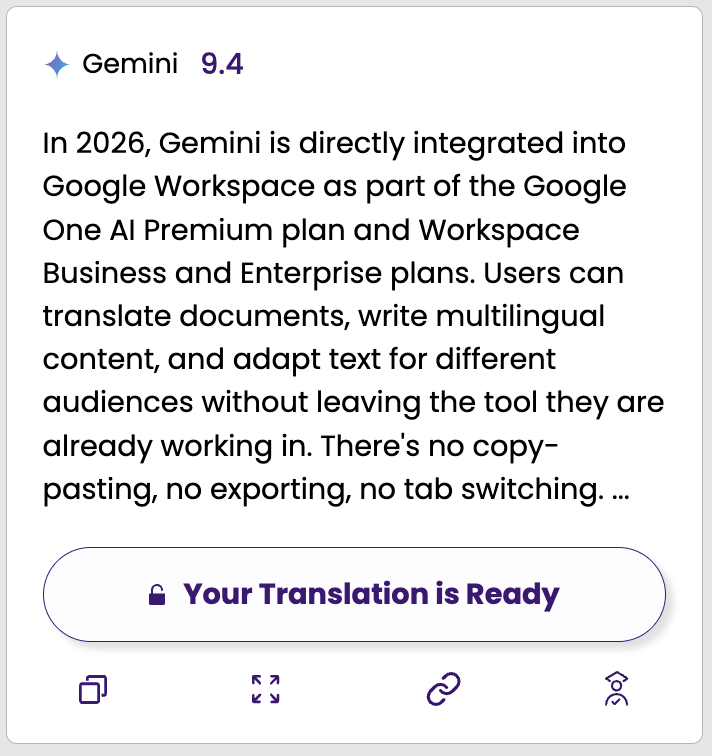
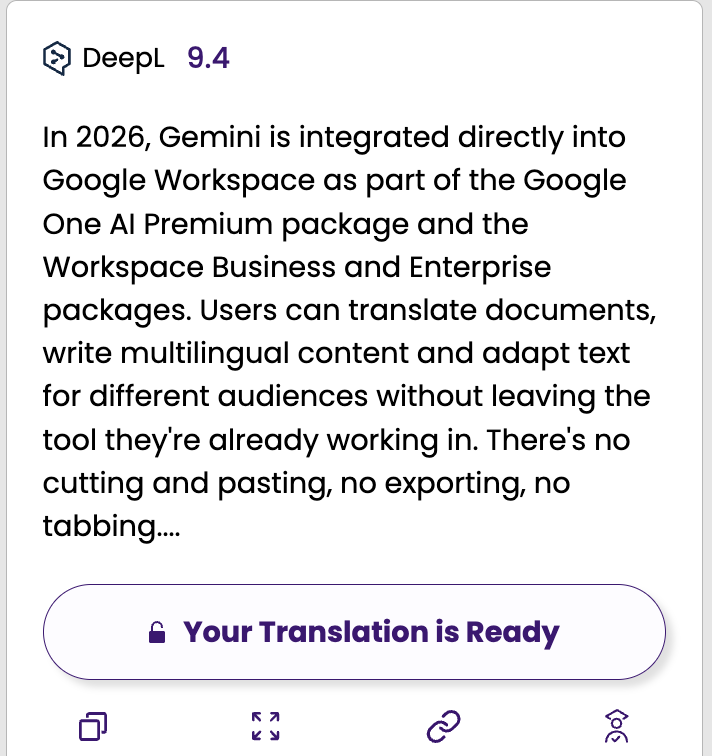
Running Gemini and DeepL against the same text and comparing where they agree (and where they diverge) gives you information that neither tool provides on its own. Divergence is not a failure; it is a signal that the passage contains interpretive latitude, and that your choice of which rendering to use is a real editorial decision rather than a settled fact. MachineTranslation.com does this across 24 models simultaneously, including both Gemini and DeepL, surfacing the output the majority converges on alongside quality scores for each. It is a different way of thinking about translation confidence: not "is this output good?" but "what did most models agree on?"
Frequently asked questions
1. Is Gemini better than DeepL for translation?
It depends on the language pair. DeepL next-gen is among the top performers for European language pairs including Spanish, French, Italian, Dutch, and Portuguese. Gemini 2.5 Pro leads on Asian language pairs including Japanese, Korean, and Chinese, and for content requiring strong contextual reasoning across long documents. For most core European pairs, both are strong enough that workflow and pricing factors matter more than translation quality differences.
2. Which is more accurate: Gemini or DeepL?
Both appear in Intento's State of Translation Automation 2025 top-tier rankings, but for different language pairs. DeepL next-gen leads on EU languages in human LQA evaluation; Gemini 2.5 Pro leads on Asian languages and scored among the best performers across nine language pairs overall. Neither is definitively more accurate — the split is by language pair and content type.
3. Does Gemini work inside Google Docs?
Yes. As of 2026, Gemini is integrated natively into Google Workspace, accessible via the sidebar in Google Docs, Gmail, and other Workspace apps. Users on Google One AI Premium or qualifying Workspace plans can translate documents without leaving the application. This workflow integration is a meaningful advantage over tools that require copy-paste or browser extensions.
4. Can I use DeepL inside Google Docs?
DeepL offers a browser extension that works across web applications including Google Docs, but it is not natively integrated into Workspace in the same way as Gemini. For heavy Google Workspace users, Gemini removes a step that DeepL's extension still requires.
5. What languages does DeepL support compared to Gemini?
DeepL supports 33 languages, primarily European pairs plus Chinese, Japanese, and Korean. Gemini supports a much broader range — it does not publish a fixed language count in the same way dedicated NMT engines do, but it handles dozens of major and minor languages with performance that varies by pair. For languages outside DeepL's 33, Gemini is the more capable option.
6. Which is better for long business documents?
Gemini's larger context window gives it an advantage for longer documents where consistency across the full text matters — defined terms, tonal register, proper noun consistency. DeepL's document translation feature handles DOCX, PDF, and PPTX with original layout preserved, which is a practical advantage for formatted business documents. If formatting is critical, DeepL's layout preservation is hard to replace. If cross-document consistency is critical, Gemini's context depth is the more relevant variable.

By Ofer Tirosh
Connect on LinkedInOfer founded Tomedes in 2007 and now leads the company's push to combine two decades of human translation expertise with AI. He writes about where the language industry is actually heading and the shifts nobody's ready for, the bets that paid off, and the ones that didn't.
Share:


