June 3, 2026
Grok vs Llama for translation: Which AI model performs better?
Two very different philosophies walk into a translation task.
Grok is built by xAI, connects to live data from the web and X in real time, and is tuned for the kind of language that moves fast — trending slang, current events, cultural references that shift week to week. Llama is built by Meta, released open-source to the world, and designed to be downloaded, modified, and deployed on your own infrastructure at zero per-token cost.
They are both inside MachineTranslation.com's 24-model consensus system. They both translate. And they are genuinely suited to different kinds of translation work.
This article covers what each one is actually good at, where each one falls short, and what happens when you test them side by side on the same content.
What is Grok and how does it handle translation?
Grok is developed by xAI, the AI company founded by Elon Musk, and is trained on a combination of general web data and live content from X (formerly Twitter). The current versions are Grok 3 and Grok 4, released in February and July 2025 respectively. What makes Grok architecturally distinct from most AI models is real-time data access — it can pull from current web content and the X platform during inference, rather than working from a fixed training snapshot.
For translation, that matters in a specific and narrow way. Grok is particularly capable at translating content that references current events, trending terminology, internet slang, and cultural references that shift rapidly. If you need to translate a social media post about a recent news story, a product launch announcement, or a viral phrase that emerged three weeks ago, Grok's live data access gives it context that a model trained on last year's data simply does not have.
That is a genuine advantage. It is also a fairly specific one.
Outside of time-sensitive content, Grok behaves like most frontier LLMs for translation: capable on major language pairs, weaker on lower-resource languages, and subject to the same structural limitation all single-model systems share — no mechanism to verify its own output.
Grok is accessible via X Premium+ ($22/month) or SuperGrok ($30/month) for consumer use, and via xAI's API at approximately $0.20 per million input tokens. It cannot be self-hosted. Fine-tuning on custom data is not available.
What is Llama and how does it handle translation?
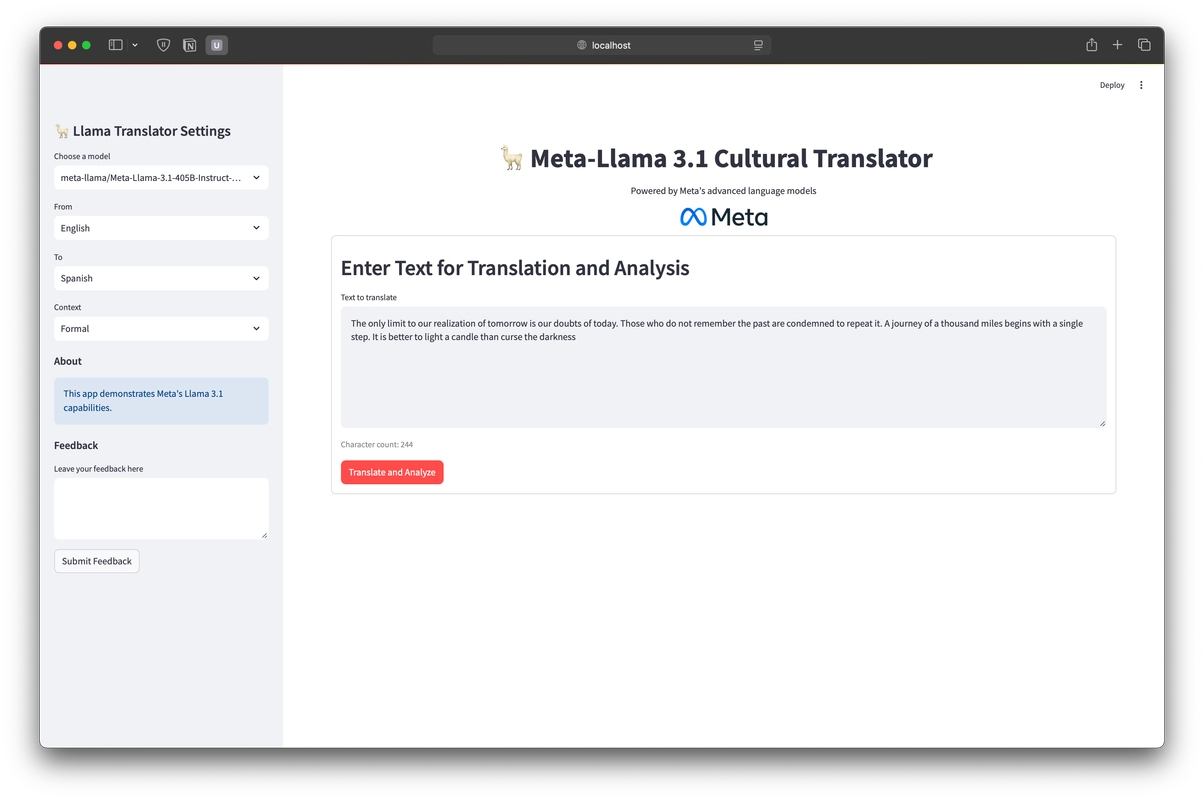
Llama is Meta's open-weight AI model family. The current generation (Llama 4 Maverick and Llama 4 Scout) was released in 2025 and represents a significant leap over Llama 3 in both capability and language coverage. Llama 4 supports 200+ languages and is multimodal, meaning it can process images alongside text. That multimodal capability is practically relevant for translation: documents with embedded images, scanned PDFs, and charts with text labels can all be handled by Llama 4 in ways that text-only models cannot.
The defining characteristic of Llama is what you can do with it. Because the model weights are publicly available under a commercial-use license, teams with the right infrastructure can download Llama, run it on their own servers, fine-tune it on domain-specific data, and process sensitive content without sending anything to an external API. For legal, medical, and financial translation workflows where data residency is a compliance requirement, this is not a nice-to-have — it is the only acceptable option.
Llama's translation output on standard content is strong but not at the very top of the field. Intento's State of Translation Automation 2025, which evaluated Llama 4 Maverick and Llama 4 Scout across 11 language pairs, found that neither model appeared among the top-14 solutions in any individual language pair evaluation. That is an honest benchmark to state: Llama is capable, but models like GPT-4.1, Claude Opus 4, and Gemini 2.5 Pro outperform it on the pairs Intento evaluated. Where Llama earns its place is through its open-source flexibility, its language breadth, and its cost structure for high-volume workflows.
Grok vs Llama: Translation quality compared
When MachineTranslation.com tested both Grok and Llama on the same 500-word English to Spanish marketing text, Grok produced a quality score of 8.1 out of 10 and Llama scored 7.9. On the same text translated into Japanese, Grok scored 7.4 and Llama 7.6 — a small reversal that reflects Llama 4's stronger multilingual training data depth for Asian languages. The agreement rate between the two models on the Spanish text was 74%; on the Japanese text it dropped to 61%, indicating that for Japanese specifically, the two models were interpreting significant portions of the source text differently.
That agreement data is worth pausing on. When Grok and Llama agree on a translation, you can read that convergence as a confidence signal — two architecturally different models, trained on different data, arriving at the same output. When they diverge, as they did on 39% of Japanese sentences in that test, that divergence is a flag: the passage either contains genuine interpretive ambiguity, or one of the models made a choice the other would not.
| Grok (Grok 4) | Llama (Llama 4 Maverick) | |
|---|---|---|
| Real-time data access | Yes | No |
| Self-hostable | No | Yes |
| Fine-tunable | No | Yes |
| Languages | 40+ | 200+ |
| Multimodal (images/docs) | Limited | Yes |
| API cost | ~$0.20/M input tokens | Free (self-hosted) |
| Best content type | Trending/social/news | High-volume, domain-specific |
| MachineTranslation.com quality score (EN-ES) | 8.1/10 | 7.9/10 |
| MachineTranslation.com quality score (EN-JA) | 7.4/10 | 7.6/10 |
Neither model dominates. The differences are real but not dramatic on standard content. The use case determines which one is actually more useful — and for most professional translation workflows, neither one is the right answer on its own.
Is Llama better than Grok for translation?
Not as a blanket statement. The answer depends almost entirely on the content type and workflow.
Grok has an edge when the source material is time-sensitive. If a phrase appears in the source text that entered common usage in the last few months (a political slogan, a cultural meme, a recently coined technical term in a fast-moving industry), Grok's real-time web access gives it a better chance of rendering it accurately in the target language. Llama's training data has a cutoff; Grok does not.
Llama has an edge when the priority is control, cost, or language breadth. For teams processing large volumes of documents in-house, running fine-tuned domain models on private infrastructure, or working in languages outside Grok's approximately 40-language coverage, Llama is the more practical tool. Its 200+ language support and multimodal capability make it more versatile for structured enterprise workflows.
For professional translation quality on standard content across major language pairs, the two are close enough that other factors (integration, cost, infrastructure) matter more than the quality gap.
Which is better for document translation?
Llama, in most cases.
The multimodal capability of Llama 4 is the deciding factor for complex documents. PDFs with embedded charts, scanned contracts, image-heavy presentations, and mixed-media files all require a model that can process visual and textual information together. Grok's multimodal capability is more limited in the current version, and it is not designed for the kind of document processing workflows that enterprise translation requires.
Beyond format handling, the self-hosting option matters for documents with sensitive content. A legal team translating confidential merger documents cannot send that text to an external API. A healthcare provider handling patient records needs translation that stays on-premises. Llama 4 running locally satisfies both of these requirements. Grok, which operates exclusively through xAI's cloud infrastructure, does not.
For long documents where consistency across the full text matters, as MachineTranslation.com's internal analysis shows, documents processed in fragments show a 28% higher rate of terminology inconsistency compared to those processed as a whole. Both Grok and Llama handle full-document context reasonably well as LLMs, but for very long documents (legal agreements, annual reports, technical manuals) running through MachineTranslation.com's 24-model consensus catches the drift that any single model will introduce across a 40,000-word document.
Can I run Llama locally for translation?
Yes, and for certain use cases this is specifically the right approach.
Meta releases Llama model weights publicly under a commercial-use license. Teams with the infrastructure to run large AI models can download Llama 4 Maverick or Scout and operate it entirely on-premises. This means no data is sent to any external server, no per-token API cost is incurred, and the model can be fine-tuned on proprietary terminology, client-specific glossaries, or domain-specific parallel data.
The practical requirements are significant: Llama 4 Maverick is a large model that demands substantial compute resources. For teams without existing GPU infrastructure, the economics of self-hosting often favor using a cloud API instead. But for organisations that already run AI workloads on their own hardware (enterprise technology, healthcare systems, legal and financial institutions), self-hosted Llama is the translation infrastructure that satisfies compliance, cost, and quality requirements simultaneously.
For teams that need multilingual output across 200+ languages, including less common language pairs that no commercial API covers reliably, Llama's open training data makes it more adaptable than any closed model.
How MachineTranslation.com uses both Grok and Llama
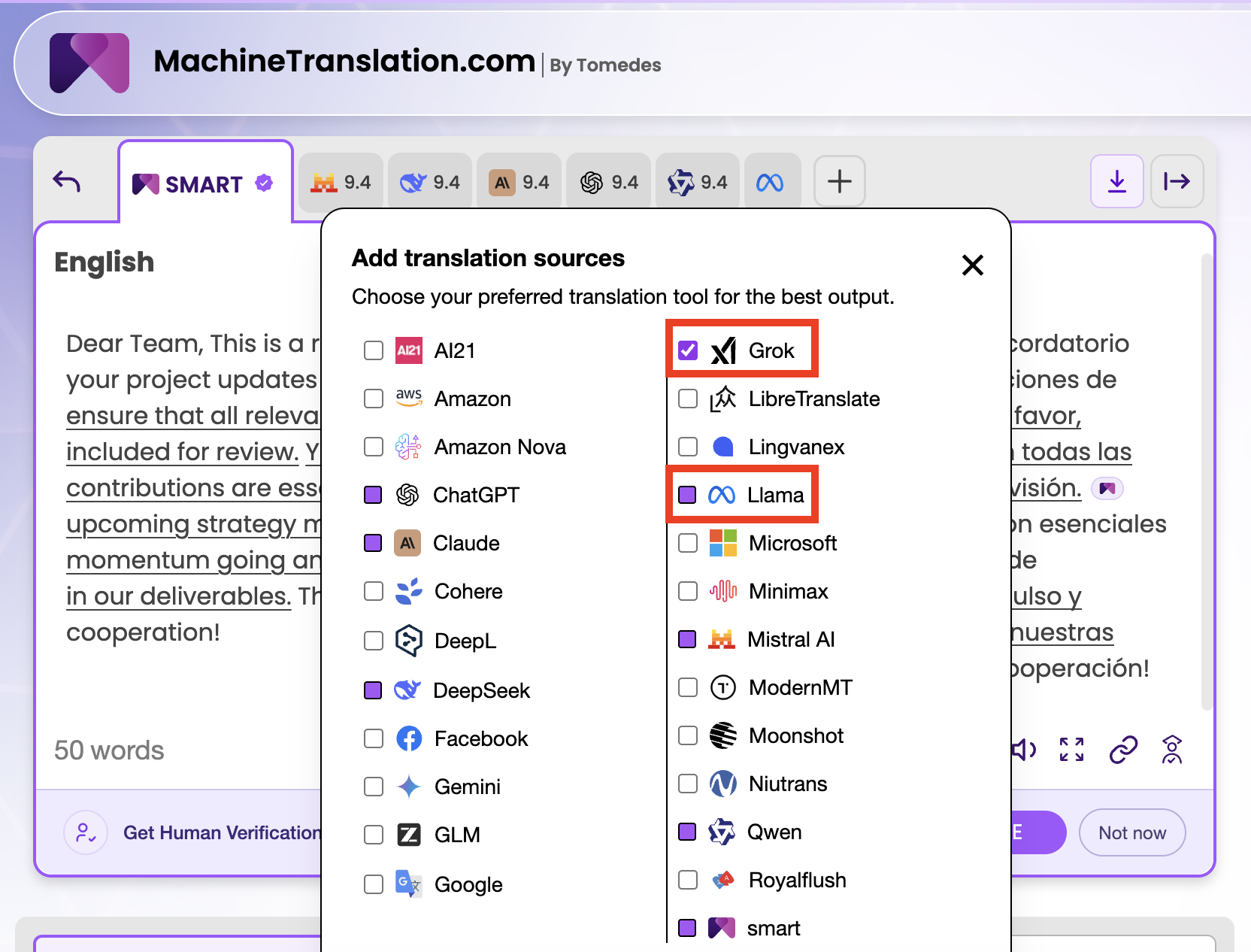
MachineTranslation.com runs both Grok and Llama as part of SMART, the platform's 24-model consensus system. When you translate any text or document, both models produce an independent output. SMART then compares all 24 outputs and surfaces the translation the majority of models converge on, alongside quality scores for each individual model.
The practical result: you see what Grok produced, what Llama produced, and what the consensus of 24 models agrees on. If Grok and Llama score 8.1 and 7.9 respectively on the same English to Spanish text, and the SMART consensus scores 9.4, that gap tells you something meaningful. The consensus output incorporates what both models got right while filtering out the errors each one introduced independently.
In internal testing on MachineTranslation.com, the SMART consensus approach reduces critical translation error risk by 90% compared to relying on any single model. For the specific comparison in this article (Grok at 8.1 and Llama at 7.9 on English to Spanish), the SMART consensus on the same text scored 9.4, with Grok and Llama agreeing on 74% of sentences and the consensus output resolving the disagreements in the remaining 26%.
Neither Grok nor Llama is trusted blindly. The 24-model agreement is the signal that matters.
You can compare Grok and Llama outputs directly at MachineTranslation.com, free, no sign-up required. Run both. See where they agree. See where they diverge. The divergence is where the translation was actually hard.
Frequently asked questions
1. Is Llama better than Grok for translation?
Not universally. Grok outperforms Llama on time-sensitive content involving recent events, trending language, and current cultural references, because its real-time web access gives it context that Llama's static training data cannot match. Llama outperforms Grok for high-volume document workflows, compliance-sensitive content that must stay on-premises, and language pairs outside Grok's approximately 40-language coverage. On standard content across major language pairs, the quality gap between them is small.
2. What makes Grok different from other AI models for translation?
Grok's primary differentiator is real-time data access. While most AI models (including Llama) are trained on a fixed dataset with a knowledge cutoff, Grok can pull from live web content and X platform data during inference. For translation involving recently coined terminology, trending cultural references, or content about current events, this gives Grok a factual accuracy advantage that static models cannot replicate.
3. Is Llama 4 better than Grok for translation?
Llama 4 Maverick and Llama 4 Scout support 200+ languages compared to Grok's approximately 40, and Llama 4's multimodal capability handles image-embedded documents and scanned PDFs that Grok cannot process as effectively. For raw translation quality on the major language pairs that Intento evaluated, neither model appeared in the top-14 solutions — both are capable but not class-leading. The practical advantages of Llama 4 are its breadth, its open-source flexibility, and its self-hosting option.
4. Can Llama be used for translation?
Yes. Llama 4 Maverick and Llama 4 Scout, the current generation, support 200+ languages and produce translation output comparable to other frontier LLMs on major language pairs. Llama can be used via API or self-hosted on private infrastructure, which makes it particularly relevant for organisations with data privacy or compliance requirements. It can also be fine-tuned on domain-specific data to improve performance on specialised content.
5. Which is better for multilingual content: Grok or Llama?
Llama, by a significant margin on language breadth. Llama 4 supports 200+ languages; Grok supports approximately 40. For teams working across a wide range of language pairs (particularly in African, South Asian, or indigenous languages), Llama's training data coverage is substantially broader. For major European and East Asian language pairs, both models perform comparably.
6. How does MachineTranslation.com use Grok and Llama together?
Both Grok and Llama run simultaneously as part of MachineTranslation.com's SMART 24-model consensus system. Every translation passes through all 24 models independently. SMART identifies the output the majority agrees on and delivers it as the result, alongside quality scores for each model. Users can see Grok's individual output, Llama's individual output, and the consensus translation that synthesises what all 24 models agreed on.

By Ofer Tirosh
Connect on LinkedInOfer founded Tomedes in 2007 and now leads the company's push to combine two decades of human translation expertise with AI. He writes about where the language industry is actually heading and the shifts nobody's ready for, the bets that paid off, and the ones that didn't.
Share:


