August 21, 2026
Best Spanish to English translator: What the data actually shows
Run the same Spanish sentence through six AI models and you will very likely get six correct sentences back, phrased six different ways, each defensible on its own.
A single quality score can't show you that. It tells you a model did well. It doesn't tell you whether the model you happened to pick agrees with the other five, or whether "well" on this sentence has five equally valid meanings.
We measured this directly at MachineTranslation.com. Spanish to English is one of the best-resourced language pairs any AI model will ever see. Every major AI model in our pool scores above its own platform average on it. It is also one of the ten highest-volume pairs on our platform where models agree with each other the least.
Short answer: No single AI model is consistently the best choice for Spanish to English. Gemini and Mistral win the most individual segments in our data, but ChatGPT, Qwen, DeepSeek, and Claude all still score above their own platform averages on this pair. MachineTranslation.com runs all of them at once and returns whichever version the majority converge on.
Why doesn't more resourcing mean more agreement?
The instinct is to assume agreement tracks how much training data a language has. Our data does not support that. Model agreement tracks how much ambiguity sits in the source text, not how well-resourced the language is.
An ordinary Spanish sentence often has several equally correct English renderings: a word can carry more than one accurate translation, a clause can be ordered more than one defensible way, and a register choice (formal or casual) can shift the whole sentence without making it wrong. More training data raises the floor on quality. It does not force models toward one shared answer, because for many sentences there is no single correct answer to converge on in the first place.
We saw a version of this in the reverse direction. In a separate ten-model test translating English into Spanish and French, every model defaulted to the informal register for a client-facing message, and none of them corrected course as the model pool grew. Quality was consistently high. Agreement on the one detail that mattered to the business reader, formality, was consistently absent.
What a single idiom does to five different models
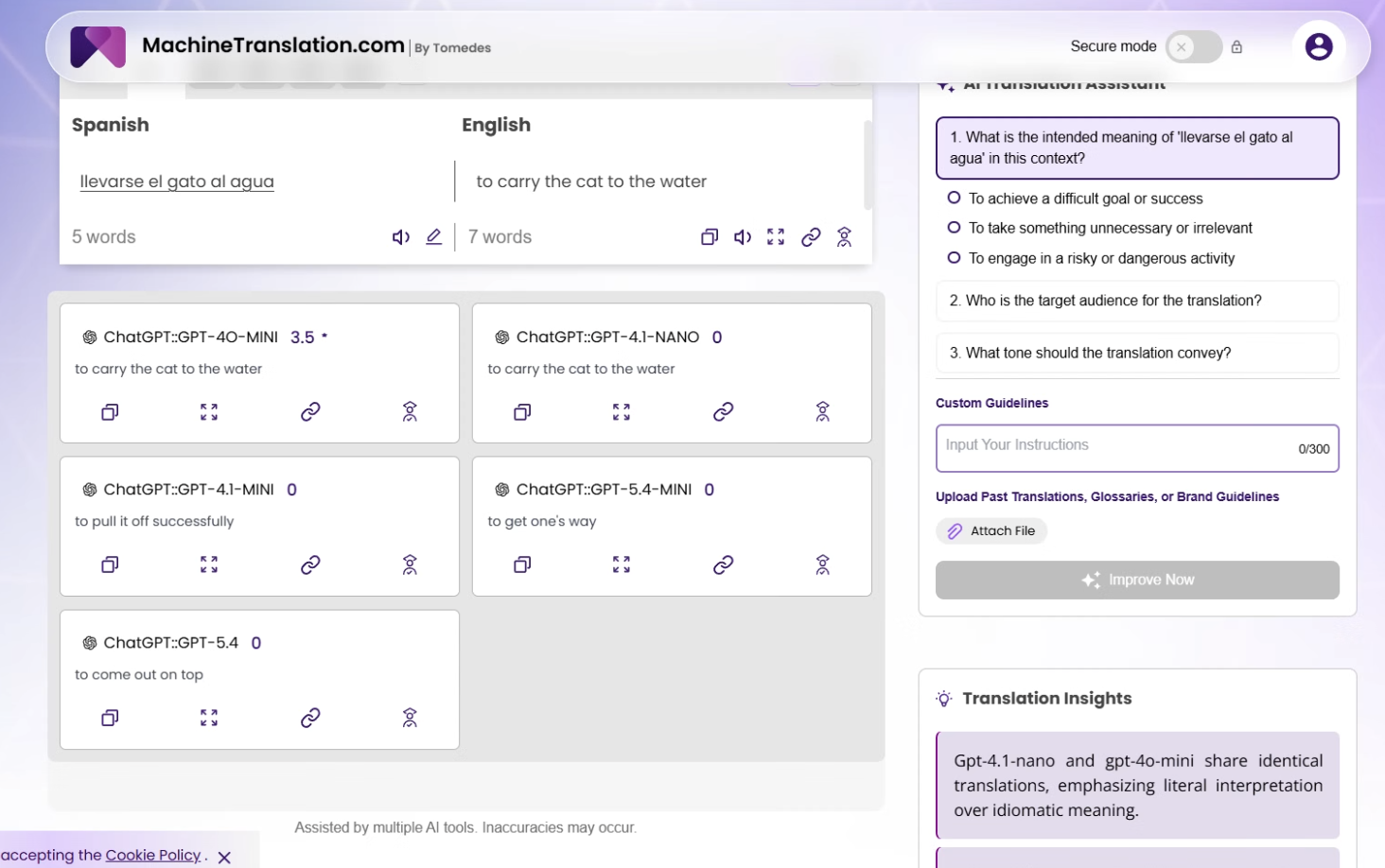
To see this at the sentence level, we ran the Spanish idiom "llevarse el gato al agua", roughly "to pull it off" or "to get away with it", through five versions of ChatGPT at once.
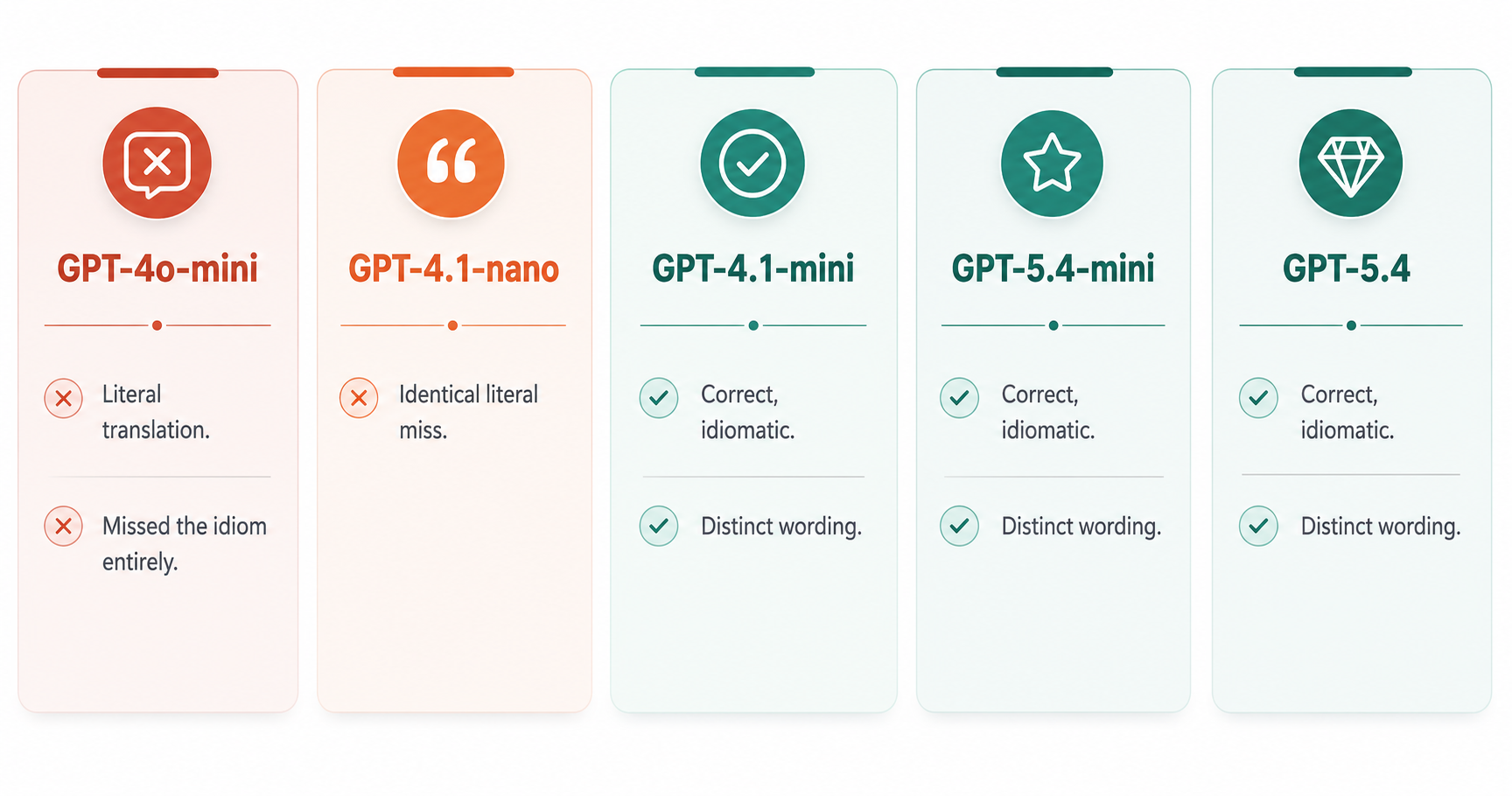
Two model versions missed the idiom in the same literal way. The other three understood it, and still produced three different, equally correct sentences. Same model family, same sentence, three defensible outputs. On Spanish to English, disagreement is rarely one model being wrong. It's usually several models being right in different words.
How each AI model scores on Spanish to English
Every engine in our consensus pool scores above its own platform average on this pair. Gemini and Mistral win the most individual segments, at 31% each. Gemini scores 0.71 points above its own average here; Mistral scores 0.21 above its own average.
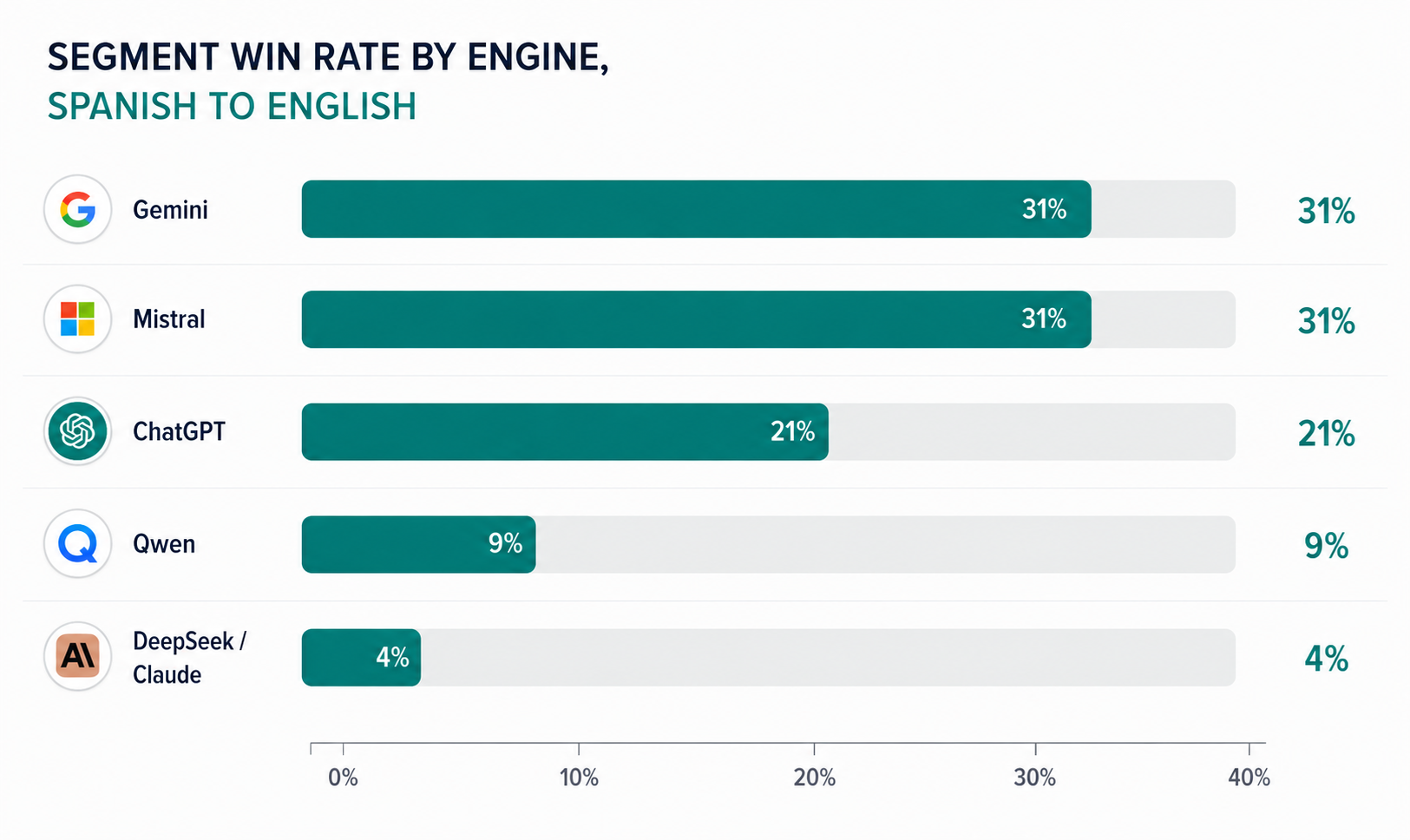
| Engine | Win rate | Avg. score | vs. own platform average |
|---|---|---|---|
| Gemini | 31% | 8.25 | +0.71 |
| Mistral | 31% | 7.92 | +0.21 |
| ChatGPT | 21% | 8.71 | above average |
| Qwen | 9% | 8.97 | above average |
| DeepSeek / Claude | 4% combined | 9.1+ | above average |
No other language pair we test shows every model in the pool clearing its own bar at once. That's a strong resourcing signal. It says nothing about whether any two of these models would hand you the same sentence.
What MachineTranslation.com does when models don't agree
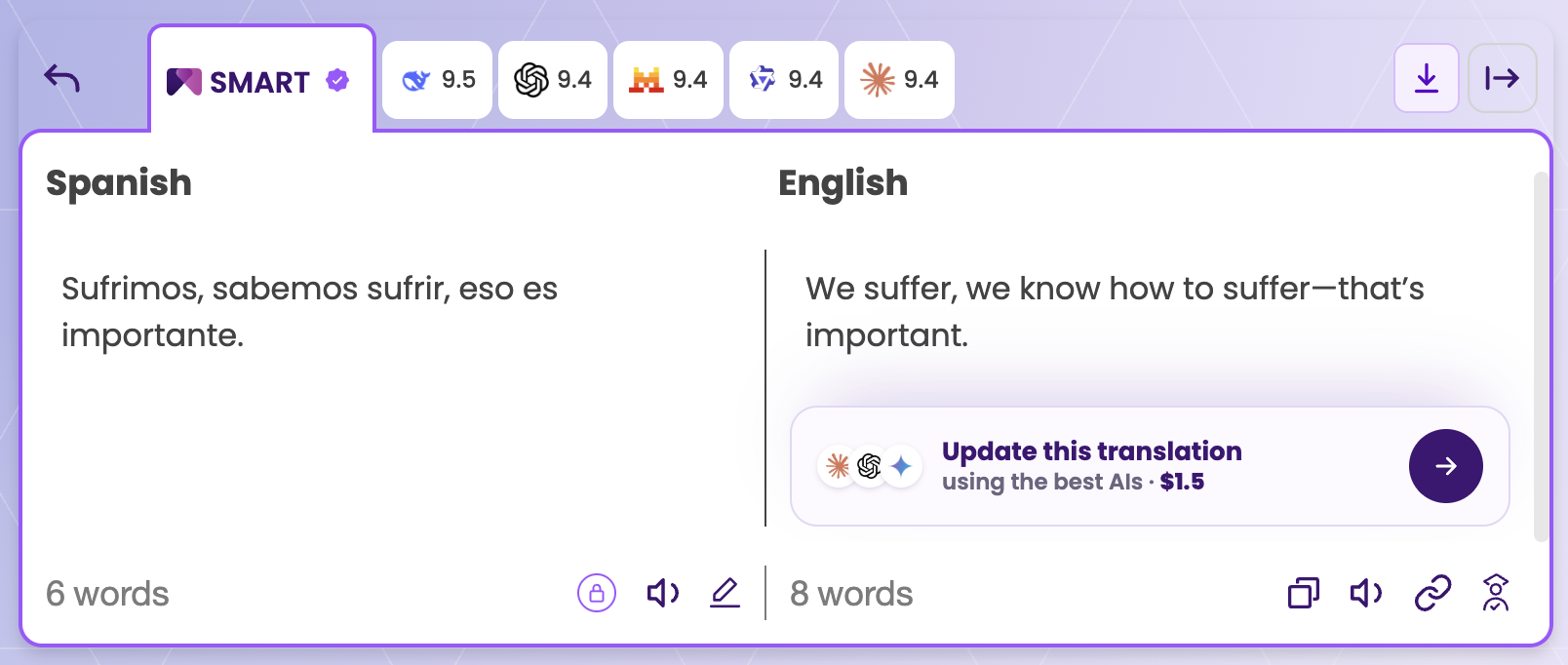
MachineTranslation.com is not built to catch a model failing obviously. On Spanish to English, that mostly is not the failure mode. It is built to answer a narrower question: when five models are each individually right, which answer did most of them actually converge on?
01. Runs the source sentence through every model in the pool at once, not one at a time.
02. Compares the outputs at the sentence level, not the document as a whole.
03. Identifies exactly where the pool converges and exactly where it splits.
04. Returns the version the majority actually chose, with no added paraphrasing or rewriting layer of its own.
This is closer to how a human editor reconciles several good drafts than to how a spell-checker catches an error. You can read more on how the selection mechanism works on our FAQ page, or see it applied on a different pair on our English to Spanish page.
Spanish is one of the best-resourced language pairs we test, and every engine in our pool scores above its own average on it. But high individual quality doesn't mean high agreement. Across our ten highest-volume pairs, English-Spanish sits near the bottom for how often models actually agree with each other, at 83.8%. That comes from ambiguity, not resourcing: agreement tracks how many valid ways there are to say something correctly, not how much training data exists for a language. A single model can be excellent and still be one of six different, equally defensible answers. Consensus doesn't fix an error here. It surfaces which correct answer the majority actually converged on.
Frequently asked questions
1. What is the best Spanish to English AI translator?
No single model is reliably the best on every sentence. In our data, Gemini and Mistral win the most segments on this pair, while ChatGPT, Qwen, DeepSeek, and Claude all still score above their own platform averages. We built MachineTranslation.com to run every model at once and return the version the majority agree on, rather than betting on one model every time.
2. Why do AI translation models disagree even when quality is high?
We've found disagreement mostly comes from ambiguity in the source sentence, not from errors. A well-resourced language like Spanish can still show a lower model agreement rate than a less-resourced one, because agreement tracks how many equally correct ways there are to phrase something, not how much training data a language has.
3. How much do AI models agree on Spanish to English translations?
We measured 83.8% average model agreement on this pair, near the bottom of our ten highest-volume language pairs. English to Hindi ranks highest at 91.9%, and Japanese to English ranks lowest at 83.6%.
4. How does MachineTranslation.com pick a translation when models disagree?
It runs the source sentence through every model in the pool at once, compares the outputs at the sentence level, and returns the version the majority converge on, rather than the output of any single model.

By Rachelle Garcia
Connect on LinkedInRachelle leads product and AI at Tomedes, where she runs the experiments that turn internal data into better translation experiences. She writes about what actually happens when you build AI products such as MachineTranslation.com — the numbers, the surprises, and the parts that don't go to plan.
Share:


