October 8, 2026
The Spanish translation that scored 100% agreement, and still missed something
A brand expanding into Spanish-speaking markets usually treats "Spanish" as one setting to get right, not a decision to make for every piece of content. Most teams pick a translation tool, run their copy through it, and move on once the output looks fluent and confident. That confidence is exactly where the risk hides.
We ran three real business sentences through MachineTranslation.com's English-to-Spanish translator to see where neutral Spanish genuinely holds up, and where "the models all agree" stops meaning what it sounds like.
Key takeaways
- A standard internal business sentence (a financial report notice) scored 9.5 out of 10 across all 8 engines tested, with 100% agreement and no regional risk, confirming neutral Spanish is genuinely fine for internal, non-consumer-facing content.
- Translating the Mexican slang word "fresa" returned a flat, unanimous "strawberry" from all 8 models, with no indication that a regional slang meaning (snobby or preppy) exists at all.
- Translating "coger," a word that is neutral in Spain but vulgar slang in Argentina and Uruguay, returned "100% agreement" on the neutral answer even though one model had explicitly flagged the regional risk in its own response, a nuance the consensus score did not surface.
- "100% agreement" describes how many models landed on the same output, not whether that output accounts for regional meaning, a distinction brands evaluating AI translation tools often miss.
- The decision point for global brands is not "is this Spanish," it's "does this specific piece of content carry regional or cultural stakes," since that is what determines whether neutral Spanish is safe or risky.
Where neutral Spanish works fine for your business
Yes, neutral Spanish is genuinely reliable for internal, non-consumer-facing business content, because this kind of writing carries almost no regional or cultural weight to begin with. We tested a routine internal notice: "The quarterly financial report is now available on the company shared drive." Every one of the 8 AI models compared, including MachineTranslation.com's consensus pick, returned the identical sentence, scored at 9.5 out of 10, with 100% agreement and zero terms in dispute.
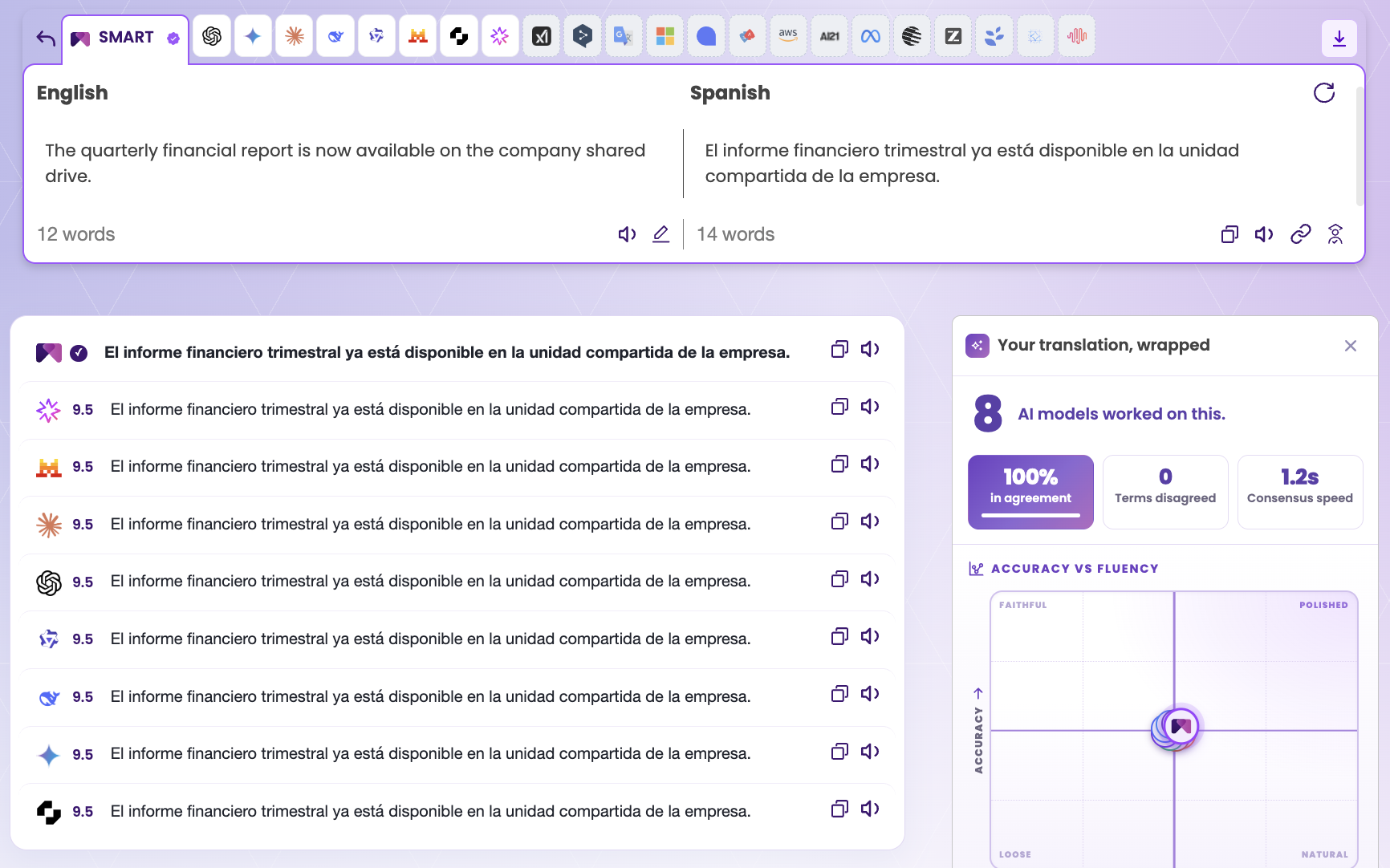
This is the kind of content most global brands actually produce the most of: internal memos, standard operating procedures, product documentation, and plain informational copy. None of it carries a joke, a slang term, or a culturally loaded phrase that could land differently in Mexico City than in Madrid. For this category, a neutral register is not a compromise, it is the correct choice. The common mistakes that do show up in Spanish business translation live elsewhere. Formality and terminology choices cause more real problems than flat informational writing like this does.
Where neutral Spanish misses regional meaning entirely
No, neutral Spanish is not safe once a word carries a regional meaning the models were never asked to consider. We tested "fresa," a common Spanish word for the fruit that also functions as Mexican slang for someone snobby or materialistic, roughly equivalent to "preppy" in English. All 8 models, including the MachineTranslation.com consensus pick, returned "strawberry," with a 4.9 out of 5 confidence rating and no acknowledgment that a second meaning exists.
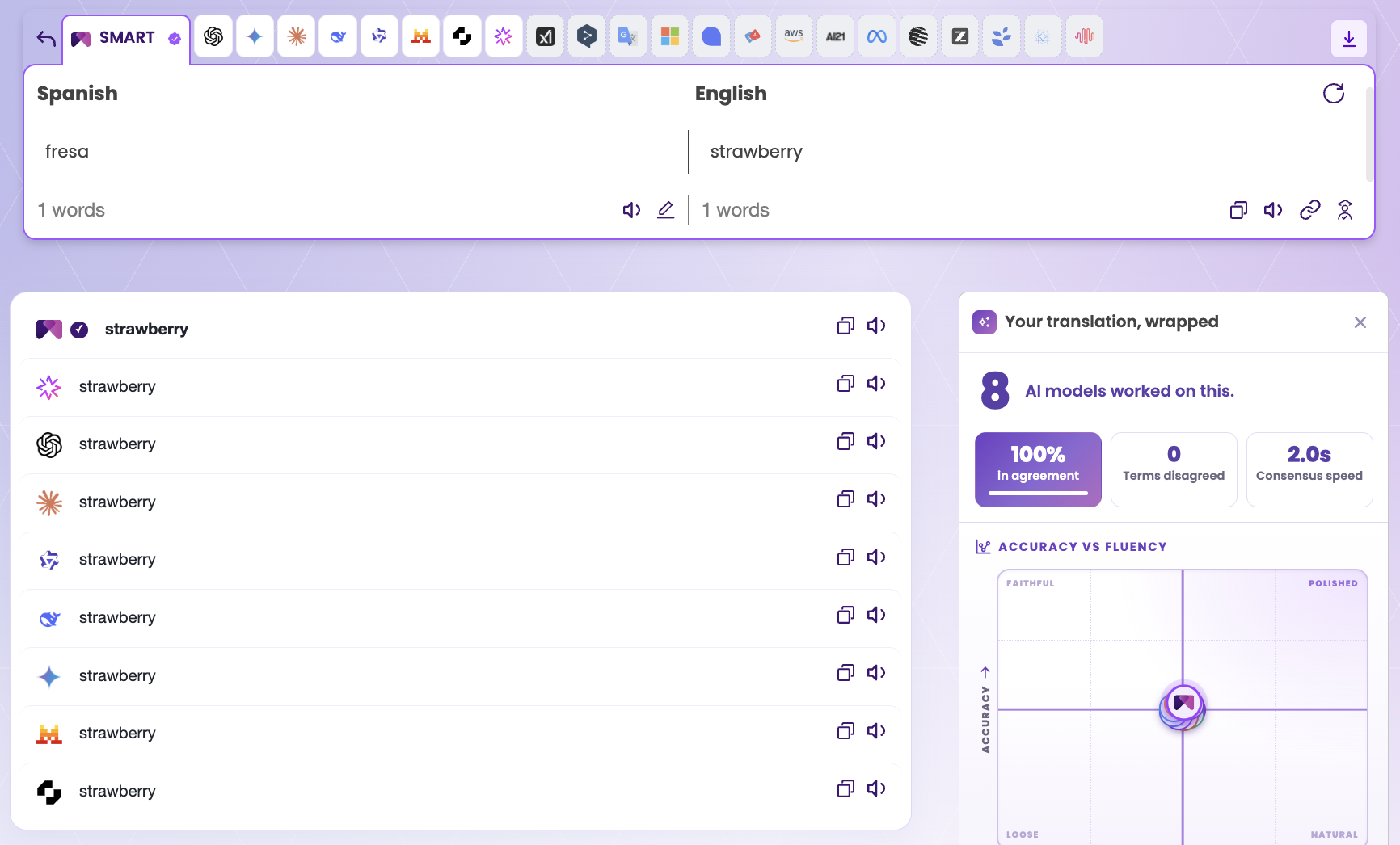
Without context, there is no way for any translation system, single-model or multi-model, to know whether a brand means the slang sense or the fruit. That is a fair limitation. The risk for a global brand is not that the ambiguity exists, it's that the tool's own confidence signals (5-star-style ratings, "100% agreement" badges) give no indication that ambiguity was ever a factor. A marketing team pulling a quick translation and trusting the confidence score would have no reason to pause here.
Why 100% model agreement is not the same as 100% accuracy
No, model agreement and translation accuracy are not interchangeable metrics, and the clearest proof of that distinction showed up in our third test. We translated "coger," a word that means "to take" or "to grab" in Spain and much of Latin America, but functions as vulgar slang in Argentina and Uruguay. Seven of the 8 models returned a flat "to take." One model went further on its own, explicitly noting in its response that the word's meaning depends on regional context, and naming the vulgar usage directly before recommending the neutral translation as the safer default without more information.
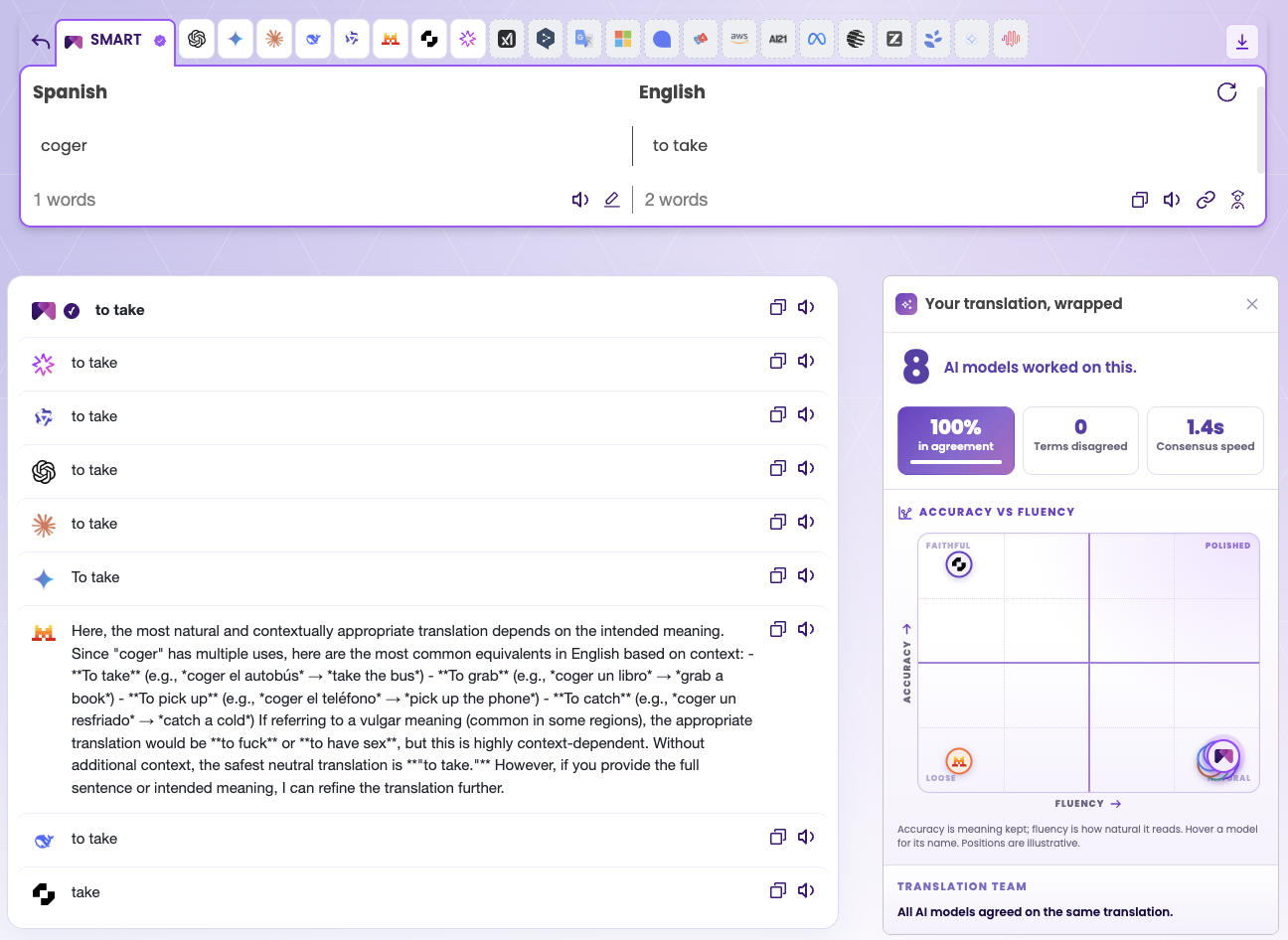
This is the finding that matters most for how brands should actually evaluate AI translation tools. The consensus mechanism counted every model that landed on "to take" as being in agreement, including the one model that arrived there after explicitly reasoning through a regional risk. The published agreement score reflected unanimous output, not unanimous awareness. A brand reading "100% agreement" as a quality signal would have no way to know that one of the eight models had quietly done more work than the rest, and that the final number gave no credit for it.
Why this happens, and why it's not a flaw unique to one tool
Agreement scoring measures output convergence, because that is what's actually measurable at scale across many models and many languages. Measuring "did this model privately reason about regional risk" is a different and much harder problem, closer to grading an explanation than grading an answer. This is exactly the same gap that shows up in AI formality defaults in Mexican business Spanish, where models trained on aggregate Spanish data default to patterns common in writing from Spain and the US, not because they assessed the Mexican context, but because that's what the training data weighted toward. The underlying issue is the same: an AI translation system's stated confidence describes how the models behaved with each other, not how well the output will land with a specific regional audience.
How to decide when regional localization is non-negotiable
The useful question for a global brand is not "is this Spanish accurate," it's "what kind of content is this, and what regional stakes does it actually carry." A financial report, a slang word, and a word with a regional vulgar meaning all scored 100% model agreement in testing, yet only one of those three actually carried real regional risk. Content type, not the agreement score, is what predicts the risk.
| Content type | Regional risk | Neutral Spanish safe? |
|---|---|---|
| Internal reports, SOPs, plain informational copy | Low | Yes, confirmed by our financial-report test |
| Product UI, support documentation | Low to moderate | Usually, unless terminology has regional variants |
| Consumer marketing copy, slogans, slang-adjacent phrasing | High | No, confirmed by our "fresa" test |
| Customer-facing phrases with multiple regional meanings | High | No, confirmed by our "coger" test |
This is also why US Spanish and Spain Spanish aren't interchangeable for brand-facing content: the moment a business decision touches how a specific audience reads a specific word, a general confidence score stops being the right signal to trust on its own, and a human reviewer familiar with that market becomes the actual safeguard here, working alongside AI translation to catch what the agreement score alone can't.
In practice, this doesn't mean adding a review step to everything a brand translates into Spanish. It means building the review step into the categories where the table above already says the risk sits: consumer copy, slang-adjacent phrasing, anything a specific regional audience will read closely. Applying that review uniformly, or skipping it uniformly, across all Spanish content misses the actual distinction these three tests just showed.
Frequently asked questions
1. Which country has the most neutral Spanish?
No single country owns neutral Spanish, since it is a constructed register built for broad comprehension, not a dialect any population actually speaks. Mexico's media industry is often cited as a reference point, since decades of exported television content normalized a relatively regional-marker-free register, but neutral Spanish is a business convention, not a national one.
2. What is the 80/20 rule for Spanish localization?
It is a working rule of thumb among localization teams: roughly 80% of business Spanish content, reports, internal documentation, general product copy, works fine in a neutral register, while the remaining 20%, usually consumer-facing or culturally specific content, carries real regional risk if left neutral. The ratio is directional, not a measured statistic.

By William Mamane
Connect on LinkedInWilliam leads marketing and growth at Tomedes, where he turns SEO experiments and real campaign data into the strategy behind MachineTranslation.com's reach. He writes about how AI products actually get found and trusted plus the tactics that work, the ones that don't, and what search is rewarding right now.
Share:


