February 26, 2026
5 common US Spanish translation errors tanking your brand trust
For global brands, the United States is a critical Spanish-speaking frontier. With over 62 million Hispanic residents, it represents the second-largest Spanish-speaking population globally. However, businesses often treat "US Spanish" as a generic checkbox, unaware that 81% of professional linguists only feel confident publishing when secure modes and structured workflows are used.
How much does "almost right" translation cost in the US Spanish market?
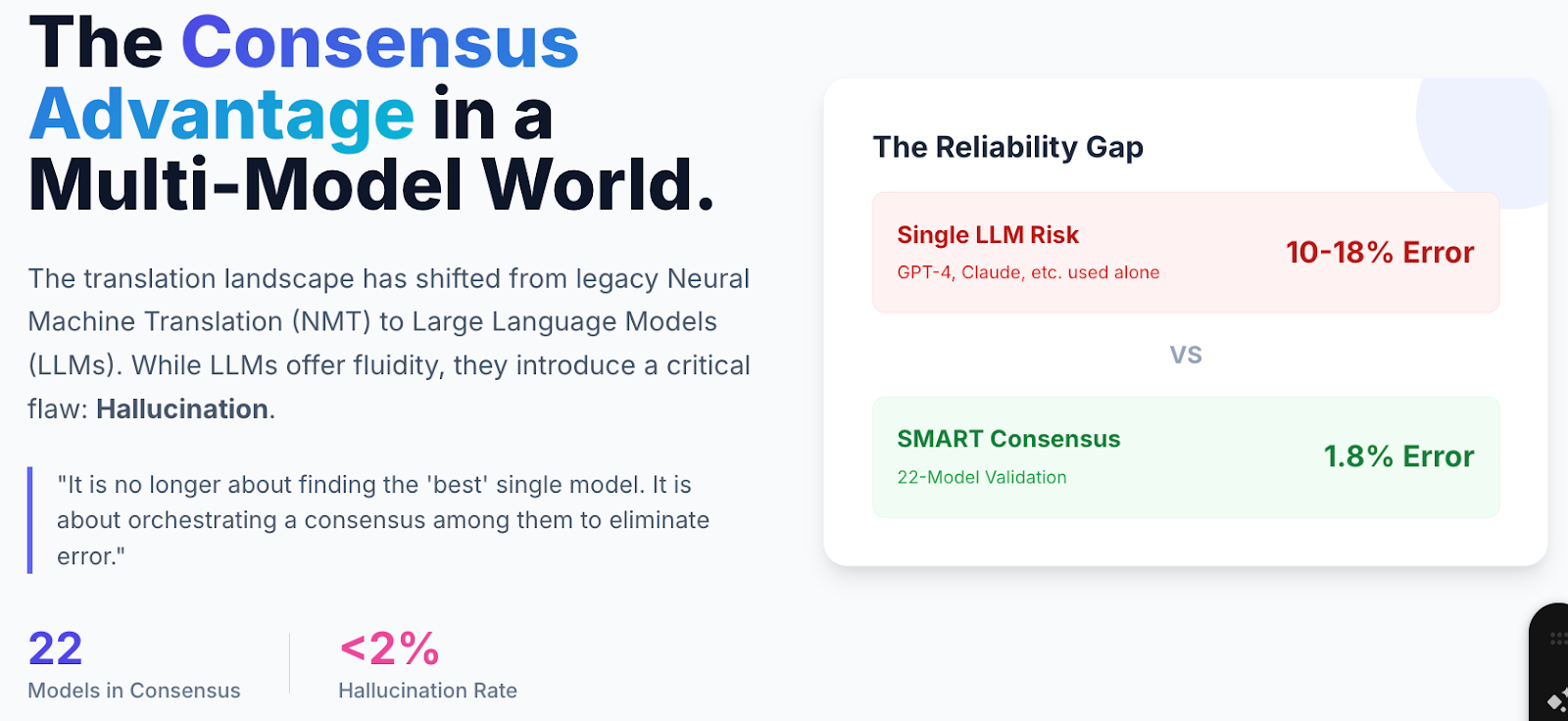
When you rely on literal translation, you risk stripping away the cultural identity of your audience. In a landscape where individual AI models "hallucinate" facts between 10% and 18% of the time, a standard machine translation is no longer a tool – it’s a liability.
(Data synthesized from Intento State of Translation Automation 2025 and MachineTranslation.com.)
Why does literal translation fail 62 million US Spanish speakers?
The US Hispanic market uses a unique linguistic fusion influenced by regional heritage and proximity to English. Standard AI models often hit a "complexity gap," where accuracy for Spanish plateaus at roughly 84-87% due to formatting errors and terminology drift.
(Source: Tomedes and Lokalise AI Translation Quality Research (2025).)
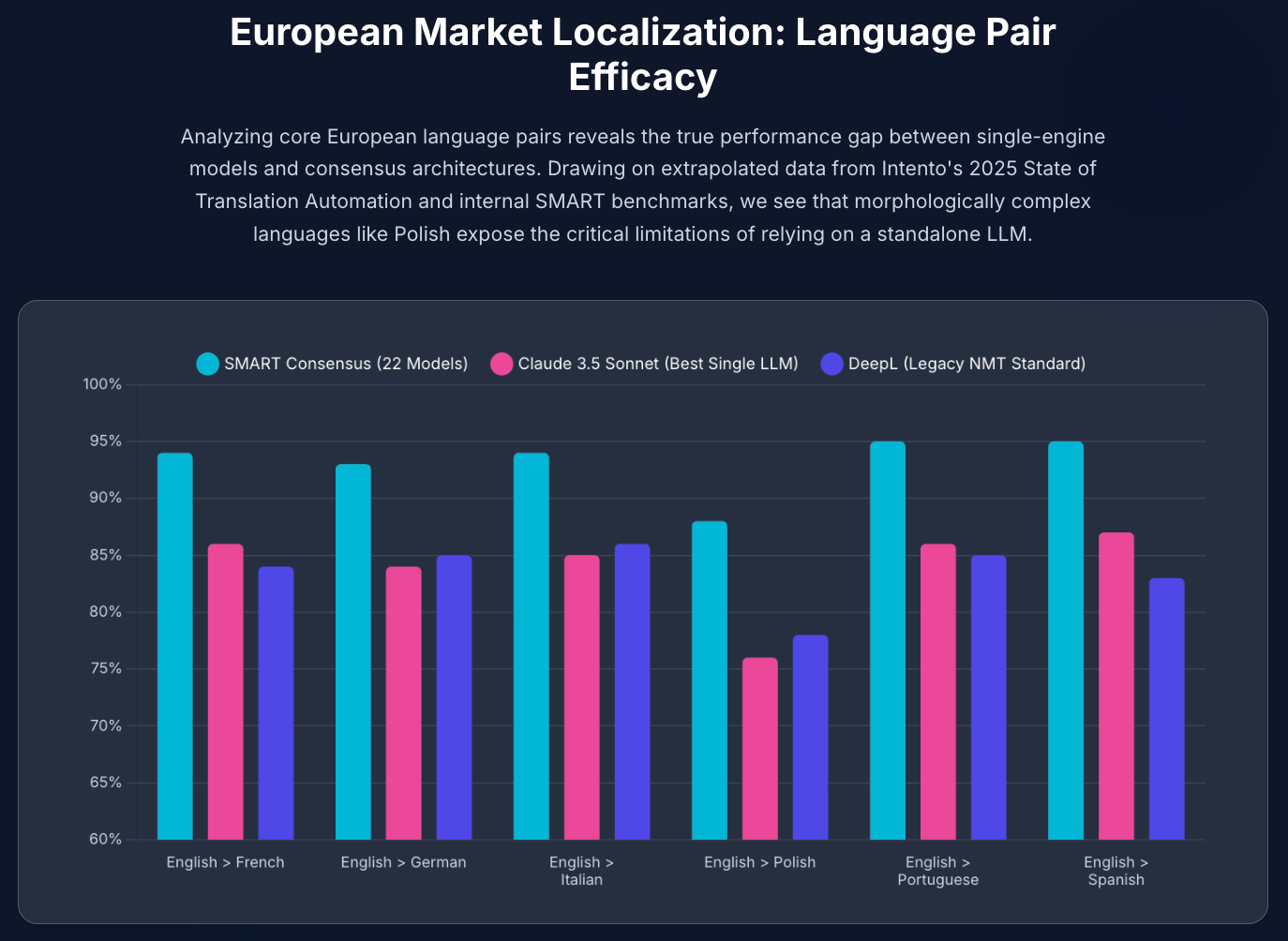
This 13-16% quality gap is where brand trust is lost. If your content feels stilted or "robotic," you aren't connecting with the community; you’re merely existing.
What are the most common Spanish translation errors in business?
We put MachineTranslation.com's SMART to the test using five sentences specifically engineered to trigger common AI failures. Here is how the consensus methodology outperformed single AI models.
1. The Formality Mismatch (Tu vs. Usted)
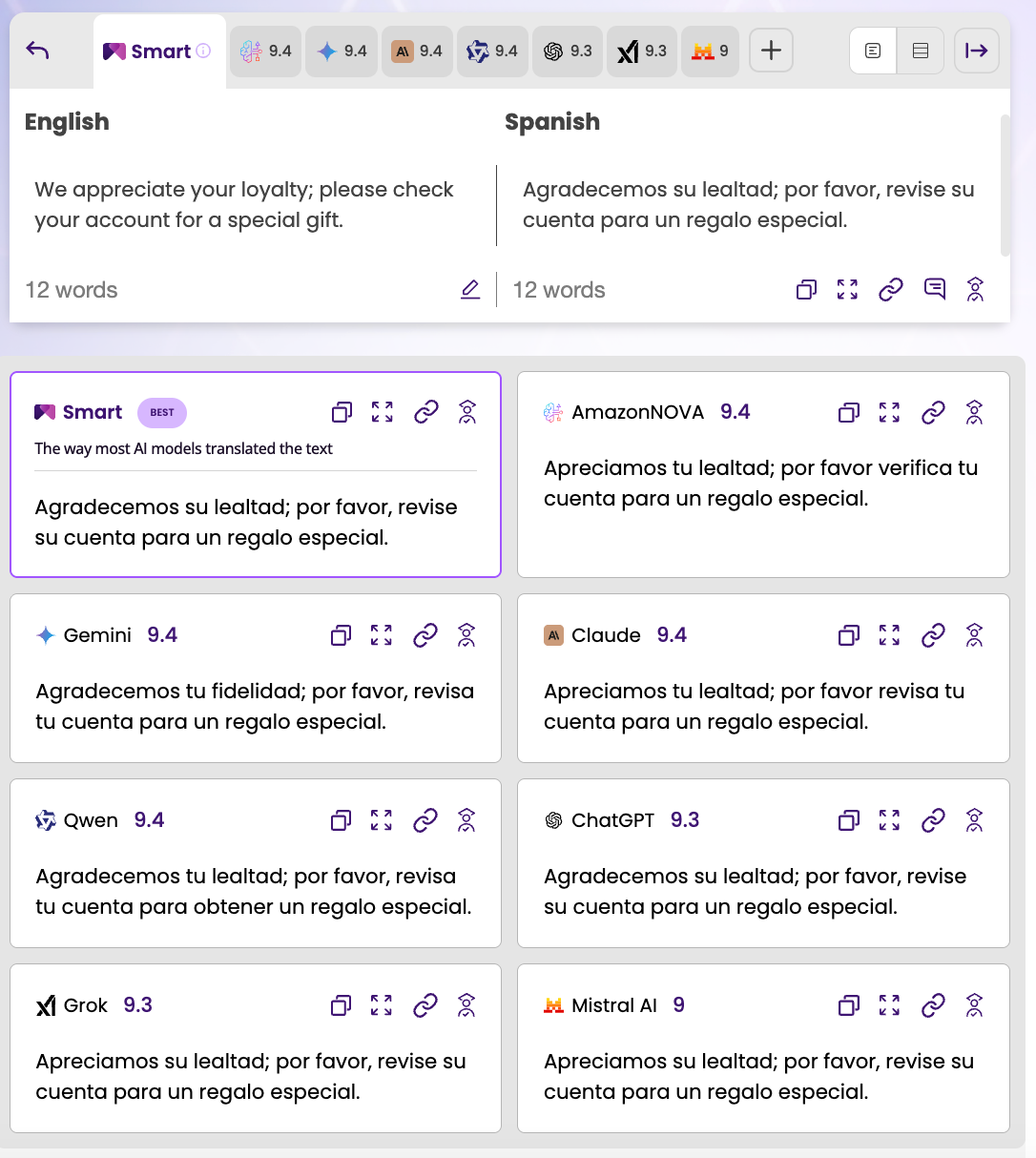
English: "We appreciate your loyalty; please check your account for a special gift."
The Single AI Failure: Models like AmazonNOVA, Gemini, and Claude defaulted to the informal "tu," which can appear overly casual or unprofessional in a formal business context.
The Consensus Result: SMART identified the formal requirement, selecting "Agradecemos su lealtad; por favor, revise su cuenta..." This maintains a respectful, consistent corporate tone that builds trust.
2. Spanglish and Loanword Nuance
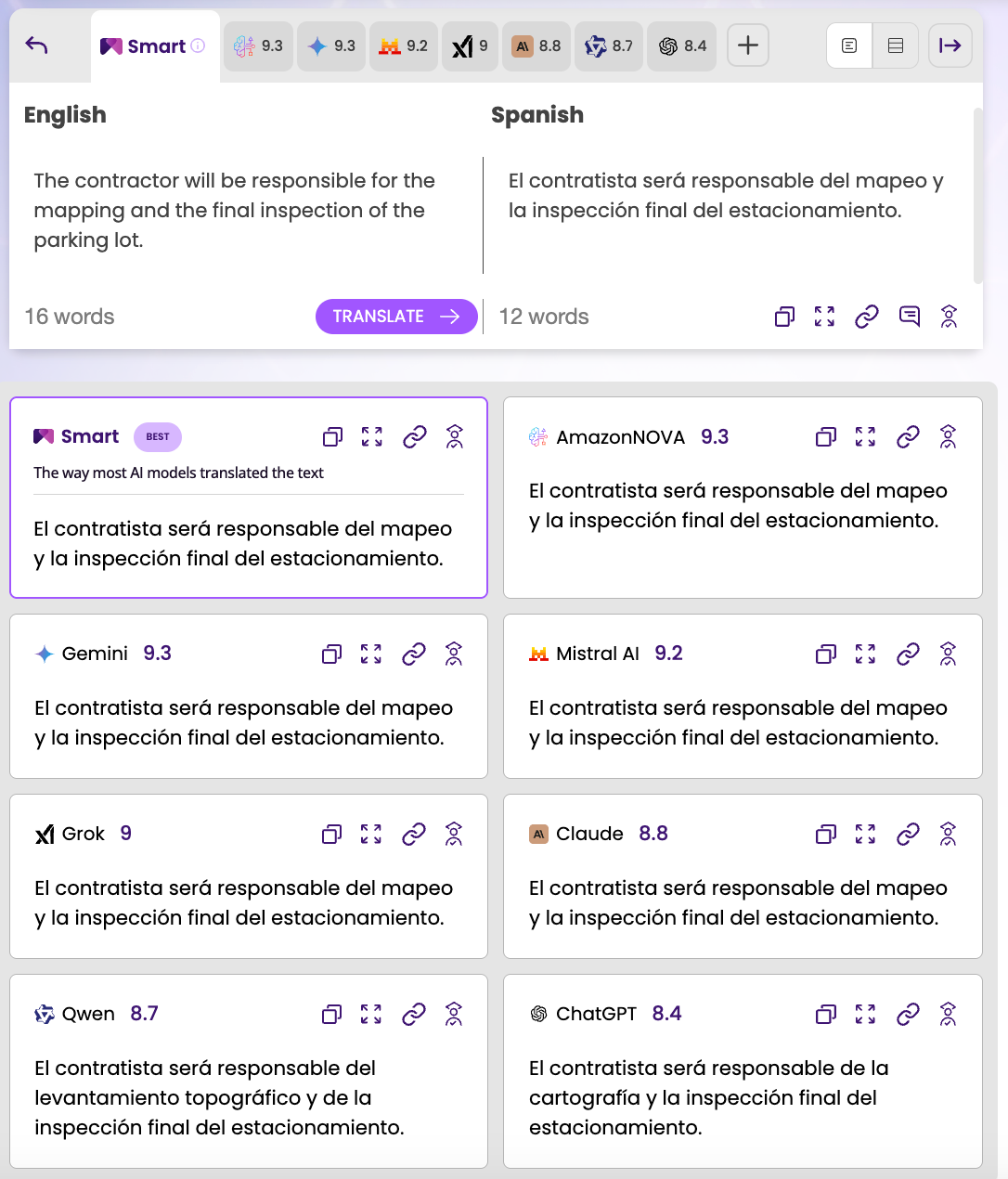
English: "The contractor will be responsible for the mapping and the final inspection of the parking lot."
The Single AI Failure: ChatGPT struggled with technical precision, translating "mapping" as "cartografía," which is far too academic for a construction context. Qwen used the even more obscure "levantamiento topográfico."
The Consensus Result: SMART chose "mapeo," a term that bridges technical accuracy with the natural phrasing used in the US Hispanic professional sector.
3. Misinterpreting "False Friends"
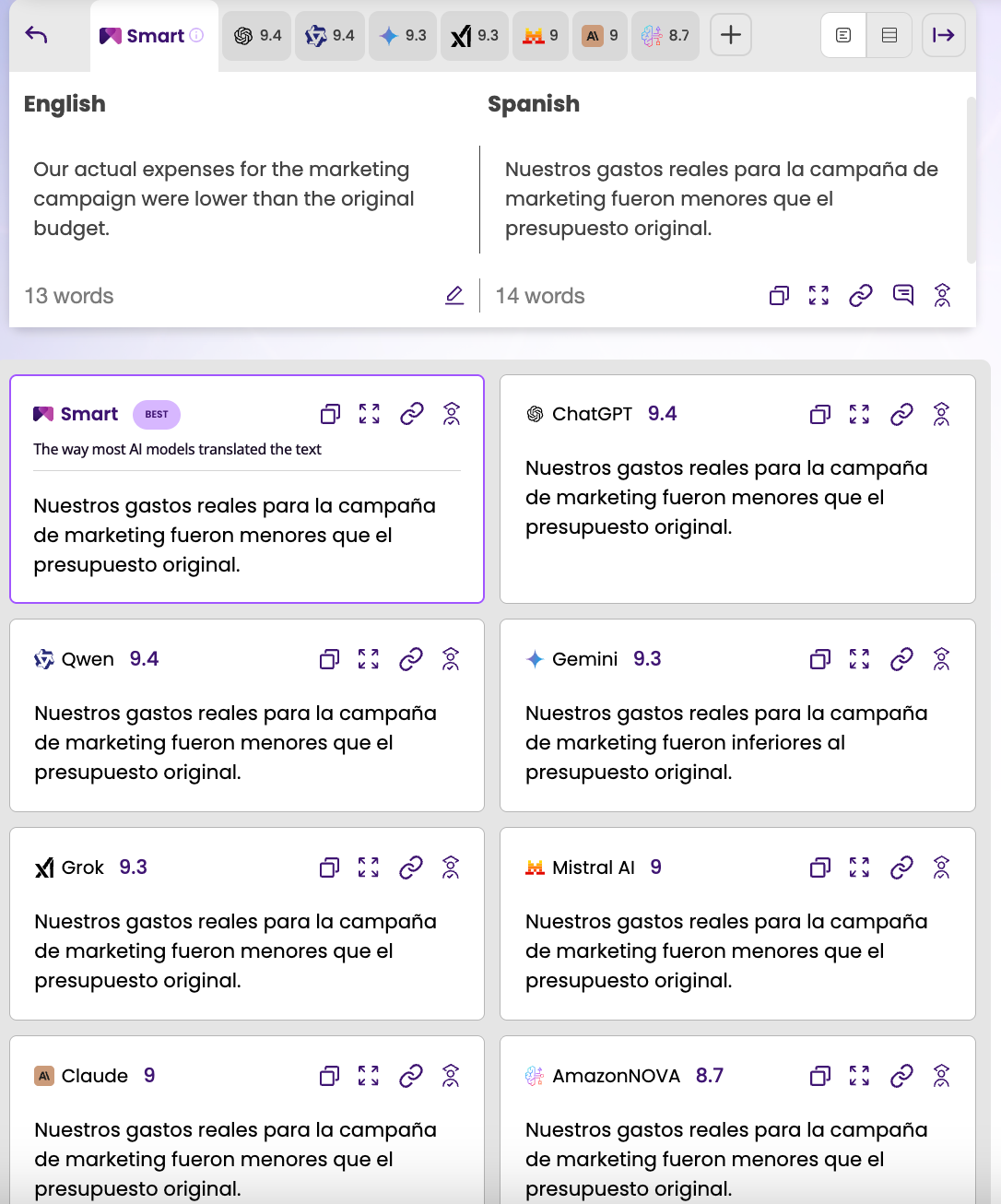
English: "Our actual expenses for the marketing campaign were lower than the original budget."
The Single AI Failure: Standalone models hallucinate facts or semantic meanings between 10% and 18% of the time. A common error is translating "actual" as "actual" (which means "current" in Spanish), confusing historical reports with current data.
(Data synthesized from Intento State of Translation Automation 2025 and MachineTranslation.com.)The Consensus Result: By cross-referencing multiple models, SMART correctly identified "actual" as factual/real, outputting "Nuestros gastos reales..." and avoiding a critical financial misinformation error.
4. Technical Tags and Code Integrity
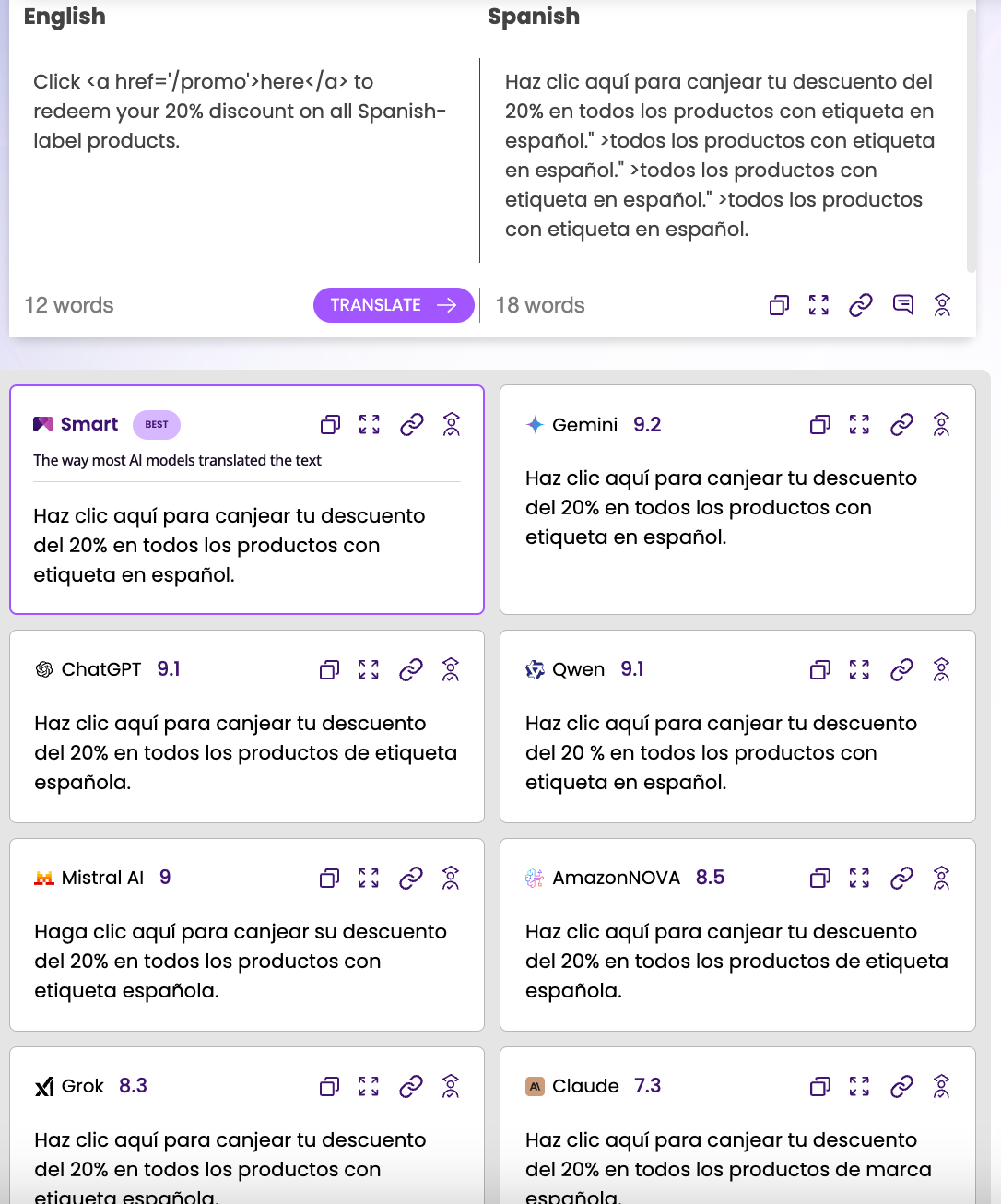
English: "Click <a href='/promo'>here</a> to redeem your 20% discount on all Spanish-label products."
The Single AI Failure: High-tier LLMs frequently break <HTML> tags while attempting to maintain narrative context. In our test, some models misplaced the link or incorrectly modified the Spanish within the tag structure.
The Consensus Result: SMART decoupled linguistic processing from structural formatting, ensuring the Spanish was native while the code remained 100% functional.
5. Lack of Dialectal Sensitivity
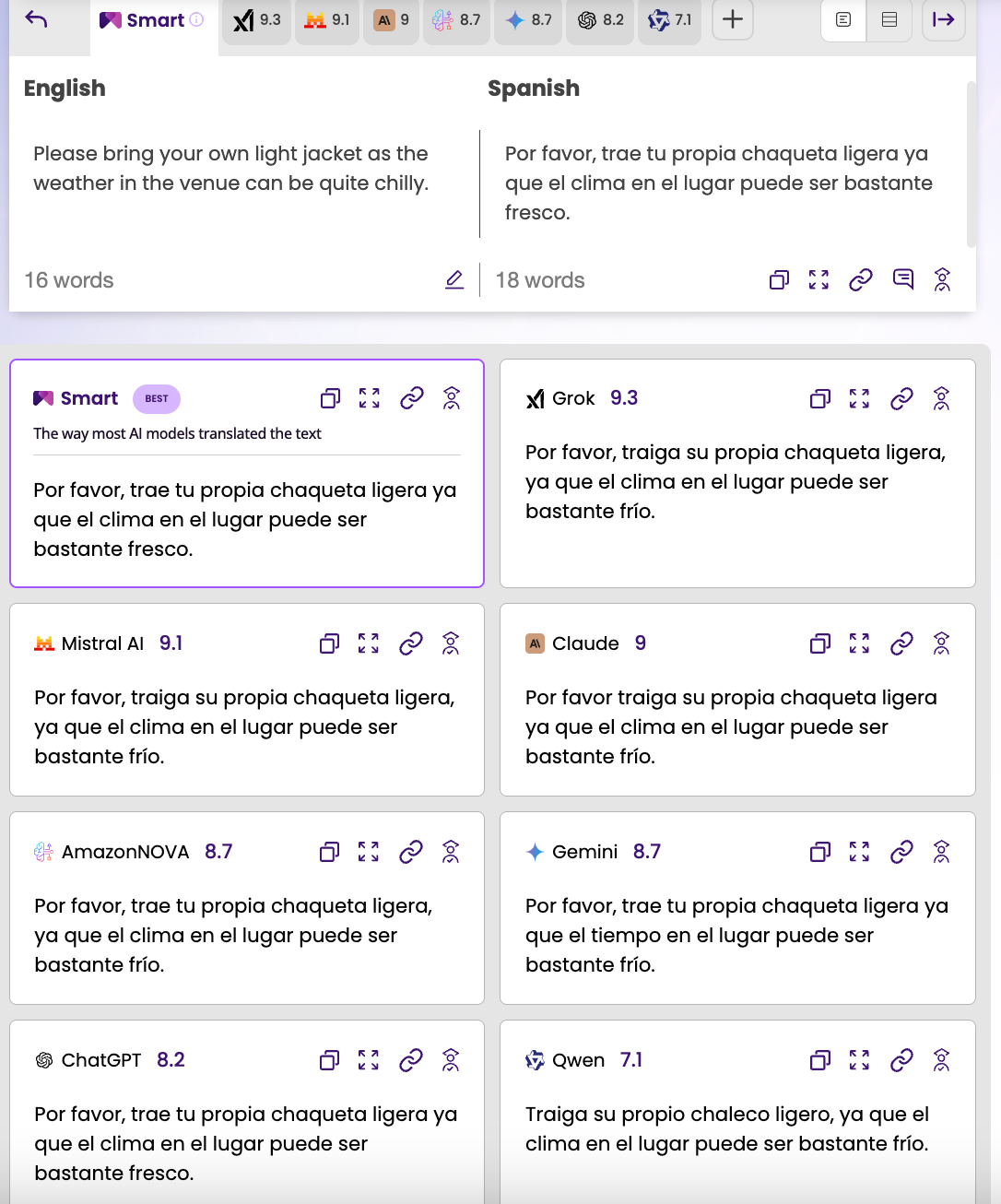
English: "Please bring your own light jacket as the weather in the venue can be quite chilly."
The Single AI Failure: Qwen hallucinated a regional term, suggesting "chaleco" (vest), which changes the entire meaning. Other AI models might use terms like "chamarra" (Mexican) or "campera" (Argentinian), which can alienate sub-segments of the US audience.
The Consensus Result: SMART selected the neutral and universally understood "chaqueta," ensuring the message remains clear for all Spanish speakers regardless of their country of origin.
Why is a single AI model not enough for professional translation?
Proprietary benchmarks of MachineTranslation.com reveal a significant reliability gap when engines operate in isolation. In regulated sectors like finance or law, a 10% error rate is a massive liability.
(Data synthesized from Intento State of Translation Automation 2025 and MachineTranslation.com.)
Engine Strategy | Effective Error Rate | Accuracy Rating |
Single LLM (ChatGPT, Claude, etc.) | 10% - 18% | ~85% |
Legacy NMT (Standard) | ~11% | High Variation |
Consensus (SMART) | < 2% | 93% - 98.5% |
When businesses switch to a consensus methodology, the effective error rate plummets. This is because the system orchestrates an agreement among multiple top-tier models simultaneously, discarding idiosyncratic outliers.
What is linguistic consensus and how does it improve accuracy?
To succeed in the US Spanish market, your strategy must move from "Task-Level AI" to "Outcome-Driven AI".
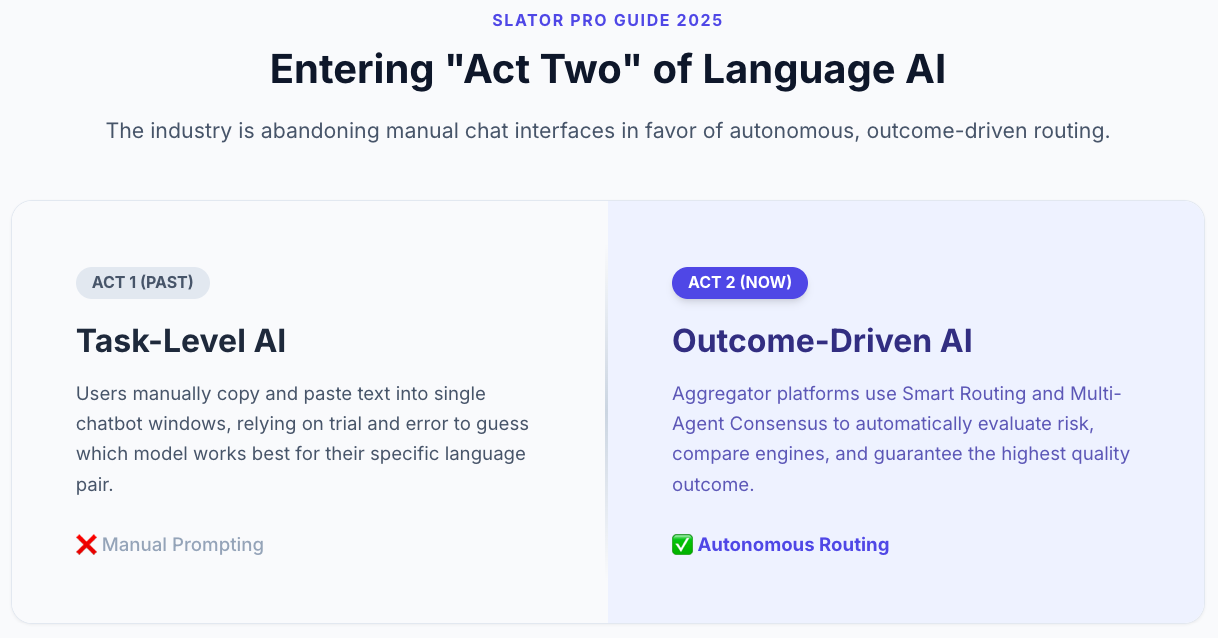
A consensus-based system doesn't just translate; it acts as a real-time auditor. It runs text through a decision matrix of 22 different NMT and LLM engines, using majority voting logic to ensure the highest quality outcome. This process reduces the time spent manually comparing outputs by 27% and cuts overall error-fixing time by 24%.
Ready to reach 62 million customers with certainty?
The nuance of the US Hispanic market requires more than a dictionary; it requires a linguistic consensus.
Try our English-to-Spanish translation tool to see how an automated audit can protect your brand trust.
FAQs
1. Why is the US Spanish translation different from the Spanish translation for Spain?
US Spanish is a "living dialect" influenced by the English environment. It requires a balance of neutral Spanish and localized terminology that standard engines – often optimized for European Spanish – frequently miss.
2. Can I just use one AI engine like DeepL for my marketing?
DeepL is a leader in "flow" with a 94.2% accuracy rating. However, relying on any single engine still exposes you to model-specific hallucinations. A consensus approach filters these outliers to reach quality scores of 98.5%.
(Benchmarking data via MachineTranslation.com internal reports and WMT24 General Machine Translation Findings.)
3. How does SMART actually work?
It runs your text through 22 different AI models simultaneously. It discards errors made by only one or two models (outliers) and delivers the version that the majority of high-tier engines agree upon.
4. Is human review still necessary with SMART?
Not necessarily. But AI has shifted the role of the translator from a "writer" to an "architect". 82% of professionals now focus 90% of their time on design, cultural adaptation, and emotional resonance, while the consensus system handles the syntactic heavy lifting.