September 25, 2026
Qwen vs Grok: Which AI model translates better?
Qwen and Grok are both general-purpose AI models, not translation-specific tools, and both are part of the pool of models MachineTranslation.com runs on every translation. That matters for how to read what follows. This is a look at how two of the platform's own models perform against each other, with the real caveats that come with that kind of data, not a contest between two outside challengers and the platform itself.
What are Qwen and Grok?
Qwen is Alibaba's family of large language models, currently on its Qwen3.8 generation, and was added to MachineTranslation.com's model pool as part of the platform's ongoing expansion. Grok is xAI's model line, currently on Grok 4.7 as of this writing, having moved through several releases since the version this article originally compared, and joined the platform separately. Neither model was built specifically for translation. Both are general-purpose systems that happen to handle many languages as part of broader language capability, which is a different starting point than a platform built and tested around translation quality specifically.
How do Qwen and Grok compare on MachineTranslation.com's own data?
Over the last 28 days of platform traffic, Grok scored higher on average than Qwen: 9.26 out of 10 against 8.87. Grok's worst-scoring 10% of translations still averaged 9.2, while Qwen's worst-scoring 10% dropped to 7.6, a wider gap at the low end than the average alone suggests.
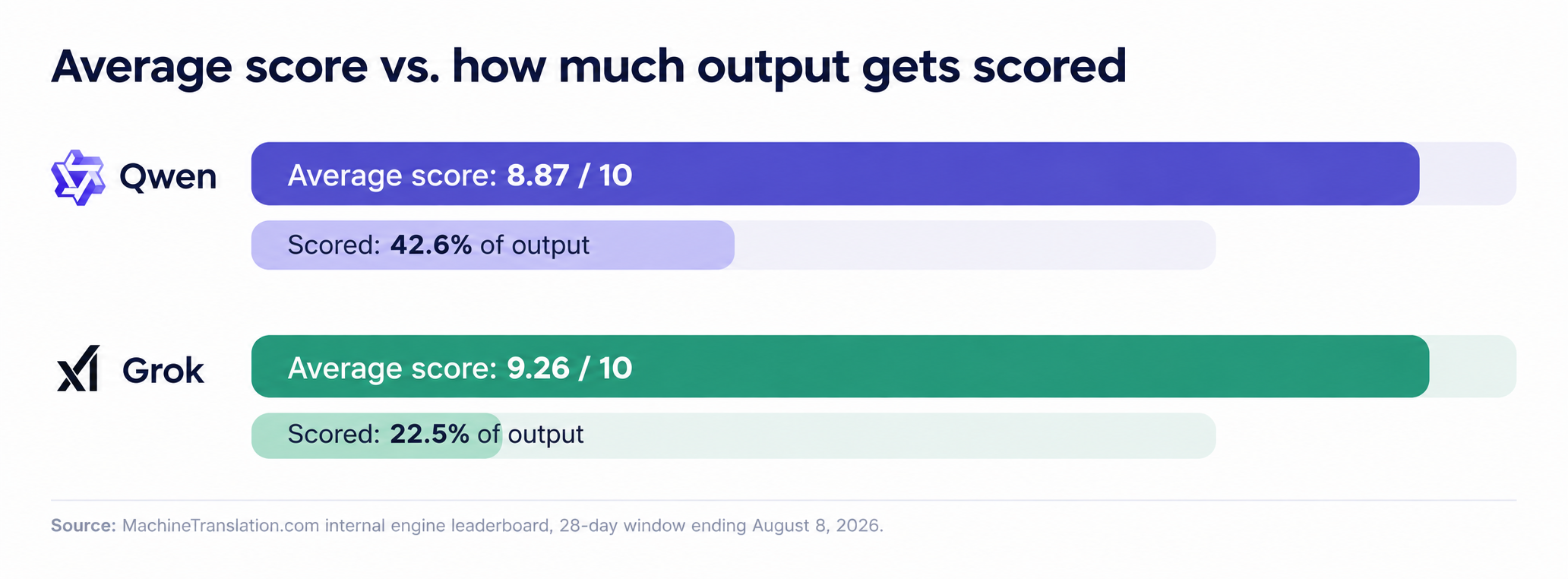
Grok's average score is higher, but it rests on scoring less than a quarter of its output, against nearly half for Qwen. The two bars tell different parts of the same story.
| Qwen | Grok | |
|---|---|---|
| Percent of output scored | 42.6% | 22.5% |
| Average score | 8.87 / 10 | 9.26 / 10 |
| Bottom 10% of scores | 7.6 | 9.2 |
Source: MachineTranslation.com's internal engine leaderboard, 28-day window ending August 8, 2026.
Does Grok's higher score mean it's the better choice?
Not on its own. Grok is used far less often on the platform than Qwen, and less than a quarter of its translations get scored at all, against nearly half of Qwen's. A smaller, less representative sample can make an average look better or worse than it would across the same volume Qwen sees. MachineTranslation.com's own reporting on this data treats scoring coverage as a real limitation, not a footnote: an engine scored on a narrow slice of its traffic hasn't been tested as thoroughly as one scored across nearly half of its output.
The honest read is that Grok's numbers are promising but thinner. Qwen's are lower on average but rest on a much larger, more representative base. Neither fact cancels the other out.
What about language coverage?
Neither Qwen nor Grok publishes a verified list of language pairs where performance drops off, and no independent testing exists to confirm one. What can be said with confidence is that neither model was built around translation quality across a specific language set the way a dedicated translation platform is. MachineTranslation.com tests and supports over 270 languages directly, which is a different kind of claim than a general-purpose model's broad but untested multilingual capability.
How MachineTranslation.com actually uses Qwen and Grok
MachineTranslation.com runs Qwen, Grok, and more than 20 other AI models on every translation, then surfaces the version those models most agree on. Neither model is excluded for scoring lower on average. Running many models at once means catching the cases where a lower-scoring model on average still gets a specific sentence right that a higher-scoring model misses. Qwen's performance also splits by direction and pairing in ways worth knowing before choosing a single model, covered in more depth in MachineTranslation.com's Qwen vs DeepSeek comparison. For a closer look at how models are tested against each other directly, see MachineTranslation.com's full model comparison testing.
Frequently asked questions
1. Is Qwen or Grok better for translation?
On MachineTranslation.com's own 28-day engine data, Grok scores higher on average than Qwen, 9.26 versus 8.87 out of 10. But Grok is scored on a much smaller, less representative slice of its output, so this isn't a clean head-to-head the way a matched-segment test would be.
2. Why does Grok have a higher average score but fewer scored translations?
Grok is used less often on the platform and only about 22.5% of its output gets scored, versus 42.6% for Qwen. A smaller, less representative sample can inflate or understate an average, which is why this comparison should be read as directional, not definitive.
3. Does Qwen or Grok support more languages?
Both are general-purpose AI models without a published, verified list of language-specific limitations. Neither is built specifically for translation, which is different from a platform that tests and scores translation quality across 270+ languages directly, rather than relying on broad multilingual training as a stand-in for measured translation performance.
4. Does MachineTranslation.com compete with Qwen and Grok?
No. MachineTranslation.com runs Qwen, Grok, and more than 20 other AI models on every translation and surfaces the version those models most agree on. It tests and combines models like these rather than competing against them as a separate model of its own.
5. Which AI model does MachineTranslation.com recommend for translation?
None by default. Different models perform differently by language pair and content type, and the gap between them can run in either direction depending on what's being translated. That variation is exactly why the platform runs multiple models on every translation rather than picking one as a standing recommendation.

By Rachelle Garcia
Connect on LinkedInRachelle leads product and AI at Tomedes, where she runs the experiments that turn internal data into better translation experiences. She writes about what actually happens when you build AI products such as MachineTranslation.com — the numbers, the surprises, and the parts that don't go to plan.
Share:


