September 4, 2026
What is back translation, and what does it actually prove?
We ran real phrases through multiple AI models, out and back. Two round trips came back exact. Two came back changed, for two completely different reasons, only one of which is actually a problem.
Back translation is the process of taking a translated sentence, translating it back into the original language, and comparing the result to the original. It is the most common self-service way to sanity-check an AI translation, and it is also frequently misread.
Here is what a real back-translation test just caught. We sent the English sentence "I saw her duck" into MachineTranslation.com, translated it into French, then translated the French result back into English. It came back as "I saw his duck."
Nothing was broken. French's third-person possessive pronoun, "son," does not mark gender the way English does. "Son canard" means his duck, her duck, or its duck, depending on context the four-word original never supplied. The AI models did not disagree with each other or make an error. They translated an ambiguous sentence into a language that cannot preserve that particular ambiguity, then translated the result back the only way French grammar allows.
The back translation changed. The translation itself did not fail. That gap is the reason this technique gets misread constantly, and it is worth looking at directly, one test at a time.
What is back translation?
Back translation, also called round-trip translation, works in two steps. First, a source text is translated into a target language (the forward translation). Second, that result is translated back into the original language without the translator or system seeing the original text (the back translation). The two English versions, before and after, get compared.
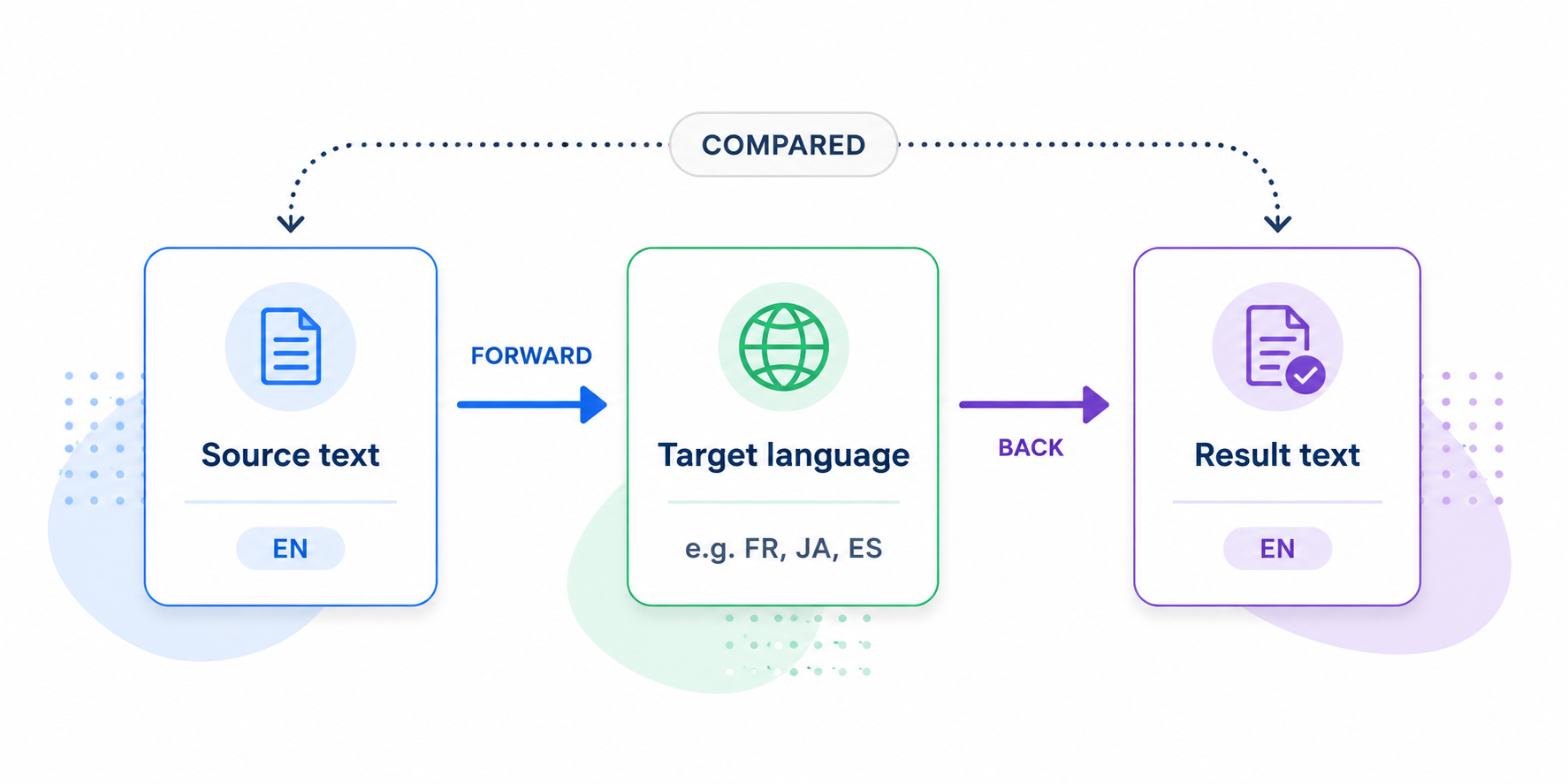
Wikipedia's entry on the technique flags the exact failure mode our duck example shows: round-trip translation cannot tell you whether a problem happened in the forward step, the back step, or both, and a good back translation can come from a bad forward translation just as easily as a bad back translation can come from a good forward one. The check tells you something changed. It does not tell you where, or whether that change matters.
What is the purpose of back translation?
People reach for back translation because it requires no bilingual reviewer. If you do not speak French, you cannot evaluate a French translation directly, but you can read the English that comes back out and judge whether it still says what you meant. That is the entire appeal: it turns a translation-quality question into a reading-comprehension question in a language you already know.
It is also why the technique shows up constantly in fields with no in-house linguists: clinical trial documentation, market research, HR policy rollouts, anywhere a team needs a fast check before something goes out. The instinct is sound. Where it goes wrong is treating a changed result as a verdict instead of a prompt to find out why it changed.
We ran four phrases through multiple AI models, out and back
To see what back translation actually catches, we ran four sentences through MachineTranslation.com live, each with a different translation challenge, each through a different language, and each in a two-hop chain: English to target, target back to English.
Two hops instead of a longer chain matters here. With a longer chain, a changed result cannot be traced to a single step, which is exactly the ambiguity Wikipedia's entry warns about. With two hops through one language, whatever comes back out is directly attributable to how that specific language handled the phrase.
| Test | Chain | Original | Round-trip result | Changed |
|---|---|---|---|---|
| Idiom | EN → JA → EN | "It's raining cats and dogs outside." | "It's pouring outside." | yes, expected |
| Business phrase | EN → DE → EN | "Please find attached our quarterly report for your review." | Identical | no |
| Casual phrase | EN → ES → EN | "Let's grab a coffee sometime this week." | Identical | no |
| Ambiguous phrase | EN → FR → EN | "I saw her duck." | "I saw his duck." | yes, worth a look |
The idiom test: A changed sentence that means the translation worked
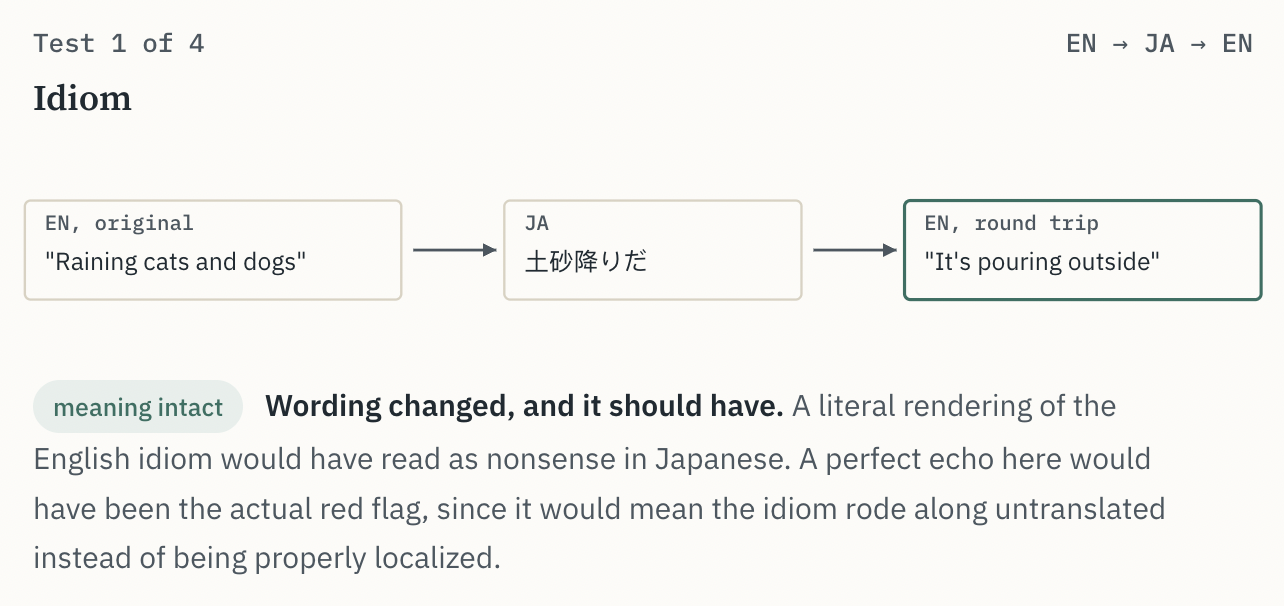
This is the first place back translation gets misread. A changed result on idiomatic language is usually evidence the translation worked, not evidence that it failed.
Two round trips that came back exact
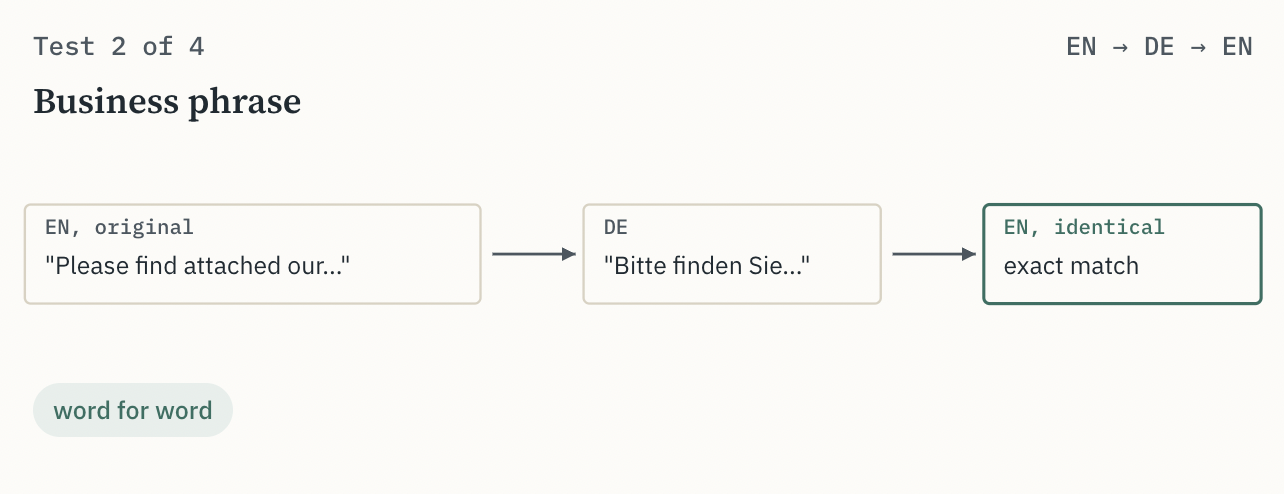
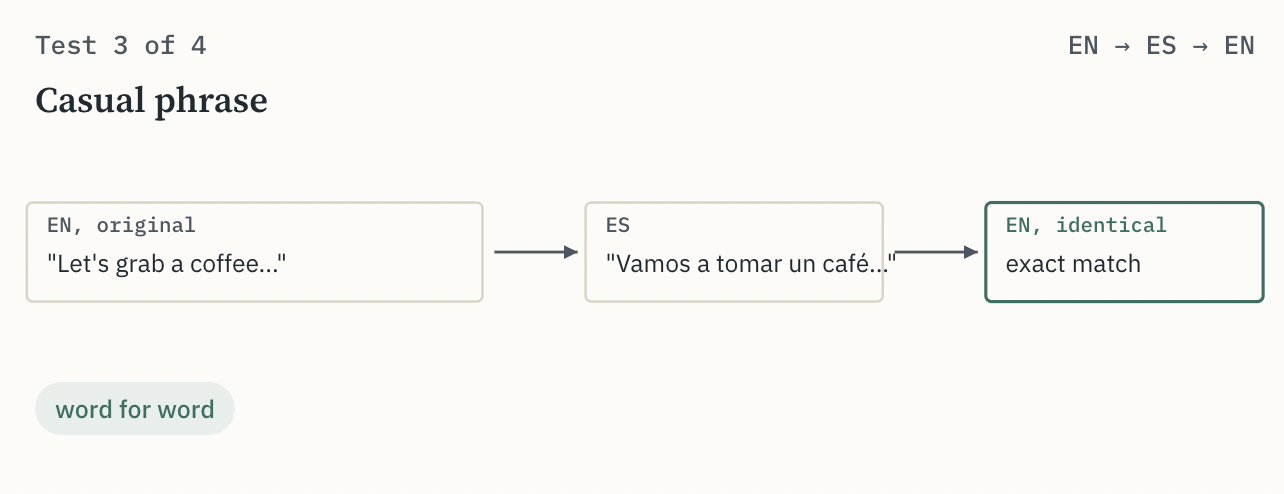
Both phrases are common, low-ambiguity language with a direct structural equivalent in the target language. That consistency is not surprising against MachineTranslation.com's own model-agreement research: across its ten highest-volume language pairs, English-to-French averages 86.0% model agreement and English-to-Spanish averages 83.8%, figures pulled from real, often messy, user submissions rather than clean single-sentence tests like these. A simple, unambiguous phrase would be expected to land toward the high end of that range, which is what happened here: a perfect round trip in both directions.
The duck problem: A back-translation error that isn't one
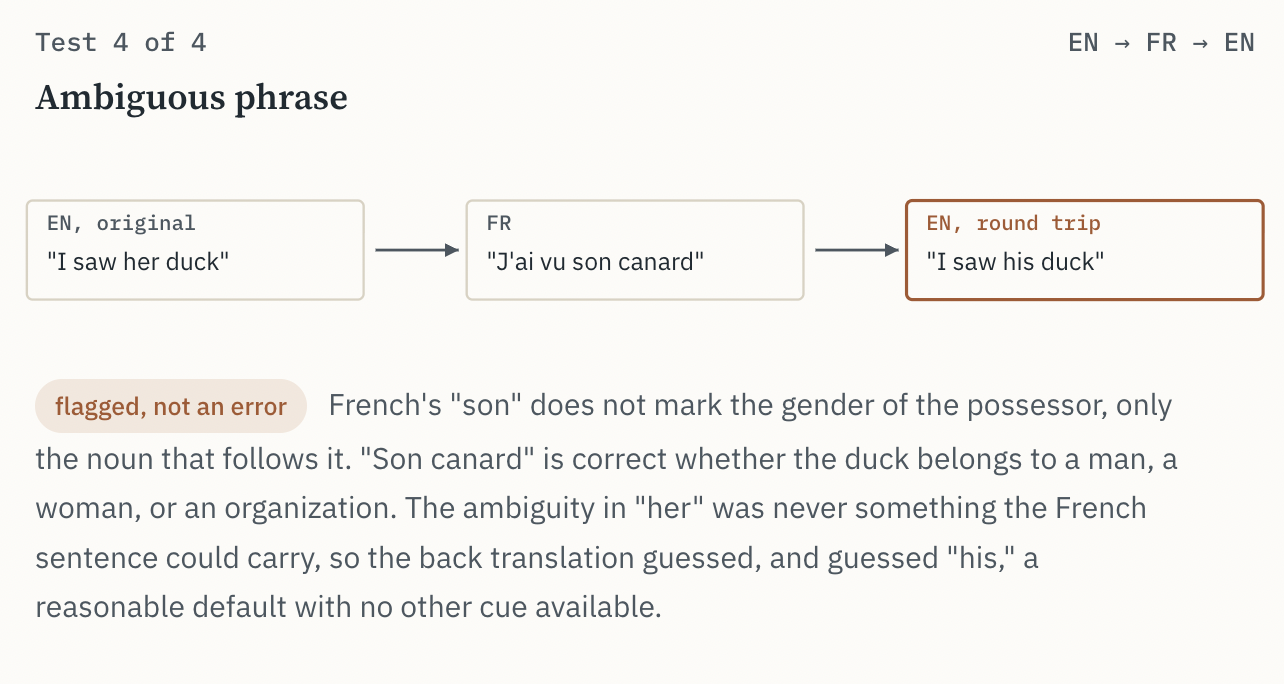
This is a structural gap in the intermediate language, not a translation error, and it is exactly the kind of result that makes back translation look broken when the translation behaved correctly at every step.
What is the back translation method actually measuring?
Across these four tests, a changed result had two entirely different causes, and only one of them is a genuine quality signal.
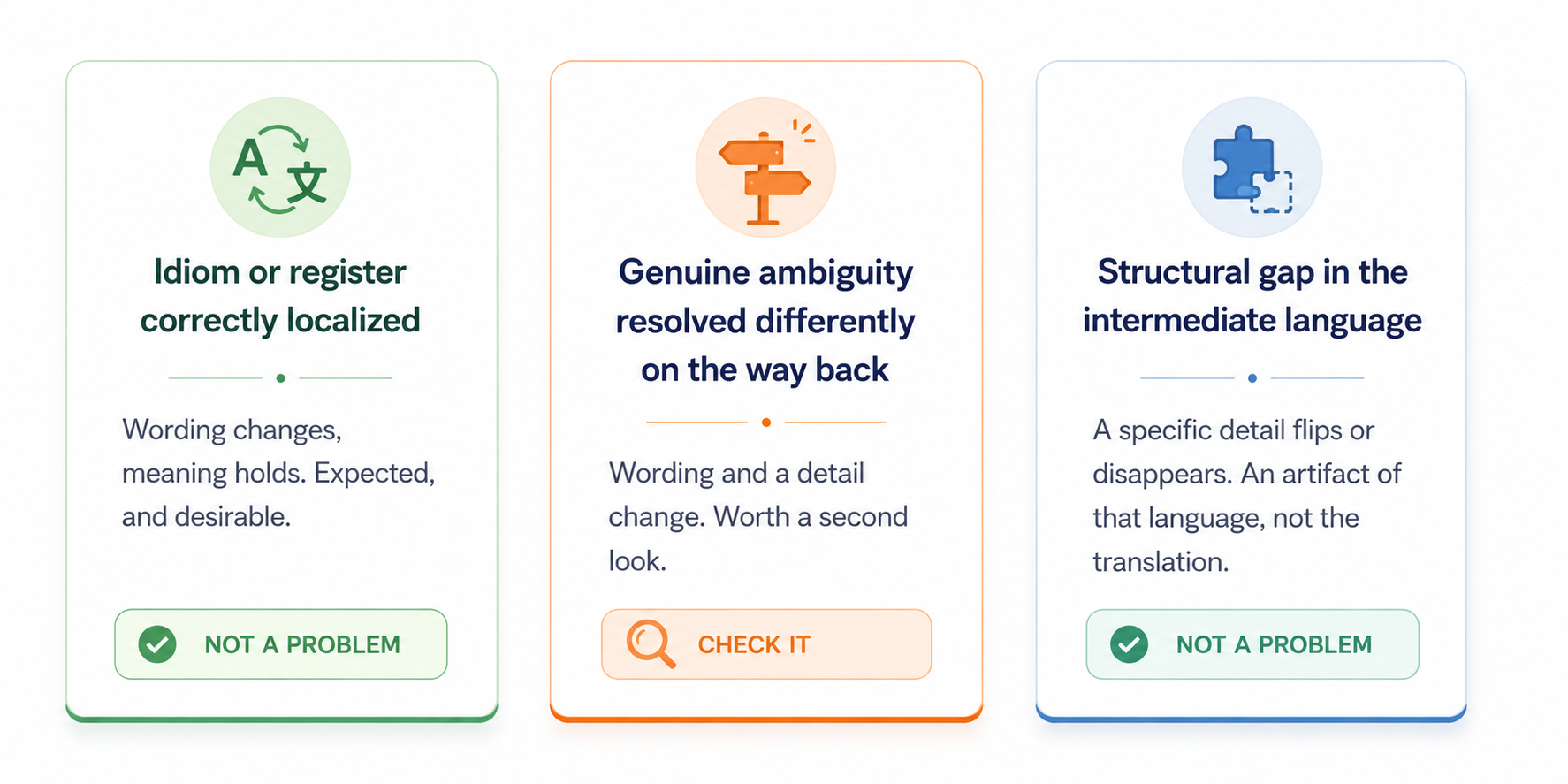
Back translation, on its own, cannot distinguish between these. It flags a mismatch and leaves the interpretation to whoever is reading it.
Back translation doesn't test whether a translation is correct. It tests whether the exact wording survives a full loop through a language that might not have a slot for everything the original sentence assumed. Those are two different questions, and treating them as the same one is where most back-translation false alarms start.
Is back translation worth doing?
Yes, with a narrower job description than most people give it. It is a fast, no-bilingual-reviewer-required way to flag a sentence worth a second look. It is not a pass or fail verdict on translation quality, and treating it that way produces the exact false alarm the duck example shows.
MachineTranslation.com's own agreement-rate research applies the same logic. A result with 90% or higher model agreement and zero or one disputed term is a reasonable candidate to ship as-is for most business content. Agreement in the mid-80s, or several disputed terms on one sentence, signals content worth routing to a human reviewer, especially for contracts or product instructions.
Back translation works the same way. A changed result is not an automatic red flag. It is a prompt to check what changed and why, the same way a mid-80s agreement score is a prompt to look closer, not a verdict on its own.
What happens when you stack more languages
As a stress test, we ran a casual phrase through four consecutive translations instead of two: English to Hebrew, Hebrew to Tagalog, Tagalog to French, French back to English.
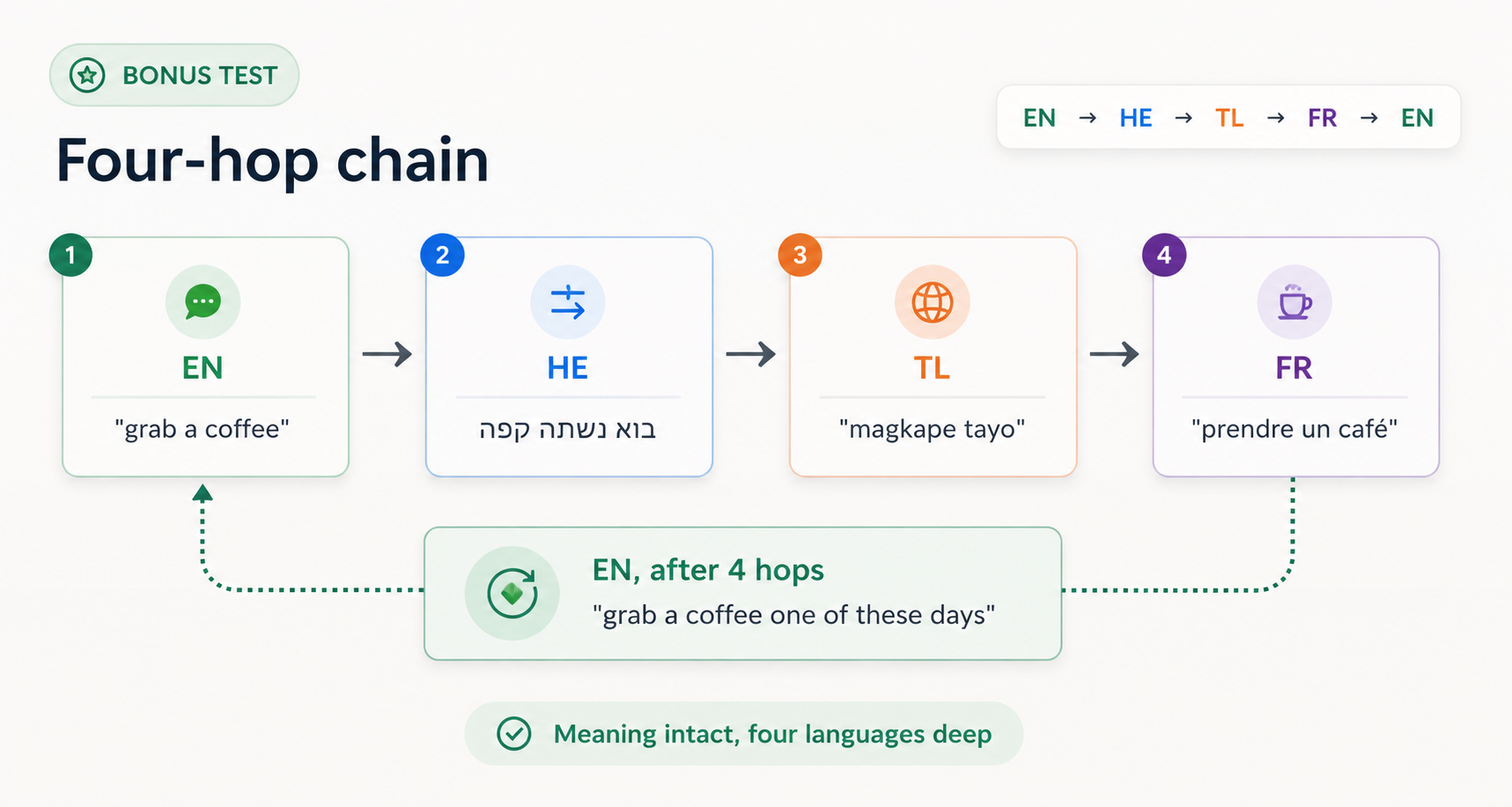
"Let's grab a coffee sometime" came back as "Let's go grab a coffee one of these days." Four translations deep, through three unrelated language families, the meaning held completely. The wording drifted slightly, the way it would if two English speakers paraphrased the same sentence to each other, but nothing was lost that would matter to the person reading it.
This is not proof that longer chains are always safe. It is evidence that a common, low-ambiguity phrase can survive a long chain intact when each individual hop is high-confidence. Reliability tracks the phrase's ambiguity and the languages involved, not the hop count on its own.
How to actually use back translation as a check
- Run it on content where a subtle error would actually cost something (contracts, medical instructions, safety warnings), not on everything by default.
- When the result changes, find out what changed before assuming something broke. A shifted idiom or register is usually fine. A shifted fact, number, or name is not.
- Check whether the intermediate language has a structural reason for the change. Gendered or ungendered pronouns, formality markers, and tense systems that do not map cleanly are common causes.
- Treat a clean round trip as reassuring, not conclusive. A bad forward translation can still produce a clean-looking back translation if the two errors happen to cancel out.
- For anything regulated or high-stakes, pair back translation with a human reviewer rather than using it as the only check. It is a triage tool, not a substitute for one.
FAQ
1. What is a back translation?
A back translation is the second step in a two-step check: a source text is translated into another language, and that result is translated back into the original language for comparison.
2. What is forward and back translation?
Forward translation is the first step, translating from the source language into a target language. Back translation is the second step, translating that result back into the original source language.
3. What is the purpose of back translation?
Back translation lets someone who doesn't speak the target language get a rough sense of whether meaning was preserved, by comparing the original text to a version that has been translated out and back, without needing a bilingual reviewer.
4. Does a failed back translation mean the translation is wrong?
Not necessarily. It can also mean an idiom was correctly localized, or that the intermediate language lacks a grammatical feature the original sentence relied on, such as gendered pronouns. Both produce a changed back translation without any actual translation error.
5. Is back translation the same as round-trip translation?
Yes. Round-trip translation, back-and-forth translation, and back translation all refer to the same two-step process.

By Rachelle Garcia
Connect on LinkedInRachelle leads product and AI at Tomedes, where she runs the experiments that turn internal data into better translation experiences. She writes about what actually happens when you build AI products such as MachineTranslation.com — the numbers, the surprises, and the parts that don't go to plan.
Share:


