August 13, 2026
How often do AI models actually agree on a translation?
A single AI model doesn't flag its own uncertainty. It picks a wording for an ambiguous sentence and states it with exactly the same confidence it would use for a straightforward one. There's no signal built into that output, no way to tell, sentence by sentence, when the model was on solid ground and when it was making a judgment call you never saw.
That's the actual gap worth closing. Not whether AI translation is accurate in general, but whether anyone using it can tell when a specific translation deserves a second look. Agreement between independent models is one way to surface that. When several models land on the same wording, that's a real signal. When they don't, that's a signal too, and it's the one single-model tools can't give you at all.
Why we measure agreement, not just accuracy
MachineTranslation.com's SMART mechanism runs every translation through several independent AI models at once. A panel we call "Your translation, wrapped" reports what share of those models landed on identical wording, which specific terms they split on, and how long consensus took to settle. Agreement becomes something you can see, translation by translation, instead of disappearing behind one confident-sounding result.
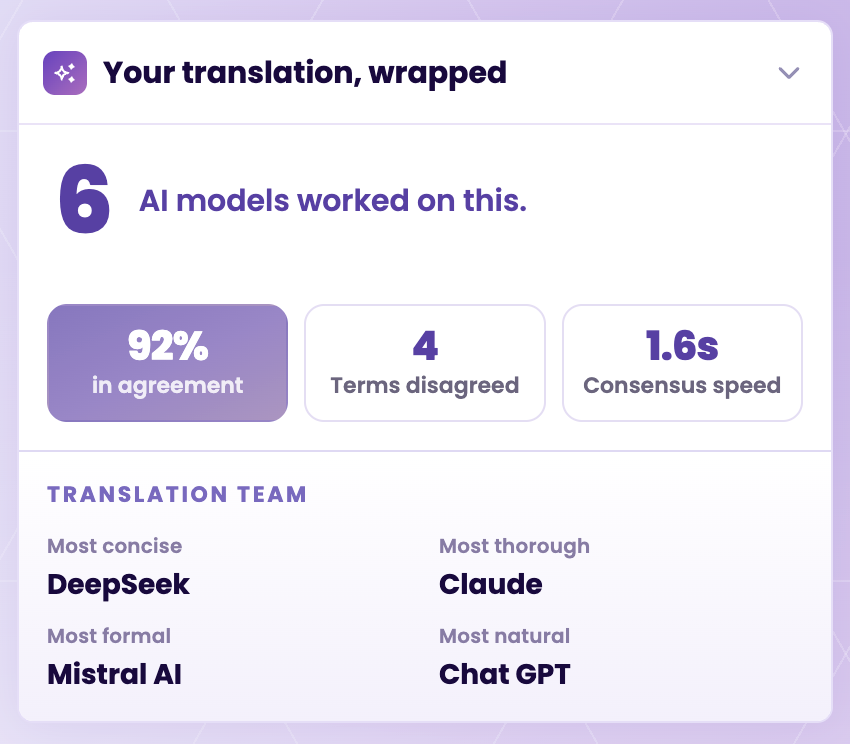
A single translation from the platform. Six models, 92% agreement, four disputed terms, consensus in 1.6 seconds.
The same panel breaks down which model did what on that sentence. DeepSeek's version ran most concise. Claude's was most thorough. Mistral AI leaned most formal. Chat GPT read most naturally.
One sentence isn't a pattern. The real question is whether 92% holds up across a language pair, or whether it moves depending on which languages are involved. Here's how we measured it:
01. Every qualifying translation runs through multiple independent models rather than one.
02. The share of models that land on identical wording becomes the agreement rate for that translation.
03. Any term where models split gets flagged individually, not averaged away.
04. The time to consensus is timestamped, so speed and agreement are tracked separately.
We pulled agreement rates across the ten highest-volume language pairs on the platform over a recent three-month window to see whether that 92% held up as a pattern or was closer to an outlier.
What agreement looks like across ten language pairs
None of the ten pairs reached full agreement, and none dropped low enough to call it a coin flip. Agreement ran from the mid-80s to the low 90s, a real spread but not a dramatic one. The ranking itself is the more useful part: it doesn't track language "difficulty" the way you'd expect going in.
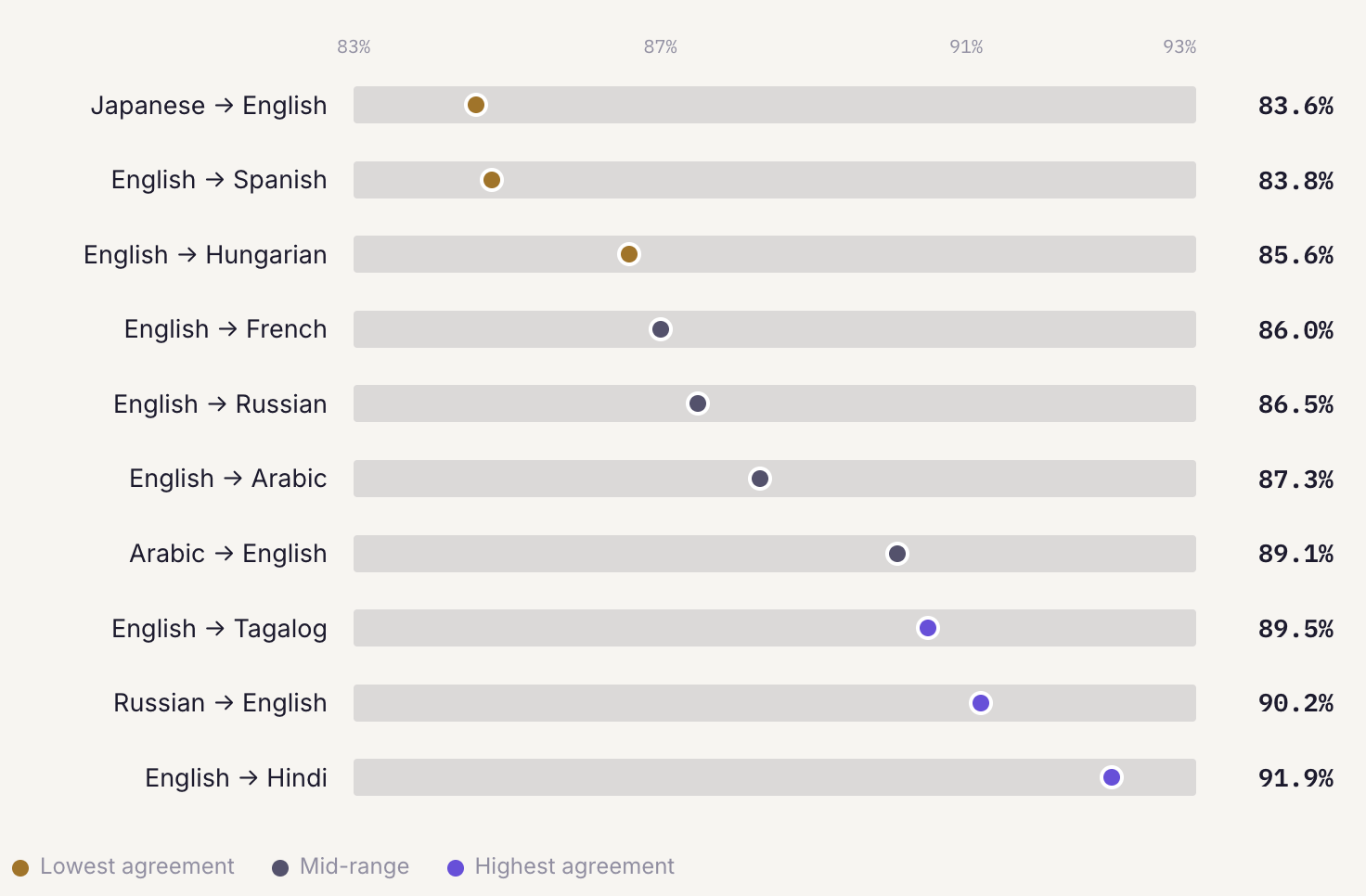
Average model agreement by language pair, ten highest-volume pairs, three-month window
Language pair | Average agreement |
|---|---|
83.6% | |
83.8% | |
85.6% | |
86.0% | |
86.5% | |
87.3% | |
89.1% | |
89.5% | |
90.2% | |
91.9% |
This sample sits alongside two related tests we've run on the same question from different angles: which AI translator is most accurate across eight test sentences, and a closer look at Spanish specifically across formality, gender agreement, and legal terminology. Those pieces test individual sentences by hand. This one measures agreement across live, real-world translation volume instead, which is why the ranking below doesn't always match what a hand-picked test sentence would suggest.
Why Spanish and Japanese sit low, and Hindi doesn't
English-to-Spanish is one of the most heavily resourced language pairs in AI translation, and it still landed near the bottom of this set. English-to-Hindi and English-to-Tagalog, pairs with less training data behind them, landed higher. If agreement tracked resourcing the way accuracy usually does, that ranking would run the other way.
What it tracks instead is ambiguity in the source text. Japanese sentence structure allows context-dependent omissions, subject, tense, and formality level, that English requires a translator to fill in explicitly. Different models resolve that gap differently, and none of them are necessarily wrong, they're making distinct, individually defensible choices about information the sentence didn't specify. Spanish carries its own version of the same problem: enough regional variation and gendered phrasing choices that models trained on different data mixes land on different answers to the same sentence.
A single model would still hand you a confident answer in either case. It wouldn't tell you that "at-will employment" has no single accepted rendering in German, or that a Spanish sentence about a "directora" could reasonably go two ways depending on regional convention. That's the specific thing a lower agreement rate is catching: not a wrong answer, but a sentence that had more than one right one, and a model that doesn't know to mention it.
This isn't unique to MachineTranslation.com's own testing. The most recent WMT shared task findings, which evaluate leading translation systems using professional human annotators, reported that even top-performing models still make meaningfully different translation choices from each other. Disagreement on ambiguous, context-heavy text is a known property of how these systems currently work, not a gap specific to any one platform.
Why disagreement isn't a defect
A single model that mistranslates a legal term or flattens an idiom doesn't announce it. There's no signal, especially if you don't read the target language yourself, that a judgment call was made at all. That's the failure mode consensus is built to catch: not by making every sentence agree, but by making the disagreement visible when it happens.
I made this same point while looking at a French title translation that split four models against one, and it holds here just as well:
"This is where multi-engine translation stops being a convenience feature and becomes a quality mechanism. When four models agree and one diverges on a title translation, that divergence is information."
Methodology note
SMART, MachineTranslation.com's own consensus mechanism, is left out of every agreement comparison in this piece. SMART is built from the outputs of the other models, so including it in its own comparison would be circular, it would win by construction, not by merit. Excluding it keeps the measurement honest: this is about how much the underlying models agree with each other, not about how well SMART summarizes them.
What this changes about how you use AI translation
The same mechanism behind these agreement rates is what SMART's consensus approach runs on every translation: rather than picking one model and hoping it's right, it runs the field and flags exactly where they split, so a reviewer knows where to look twice. Your Translation, Wrapped is the visible layer of that same mechanism, shown on every qualifying translation rather than buried in a report.
In practice, that gives you a second data point most AI translation tools don't expose at all: not just the output, but how contested it was. A translation that settles at 90%+ agreement, with zero or one disputed term, is a reasonable candidate to ship as-is for most business content. One that lands in the mid-80s, or flags several disputed terms on a single sentence, is telling you something specific: the source text carried more than one defensible reading, and a model picked one without announcing it. That's exactly the case worth routing to a human reviewer before it goes out, particularly for contracts, product instructions, or anything where the wrong reading of an ambiguous clause has a real cost.
Treat the agreement rate as a triage signal, not a verdict. It doesn't tell you which model was right. It tells you whether there was a decision made behind the translation you're looking at, and how contested that decision was. For anyone translating content where a missed ambiguity actually costs something, that's a more useful starting point than assuming all AI translation tools are roughly interchangeable. Some pairs settle fast. Others don't. Knowing which kind you're working with tells you where to look before you publish, not after.
Frequently asked questions
1. Do all AI translation tools give the same result?
No. Across ten major language pairs on MachineTranslation.com, AI model agreement ranged from roughly 84% to 92%. Models regularly reach the same answer on straightforward text, but they diverge on ambiguous phrasing, regional variation, or grammar that depends on context the source sentence never specified.
2. Which AI model is most accurate for translation?
There isn't one model that wins every category or every language pair. Accuracy depends heavily on the specific language pair and content type, which is why comparing models on a single test sentence, rather than across many real translations, can be misleading.
3. How reliable is AI for translation?
Reliability improves when multiple models are compared instead of relying on one. A consensus approach that shows exactly where models disagree lets a human reviewer catch ambiguity that a single-model translation would otherwise resolve silently, with no signal that a judgment call was made.
4. What can AI not translate accurately?
Idioms, culturally specific phrasing, and sentences carrying grammatical ambiguity, like context-dependent pronouns, gender, or formality level, are where AI models are most likely to disagree with each other. Those are also the cases most likely to need a human reviewer before publishing.
5. Why do some language pairs show more AI disagreement than others?
Disagreement tracks ambiguity in the source language more closely than it tracks how well-resourced that language is. Highly resourced pairs like English to Spanish can still show meaningful model disagreement when the source sentence is grammatically ambiguous, regardless of how much training data exists.

By Rachelle Garcia
Connect on LinkedInRachelle leads product and AI at Tomedes, where she runs the experiments that turn internal data into better translation experiences. She writes about what actually happens when you build AI products such as MachineTranslation.com — the numbers, the surprises, and the parts that don't go to plan.
Share:


