September 14, 2026
Can nonprofits trust AI translation for outreach materials?
Yes, but reliability depends heavily on the language pair, not the type of organization asking. For widely spoken languages, single-model AI translation is often reliable enough on its own. For the languages many outreach and educational organizations actually need, materials for a new congregation, a training manual for a literacy program, a consent form for a research study, translated into a language few AI models are trained well on, the picture changes: individual models disagree with each other far more often, and that disagreement is exactly what a consensus approach is built to catch.
Most conversations about AI translation quality center on the languages every model is heavily trained on: English, Spanish, French, Mandarin. That's not where outreach and educational translation usually happens. Nonprofits, schools, and community organizations are often translating into languages that see a fraction of the training data those major pairs get, and that gap shows up in a specific, measurable way: models stop agreeing with each other. We test this directly, because it's the exact condition MachineTranslation.com's consensus mechanism exists to handle.
Why is outreach translation different from everyday translation?
Outreach and educational material has a specific property that changes what "good enough" means: the reader usually can't independently verify it. A business translating a contract can hire a bilingual lawyer to check the result. A congregation translating devotional material for new members, a research team translating a consent form for study participants, or a literacy program translating a training manual into a language spoken by a small, often underserved population frequently has no equivalent safety net, sometimes not even a second fluent speaker to consult. Whatever the translation says is likely to be taken at face value, whether or not it's right.
That combination, low training-data availability and low ability for the reader to catch an error, is exactly the failure mode we built MachineTranslation.com's consensus mechanism to address.
Why is reliability harder to guarantee in low-resource languages?
AI translation models learn from the volume of paired text available in a language combination. English-Spanish has enormous quantities of professionally translated and informally paired text behind it. Languages like Twi, Tamazight, and Inuktitut have a fraction of that. The model isn't guessing randomly, but it's working from thinner evidence, and that shows up as measurably higher disagreement between independent models translating the same sentence.
This shows up clearly in our own testing on low-resource language pairs. English-to-Twi, Arabic-to-Tamazight, and English-to-Inuktitut together draw more than 60,000 sessions a month on MachineTranslation.com, with unusually low bounce rates for how underserved these pairs are. That's a real, sustained pattern of use, not a rare edge case someone stumbled into once.
Underserved language pairs, real and sustained use
(Platform data · language-pair engagement vs. site average)
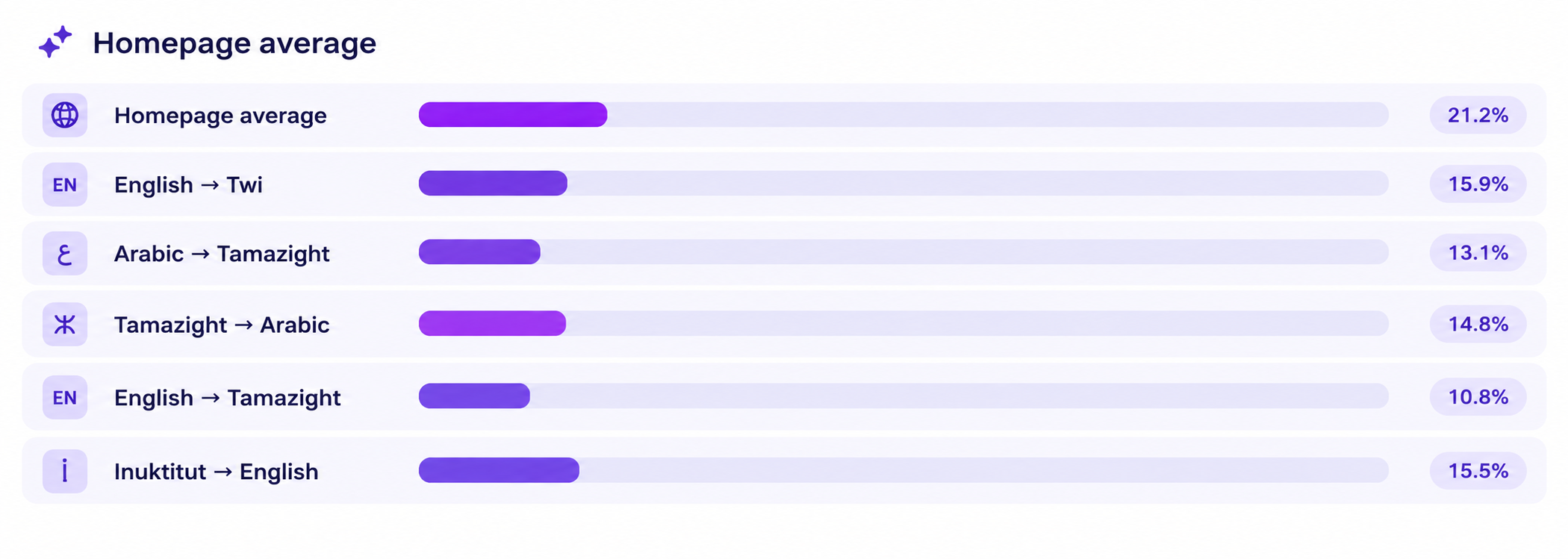
Bounce rate by page, lower is better. Every one of these underserved pairs bounces less than the site's own homepage average, a sign of real, purposeful use rather than casual browsing.
What does model disagreement actually look like?
Three examples from our own model testing show what disagreement actually looks like in practice.
| Test | What happened |
|---|---|
| English → Twi ("Please send me the document before Friday") | Six AI models produced six different Twi translations of a seven-word sentence. Total fragmentation, not minor stylistic variation. |
| Arabic → Tamazight ("Can I help you?") | Mistral AI returned the English source untranslated, a hard failure, while other models produced varying Tamazight outputs. |
| English → Inuktitut ("The weather is very cold today") | Models split on writing system without being asked. One returned proper Canadian syllabics; others defaulted to Latin romanization, and one produced repetitive, hallucinated characters within its syllabics output. |
None of these are edge cases you'd only find by hunting for them. They surfaced in direct, single-sentence tests. A single model asked to translate any one of these would have returned a confident, fluent-sounding answer, with nothing in the output itself signaling that five other models would have disagreed with it.
How does consensus help close the gap?
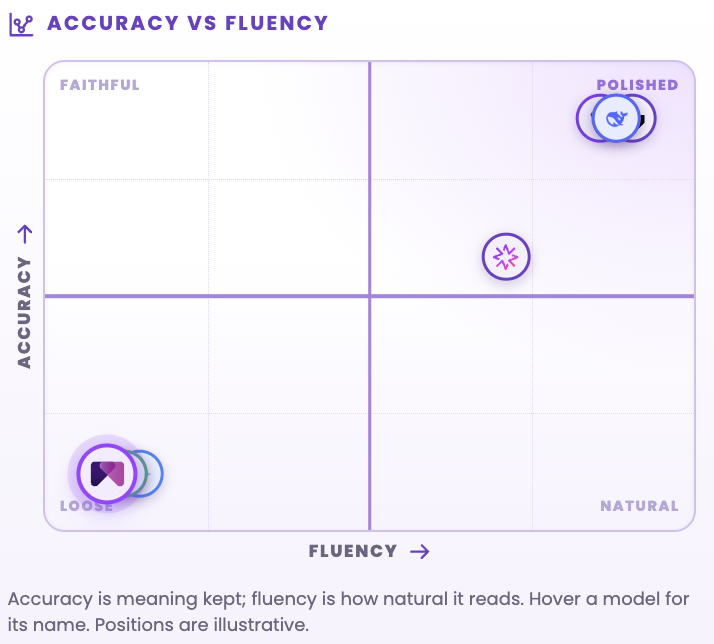
Individual models perform worse on low-resource languages, and the harder problem is that a reader has no way to detect when they do. Running independent models and requiring them to agree before producing a result is the closest thing to built-in verification available at scale for languages where a second fluent reviewer is hard to find. When the models agree, that agreement is a real reliability signal. When they don't, the disagreement itself becomes the useful information, it tells you exactly where to slow down.
Across 10,000 translated segments spanning 10 language pairs, tested for terminology accuracy, semantic fidelity, and negation handling against human-verified references, this approach reduced translation error risk by 90% compared to a single-model baseline. That figure varies by content type. Standard business content typically scores 9.4 to 9.5 on our internal quality scale. Idiomatic and figurative language scores 9.0 to 9.2. Content where models structurally disagree, minority languages and culturally specific text among them, scores 7.3 to 8.0, lower, and exactly the band where a second opinion matters most.

Where a single model's fluency is least trustworthy
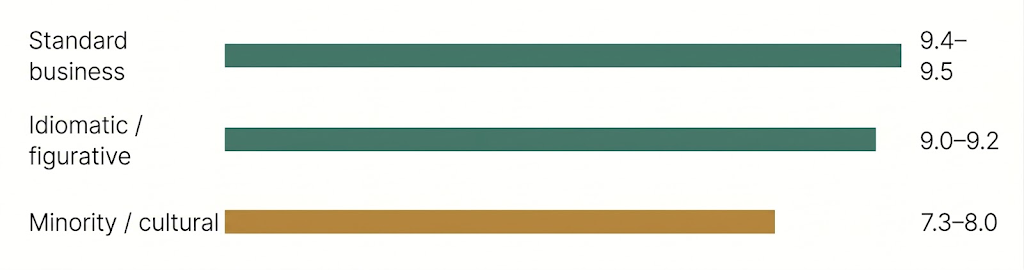
Internal quality scale, 0–10. Minority-language and culturally specific content scores lowest, and is exactly the content where a single model's confident, fluent-sounding output is least worth trusting on its own.
Consensus has a real limit. If every model in the pool shares the same training gap, agreement between them doesn't guarantee the answer is correct, it just means they made the same mistake together. Consensus tells you where the evidence is strong and where it's thin. A bilingual reviewer is still necessary for anything safety-critical or legally significant, and that was the design intent from the start, not an afterthought.
What should you check before trusting a translation?
A short, practical list, whether you're translating a training manual, a devotional handout, or a research consent form:
01. Check whether the language pair is well-resourced.
Major world languages carry far more training data than regional or minority languages. Treat the latter as higher-risk by default.
A single fluent-sounding output gives you nothing to check against. A tool that shows whether independent models agree gives you a real signal.
When models split on a term or a phrase, that's exactly the spot to slow down and get a second, human opinion.
Consensus narrows the risk. It doesn't eliminate the need for a bilingual reviewer on content where an error has real consequences.
None of this makes low-resource translation risk-free. What it does is make the risk visible instead of silent, and visible risk is something an organization can actually plan around.
Frequently asked questions
1. What kinds of materials do nonprofits, religious organizations, and educators most often need translated?
Three categories show up constantly: training and curriculum materials for literacy or education programs, devotional and religious teaching content for outreach into new communities, and consent forms or study materials for academic research. All three commonly need translation into underserved languages where AI models have the least training data to work from.
2. Can AI translation be trusted for nonprofit and educational outreach materials?
It depends on the language pair more than the content type. For widely spoken languages, single-model AI translation is often reliable. For low-resource languages, individual models disagree far more often, and multi-model consensus, checking whether independent models agree before trusting an output, closes most of that gap.
3. Why do AI models disagree more on low-resource languages?
AI translation models learn primarily from the volume of text available in a language pair online. Widely spoken pairs like English-Spanish have enormous training data behind them. Languages like Twi, Tamazight, or Inuktitut have far less, so models are working from thinner evidence, and that shows up as disagreement between models on the same sentence.
4. Does multi-model consensus fully replace human review for outreach translation?
No. Consensus tells you where models agree and where they don't, which is valuable information, but that agreement doesn't guarantee correctness if every model in the pool shares the same blind spot. For high-stakes outreach material, pairing consensus with human review remains the more reliable approach.
5. How can an organization check whether an AI translation is reliable before publishing it?
Check whether the language pair is well-resourced or not, look for a tool that shows model agreement rather than a single silent output, treat low agreement as a flag for human review, and never publish safety-critical or legally significant translated material without a bilingual reviewer regardless of how confident the output sounds.

By Rachelle Garcia
Connect on LinkedInRachelle leads product and AI at Tomedes, where she runs the experiments that turn internal data into better translation experiences. She writes about what actually happens when you build AI products such as MachineTranslation.com — the numbers, the surprises, and the parts that don't go to plan.
Share:


