October 28, 2026
Can AI translate Spanish accounting terms correctly?
In a set of accounts, a loss that will happen and a loss that may happen are different things. The first goes on the books. The second goes in a note. A translation that swaps one for the other can pass a quick read, because the Spanish is fluent and the sentence still sounds like accounting. A fluent sentence with one wrong word is the failure I worry about most when AI translates finance text.
So can AI translate Spanish accounting terms correctly? It depends on the direction. In MachineTranslation.com tests on October 27, 2026, the AI consensus returned the correct English term for all seven Spanish accounting sentences we ran. Going into Spanish, it wrote "eventualmente" and "pérdida eventual" for "eventually" and "the eventual loss", and those Spanish words mean something else.
As of October 2026, MachineTranslation.com's connector for AI assistants returns the translation that 22 AI models agree on and is available to paid subscribers. We ran 12 short sentences through it. Each sentence holds a term that looks like an English word or has more than one valid Spanish form. Every sentence was a single run, apart from one we repeated, so I read the results as a pattern worth checking. They do not give an accuracy rate.
Key takeaways
- In MachineTranslation.com tests on October 27, 2026, the AI consensus returned the correct English term for 7 of 7 Spanish accounting sentences, including contingent liabilities, net present value, bonds, fiscal year, debit and credit, occasional income and depreciation of property, plant and equipment.
- Going into Spanish, the consensus wrote "eventualmente" for "eventually" and "pérdida eventual" for "the eventual loss", and the Real Academia Española says eventual describes something that may or may not happen.
- A second run gave the same wrong answer, while "eventually" in a loan sentence came out right, so the error depends on the sentence around the word.
- A peer-reviewed study in the journal Terminology found about 25% terminological variation in the Spanish texts of international accounting standards and considerable inconsistency in Spanish companies' financial statements.
- Before Spanish accounts go to an auditor, check the direction of translation, search for look-alike words such as eventual, agree one glossary, keep the document whole, and have a qualified person review the text.
Can AI translate Spanish accounting terms into English correctly?
Yes, in MachineTranslation.com tests on October 27, 2026, the AI consensus returned the correct English term for all seven Spanish accounting sentences, including the textbook traps pasivos eventuales, valor actual neto and obligaciones. Each sentence was one run of a short text.
Each of these Spanish terms looks like an English word and means something else. According to the Real Academia Española's usage guide, eventual means something that may or may not happen, so pasivos eventuales are contingent liabilities. Under IAS 37, a contingent liability is not recognised in the statement of financial position and is disclosed in the notes unless the chance of an outflow is remote.
In valor actual neto, actual means current, so the term is net present value. In the Real Academia's legal dictionary, obligaciones are negotiable securities that a company issues to recognise a debt to the holder, with periodic interest and repayment of the principal, so they are bonds. Ejercicio is the financial year, and cargo and abono are the debit and credit sides of an entry.
Single runs through MachineTranslation.com's connector on October 27, 2026
| Spanish term | English look-alike | Correct English term | What the AI consensus returned |
|---|---|---|---|
| pasivos eventuales | eventual liabilities | contingent liabilities | Contingent liabilities |
| valor actual neto | actual net value | net present value | net present value |
| obligaciones | obligations | bonds | bonds |
| ejercicio | exercise | financial year | fiscal year |
| cargo y abono | charge and payment | debit and credit | debit and credit (and accounts payable for proveedores) |
| ingresos eventuales | eventual income | occasional income | occasional income |
| amortización del inmovilizado material | amortization of tangible fixed assets | depreciation of property, plant and equipment | Depreciation of property, plant, and equipment |
I would not call seven out of seven a solved problem. These terms appear in every Spanish accounting glossary, and I expect AI models have seen them many times. A test of 12 sentences cannot tell us about the rarer terms.
Which Spanish accounting terms did AI get wrong going into Spanish?
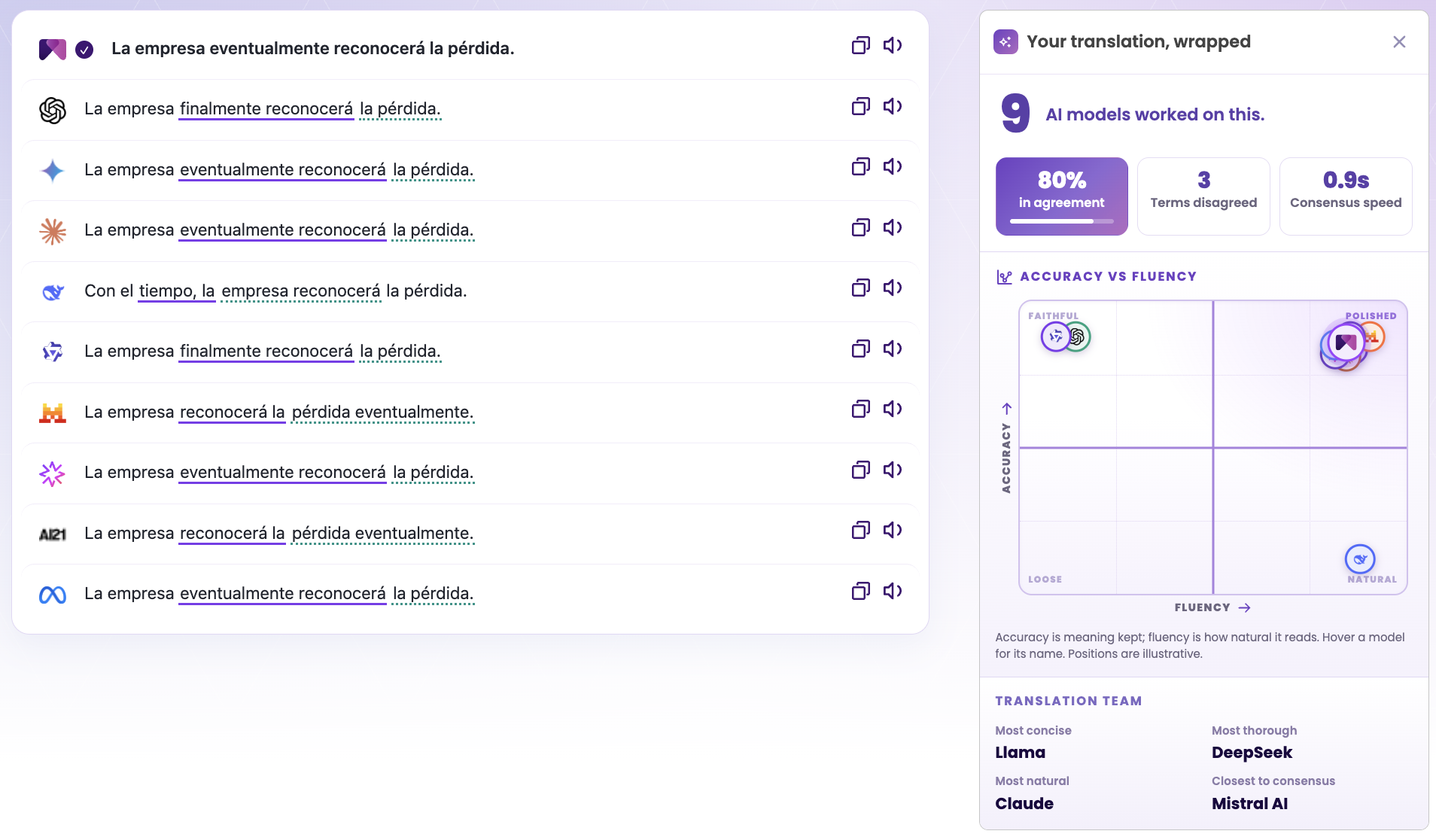
The terms that went wrong were "eventually" and "eventual". The consensus wrote "eventualmente reconocerá la pérdida" for "will eventually recognize the loss", twice, and "la pérdida eventual" for "the eventual loss". It translated "eventually" correctly in a loan sentence, with "con el tiempo".
Single runs through MachineTranslation.com's connector on October 27, 2026
| English sentence | AI consensus in Spanish | Verdict |
|---|---|---|
| Actual results were lower than the budget. | Los resultados reales fueron inferiores al presupuesto. | Correct, reales and not actuales |
| The loan will eventually be repaid in full. | El préstamo se pagará íntegramente con el tiempo. | Correct |
| The company will eventually recognize the loss. | La empresa eventualmente reconocerá la pérdida. (same result on a second run) | Wrong, says the loss may happen |
| The eventual loss was recorded in the next quarter. | La pérdida eventual se registró en el próximo trimestre. | Wrong, says a possible loss |
| Depreciation is calculated on a straight-line basis. | La depreciación se calcula por el método lineal. | Acceptable, depends on the country |
The Real Academia Española's usage guide says eventualmente properly means in a circumstantial way, and that it must not be used to mean finally. It calls that use a calque of the English eventually. The same guide defines eventual as something that can happen or not, so "la pérdida eventual se registró" describes a loss that may or may not occur as if it had been recorded.
That changes what the sentence says about the books. Under IAS 37, an outflow that is not probable is treated as a contingent liability and goes in the notes, unless the chance is remote. "Eventualmente reconocerá la pérdida" can read as a loss that may be recognised, while the English says it will be. I think a fluent sentence like this is easy to pass in a review because nothing in it looks wrong.
My read is that the English word causes the problem. "Eventually" is common, and its Spanish look-alike is a real Spanish word, so the output stays fluent. I cannot test that from the consensus alone, because the connector does not show what each AI model wrote.
Results of the 12 test sentences by direction, single runs on October 27, 2026.
Why can a fluent translation pass a quality check?
A quality score rates fluency and overall meaning, and a sentence like "eventualmente reconocerá la pérdida" is fluent Spanish. In one MachineTranslation.com test, five AI models all scored 9.4 on a financial sentence and still used three different French terms for "recognition".
A limitation-of-liability clause translated into Spanish showed the same pattern. Four AI models scored between 9.4 and 9.5, yet two wrote "que surjan de" and two wrote "derivados de", a difference in scope that a fluency score does not see, as covered in our test of business documents.
Agreement has the same blind spot. In an earlier test, a Spanish financial notice scored 9.5 out of 10 across 8 AI models with 100% agreement and no disputed terms, as covered in our Spanish test of a financial report notice. That is a good result for plain financial text. It cannot show whether every AI model shared one false friend.
I think identical scores and full agreement are signals to read the terms, because neither one checks them.
How much do Spanish accounting terms vary?
A peer-reviewed study in the journal Terminology (volume 28, 2022) found about 25% terminological variation in the Spanish texts of international accounting standards. It also found considerable inconsistency in Spanish companies' financial statements, in both the Spanish originals and their English translations.
Our depreciation sentence shows what that looks like. The consensus wrote "depreciación". Qonto's Spanish glossary says some countries use depreciación as an exact equivalent of amortización for tangible fixed assets, while Spanish accounting and tax rules use amortización. Both terms are correct somewhere, so the right one depends on who reads the accounts.
Length makes this harder. MachineTranslation.com internal research found 28% more terminology inconsistency in documents processed in fragments than in documents processed whole, and a set of accounts repeats the same terms across many sections.
I would choose one glossary per country and per standard before any translation starts, and check the output against it. MachineTranslation.com lets you apply glossaries, as its English to Spanish (Spain) translator page describes.
What should you check before sending Spanish accounts to an auditor?
Before Spanish accounts go to an auditor, lender or regulator, check five things: the direction of translation, look-alike words such as eventual and eventualmente, the glossary, whether the document stayed whole, and whether a qualified person reviewed it. Each check comes from a gap in the tests above.
- Check the direction. In these tests, Spanish to English came back clean and English to Spanish did not, so give English to Spanish text a closer read.
- Search the Spanish output for look-alikes. Look for eventual and eventualmente first. They are real Spanish words, so a spell check passes them, and the Real Academia Española gives them meanings the English words do not have.
- Agree one glossary. Pick the term your reader's country uses, such as amortización or depreciación, and check the output against it. MachineTranslation.com lets you apply glossaries.
- Keep the document whole. MachineTranslation.com internal research found 28% more terminology inconsistency in documents processed in fragments than in documents processed whole.
- Have a qualified person review it. Human Verification sends a MachineTranslation.com translation to a certified professional, and I would use it, or an accountant who reads Spanish, for anything an auditor, lender or regulator will read.
My take is that the useful question is which words to check. The AI consensus handled the vocabulary found in every glossary, and it missed a common English word with a Spanish look-alike. For accounts that go to an auditor, I would pair the AI translation with a reviewer who knows the standard.
Frequently asked questions
1. What are false friends in Spanish accounting?
False friends are words that look alike in English and Spanish and mean different things. In accounting, eventual (possible), obligaciones (bonds) and ejercicio (financial year) are examples. The Real Academia Española defines eventual as something that may or may not happen, so a pasivo eventual is a contingent liability.
2. Does 'eventualmente' mean 'eventually' in Spanish?
No, eventualmente means in an occasional or circumstantial way, and the Real Academia Española says it must not be used for finally, calling that use a calque of English. In MachineTranslation.com's October 27, 2026 test, the AI consensus still used it for 'will eventually recognize the loss'. Con el tiempo works instead.
3. Is amortización the same as depreciation?
It depends on the country, because Spanish accounting and tax rules use amortización for fixed assets, while some countries use depreciación as an exact equivalent for tangible assets, according to Qonto's glossary. English splits the two terms by asset type. Pick the term your reader's country uses and keep it consistent.
4. Can I use AI to translate financial statements?
It depends on the use, because in MachineTranslation.com's October 2026 tests the AI consensus handled common accounting terms into English but missed 'eventually' into Spanish. A Spanish financial notice scored 9.5 across 8 AI models with 100% agreement. For statements that go to auditors, lenders or regulators, add a qualified human reviewer.

By Rachelle Garcia
Connect on LinkedInRachelle leads product and AI at Tomedes, where she runs the experiments that turn internal data into better translation experiences. She writes about what actually happens when you build AI products such as MachineTranslation.com — the numbers, the surprises, and the parts that don't go to plan.
Share:


