September 1, 2026
MachineTranslation.com adds Gemma and Mercury to its AI model lineup
Most translation tools ask you to trust one model's output and move on. There's no way to know, from the outside, whether that model handled your sentence well or quietly got something wrong (a dropped negation, a mistranslated idiom, a formality mismatch nobody flagged). MachineTranslation.com was built around a different idea: run the same text through several independent AI models at once, and surface the translation those models most agree on. When models converge, that agreement is the signal. When they don't, that's exactly the part worth a second look.
That lineup just grew by two. Google's Gemma and Inception Labs' Mercury are now live on the platform, running alongside the existing pool of AI models on every translation.
What's new
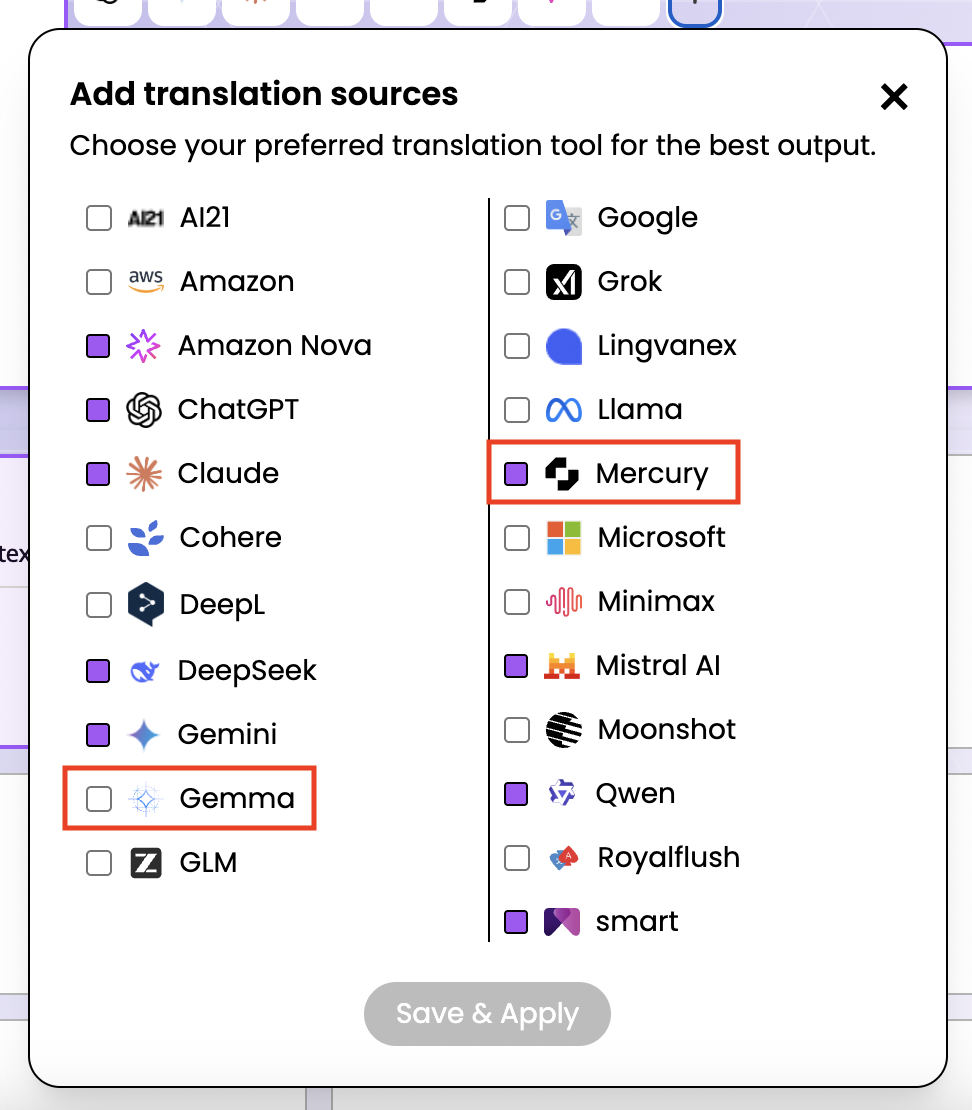
MachineTranslation.com now includes Gemma, Google DeepMind's open-weight model family, and Mercury, Inception Labs' diffusion-based language model, in the pool of AI models it runs on every translation. Both are live now (no waitlist, no separate plan required).
| Gemma | Mercury | |
|---|---|---|
| Built by | Google DeepMind | Inception Labs |
| Generation method | Autoregressive - one token at a time, same as every other model already in the pool | Diffusion - generates blocks of text in parallel |
| Release status | Open-weight, Apache 2.0 license | Commercial API |
| Known strength | Reasoning and multilingual coverage across 140+ languages | Inference speed, built for latency-sensitive use cases |
| What it adds to the pool | Another independent read from a different training lineage | The first structurally different generation process in the lineup |
A full head-to-head test of the two on real translation tasks is coming as a separate article once there's enough volume to report real numbers rather than early guesses.
Gemma joins the lineup
Gemma is Google DeepMind's open-weight family of models, built on the same underlying research as Gemini but released for anyone to run and inspect. The latest generation is trained for strong reasoning and broad multilingual coverage, which is exactly the kind of profile that earns a model a seat in a cross-checking process built to catch what a single model misses. Adding it gives every translation one more independent read from a model with a genuinely different training lineage than the ones already in the mix.
Mercury brings a different kind of model entirely
Every model MachineTranslation.com has run until now generates text the same fundamental way: one token at a time, each one waiting on the last. Mercury doesn't. It's built on diffusion, the same family of techniques that generates images by refining noise into a picture, applied here to language instead. Mercury generates blocks of a translation in parallel rather than word by word, which is what gives diffusion models their speed advantage over standard architectures.
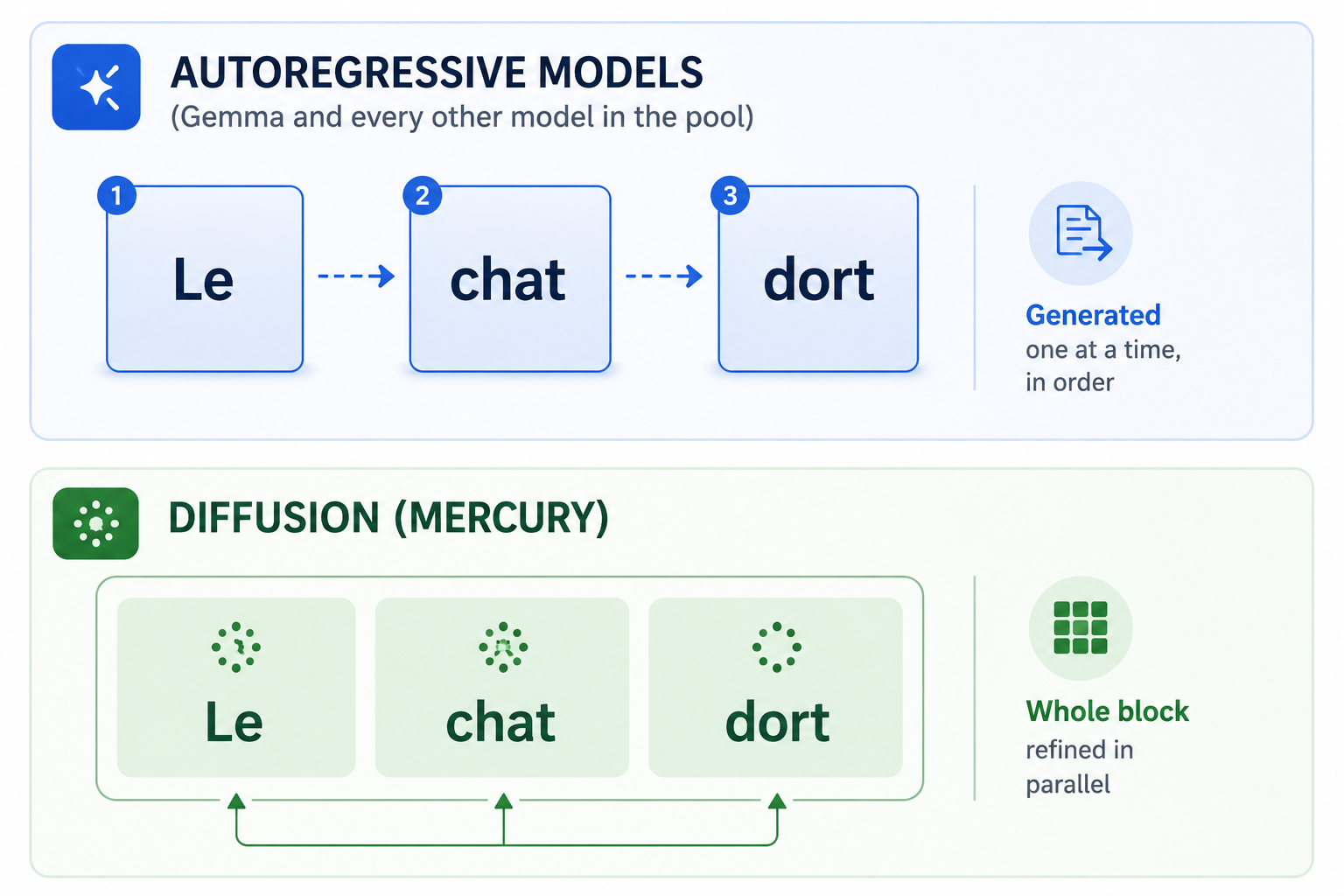
Autoregressive models like Gemma generate one token at a time, each one dependent on the last. Mercury's diffusion architecture refines an entire block of tokens together, which is the source of its speed advantage.
Mercury doesn't just add another vote to the pool. It adds a different way of arriving at an answer, built on assumptions about language generation that none of the other models share.
Why adding different kinds of models matters more than adding more of the same
Two similar models are more likely to make the same mistake in the same place, for the same reason (shared training data, shared blind spots, shared assumptions about how a sentence should read). A cross-checking process only catches what a single model misses if the models in it actually disagree sometimes, and for that, they need to differ in more than just their name.
Internal testing has consistently shown the value of that kind of independence: individual top-tier models carry a hallucination rate of 10 to 18 percent on translation tasks, and cross-checking a translation against multiple independent models brings that down to roughly 1 to 2 percent (a 90 percent reduction in critical errors compared to relying on any single model). That gap exists because most models get the same easy sentences right and disagree on exactly the same handful of hard ones such as idioms, formal register, legal or medical terminology with no safe default. A model built on a fundamentally different architecture is more likely to land somewhere different on those hard cases, which shows up directly in the per-translation agreement breakdown every MachineTranslation.com result already displays.
What this changes for you
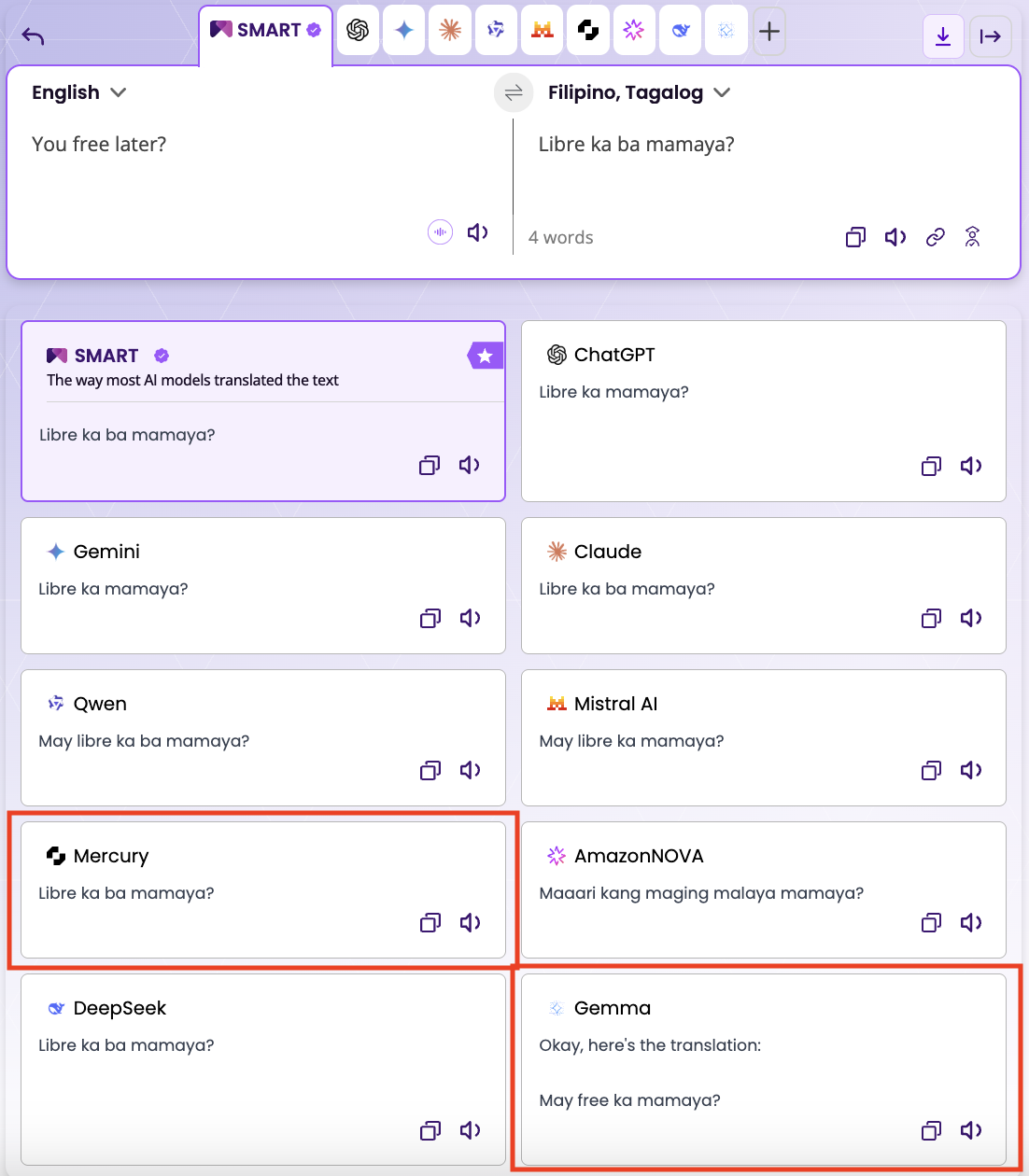
The workflow stays the same: enter or upload text, choose a language pair, get a single translation back. Underneath that result, two more models are now part of what gets checked before you see an answer, one of them running on an entirely different generation process than anything in the pool before it.
Every translation now gets checked against a wider range of ways a model can arrive at an answer than it did last week (including, for the first time, one that doesn't generate a single word at a time).
Frequently asked questions
1. What are Gemma and Mercury?
Gemma is Google DeepMind's open-weight model family, now on its fourth generation, built for strong reasoning and broad multilingual coverage. Mercury, from Inception Labs, is a diffusion-based language model (a different architecture from every other model on the platform, generating text in parallel instead of one word at a time).
2. Does adding Mercury change how MachineTranslation.com works?
The core process stays the same: every translation still runs through multiple independent AI models at once, and the platform surfaces the version those models most agree on. Mercury adds a structurally different model to that pool, which is what changes (not the process itself).
3. Is Mercury faster than the other models on MachineTranslation.com?
Mercury is built around a diffusion architecture designed for speed, generating blocks of text in parallel rather than one token at a time. That said, MachineTranslation.com runs every model in parallel regardless, so the platform's overall response time is set by the slowest model in the pool, not by any single model's raw speed.
4. Why does MachineTranslation.com add new AI models regularly?
Each model added is another independent perspective checking the same translation. Internal testing shows this cross-checking process cuts critical translation errors by up to 90% compared to relying on any single model, largely by catching the errors a single fluent-sounding model would otherwise produce with no warning sign attached.

By Rachelle Garcia
Connect on LinkedInRachelle leads product and AI at Tomedes, where she runs the experiments that turn internal data into better translation experiences. She writes about what actually happens when you build AI products such as MachineTranslation.com — the numbers, the surprises, and the parts that don't go to plan.
Share:


