September 30, 2026
How to translate a legal document with AI
Yes, AI can translate a legal document well, and it's also true that a single model can hand you a fluent, confident translation with a clause quietly wrong inside it. Nothing in that output tells you which one you got, no warning, no flagged term, just a document that reads perfectly well either way. The fix isn't a better model. It's checking the same document against several independent models at once and looking at exactly where they agree and where they don't.
Most people asking this aren't looking for a theory lesson. They have a contract in front of them, in a language they don't fully control, and they need to understand it now, not after a certified translation comes back in three or four business days at a few hundred dollars. The first instinct for a lot of people is to paste the whole thing into Google Translate and hope for the best. They can't check the result themselves either way, because if they read the target language fluently they wouldn't need a translator in the first place. And underneath all of that sits the question nobody says out loud: is this actually safe to rely on for something with legal weight, or will they find out the hard way that it wasn't?
That's the real problem this piece answers, not just whether AI can translate legal language, but whether you can tell when it's gotten something right and when you need to slow down. We ran this directly on a real contract rather than describing it in the abstract, and the results are below.
Why do AI models disagree on legal language?
More businesses than ever are handling contracts across languages without ever calling a translation provider first. That's not a criticism, it's just where the industry has landed. AI made translation fast enough that a document goes from "we need this in another language" to "here's the translation" in under a minute, and that speed has quietly become the default for real business decisions, including ones with real legal weight behind them. The part that hasn't caught up is the habit of checking the result the way you'd check anything else this important.
Legal writing is built out of terms of art, conditional clauses, and carefully defined roles, "the Contractor," "the Client," "shall," "provided that." Every one of those carries specific weight, and every AI model makes its own judgment call about how to render that weight in another language. A business email tolerates a little drift in phrasing. A contract doesn't, because the words are the agreement.
That's the whole reason a business signs something it didn't write in the first place: it's trusting the translation to carry the same obligations across the language gap. Trusting a single model to get that right, silently, with no way to check, is a real risk most people don't think about until something goes wrong.
How to translate a legal document with AI, step by step
Here's the actual process, walked through on a real six-clause service agreement, confidentiality, indemnification, termination, governing law, and the rest. Nothing about the document was chosen to make a point. It's the kind of short, ordinary agreement a small business signs with a contractor or vendor, not a stress-test built to trip up a model on purpose.
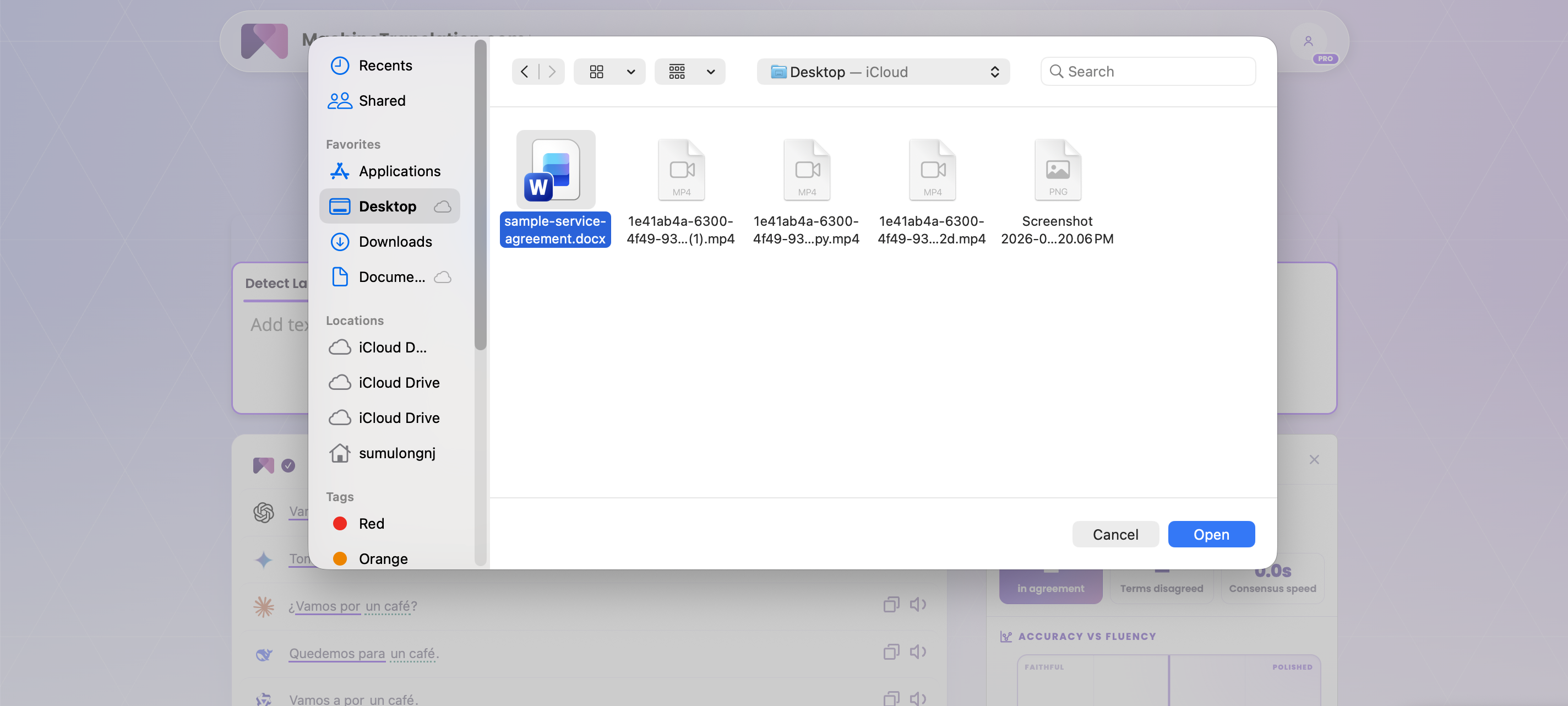
Step 1: Upload the document instead of retyping it
Drop the file in directly, PDF or Word, rather than copying and pasting the text. Uploading keeps the document's structure, numbering, and formatting intact, which matters for a contract, where clause numbers and section breaks carry meaning.
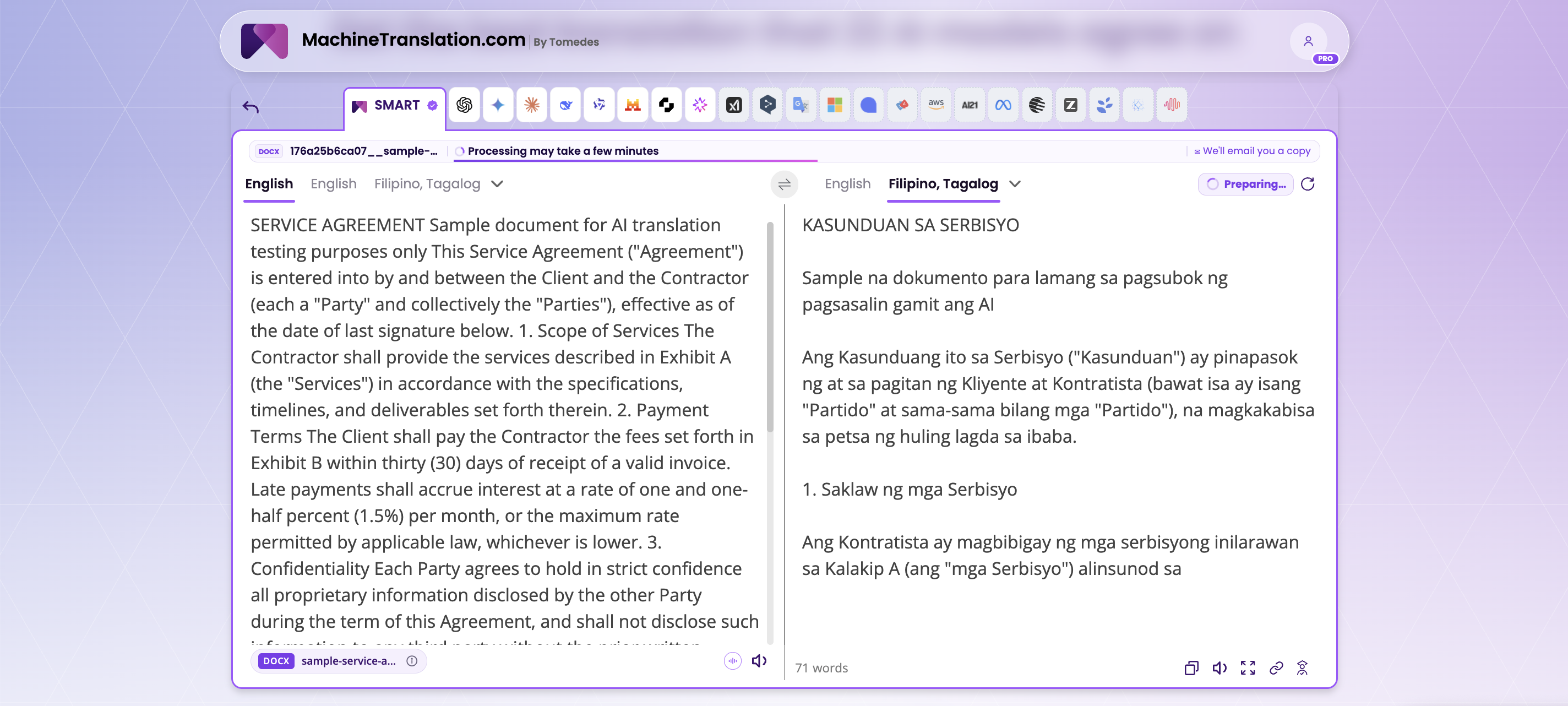
Step 2: Choose the language pair and let the AI models run
Set the source and target language, and let the platform run the document through the top AI models rather than a single model. On this test, that meant 8 independent AI models translating the same document at once, English to Filipino (Tagalog), finishing in 6.0 seconds.
Step 3: Look at the agreement and disagreement numbers before reading a word
Before you read the translation itself, check what the models actually agreed on. That single number tells you more about how much to trust the result than reading it for fluency ever will.
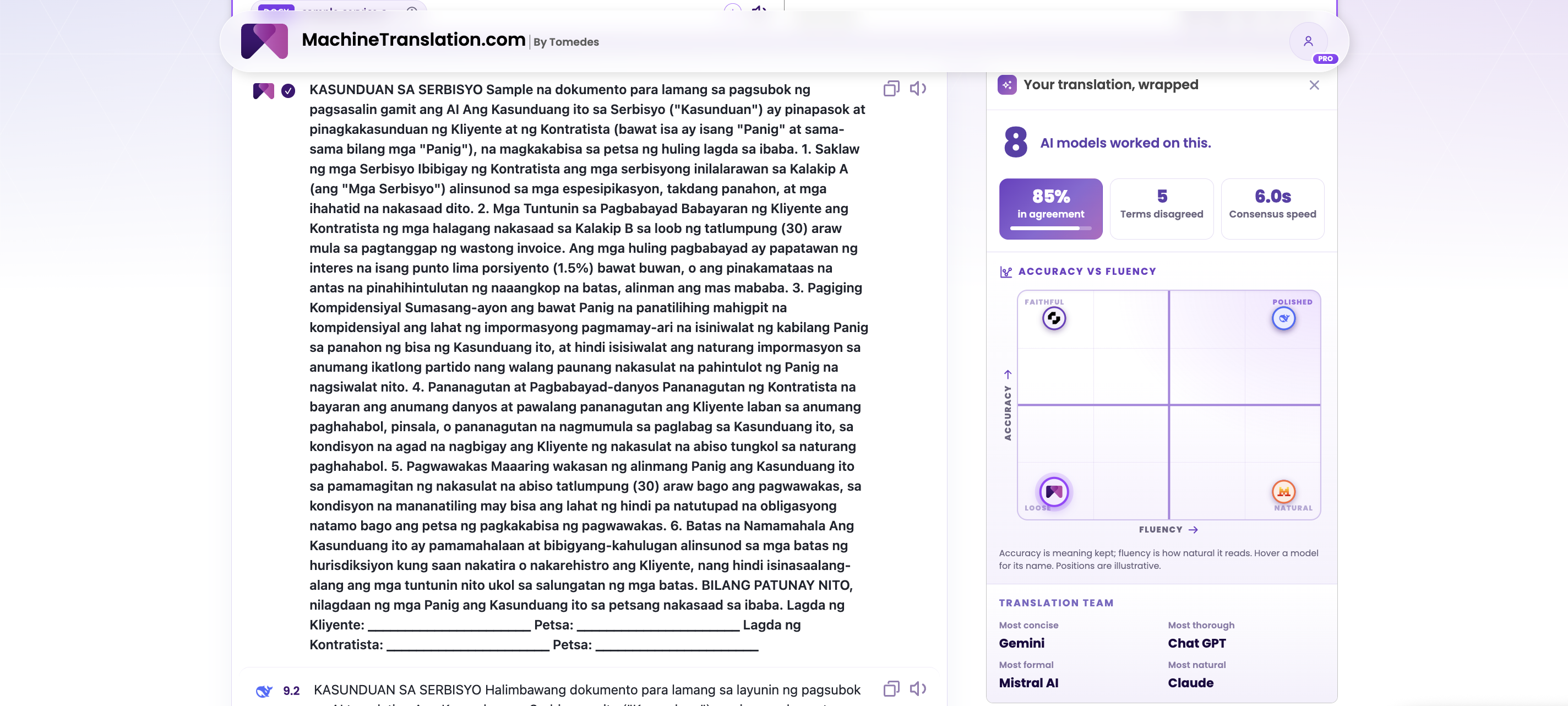
That's a meaningfully different question than "did the translation work." Of course it worked, every one of the eight models produced fluent, readable output. The question that actually matters for a contract is narrower: which five words, out of several hundred, needed a second look before anyone treated the document as final. A single-model tool can't answer that question at all, because it never shows you what the other seven attempts looked like. It just gives you one answer and lets you assume it's the only one there was.
Eighty-five percent agreement across eight models on a real contract is a strong result. The five specific terms where they didn't agree are the ones that matter. Those are exactly the spots, a term, a phrase, a register choice, where a single model's fluent output could quietly be the wrong one, and where we'd tell you to slow down and get a second opinion before you sign anything.
Step 4: Check the specific terms where models disagreed
Go straight to the flagged terms rather than re-reading the whole document. One disagreement is worth showing directly rather than just describing. Every model was asked to translate the same title, "Service Agreement." Two different, real translations came back for that one phrase alone:
| Filipino (Tagalog) rendering | What it actually implies |
|---|---|
| Kasunduan sa Serbisyo | "Agreement for service", the more literal, contract-style rendering |
| Kasunduang Paglilingkod | "Agreement of service-rendering", a valid but noticeably different formal register |
Neither is wrong exactly, but they're not interchangeable in a formal document, and a single model would have handed you one of them with total confidence, no indication that another equally fluent option existed. Agreement across independent models is a real signal, and so is disagreement, just a different one.
If your document is going into a specific language, it's worth checking whether we've already tested that pair directly. Legal and technical translation into German carries its own term-level precision problems, covered in how to translate legal and technical documents from English to German, and French business translation carries its own liability considerations, covered in how to translate business documents from English to French. This piece is the general version of the same argument those make for a specific language pair.
Step 5: Decide whether the document needs to be certified
This is the step people skip, and it's the one that actually matters most. A consensus translation is a genuinely useful working document. Whether it's enough on its own depends entirely on what you're about to do with it, which the next section walks through directly.
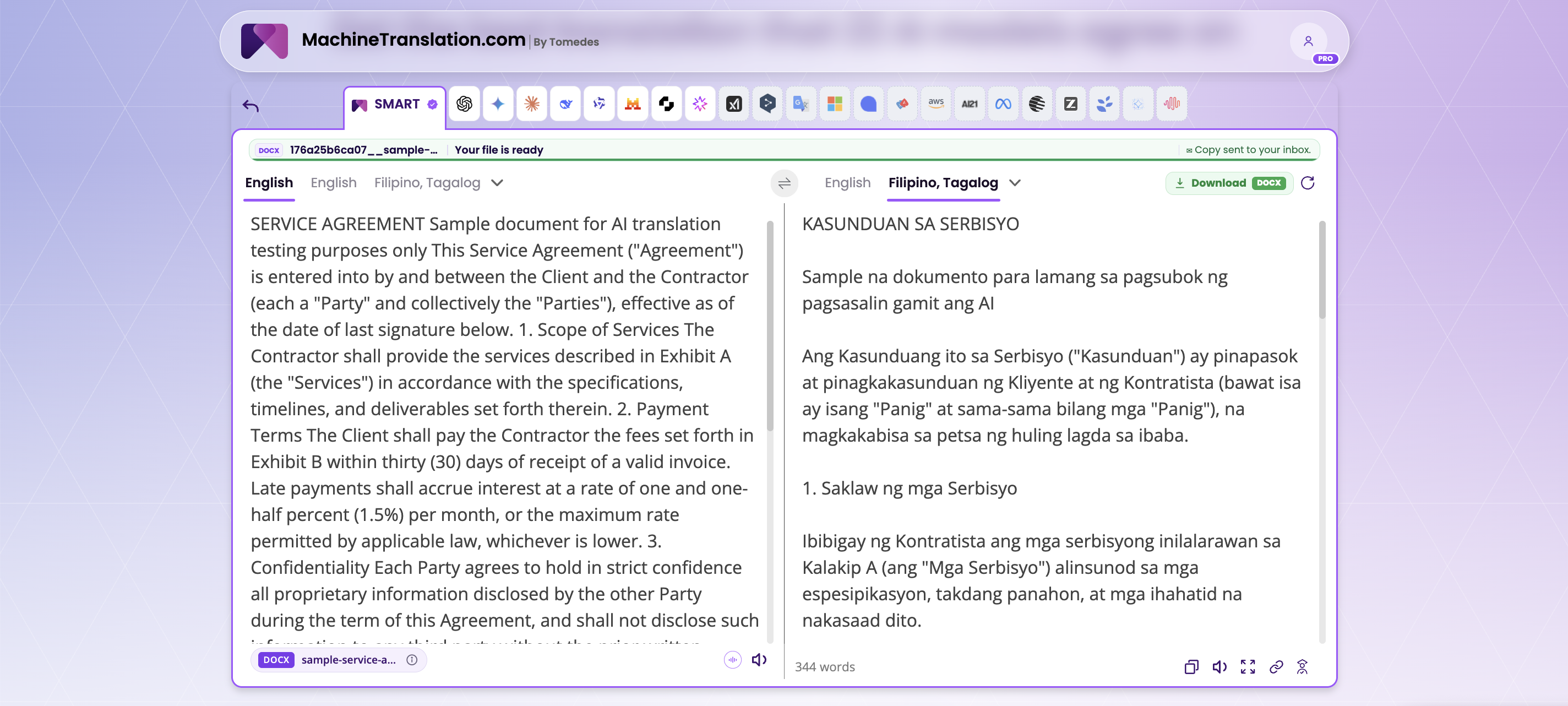
Step 6: Download the result
Once you've reviewed the flagged terms, download the translated document in its original format, ready to send, file, or hand to a reviewer.
When do you need a human, not just AI?
I want to be direct about this, because the honest answer matters more than the sales pitch. Agreement across multiple AI models is a genuine improvement over trusting one model's fluent guess, and it's the right tool for understanding a document, negotiating one, or getting a fast, reliable working draft. It is not a certified translation, and it doesn't carry legal certification.
For anything that has to be filed, submitted to a court, or formally certified, the right tool is human verification layered on top of the AI result, or, for documents that require certified legal translation specifically, certified legal translation service. The line between these two is worth drawing plainly rather than leaving fuzzy: AI agreement is the right tool for understanding what a contract says and catching where a single model might have gotten something wrong. Certification is the right tool for proving, to a court or an institution, that the translation is accurate and complete. Those are different jobs, and a business is better served knowing which one it actually needs before it picks a tool, not after.
We built MachineTranslation.com around the same belief: know exactly what a translation can and can't promise you, and never let a confident-sounding result substitute for that honesty.
Frequently asked questions
1. Can AI actually translate a legal document correctly?
Often, yes, but a single AI model can produce a fluent, confident translation of a legal document and still get a clause wrong, with nothing in the output signaling it happened. Running the same document through multiple independent models and comparing the results catches most of what a single model would miss.
2. Why do AI models disagree on legal language?
Legal writing relies on precise terms of art, conditional clauses, and defined roles that carry specific legal weight. Different models trained on different data make different judgment calls on exactly these points, which is why the same contract can come back with real wording differences depending on which model translated it.
3. What should you check before signing an AI-translated legal document?
Check whether the translation came from a single model or a consensus of several, look specifically at defined terms and conditional clauses rather than reading for general fluency, treat any disagreement between models as a flag rather than noise, and have a bilingual reviewer confirm anything you're about to sign, file, or submit.
4. Does AI consensus replace a certified human legal translation?
No. Consensus tells you where multiple AI models agree and where they don't, which meaningfully reduces risk, but it isn't a certified translation and doesn't carry legal certification on its own. For documents that need to be filed, submitted to a court, or formally certified, a certified human legal translation is still the right choice.
5. How reliable is AI translation for contracts specifically?
In a direct test translating a real sample contract across multiple clauses (confidentiality, indemnification, termination, governing law), eight independent AI models reached 85% agreement, with 5 specific terms where they diverged. Those 5 terms are exactly the spots worth a second look before relying on the result.
6. How much does it cost to translate a legal document with AI?
AI consensus translation itself is fast and low-cost compared to certified human translation, which is priced per document and typically takes a few business days to turn around. The cost difference is exactly why it matters to know which one you actually need: a working translation to understand a contract, or a certified one to file or submit it.
7. Can I certify my own translation?
Generally, no. Most courts, government agencies, and institutions that require a certified translation don't accept self-certification, even if you're fluent in both languages, because certification exists to establish independence and accountability. A certified human translator or translation agency is the right path when certification is actually required.

By Ofer Tirosh
Connect on LinkedInOfer founded Tomedes in 2007 and now leads the company's push to combine two decades of human translation expertise with AI. He writes about where the language industry is actually heading and the shifts nobody's ready for, the bets that paid off, and the ones that didn't.
Share:


