September 30, 2026
Three ways AI translators handle gender in French
Translate "the manager" into Spanish and the decision is simple: gender lives on a single letter at the end of the word. Translate the same sentence into French, and there isn't one decision to make. There are several, and the correct one changes depending on which job title, which word ending, and in some cases which side of the Atlantic the reader is on.
We tested this directly. In a 10-model comparison covering both languages, English-to-Spanish gender agreement came back identical across every model, in both test rounds. The equivalent English-to-French test didn't. Models split into three distinct, individually valid strategies for feminizing "manager", not because any of them were wrong, but because French genuinely offers more than one correct answer.
French gender agreement isn't one rule. It's several.
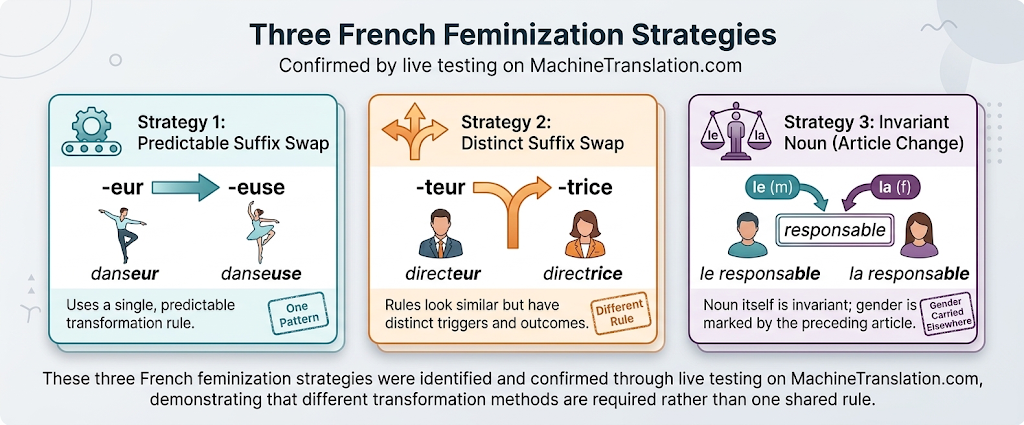
Spanish mostly resolves gender with a suffix swap: -o to -a. French has at least three different mechanisms in active use, and a model has to know which one applies to which specific word.
01. Suffix change, -eur to -euse
Common for words like danseur/danseuse (dancer) or vendeur/vendeuse (salesperson). Straightforward once the pattern is known.
02. Suffix change, -teur to -trice
Used for words like directeur/directrice (director) or acteur/actrice (actor). A different transformation from strategy one, applied to words that look similar on the surface.
03. No change to the noun, only the article and agreement
Epicene nouns like responsable, journaliste, or artiste stay identical for both genders. Gender shows up only on le/la and on any agreeing adjective, which is easy to miss if a model treats the noun in isolation.
A fourth complication sits on top of these three: some professions have a settled feminine form and others are still contested, which is a French-language debate, not an AI limitation, but one that any translation system still has to navigate.
What we found testing it live
We ran a series of ordinary business sentences through MachineTranslation.com's English-to-French translator to see how the third strategy, the invariable noun, actually plays out.
Live test 1, English source
"The manager approved the new marketing budget after reviewing it with the finance team."
Le responsable a approuvé le nouveau budget marketing après l'avoir examiné avec l'équipe financière.
Live test 2, English source
"She is the manager of the regional sales team and reports directly to the CEO."
Elle est la responsable de l'équipe de vente régionale et rend compte directement au PDG.
Live test 3, English source
"Our new manager, Sophie, starts on Monday and will oversee the entire logistics team."
Notre nouvelle responsable, Sophie, commence lundi et supervisera toute l'équipe logistique.
With no gender signal in the English source, the consensus defaulted to "le responsable." Once the pronoun made the gender explicit, it correctly switched to "la responsable," and correctly carried that agreement onto the adjective "nouvelle" in the third example. That's strategy three working as intended: the noun itself never changes, so the model has to track gender through the surrounding words instead, which is a different and in some ways harder task than a simple suffix swap.
Live test 4, English source
"The author will speak at the conference about her latest novel."
L'auteure parlera à la conférence de son dernier roman.
This one lands on genuinely contested ground. "Auteure" is a real, widely used feminine form, popularized through Quebec's language authority and now common in mainland French as well. "Autrice," an older form that fell out of common use, has seen a strong revival through feminist linguistic advocacy in recent years. Neither is incorrect, and the Académie française's own 2019 report on feminizing job titles acknowledged multiple coexisting forms rather than settling on one, which is exactly why this is also where regional spelling conventions diverge between France and Quebec. A translation tool picking one is making a real editorial choice, whether or not it's framed that way.
Spanish gender agreement is a solved problem because there's a single right answer to converge on. French doesn't give us that luxury for every word. When three different endings need three different transformations, and some of those transformations are themselves still being debated in French, consensus isn't finding the one correct translation. It's picking the most defensible answer among several that are all legitimately correct, and being consistent about which one it picks.
Why this is harder to get consistently right than it looks
A model that gets "directeur to directrice" right has learned nothing that helps it with "auteur to auteure," because the transformation itself is different. And a model that correctly leaves "responsable" unchanged has to actively resist applying a suffix rule it just used correctly one sentence earlier. Comparing outputs across more models doesn't erase this difficulty, but it does catch the cases where one model applies the wrong strategy to the wrong word, which is a different and more useful signal than any single engine can produce on its own.
Gender agreement isn't the only place French and English handle gender differently, either. A back-translation test we ran separately found the reverse problem: French's third-person possessive pronouns don't mark gender the way English "his" and "her" do, so information can go missing in one direction that had to be invented in the other. That's a distinct issue from feminization, but it's part of the same underlying pattern: gender information doesn't map cleanly between the two languages in either direction, which is also a substantially broader problem than any single language pair, as earlier research on gender bias in machine translation has found.
Frequently asked questions
1. How do you translate masculine and feminine words into French?
It depends on how the word ends. Words ending in -eur often become -euse (danseur to danseuse), words ending in -teur often become -trice (directeur to directrice), and some nouns like responsable or journaliste don't change form at all, only the article does (le/la). There isn't one universal rule, which is part of why AI translation has to handle each word differently rather than applying a single pattern.
2. How do I get AI to translate a document accurately?
For most content, comparing the output of multiple AI models rather than relying on one catches errors a single engine would miss. Gender agreement in French job titles is one specific example: a document with several different professions in it may need three different feminization rules applied correctly within the same page, which is exactly where single-engine tools are more likely to slip.
3. Can AI translate French to English accurately?
Yes, for most general content. Gender-related nuance is one of the harder edge cases, since French grammatical gender doesn't map directly onto English, and information can be lost or added in either direction depending on the sentence.

By Rachelle Garcia
Connect on LinkedInRachelle leads product and AI at Tomedes, where she runs the experiments that turn internal data into better translation experiences. She writes about what actually happens when you build AI products such as MachineTranslation.com — the numbers, the surprises, and the parts that don't go to plan.
Share:


