October 15, 2026
Does AI translate German differently for Austria and Switzerland?
If you are launching a German-language site or price list, the first localization decision is easy to make by accident, because it is a single choice in a language list. Pick "German" and the same translated page goes to Berlin, Vienna and Zurich. The Austrian reader then sees Januar where local documents write Jänner, and the Swiss reader sees Straße in a country where the letter ß is not used.
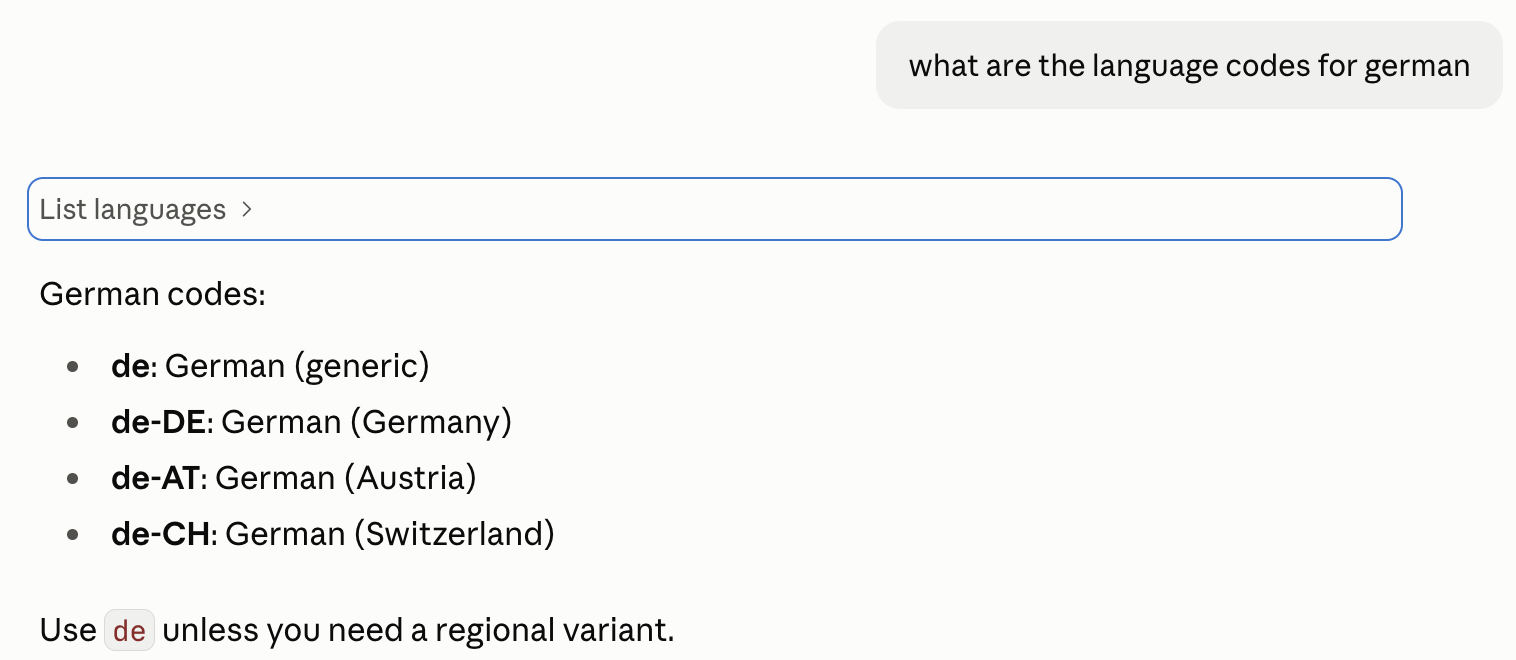
The fix is a setting, with one catch. MachineTranslation.com's connector for AI assistants lists German (Germany), German (Austria) and German (Switzerland) as three separate language codes, while the website's language list shows a single German option. In our tests, choosing the market code gave the local spelling, words and number formats. Choosing plain German did not.
On October 14, 2026, we sent short business sentences through MachineTranslation.com's connector for AI assistants, which returns the translation that 22 AI models agree on and is available to paid subscribers. We used four German language codes, which are plain German, German (Germany), German (Austria) and German (Switzerland), and recorded the output. MachineTranslation.com's English to German translator on the website also compares 22 AI models. Germany, Austria and Switzerland are often grouped as the DACH region, and these tests show where one German setting stops working across all three.
Key takeaways
- In October 2026 tests through MachineTranslation.com's connector, the German (Austria) code returned Jänner for January and Ordination for a doctor's office, where the German (Germany) code returned Januar and Arztpraxis.
- The German (Switzerland) code wrote Strasse with ss, used Velo and parkieren, and wrote a Swiss franc amount as 1'200.50, while plain German wrote Straße, Fahrrad and 1.200,50 for the same inputs.
- In all five tests where Austria or Switzerland has its own form, plain German did not use it.
- The connector's German (Switzerland) code produces written Swiss Standard German, and neither the connector nor the website lists the spoken Swiss German dialects, which are mostly unwritten.
- The website's language list shows one German option, so check each translation for spelling, everyday words and amounts, and use a native reader or Human Verification for contracts and invoices.
German is written differently in Germany, Austria and Switzerland
Written German differs between Germany, Austria and Switzerland in spelling, everyday words and number formats. Readers understand each other, so the differences are easy to miss in review. Switzerland does not use the letter ß, Austria writes Jänner for January, and Swiss currency amounts use an apostrophe as the thousands separator.
German has more than one national standard, and each one is documented. Wikipedia's entry on Austrian German says the form used in Austrian schools and official texts has been defined by the Österreichisches Wörterbuch since 1951. Wikipedia's entry on Swiss Standard German describes the written form used in Swiss books, laws, newspapers and most advertising, and notes that it replaces ß with ss.
A local reader can often tell when a page was written for another country. I treat the German variant as a market decision, in the same group as currency and tax wording, because a page that reads as foreign can cost trust with the buyers you are trying to win. Formal address is a separate issue that applies in all three markets, and the common mistakes in English to German business translation cover it.
What plain German does to Austrian and Swiss text
In MachineTranslation.com tests run in October 2026, plain German did not use a single Austrian or Swiss form. It wrote Januar, Straße, Arztpraxis, Fahrrad and 1.200,50, where Austrian readers expect Jänner and Ordination and Swiss readers expect Strasse, Velo and 1'200.50. Those outputs are correct for Germany and understandable everywhere else.
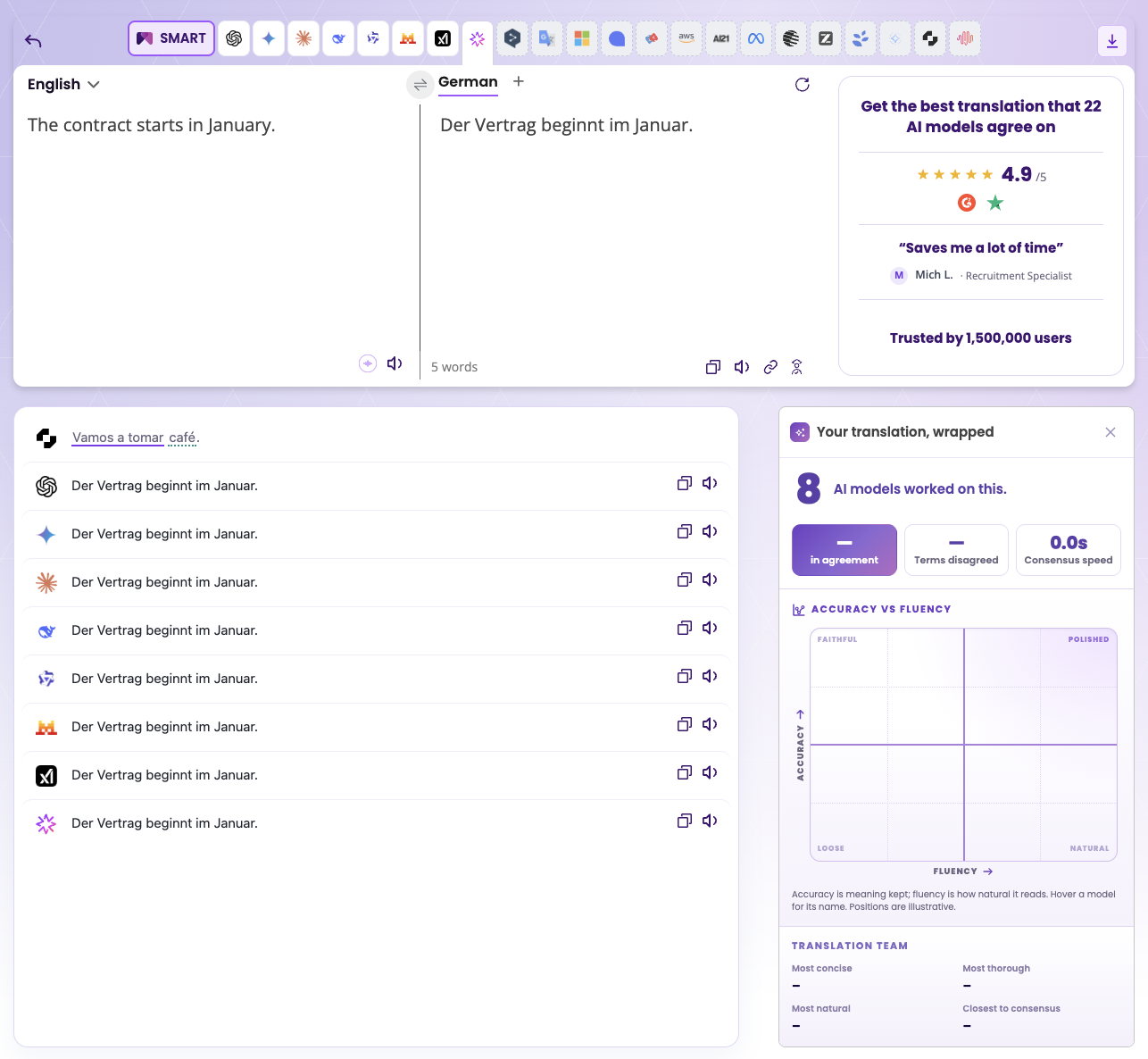
Each row in the table below is one English sentence run once through four language codes on October 14, 2026, which were German (Germany), German (Austria), German (Switzerland) and plain German. This is a spot check of short sentences.
| English sentence | German (Germany) | German (Austria) | German (Switzerland) | Plain German |
|---|---|---|---|---|
| The contract starts in January. | Januar | Jänner | Januar | Januar |
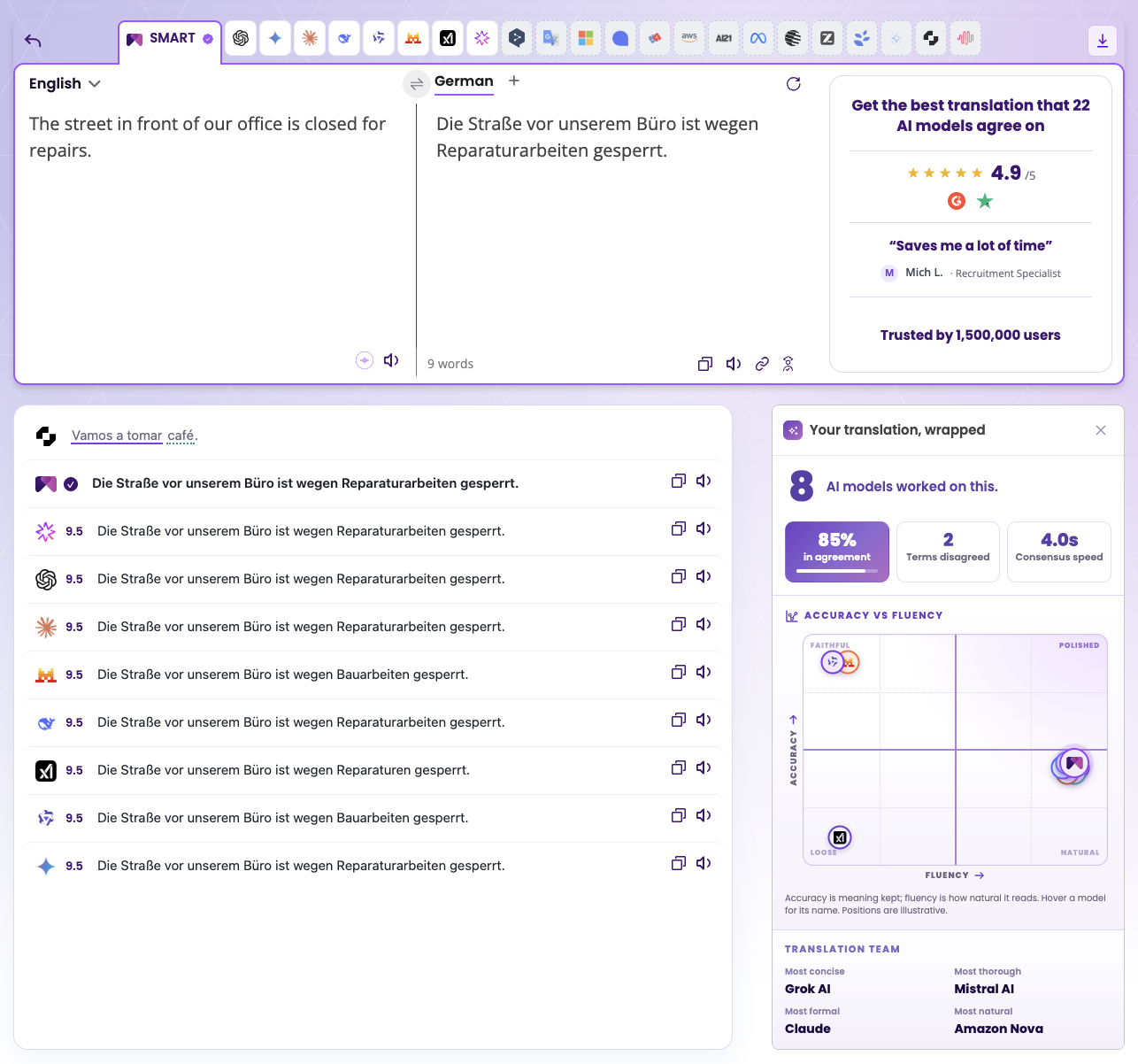
| The street in front of our office is closed for repairs. | Straße | Straße | Strasse | Straße |
| The doctor's office is closed on Friday. | Arztpraxis | Ordination | Arztpraxis | Arztpraxis |
| Please park your bicycle behind the building. | parken Sie Ihr Fahrrad | stellen Sie Ihr Fahrrad ab | parkieren Sie Ihr Velo | stellen Sie Ihr Fahrrad ab |
| The invoice total is 1,200.50 euros (Swiss francs for Switzerland and plain German). | 1.200,50 Euro | 1.200,50 Euro | 1'200.50 Schweizer Franken | 1.200,50 Schweizer Franken |
Local forms are shaded. Row five used euros for the Germany and Austria codes and Swiss francs for the Switzerland and plain German codes.
Plain German is not the same as choosing Germany. In the bicycle row, plain German wrote stellen Sie Ihr Fahrrad ab, while the Germany setting wrote parken Sie Ihr Fahrrad. Both are ordinary German, and neither is the Swiss form. Across all five rows, plain German never picked an Austrian or Swiss form, so treat it as a setting where no market was chosen. In practice, a site or invoice template built on plain German ships Germany's spelling, words and number formats to every market, and I would make that a deliberate choice.
The website works differently from the connector. Its language list shows a single German option, and the English to German page describes Austrian and Swiss coverage through Human Verification, which connects the translation to a professional German translator with regional expertise.
How can I translate English to Austrian German?
Use the German (Austria) code, de-AT, when you translate through MachineTranslation.com's connector. In MachineTranslation.com tests run in October 2026, it returned Jänner for January and Ordination for a doctor's office, where the Germany code returned Januar and Arztpraxis. Wikipedia lists Jänner as Austrian usage, and Duden marks Ordination as Austrian usage for a doctor's practice.
Austria shares more with Germany than Switzerland does. The Austria code wrote Straße with ß and an invoice total of 1.200,50 euros exactly as the Germany code did, and Wikipedia confirms that ß is used in Austria and Germany but not in Switzerland. The Austria code matters most for months and vocabulary. I would start the Austria review with months and everyday vocabulary on customer-facing pages, since a local reader meets those first.
Wikipedia also notes that Austrian administrative and legal vocabulary differs from Germany's, and it points to a dedicated reference work for Austrian legal, administrative and economic terms. For contracts and filings, that is where I would ask a native reader to check the final text. Austrian dialects exist, but they are traditionally spoken and rarely written, so a written translation targets the standard form.
Translating English into German for Switzerland
Use the German (Switzerland) code, de-CH, when you translate through MachineTranslation.com's connector. In MachineTranslation.com tests run in October 2026, it wrote Strasse with ss, used Velo and parkieren for bicycle parking, and formatted an invoice amount as 1'200.50 Swiss francs. Plain German wrote Straße, Fahrrad and 1.200,50 for the same inputs.
Swiss Standard German has its own vocabulary too. Wikipedia lists Billett for a ticket, Velo for a bicycle and parkieren for to park, and names the replacement of ß with ss as the main spelling difference.
Amounts need extra care. According to Wikipedia's article on decimal separators, Swiss currency values use an apostrophe as the thousands separator and a dot as the decimal separator, as in 1'234'567.89, while Germany and Austria write 1.234.567,89. Swiss texts use a second style for other numbers, so confirm which style your finance team follows.
Invoices are a good place to check this. The franc amount came back from plain German as 1.200,50, which follows the German convention. The Switzerland code wrote 1'200.50, which matches the currency style Wikipedia describes for Switzerland.
Wikipedia also lists grammar differences, such as das E-Mail in Switzerland and die E-Mail in Germany. We did not test those, so ask a native reader to check them.
Is there a translator for Swiss German?
It depends on what you mean by Swiss German. MachineTranslation.com's connector lists German (Switzerland), which produces written Swiss Standard German, the form used in books, official publications and most advertising. The spoken Swiss German dialects are the everyday spoken languages of German-speaking Switzerland, and they are mostly written only in informal messages.
Wikipedia notes that there is no continuum between the two. Speakers use either Swiss Standard German or a dialect, and they know which one they are using. Neither the connector's language list nor the website's has an entry for a Swiss German dialect, so text that must read like spoken Zurich or Bernese dialect needs a human writer.
For business documents, contracts, websites and product pages, Swiss Standard German is the written standard, so it is the form to ask for.
When one German page is enough and when to split it
One German page is enough when the text has no prices, dates, contracts or everyday vocabulary that change by market, such as internal documentation. Split the German content by market when readers see those things. In MachineTranslation.com tests run in October 2026, Austria and Switzerland differed from Germany in months, everyday words, spelling and amounts.
If I had to sequence the work, I would start with Switzerland. Every word that uses ß changes, and franc amounts follow their own style, so the differences appear in ordinary pages and invoices. Austria comes second, because the differences sit mostly in months and vocabulary. Germany is the baseline.
Before you commit to separate pages, check how much of your traffic comes from each country. Google Search Console's Performance report can group and filter data by the country where the search originated, so you can see how much of your search traffic comes from Austria and Switzerland before you build a market page. If the numbers justify separate pages, step five below covers how to mark them for search engines.
How to check a German translation for each market
Translate each text with the German code that matches its market where one is available, then check spelling, everyday words and amounts. Ask a native reader from that market to review anything binding, such as contracts and invoices. The five steps below turn that into a routine.
- Decide the market for each text. A price page for Zurich and a price page for Vienna are two translation jobs, even when the English source is the same.
- Choose the matching language code, which is German (Germany), German (Austria) or German (Switzerland), when you translate through the connector. On the website, which lists one German option, plan a human review for each market.
- Read the output for three things, which are ß or ss, everyday words such as Jänner, Ordination or Velo, and the way amounts are written.
- Have a native reader from that market review contracts, invoices and customer-facing copy. MachineTranslation.com also offers Human Verification for this step.
- If you publish a separate page for each market, tell search engines which page serves which reader with hreflang values such as de, de-AT and de-CH, as described in Google Search Central's guide to localized versions.
If you change one thing this week, change the language field in your localization briefs from "German" to the name of the market. It costs nothing, and every translator, tool and reviewer downstream then knows which version to deliver.
Frequently asked questions
1. Is Austrian German and German the same?
No, Austrian German is a national standard of German with its own vocabulary and its own official dictionary, the Österreichisches Wörterbuch. Most written text looks the same, but Austria writes Jänner for January and Ordination for a doctor's office. Austria uses the letter ß, as Germany does.
2. What are the key differences between Swiss German and Standard German?
Written Swiss Standard German differs from German in Germany mainly in spelling and vocabulary. It replaces ß with ss and uses words such as Velo for bicycle and parkieren for to park. The spoken Swiss German dialects are a separate matter and are mostly unwritten.
3. Can AI translate languages accurately?
It depends on the text and the language pair. In our German tests, the market setting decided whether Austrian and Swiss spelling, words and amounts appeared at all. Short business sentences came back as readable German in every setting, so a native reader should still check contracts, invoices and customer-facing copy.
4. How to translate without using AI?
Hire a professional translator who is a native reader of the market you are writing for, and ask for Austrian or Swiss Standard German by name. Tomedes, the translation company that developed MachineTranslation.com, offers human translation, and MachineTranslation.com offers Human Verification to add a native review to an AI translation.

By William Mamane
Connect on LinkedInWilliam leads marketing and growth at Tomedes, where he turns SEO experiments and real campaign data into the strategy behind MachineTranslation.com's reach. He writes about how AI products actually get found and trusted plus the tactics that work, the ones that don't, and what search is rewarding right now.
Share:


