You've probably already seen the standard list: Portuguese "saudade," Japanese "komorebi," Danish "hygge." They're real, and they're genuinely hard to translate, but they're also the same three examples every article on this topic reaches for. We tested seven different untranslatable words against real AI models, plus 14 idioms and 14 trending phrases, to see what actually happens when a word has no direct equivalent to translate into.
What makes a word untranslatable?
An untranslatable word is a term with no single equivalent in another language, not because it can't be explained, but because no other language has packaged that exact meaning into one word. The Russian "toska" describes a spiritual ache with no single English equivalent. The Indonesian "jayus" describes a joke so badly told that you laugh anyway.
Here's the honest caveat: in a narrow sense, no word is truly untranslatable. You can explain almost any concept in another language given enough words. "Untranslatable" really means no single word in the target language captures the same meaning as economically as the original does. That distinction matters specifically for AI translation, because a model has to decide whether to expand a word into a phrase, borrow it directly, or approximate it with something close but not exact, and that decision is where models start to disagree with each other.
What is the most difficult word to translate?
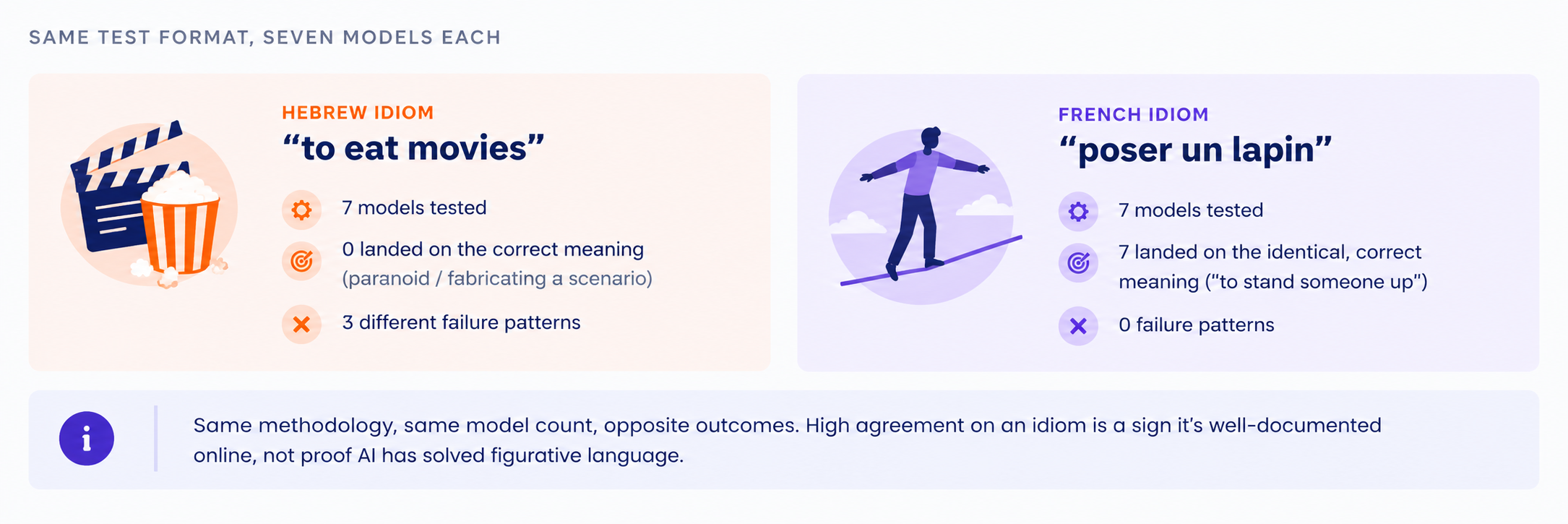
There's no single answer, because difficulty depends on the target language, not just the word. The clearest evidence we have is a single test that ran the same idiom-testing method on two different languages with opposite results. In Hebrew, we ran "לאכול סרטים," literally "to eat movies" and actually meaning to be paranoid or fabricate a scenario, through seven models at once. None of them landed on the correct meaning. They failed in three distinct ways: some translated it completely literally, some confidently produced a different, wrong figurative meaning, and some caught only part of the sense.
We ran the French idiom "poser un lapin à quelqu'un" through seven models: GPT-4.1-nano, GPT-4.1-mini, GPT-4o-mini, GPT-5.4, GPT-5.4-mini, DeepSeek V4-Pro, and DeepSeek V4-Flash. All seven returned the same correct translation, "to stand someone up."
Perfect agreement isn't the same as AI having solved the difficulty. As my colleague Ofer Tirosh put it after that test: complete consensus on "poser un lapin" is a sign AI has memorized one of the most documented French idioms online, not a sign it understands figurative language in general. The Hebrew idiom above got the opposite result from the same method, because it's far less documented.
The same difficulty shows up on single words, not just idioms. We ran a sentence containing the slang term "brainrot" from English into Spanish, a genuinely hard case since Spanish has no direct equivalent, and found three models left it untouched, one italicized it, and one wrapped it in quotation marks, all describing the identical word. A word can be "difficult to translate" not because a model gets it wrong, but because there's no established right answer to converge on yet, a pattern we've also documented in a broader test of how AI handles brand-new words.
Why does AI struggle with idiomatic language?
Take "poser un lapin à quelqu'un" again, which translates word for word as "to place a rabbit on someone." Its actual meaning, to stand someone up, has nothing to do with rabbits. A model has to recognize the phrase as idiomatic before it can even attempt the correct meaning. Recognizing that a phrase is idiomatic and knowing what it actually means are two separate hurdles, and a model can clear the first without clearing the second, which is exactly what produced the three different failure patterns on the Hebrew idiom above.
What are the downsides of AI translation?
The clearest downside is that a model can be fluent and still wrong in a way that's hard to catch, because the output reads naturally either way. Model size and price don't reliably fix this. We ran the German idiom "Ich verstehe nur Bahnhof," literally "I only understand train station," meaning "this makes no sense to me," through five models. ChatGPT and Claude, the two most recognized names in the comparison, both translated it literally and got it wrong. Mistral, DeepSeek, and Qwen all identified the correct idiomatic meaning.
Price tells a similar story. We ran "put her foot in her mouth" from English into French through two models on opposite ends of the price scale, GPT-4.1-nano and Claude Opus 4-7, a roughly 62-times difference in cost. Both scored 9.4, differing only in a single preposition. Idiom translation is one of the clearest places where a bigger name or a higher price doesn't guarantee a better result.
This pattern isn't unique to our own testing. A 2025 peer-reviewed study examining how ChatGPT, Gemini, and DeepSeek handle Macedonian proverbs and idioms found the same shape of failure: all three models favored direct, literal translations over idiomatic equivalents, produced uniform results on simpler proverbs, and lost stylistic elements like rhyme and wordplay on the more complex ones.
What untranslatable words, idioms, and phrases has AI been tested on?
Below are 35 real words and phrases we've tested and published: 7 untranslatable words and slang terms, 14 idioms across six languages, and 14 trending phrases pulled from music, sports, and internet culture.
Should you trust AI to translate slang and internet trends?
For a quick, informal read, yes, with one caveat that doesn't apply to a fixed idiom: slang dates. A phrase that's current when a model is trained can be stale, ironic, or replaced within a year, and unlike "raining cats and dogs," there's no decades of dictionary consensus backing up whether a translation is still right. The 14 phrases below are pulled from real 2026 cultural moments, songs, sports, and internet trends, and some of them will read as dated faster than the idioms above. That's expected. We're publishing them as a snapshot of how AI handles live language, not as a permanent reference the way the idiom set is.
Frequently asked questions
1. What is the most difficult word to translate?
There's no single answer, because "most difficult" depends on the target language, not just the word. We've found words that translate cleanly into one language and completely stump AI models in another, like an idiom that seven models translated identically into one language and seven models each got wrong in a different way for a second language, using the same source phrase.
2. Is it true that no word is really untranslatable?
In one narrow sense, yes: you can explain almost any concept in another language given enough words. "Untranslatable" really means no single word in the target language captures the same meaning as economically. That distinction matters for AI translation specifically, because a model has to decide whether to expand a word into a phrase, borrow it directly, or approximate it, and we've found models don't agree on which choice is right even for the same word.
3. What are the downsides of AI translation?
The clearest downside shows up on idiomatic and untranslatable language: a model can be fluent and still wrong in a way that's hard to catch, because the output reads naturally. We've also found that a bigger or more expensive model isn't reliably better at this than a smaller one, and that perfect agreement across models on a tricky phrase can mean the phrase is well-documented online, not that AI has solved the underlying difficulty.
4. Why does AI struggle with idiomatic language?
Because an idiom's meaning doesn't come from its individual words, and most models are trained to translate words. We've seen this produce a complete failure: seven models translated the same Hebrew idiom, and zero got the meaning right, each failing in a different way. Some idioms score well, but the ones that don't tend to fail completely rather than partially.
5. Should you trust AI to translate slang and internet trends?
For a quick, informal read, yes. Slang and trending phrases date quickly and often carry meaning that depends on the exact cultural moment they came from, which makes them harder to verify over time than a fixed idiom. Treat AI's read on a brand-new slang term as a first guess, not a settled answer, especially a few months after the term first appeared.