What are examples of legal contract clauses translated by AI?
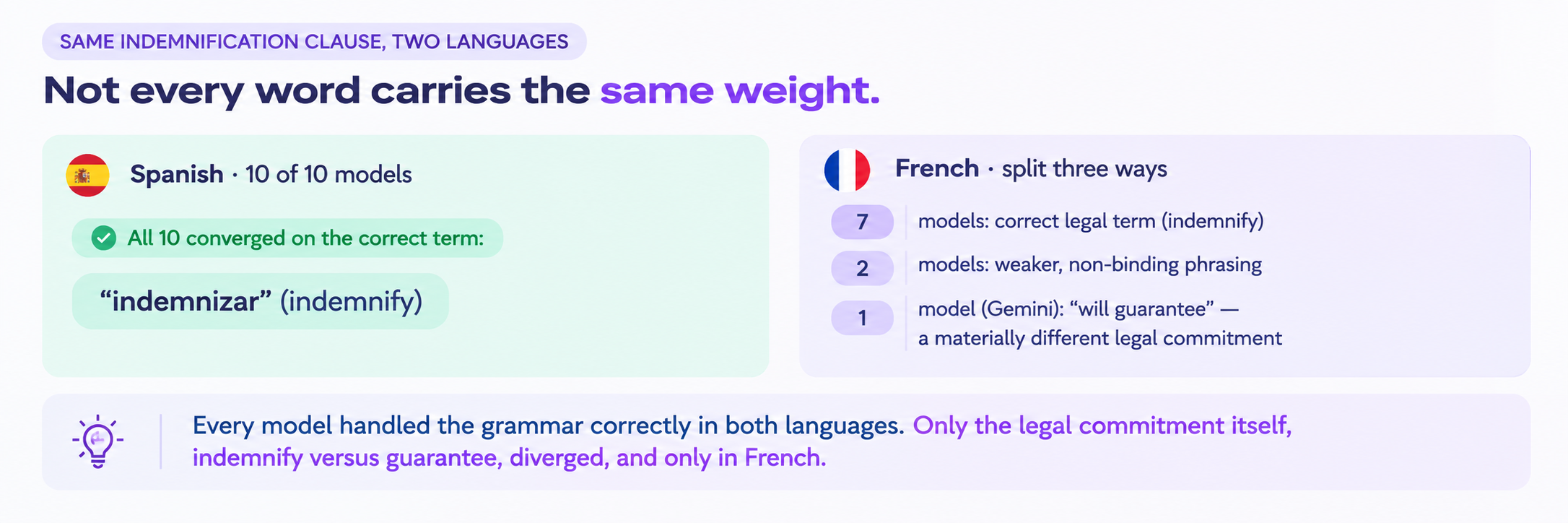
One clause needs its own explanation, since it is the test behind this article's headline finding.
| Clause | Target language | What the test showed |
|---|---|---|
| Indemnification clause | Spanish | All 10 models converged on the legally precise term, "indemnizar." The same clause tested in French split three ways, with one model materially changing the commitment to "will guarantee." |
The governing law clause is the widest single test we've run: the same clause, translated across 18 language pairs, so you can see exactly where a standard piece of contract boilerplate holds up and where it doesn't.
Two Portuguese rows aren't linked to a general language-pair page above, since MachineTranslation.com splits Portuguese into Brazil and Portugal variants and the source data didn't specify which.
Do you need a certified human translator for a legal contract?
For anything you plan to sign, file, or rely on in a dispute, yes. This matches the actual standard the legal translation industry follows: ISO 20771. It is the international standard for legal translation services, and it explicitly excludes the use of output from machine translation, even with post-editing, from its scope. It's a scope boundary the standard draws on purpose, because a certified legal translator is accountable for the result in a way a model comparison isn't.
In practice: use AI for the fast, informed first pass, and to find out exactly where models disagree, the way the indemnification and at-will-employment tests above did. Then route the final version through Human Verification before it becomes the version anyone signs. A professional linguist reviews the AI output and returns it with a 100% accuracy guarantee, which is the level of accountability a contract actually needs.
FAQ
1. How accurate is AI translation for legal contracts?
It varies by language pair and clause type. We found all 10 models converged on the correct legal term for an indemnification clause translated into Spanish. For the same clause into French, models split three ways, and one materially changed the legal commitment from "indemnify" to "guarantee." The same contract can be safe in one language and risky in another.
2. Why do AI models disagree on legal terminology?
Legal terms often have a precise meaning in one legal system that doesn't map cleanly onto another, so models have to choose between a literal rendering and a functionally equivalent one. We've seen this produce a 0% consensus rate on a single term, with different models each choosing a different, non-overlapping translation, none of which was flagged as wrong by the models themselves.
3. How do you check if a legal translation is accurate?
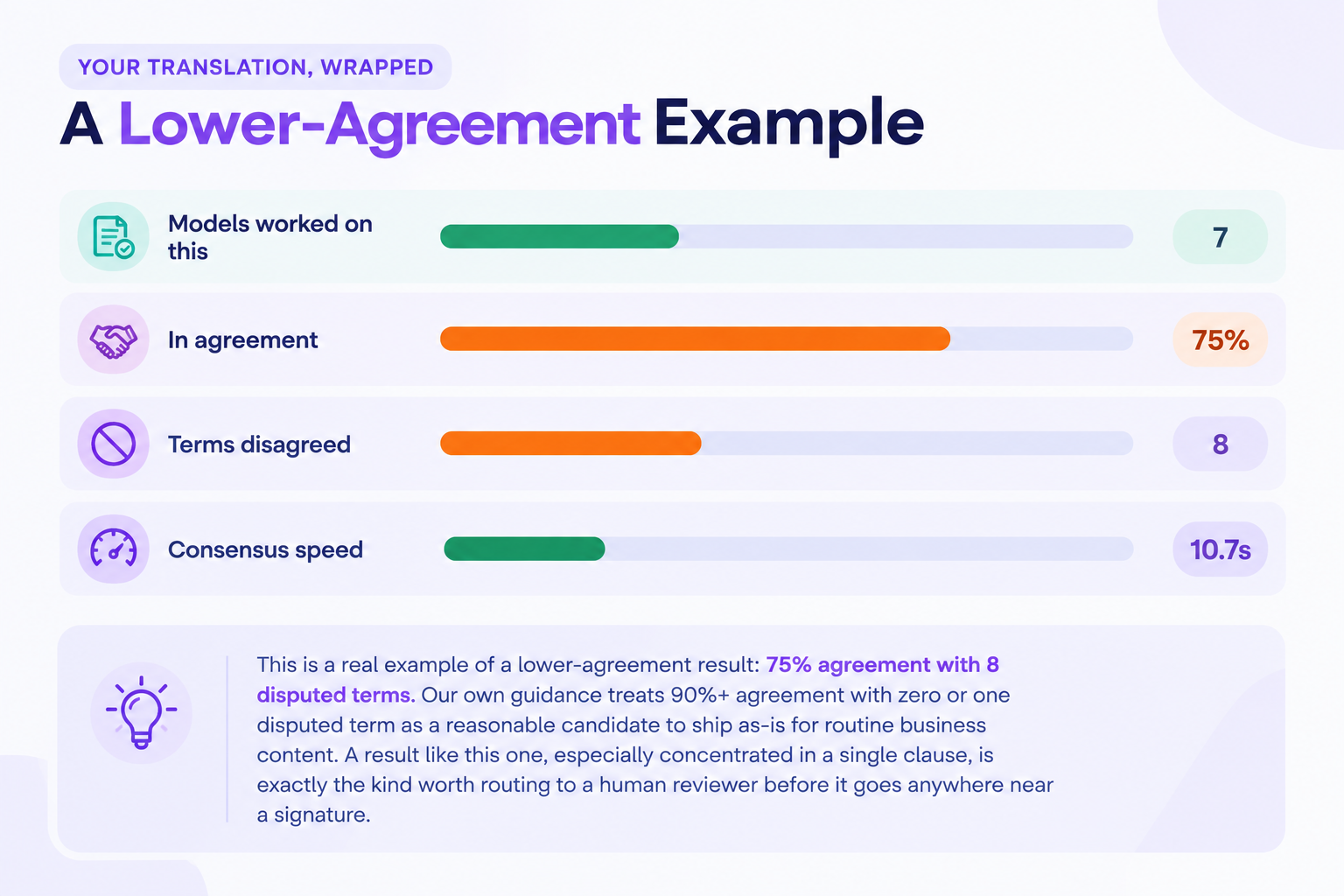
We run every translation through multiple AI models at once. A panel called "Your translation, wrapped" shows how many models worked on it, what percentage agreed, how many terms they disagreed on, and how fast they reached a final answer. For legal content specifically, we treat anything under 90% agreement, or several disputed terms concentrated on one clause, as a signal to route that clause to a human reviewer rather than ship it as-is.
4. Do I need a certified human translator for a legal contract?
For anything you intend to sign, file with a court or regulator, or rely on in a dispute, yes. ISO 20771, the international standard for legal translation, explicitly excludes machine translation output, even with post-editing, from its scope. Use AI to get a fast, informed first draft and to catch where models disagree, then route the final version through a certified human legal translator before it's binding.
5. What happens if a contract is translated incorrectly?
Courts generally enforce the wording of the contract as translated, not what either party intended. A mistranslated liability, indemnification, or governing-law clause can shift financial exposure, change which court has jurisdiction, or weaken a party's position in a dispute, often without anyone noticing until the disagreement is already underway.