October 21, 2026
Is Mistral, France's own AI, better at French?
If you are choosing an AI model for French content, you have probably heard the shortcut. Use Mistral, because it is French. The logic sounds fair. An AI model built in Paris by French researchers should know French better than one built somewhere else. The pages that rank for that question are feature tables and forum threads, and none of them checks the claim against translation scores.
We checked it. In MachineTranslation.com's production scores, Mistral does post the highest average on French pairs. It posts a lead of the same size on pairs that have nothing to do with French, so the lead does not look like a French advantage. The scores also come with a gap that changes how much weight they deserve, and we show that gap in full.
The data covers 28 days of production quality scores, from July 12 to August 8, 2026, for the AI models that MachineTranslation.com compares on every translation, including in MachineTranslation.com's English to French AI translator. We use averages and percentages only. We leave out the platform's own blended result and compare individual AI models. The data does not separate Mistral's versions, so we write about the Mistral AI model as a whole and not about one version of it.
Key takeaways
- In MachineTranslation.com's production scores for July 12 to August 8, 2026, Mistral AI had the highest average of the six main AI models on English to French, French to English and French to Arabic, for example 9.32 on French to English against 8.92 to 9.13 for the others.
- Mistral's lead over the other five AI models was +0.30 on pairs into French and +0.23 on pairs out of French, against +0.33 on pairs without French, so the data shows no French home-field advantage.
- On French to English, 2.0% of Mistral's scored outputs fell below 8 out of 10, against 13.3% for ChatGPT and 14.3% for Gemini.
- Only 30% of Mistral's outputs carry a quality score, against 43% to 55% for the other five AI models, and published tests show Mistral returning no output or scoring 0 in several cases, so its average may flatter it.
- On the same segments, the gap between the five AI models in the bias-corrected panel shrinks from 0.21 points to 0.07 on French to English, which suggests raw averages overstate the differences between AI models.
Does the French AI score best on French?
Yes, on raw averages, Mistral AI scored highest of the six main AI models (ChatGPT, Claude, DeepSeek, Gemini, Mistral AI and Qwen) on English to French, French to English and French to Arabic in MachineTranslation.com's July 12 to August 8, 2026 production data. On French to English it also had the lowest share of outputs below 8, at 2.0%.
Each score is a quality rating out of 10 for one AI model's output. The scale is compressed, so most scores sit between 9 and 10. The data's own guidance is to read the share of outputs below 8 as the practical bad-output rate, so the table shows both.
| AI model | English to French | French to English | French to Arabic |
|---|---|---|---|
| Mistral AI | 9.27 (3.7%) | 9.32 (2.0%) | 9.35 (0.8%) |
| DeepSeek | 9.26 (2.7%) | 9.13 (6.3%) | 9.20 (2.2%) |
| Claude | 9.17 (4.9%) | 9.08 (8.7%) | 9.20 (4.0%) |
| Gemini | 9.14 (8.3%) | 8.92 (14.3%) | 9.10 (6.8%) |
| Qwen | 9.06 (8.7%) | 9.01 (9.8%) | 8.91 (11.4%) |
| ChatGPT | 9.05 (10.4%) | 8.96 (13.3%) | 9.00 (6.7%) |
Average score out of 10, with the share of scored outputs below 8 in brackets. Raw averages, not bias-corrected. The source is MachineTranslation.com AI model quality scores for July 12 to August 8, 2026.
Mistral's lead is widest on French to English, where its average of 9.32 sits 0.19 points above the next AI model, DeepSeek, and 0.40 above Gemini. On English to French the race is close. Mistral's 9.27 is 0.01 ahead of DeepSeek's 9.26, and DeepSeek has the lower bad-output rate, 2.7% against 3.7%.
Is that lead a French advantage?
No, the lead is not specific to French, because Mistral leads by about the same margin on pairs with no French in them. Across 166 language pairs, Mistral's average beat the other five AI models by +0.33 points on pairs without French, +0.30 on pairs into French and +0.23 on pairs out of French.
For each pair, we subtracted the average of the other five AI models from Mistral's average, then averaged those gaps within each group. We only used pairs where all six AI models had enough scored outputs. That gave 154 pairs without French, 7 into French and 5 out of French, and Mistral led on every one of the 166.
The site-wide numbers say the same. Across every pair, Mistral's average is 9.29, above the other five AI models, which range from 8.87 to 9.08. An AI model that leads everywhere tells us something about itself or about how it is scored. It tells us little about French.
The company is French, headquartered in Paris and founded in April 2023 by three French researchers, according to Wikipedia's entry on Mistral AI. Where an AI model is built does not appear to decide how it scores on French.
Can a high average hide a failure?
Yes, because an average only counts outputs that received a score, and an AI model that returns nothing may never appear in it. In MachineTranslation.com's data, 30% of Mistral's outputs carry a quality score, against 43% to 55% for the other five AI models.
The data's own notes say the raw AI model averages are not bias-corrected, because AI models are scored at different rates. A low rate can be harmless. It also means Mistral's average describes a smaller share of what the AI model returned than the other averages do.
Published tests give a reason to take that gap seriously. In a test of the French sentence "Elle est directrice adjointe du département commercial", four AI models returned readings of the job title and Mistral produced no output, which scored 0, as described in our look at the June 2026 jump in French translation. In a limitation-of-liability clause translated into Spanish, four AI models scored between 9.4 and 9.5 and Mistral scored 0, as covered in our test of business documents. In a 57-word English paragraph translated into Tagalog, Claude, DeepSeek and ChatGPT scored 9.4, Qwen scored 8.3 and Mistral scored 0, as covered in our piece on what accurate AI translation means.
We have not confirmed how the production scores treat an empty output. If they leave it unscored, Mistral's average describes the translations it returned, and its 2.0% bad-output rate on French to English may understate what a customer would see. For that reason we do not read the lead in the first table as proof that Mistral is the most reliable French AI model. A high average and a gap in coverage can both be true at once.
Which AI is the best at French?
None of the AI models wins every French pair, and the gaps shrink once every AI model is scored on the same text. In the bias-corrected panel, DeepSeek leads both English to French and French to English by small margins. Mistral is not in that panel, so its place there is unknown.
The panel counts only segments where ChatGPT, Claude, DeepSeek, Gemini and Qwen all received a real score, so each AI model is judged on identical source text. That removes the effect of one AI model being scored on easier batches than another. Across all pairs, the panel ranked DeepSeek first and Qwen last in both 28-day windows.
Scoring all five AI models on the same segments changes the picture. On French to English, the gap between the best and worst of the five AI models falls from 0.21 points in the raw data to 0.07. On English to French it falls from 0.21 to 0.18. ChatGPT shows how far the raw view can mislead. It has the second-highest bad-output rate in the raw French to English data, at 13.3%, and sits second in the panel, with an average of 9.16.
What does it look like when Mistral is the odd one out?
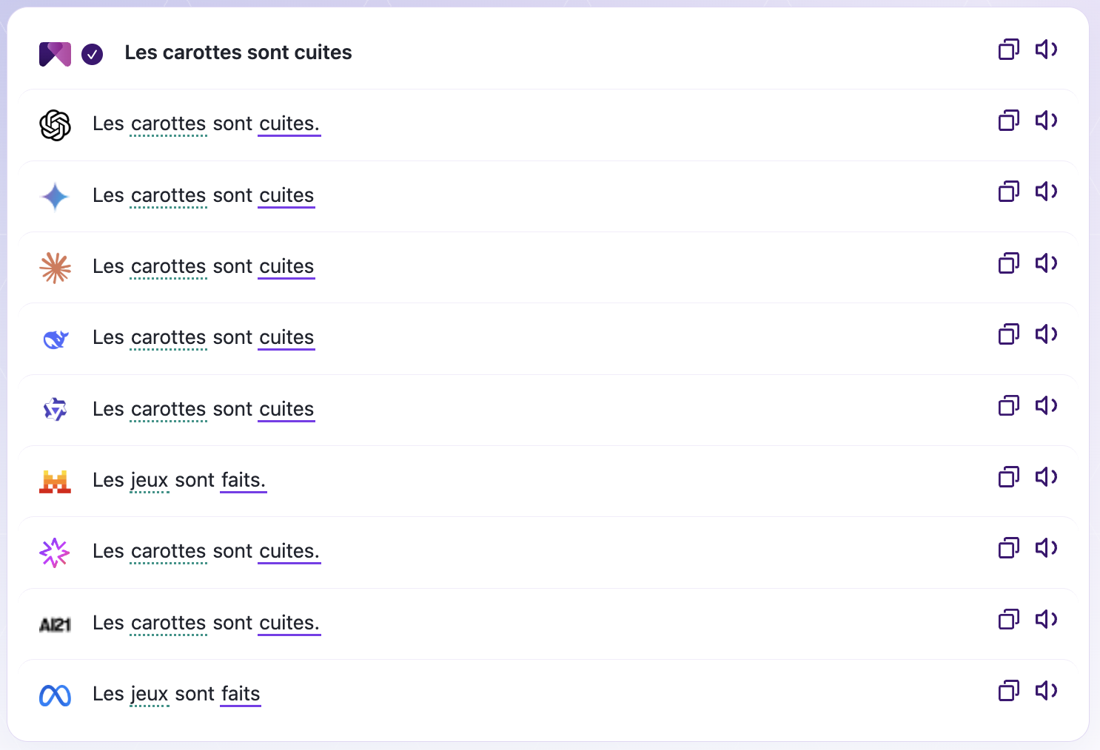
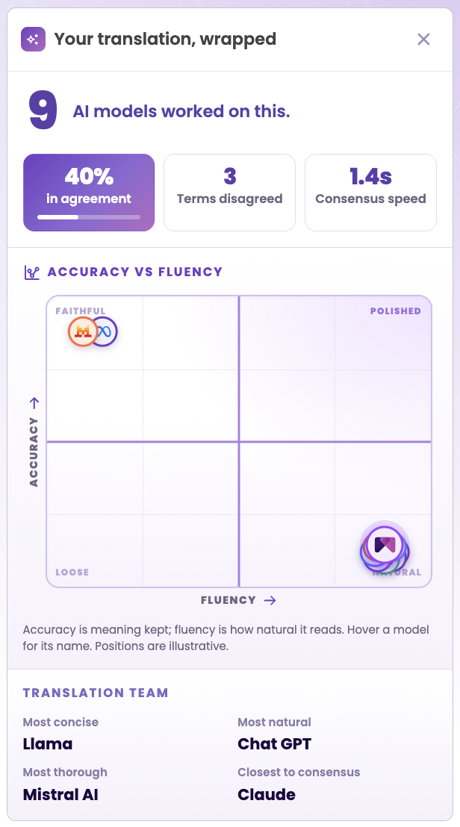
On the French idiom "Les carottes sont cuites", Mistral and Llama returned "Les jeux sont faits" while the other seven of nine AI models returned the sentence unchanged. The Wrapped panel reported 40% agreement and 3 disputed terms. A split like that is where consensus has work to do.
The idiom means that the situation is hopeless or the decision is final, according to The Local France, and a word-for-word reading of "the carrots are cooked" misses that. In an earlier head-to-head test of Claude and GPT-4.1, ChatGPT and Claude translated it word for word, only Mistral found the correct meaning, and the platform selected Mistral's version.
We ran the sentence again this week. The language pair was set to English to French, so most AI models treated the text as French that needed no translation. The run shows how AI models behave when they disagree. The first screenshot shows each AI model's output. The second shows the Wrapped panel for the same run.
How should you read AI model scores for French?
Read AI model scores for French in five steps. Use the share of outputs below 8, check the exact language pair, ask how empty outputs are counted, compare AI models on the same segments, and keep a second opinion for anything legal or financial. Each step comes from a gap we found in the data above.
- Use the share of outputs below 8 as the main number. Scores cluster between 9 and 10, so the average hides the gap between an AI model that averages 9.3 and one that averages 9.1. Scores also do not predict satisfaction. In the data, 1-star and 5-star ratings had almost the same average machine score, 9.08 and 9.10.
- Check the exact pair and direction. French to English and English to French rank the AI models differently, as the ChatGPT and Gemini figures show.
- Ask how empty outputs are counted. An AI model scored on 30% of its outputs and one scored on 55% of its outputs are not measured on equal terms.
- Compare AI models on the same segments. A bias-corrected panel cut the gap between five AI models on French to English from 0.21 points to 0.07.
- Keep a second opinion for text that carries legal or financial weight. MachineTranslation.com's English to French translator shows every AI model's output next to the consensus, so a disagreement is visible before the text goes out.
The number I would most like to see next is Mistral's no-output rate on French pairs, because it decides whether the lead in the first table is real.
Frequently asked questions
1. Which country owns Mistral?
Mistral AI is a French company headquartered in Paris, and three French researchers founded it in April 2023, according to Wikipedia. The same source lists the Dutch company ASML as an 11% shareholder, so ownership is not purely French. In MachineTranslation.com's scores, its French origin did not show up as a French-specific lead.
2. What is the French equivalent of ChatGPT?
Mistral AI's chat assistant, Le Chat, is the product most often compared with ChatGPT. Wikipedia says Le Chat was renamed Vibe at the end of May 2026. MachineTranslation.com compares translations from up to 22 AI models, including Mistral AI and ChatGPT, so it can show where they agree and where they split.
3. Is Mistral better than OpenAI?
It depends on the language pair, because no single AI model wins everywhere. In MachineTranslation.com's July 12 to August 8, 2026 scores, Mistral AI's average beat ChatGPT's on all three French pairs. Only 30% of Mistral's outputs carry a score, against 55% for ChatGPT, so the comparison needs care.
4. Is ChatGPT or Gemini better for translation?
It depends on the language pair, because the gap between them changes with direction. On French to English, 13.3% of ChatGPT's scored outputs and 14.3% of Gemini's fell below 8. On English to French the figures were 10.4% and 8.3%. Neither AI model wins both French directions.

By Rachelle Garcia
Connect on LinkedInRachelle leads product and AI at Tomedes, where she runs the experiments that turn internal data into better translation experiences. She writes about what actually happens when you build AI products such as MachineTranslation.com � the numbers, the surprises, and the parts that don't go to plan.
Share:


