July 22, 2026
The pricing problem we kept hearing about, and what we built instead
You've got one document. A contract, due Thursday, going to a partner who won't read past the first mistranslated clause. You don't need this translated every week. You need it translated once, correctly, by Thursday.
That's the exact moment our old pricing page used to fail you. Every option in front of you assumed one of two things: that you were a casual visitor who didn't need much, or a committed subscriber who needed it every day. Neither one was true. You needed something in between, and until now, we didn't have a plan for that.
We'd heard a version of this often enough, and seen it clearly enough in our own usage data, that it stopped looking like an edge case and started looking like a gap in the product. So we rebuilt the pricing page around it. Here's what changed, why, and what it actually means for how you pay.
The subscription assumption we kept building around
Most SaaS pricing is built for one behavior: recurring use. That's a reasonable default when a product is something people open every day. It's a worse default when a product gets opened in bursts, once for a big project, then not again for months.
Translation is a burst product for a lot of people. A single contract. A product listing going into a new market. A one-off application. The subscription model asks you to commit to a monthly relationship for a need that might last one afternoon.
We built our original Pro plan the way most tools build their paid tier: monthly, unlimited, recurring. It's still the right plan for a lot of people, and it isn't going anywhere. But for a long time it was the only paid option, which meant everyone with a one-off need was being asked a question that didn't match their situation: are you willing to pay every month for something you need once?
What our own data told us
Our data lead ran two hand-coded studies this quarter looking at what paying and free users actually translate, not just how much. The gap between the two groups turned out to be sharper than we expected.
The median paying user translates 541 words. The median free user translates 12 words if they're a returning visitor, or 10 if it's their first visit. That's a roughly 54-times difference in typical length, and it holds up across the full population, not a small sample. Paying users are also far more likely to upload a whole file rather than paste text: 60.5% have uploaded a document at least once, against roughly one in ten free users.
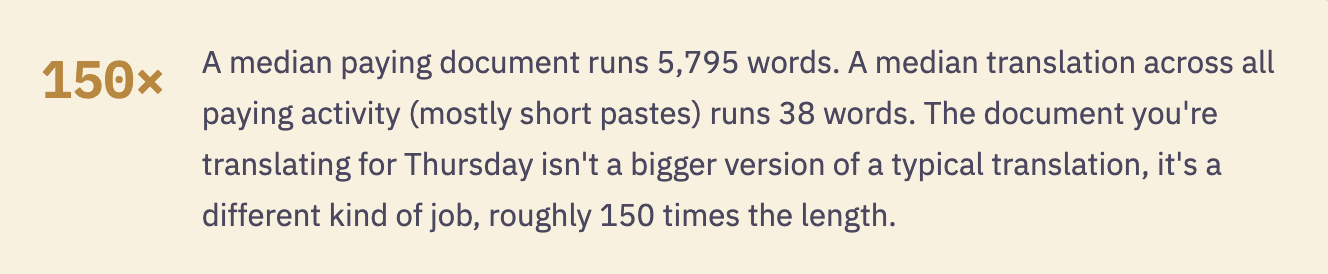
Legal and official paperwork (contracts, certificates, filings) is the second most common category among paying document uploads, and it's on the shorter end of that range: a median of about 2,805 words, closer to a working contract than a manuscript. That's the exact shape of job the old pricing page had no good answer for: too substantial for the free tier's per-translation limits, too infrequent to justify a recurring plan.
The 24-hour pass wasn't new to this update either, it launched last year as the industry's first pay-as-you-go AI translator, according to Slator's coverage at the time. We already had a partial answer to the gap these studies confirmed: that same pass, priced as a one-time fee instead of a monthly charge. When we cut its price from $9.50 to $6 earlier this year, alongside a Pro plan cut from $39 to $19, it didn't just bring more people through the door. It produced an all-time monthly high for that access type on its own, which told us something specific: this isn't a discount version of the subscription audience. It's a different audience with a different need, and it's the same audience our data just put numbers to.
Three ways to pay now
So instead of one paid plan trying to serve every use case, we built pricing around how long you actually need access, not how much you translate.
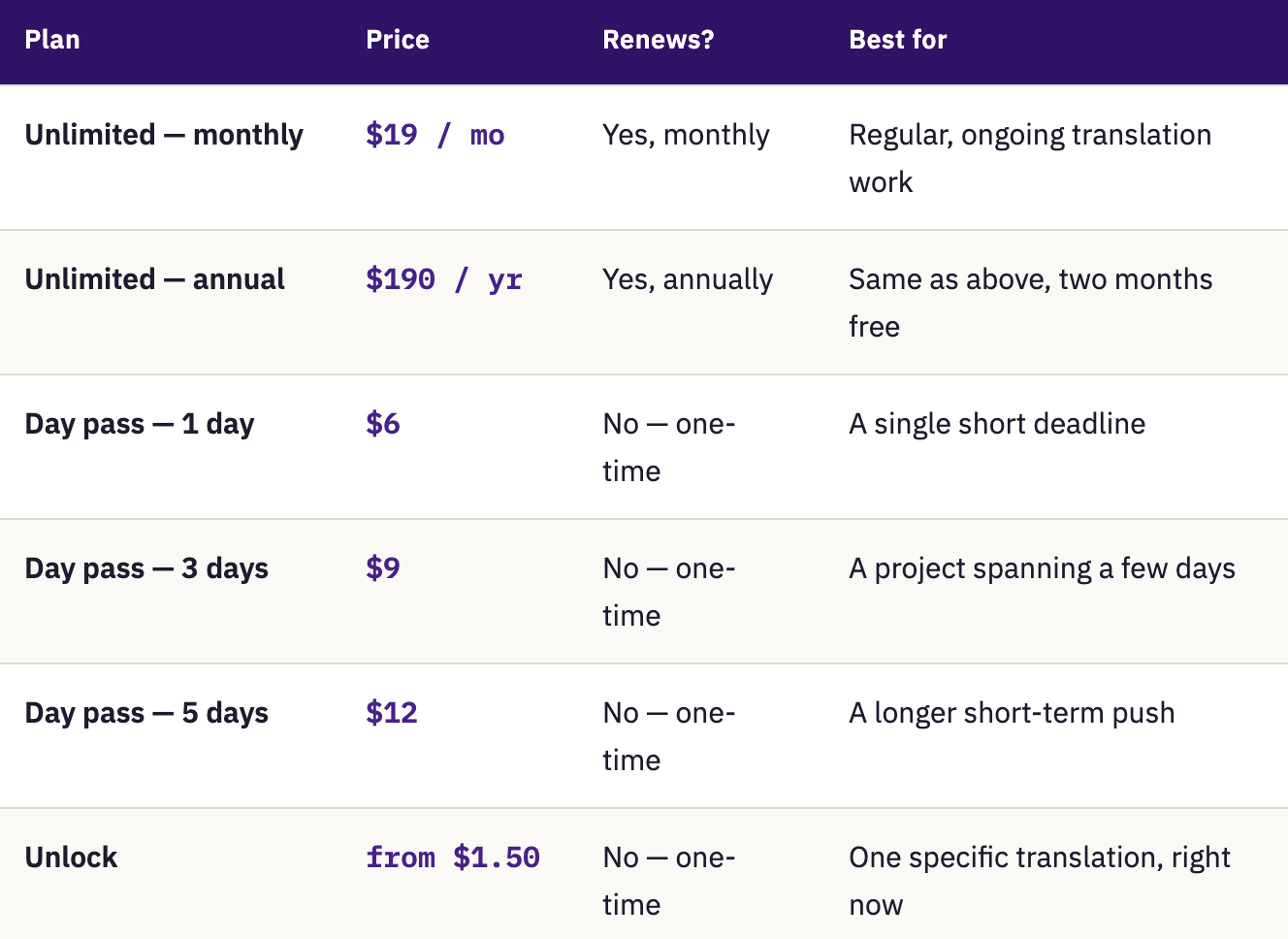
Pricing shown in USD; MachineTranslation.com displays local currency automatically based on where you're signing up from. See the full breakdown on the current MachineTranslation.com pricing page.
What each option actually saves you: the 3-day pass costs the same as six single Unlocks, and the 5-day pass costs the same as eight, so once a job runs past a handful of documents, the pass is cheaper than paying per translation. Annual Unlimited is priced at exactly 10 months of the monthly rate, so committing for a year gets you two months free. None of the one-time options renew unless you separately choose Unlimited. If you pick a 3-day pass, it ends after three days. That was a deliberate choice: the point of this update was removing the subscription assumption, not hiding it behind an auto-renew toggle.
What's included, and what changed for free users
Every user, free or paid, still gets document processing, layout preservation, and SMART's multi-model consensus on every translation. That part of the product was never behind a paywall, and it isn't starting now.
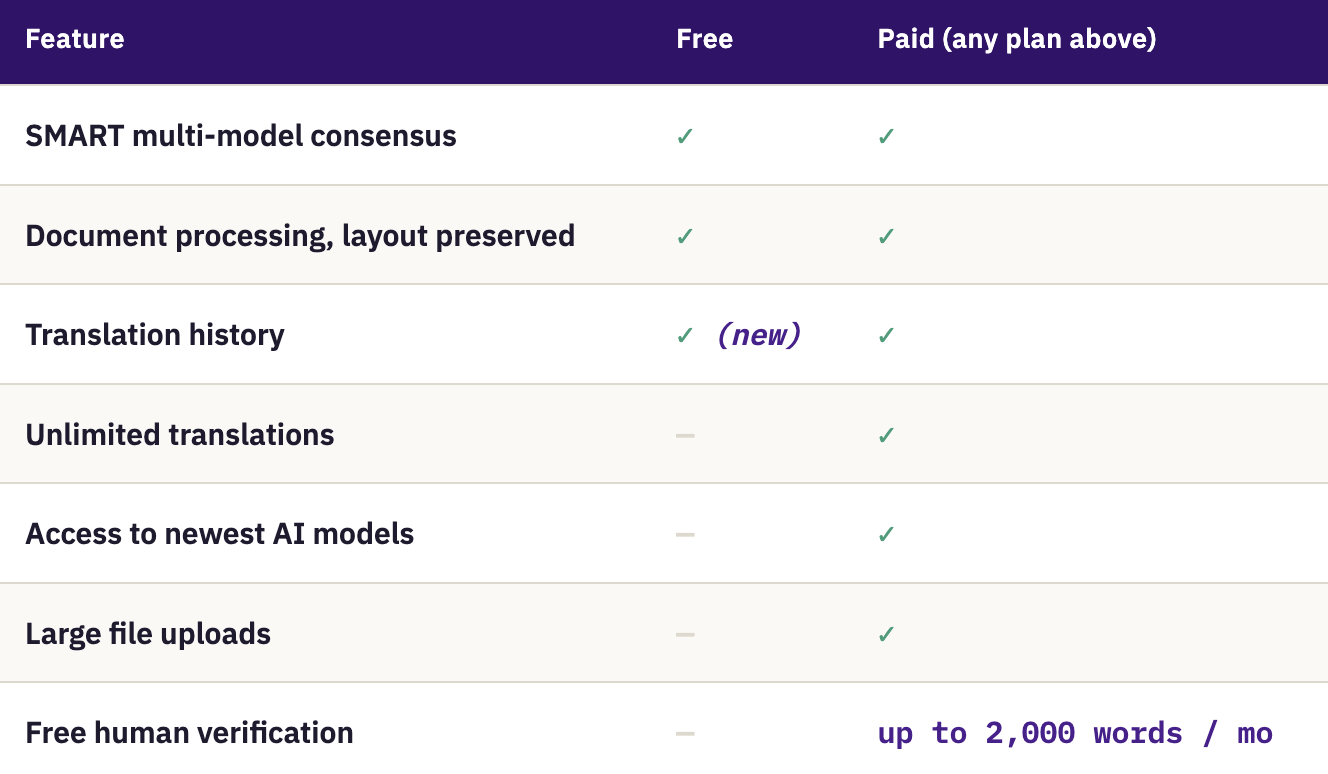
The one that's easy to miss: free users now get full access to their translation history, which was previously a paid-only feature. If you've ever needed to find a translation you did last month and couldn't, that's fixed.
The other new addition sits on the paid side: free human verification for up to 2,000 words a month, on any of the plans above. A professional linguist reviews the AI output at no extra charge, up to that monthly allowance. Beyond it, verification is available per word. This is the same in-platform human verification feature we've written about before, now bundled into every paid plan by default.
Why paying users still get the newer models
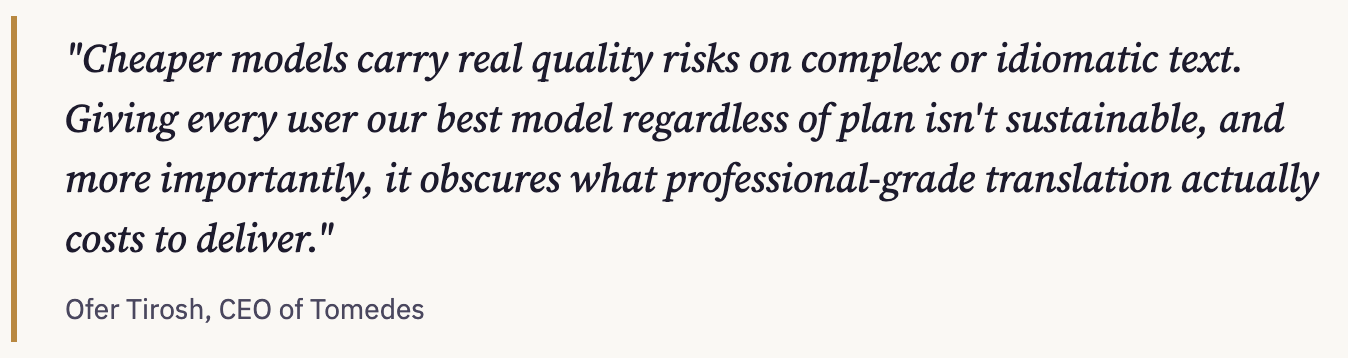
We wrote about the reasoning behind model tiering while we were still building it: paying users get access to more advanced models from OpenAI, Anthropic, Google, and others, because our internal testing showed the quality gap between model tiers is negligible on simple text and significant on complex, idiomatic, or domain-specific content. Ofer put it plainly when we first announced the decision:
That reasoning still holds here, and it applies regardless of which paid option you pick. SMART's consensus is only as strong as the models feeding it. Whether you're on Unlimited, a day pass, or a single Unlock, access to the newer model pool means a stronger consensus, not just a better individual output. More advanced models, better consensus, more reliable translation: the same principle behind everything we build, regardless of how you're paying for it.
Picking the right option for a single job
1. One document, one deadline, done. Unlock a single translation. Pay once, no account commitment beyond that job.
2. A short-term project spanning a few days. A day pass, matched to how many days you actually need, not how many you might use.
3. Ongoing, regular translation work. Unlimited, monthly or annual. Annual is the better rate if you're confident you'll still need it in six months.
4. Anything going to a client, regulator, or the public. Add human verification. It's free up to 2,000 words a month on any paid plan above.
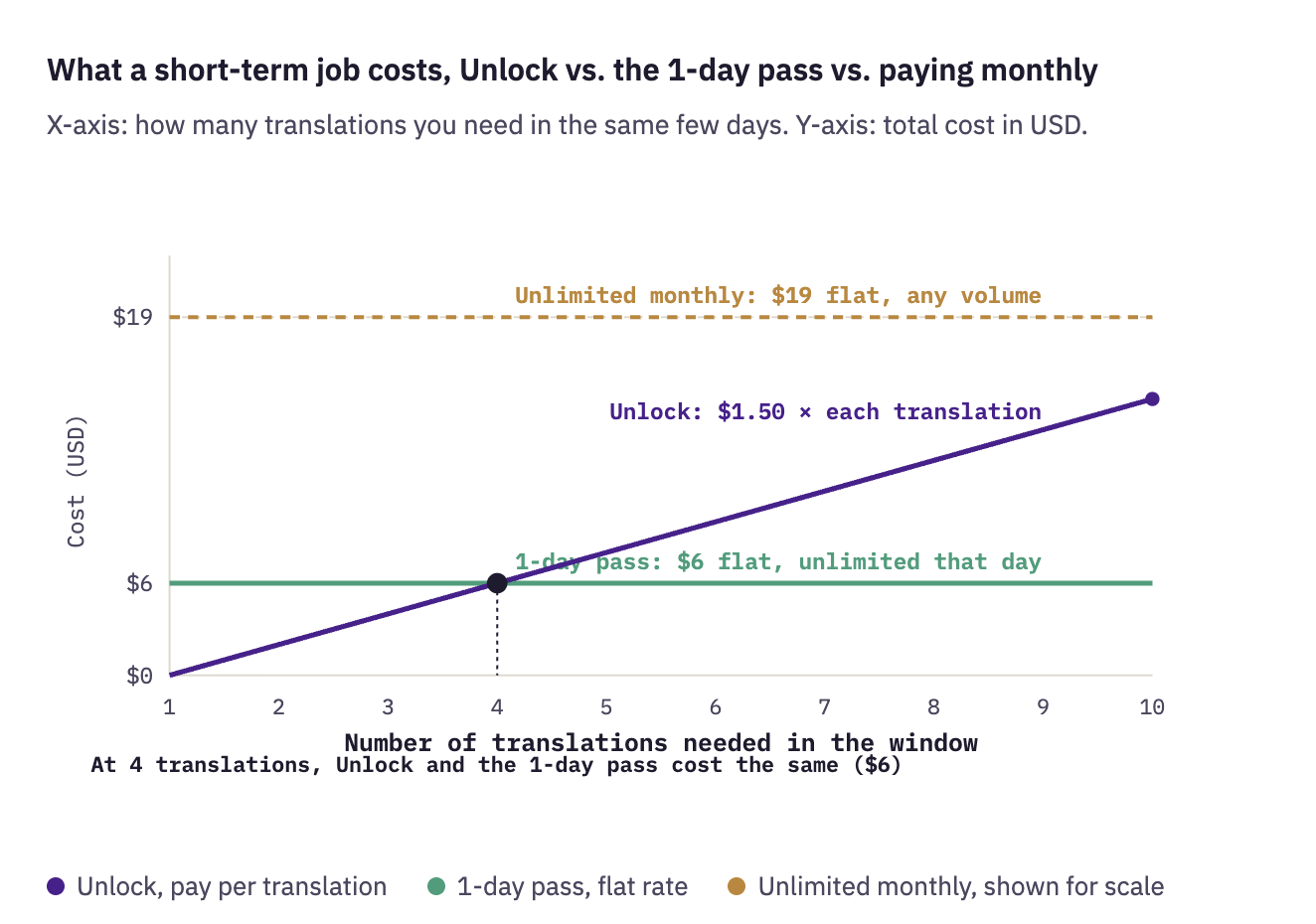
Read it plainly: below 4 translations in the window, Unlock is cheaper. Above 4, the 1-day pass is. The monthly line sits far above both because it's built for volume that repeats month after month, not a single short window, it's there to show why Unlimited stops being the obvious choice once your need is temporary.
What we're watching next
We're watching two things closely over the next few months. First, whether the day-pass durations we picked (1, 3, and 5 days) actually match how long people's projects run, or whether we're missing a shape of demand in between. Second, whether the free 2,000-word human verification allowance gets used the way we expect: on the handful of translations a month where the stakes are highest, rather than spread thin across everything.
If the data says we picked the wrong durations, we'll change them. That's the same approach we took with the original 24-hour pass, and the same one Ofer wrote about when we last reconsidered pricing: hold the number steady until the data gives you a specific reason to move it, and when it does, move it.
Pay for what the job actually needs, once for a single translation, a few days for a project, or every month if the work never really stops.
Frequently Asked Questions
1. Is there an AI translator without a subscription?
Yes. MachineTranslation.com offers three no-subscription options: Unlock (pay once for a single translation), day passes (1, 3, or 5 days of unlimited access, one-time payment, no auto-renewal), and a free tier for everyday use. The Unlimited plan remains available for people who translate regularly.
2. Are paid translation apps worth it?
For short, casual text, often not, free tools handle it fine. For documents where a mistake has real consequences (contracts, medical forms, official filings), paying gets you access to newer AI models and a stronger multi-model consensus, plus optional human verification. Whether it's worth it depends on what's riding on the translation, not the word count.
3. Do you have to pay for an AI translator?
No. MachineTranslation.com's free tier includes SMART's multi-model consensus, document processing with layout preservation, and full translation history. What's reserved for paid plans is unlimited volume, the newest AI models, large file uploads, and free monthly human verification.
4. How much does an AI translator cost?
On MachineTranslation.com: free for everyday use, from $1.50 to unlock a single translation, $6 for a 1-day unlimited pass, or $19 a month (or $190 a year) for ongoing use. Pricing displays automatically in your local currency at checkout.
5. What's the difference between Unlock and a day pass?
Unlock pays for one specific translation. A day pass gives unlimited translations for a set number of days, which is better value once you have more than a handful of documents to get through in a short window.

By William Mamane
Connect on LinkedInWilliam leads marketing and growth at Tomedes, where he turns SEO experiments and real campaign data into the strategy behind MachineTranslation.com's reach. He writes about how AI products actually get found and trusted plus the tactics that work, the ones that don't, and what search is rewarding right now.
Share:


